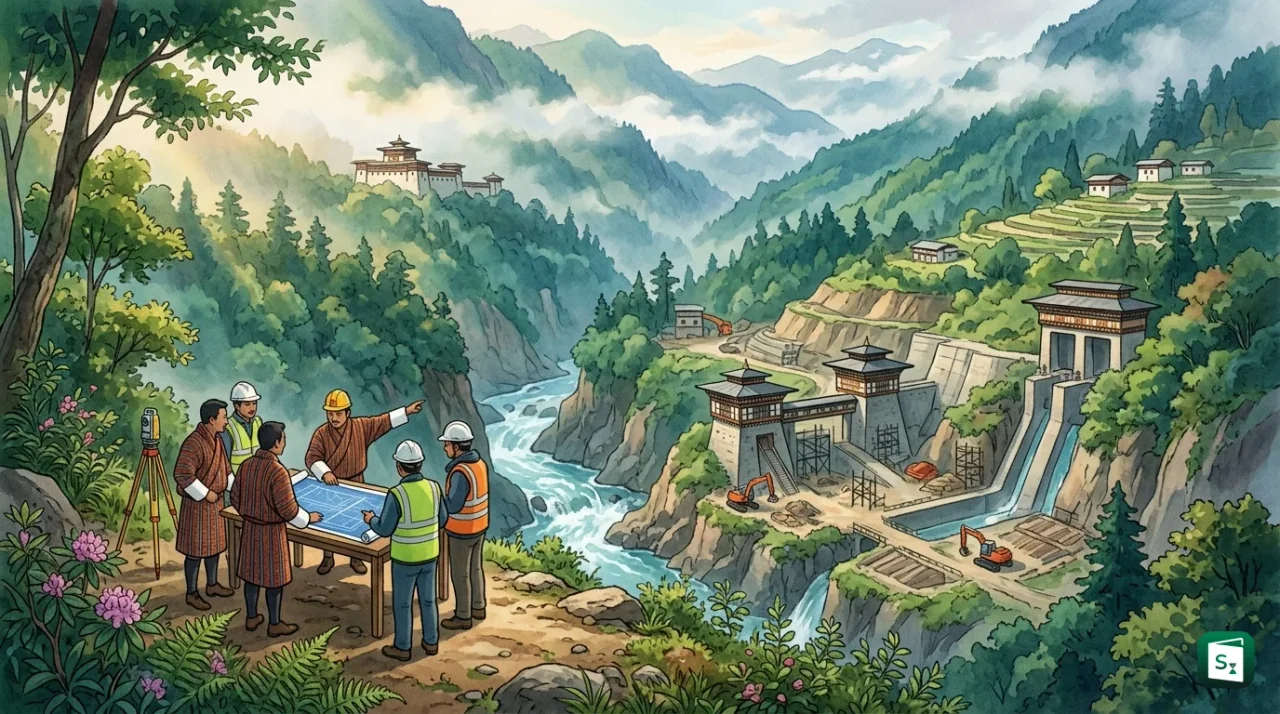
Adani Power Ltd and Bhutan’s Druk Green Power Corporation signed a Shareholders Agreement on 5 October 2026 to build the 770 MW Chamkharchhu-I Hydroelectric Project on the Chamkharchhu River in Zhemgang district of central Bhutan. The Adani Power Bhutan hydroelectric project will be developed as a 49:51 joint venture and is the second collaboration after the 570 MW Wangchhu project under a broader 5,000 MW pact signed in May 2025. The project aims to meet Bhutan’s winter power demand and export surplus clean power to India in summer, deepening cross border energy ties.
What Is the Chamkharchhu-I Hydroelectric Project?
The Chamkharchhu-I Hydroelectric Project is a planned 770 MW peaking run-of-river plant on the Chamkharchhu River in Zhemgang district of central Bhutan. A run-of-river plant uses the natural flow of the river with only small pondage, so it diverts water through tunnels to spin turbines without building a large storage reservoir.
The Chamkharchhu River, also written as Chamkhar Chhu, rises in the high mountains north of Bumthang and flows south through Zhemgang before joining the Manas river system that drains into the Brahmaputra in India. The project site lies near Khomshar village in Bardo Gewog. Like other Himalayan rivers, the flow is high in the monsoon summer and low in the dry winter, so power output will peak in summer.
The engineering design includes a 108 metre concrete gravity dam, a 19.2 km headrace tunnel with a diameter of 7.25 metres, and an underground powerhouse. The powerhouse will house four Pelton turbines of 192.5 MW each with an overall generation efficiency of 90.6 percent. The plant is designed to generate 3,397 GWh in a 90 percent dependable year and can operate as a peaking station with live storage of 2.677 million cubic metres.
The Detailed Project Report (DPR), which is the full technical and cost blueprint of a dam project, was first prepared in 2015 by India’s National Hydroelectric Power Corporation (NHPC). Since nearly a decade had passed, the Druk Green Power Corporation started a review in 2025. In February 2026, a consortium led by Lahmeyer International GmbH with ERM-Siam and Druk Consult International began updating the DPR and preparing a fresh Environmental and Social Impact Assessment (ESIA) in line with current standards.
Key Terms of the Shareholders Agreement
The Druk Green Power Corporation and Adani Power signed the Investment-cum-Shareholders Agreement on 5 October 2026 in the presence of Bhutan Prime Minister Dasho Tshering Tobgay. A Shareholders Agreement is a legal contract that fixes the ownership, funding and management rules of a joint company. The signing was also attended by Bhutan’s Finance Minister and Minister of Energy and Natural Resources along with officials from Druk Holding and Investments (DHI), the Bhutan Power Corporation and the DGPC board.
Under the agreement, Adani Power and DGPC will jointly set up a public company in Bhutan to build and run the project. Adani Power will hold 49 percent equity and DGPC will hold 51 percent, with capital contribution in the same ratio. Each partner will appoint three directors to the board of the project company.
The project will follow the Build, Own, Operate and Transfer (BOOT) model with a concession of 30 years from the Commercial Operation Date. The Commercial Operation Date, usually shortened to COD, is the day the plant starts full commercial supply. After 30 years, ownership will transfer as per the concession terms. Construction is expected to start in the first half of 2027 and commissioning is targeted within six years of ground breaking.
| Item | Detail for Chamkharchhu-I |
|---|---|
| Capacity | 770 MW |
| River and location | Chamkharchhu River, Zhemgang district, central Bhutan |
| Type | Peaking run-of-river with small pondage |
| Partners | DGPC 51 percent, Adani Power 49 percent |
| Agreement | Investment-cum-Shareholders Agreement signed 5 October 2026 |
| Development model | BOOT, 30 years from COD |
| Construction start | First half of 2027 |
| Commissioning target | Within six years of ground breaking |
| Umbrella framework | 5,000 MW MoU between Adani Group and DGPC signed May 2025 |
Druk Green Power Corporation and Bhutan Hydropower Landscape
The Druk Green Power Corporation Limited, usually shortened to DGPC, is Bhutan’s state owned power generation utility. DGPC was incorporated in January 2008 by merging the Chhukha, Kurichhu and Basochhu plants, with the Tala plant added in 2009 and Mangdechhu in 2022. DGPC is a wholly owned subsidiary of Druk Holding and Investments (DHI), which is the commercial arm of the Royal Government of Bhutan. The Managing Director of DGPC is Dasho Chhewang Rinzin (as of October 2026).
DGPC operates an installed capacity of about 2,471 MW across eight hydropower plants, including Chhukha, Tala, Kurichhu, Basochhu and Mangdechhu, and generates more than 10,000 GWh in a year. In 2024, DGPC revenue more than doubled after consolidation of Mangdechhu. Hydropower contributes nearly 22 percent of Bhutan government non grant revenue through royalty, taxes and dividends and about 7.5 percent of Gross Domestic Product. Domestic supply is handled by the sister utility Bhutan Power Corporation Limited, while surplus power is exported to India through PTC India Limited.
Adani Power Ltd, headquartered in Ahmedabad, started construction of its first plant at Mundra in Gujarat in 2006. Adani Power is India’s largest private thermal power producer with operating capacity of about 18,110 MW across 12 plants in eight states (as of 2026) plus a 40 MW solar plant in Gujarat. The company plans to raise capacity to 30,670 MW by 2030. The Bhutan venture marks a clear diversification of Adani Power from thermal power into Himalayan hydropower.
Bhutan holds technically feasible hydropower potential of about 30,000 MW to 33,000 MW across 90 sites, of which only around 2,453 MW has been developed. The long term national goal is 25,000 MW of clean energy by 2040, including 15,000 MW of hydro and 5,000 MW of solar under the Corporate Strategy Plan 2025 to 2040.
| Bhutan hydropower project | Capacity | Status and partner |
|---|---|---|
| Chhukha Hydroelectric Project | 336 MW | Commissioned 1988, India assisted |
| Kurichhu Hydroelectric Project | 60 MW | Commissioned 2001, India assisted |
| Tala Hydroelectric Project | 1,020 MW | Commissioned 2006 to 2007, largest operating plant |
| Mangdechhu Hydroelectric Project | 720 MW | Commissioned 2019, jointly inaugurated by India and Bhutan Prime Ministers |
| Punatsangchhu-II Hydroelectric Project | 1,020 MW | Completed August 2025 |
| Punatsangchhu-I Hydroelectric Project | 1,200 MW | Under construction |
| Wangchhu Hydroelectric Project | 570 MW | Shareholders Agreement with Adani Power, September 2025 |
| Dorjilung Hydroelectric Project | 1,125 MW | Jointly developed by DGPC 60 percent and Tata Power 40 percent, World Bank support of $515 million |
| Kholongchhu Hydroelectric Project | 600 MW | Joint venture model, foundation stone laid 2014 |
| Khorlochhu Hydroelectric Project | 600 MW | Under Tata Power and DGPC 5,000 MW MoU |
How Many Hydropower Projects Does Bhutan Have?
Bhutan has eight operating hydropower plants under the Druk Green Power Corporation with combined installed capacity of about 2,471 MW, led by Tala (1,020 MW), Mangdechhu (720 MW), Chhukha (336 MW), Kurichhu (60 MW) and Basochhu (64 MW), plus Dagachhu, Nikachhu and small plants.
The count rises when projects under construction and sanctioned joint ventures are added. The 1,200 MW Punatsangchhu-I plant is under construction in Wangdue Phodrang, while the 1,020 MW Punatsangchhu-II plant was completed in August 2025. Together with four operating intergovernmental projects, Bhutan’s jointly developed capacity with India has reached 3,156 MW.
Beyond the state led fleet, a new pipeline is taking shape through private partnerships. Tata Power and DGPC signed a Memorandum of Understanding in November 2024, later expanded in May 2026, to develop 5,033 MW including Dorjilung, Khorlochhu, Gongri reservoir with Jeri pumped storage, Chamkharchhu-IV and Nyera Amari. Adani Group and DGPC signed a separate MoU in May 2025 for 5,000 MW. Chamkharchhu-I at 770 MW would be among the largest single additions, close in scale to Tala and Mangdechhu, and will feed both winter domestic demand and summer exports.
India Bhutan Hydropower Cooperation and Electricity Trade
India Bhutan hydropower cooperation began in 1961 with the Jaldhaka agreement for a barrage in Bhutanese territory feeding a 27 MW plant in West Bengal. The first mega project was the 336 MW Chhukha project, for which the agreement was signed in 1974 and the plant was fully commissioned in 1988 with 60 percent grant and 40 percent loan from India. The success of Chhukha opened the path for the 60 MW Kurichhu project agreed in 1994 and the 1,020 MW Tala project agreed in 1996 and commissioned in 2006 to 2007. The 720 MW Mangdechhu project was jointly inaugurated in August 2019 and later won the Brunel Medal in 2020.
The legal framework was formalised through the Agreement on Cooperation in Hydroelectric Power signed in July 2006 for 5,000 MW, raised to 10,000 MW by 2020 under the Protocol signed during Prime Minister Manmohan Singh’s visit in May 2008. Ten projects were identified, including Punatsangchhu-I and II, Mangdechhu, Bunakha, Sankosh, Chamkharchhu-I, Kuri-Gongri, Kholongchhu, Wangchhu and Amochhu. In April 2014, India and Bhutan signed a Framework Inter-Governmental Agreement for four joint venture projects totalling 2,120 MW, namely Kholongchhu at 600 MW, Bunakha at 180 MW, Wangchhu at 570 MW and Chamkharchhu at 770 MW, to be built by public sector undertakings of both sides after appraisal of DPRs. In March 2024, Prime Minister Narendra Modi’s visit to Bhutan produced a Joint Vision Statement on India Bhutan Energy Partnership covering new hydro, solar and green hydrogen with Indian entities as strategic partners.
Trade rules support this cooperation. The 2007 India Bhutan Friendship Treaty and the 2016 Agreement on Trade, Commerce and Transit provide a free trade regime and duty free transit for Bhutan. India buys surplus Bhutan power through PTC India Limited, which is authorised for cross border trade. Since September 2023, Bhutan plants such as 64 MW Basochhu and later Nikachhu have been allowed to sell on the Indian Energy Exchange (IEX) in the Day Ahead and Real Time markets. The flow is two way in nature. Bhutan’s peak demand more than doubled from 420 MW in 2021 to 1,026 MW in 2024, so India approved import of 1,100 MW by Bhutan from November 2024 to May 2025 for the lean winter season. Nearly 70 percent of Bhutan generation is exported to India, and power accounts for about 63 percent of Bhutan total exports.
Adani Power and Tata Power Portfolios in Bhutan
The Chamkharchhu-I deal sits alongside a parallel Tata Power portfolio, which helps explain the competitive shift from purely government funded plants to private joint ventures.
| Feature | Adani Power and DGPC partnership | Tata Power and DGPC partnership |
|---|---|---|
| Umbrella MoU | 5,000 MW, signed May 2025 | 5,033 MW, MoU November 2024 expanded May 2026 |
| Second flagship under pact | Chamkharchhu-I, 770 MW in Zhemgang | Dorjilung, 1,125 MW in Mongar and Lhuentse on Kurichhu river |
| First project | Wangchhu, 570 MW, agreement September 2025 | Khorlochhu, 600 MW plus Dagachhu experience since 2008 |
| Financing style | BOOT joint venture company, 49:51 shareholding | Public Private Partnership with World Bank Group support |
Why the Project Matters for Bhutan and India
The Chamkharchhu-I project directly addresses Bhutan’s seasonal power gap. Bhutan’s rivers run lean in winter when heating demand peaks, which forces imports from India. As a peaking run-of-river plant with pondage for daily peaking, Chamkharchhu-I can release stored water during evening peak hours in winter and improve system stability. In summer, when monsoon flows are strong, the same plant will generate surplus power for export to India.
The revenue effect is large for a small economy. Bhutan’s hydropower earnings fund roads, schools and public services, and power is the country’s largest export. A 770 MW addition operating at high Himalayan efficiency can generate over 3,300 GWh in a good year, adding export income after meeting home demand. For India, the power arrives in summer when air conditioning load is high, so it supports peak demand without carbon emissions.
The location adds a development gain. Zhemgang in central southern Bhutan is relatively less developed. Large hydropower construction brings roads, bridges, tunnels, jobs for skilled and unskilled workers and local supply contracts. The updated ESIA will study effects on forests, aquatic life, sediment flow and local communities, which matters because Bhutan’s Constitution requires maintaining at least 60 percent forest cover and the country follows a carbon negative policy rooted in Gross National Happiness.
The Way Forward
The immediate next step is completion of technical and environmental groundwork. The Lahmeyer consortium mandate, awarded in February 2026, covers review of hydrology, geology and dam design, tender level drawings and a full ESIA with mitigation plans for biodiversity, water use and resettlement. The consultant’s work is expected to take about 12 months and will feed into clearances from Bhutan’s Department of Environment and Climate Change, forestry permits and social approvals.
The commercial path will then need a long term Power Purchase Agreement, transmission linkage and financial closure. The Bhutan Sustainable Hydropower Development Policy 2021 and the National Energy Policy 2025 allow PPP development with DGPC holding majority equity, which this 51:49 structure follows. Past experience at Punatsangchhu-I, where geological surprises caused landslides and long delays, shows why updated drilling, tunnel design and cost estimates matter before ground breaking in 2027. If construction stays on schedule, the six year build to around 2033 would lift Bhutan’s installed capacity toward 7,000 MW by the early 2030s and create a working model for the remaining 5,000 MW pipeline.
Key Takeaways
- Adani Power and DGPC signed the Investment-cum-Shareholders Agreement for the 770 MW Chamkharchhu-I project on 5 October 2026.
- The project is a peaking run-of-river plant on the Chamkharchhu River in Zhemgang district with a 108 metre dam and 19.2 km headrace tunnel.
- The joint venture follows a 51:49 shareholding in favour of DGPC under the BOOT model with a 30 year concession from COD.
- Construction is planned from the first half of 2027 with commissioning within six years, as the second deal after the 570 MW Wangchhu project.
- Both projects fall under the 5,000 MW MoU signed between Adani Group and DGPC in May 2025.
- DGPC, incorporated in January 2008 as a subsidiary of DHI, operates about 2,471 MW while Bhutan holds nearly 30,000 MW of feasible hydropower potential.