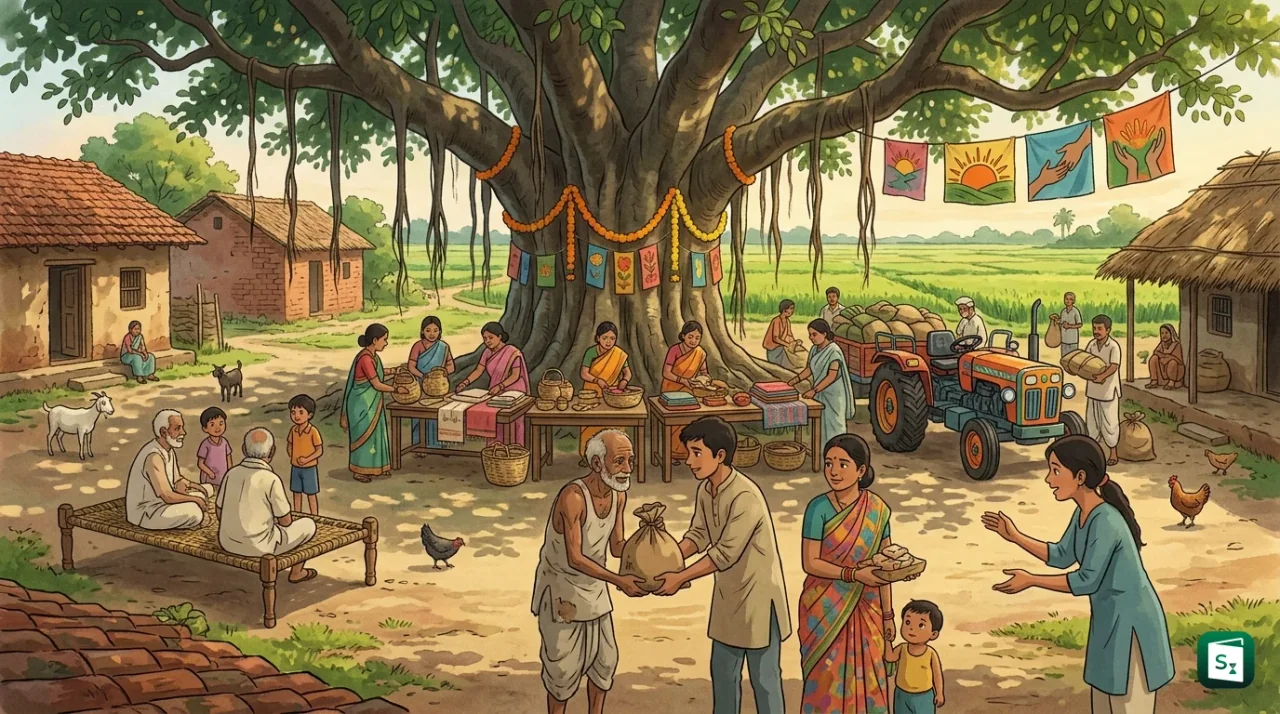
India observes Antyodaya Diwas every year on September 25 to mark the birth anniversary of Pandit Deendayal Upadhyaya, thinker and co-founder of the Bharatiya Jana Sangh (BJS). The Government of India declared September 25 as Antyodaya Diwas in 2014. The day promotes the idea that welfare and growth must first reach the poorest person in the queue.
What Is Antyodaya Diwas?
Antyodaya Diwas is the national observance held on September 25 each year to remember the birth anniversary of Pandit Deendayal Upadhyaya. The Government of India named his birth anniversary as Antyodaya Diwas in 2014. The day honours his call for uplift of the last person and reviews welfare work for poor households.
The September 25 date is fixed because Upadhyaya was born on 25 September 1916. The 2026 observance marked his 110th birth anniversary. Ministries, state governments, local bodies and educational institutions use the day to hold tributes, discussions, cleanliness drives, blood donation camps and outreach programmes for self help groups, artisans and rural families.
| Fact | Detail |
|---|---|
| Name of observance | Antyodaya Diwas, also called Rashtriya Antyodaya Diwas |
| Date | September 25 every year |
| Observed since | 2014 |
| Commemorates | Birth anniversary of Pandit Deendayal Upadhyaya |
| Organisation linked to him | Bharatiya Jana Sangh (BJS), forerunner of the Bharatiya Janata Party |
What Does Antyodaya Mean in English and Hindi?
The word Antyodaya combines two Sanskrit words, antya meaning last and udaya meaning rise. In English, Antyodaya means rise of the last person or uplift of the poorest person. In Hindi, it means Antim Vyakti ka Utthan. The test of any plan, therefore, is how it treats the person at the end of the line.
Upadhyaya borrowed the spirit of the term from the Gandhian tradition. Mahatma Gandhi spoke of Sarvodaya, which means progress of all. Upadhyaya argued that Sarvodaya can be reached only through Antyodaya. In simple words, if the poorest family gains food, work and dignity, the whole society moves forward. This yardstick is often repeated in speeches on Antyodaya Diwas to judge policies on food, housing, health and jobs.
Who Was Pandit Deendayal Upadhyaya?
Pandit Deendayal Upadhyaya was an Indian thinker, journalist, organiser and political leader who lived from 25 September 1916 to 11 February 1968. He was born in Nagla Chandrabhan village in Mathura district, in present day Uttar Pradesh, in the sacred Brij region. He lost his father Bhagwati Prasad Upadhyaya before the age of three and his mother Rampyari Upadhyaya before the age of eight, and was raised by his maternal uncle and aunt.
Upadhyaya studied in Sikar and Pilani in present day Rajasthan and earned a Bachelor of Arts degree from Sanatan Dharma College, Kanpur, then linked to Agra University. He joined the Rashtriya Swayamsevak Sangh (RSS), a social and cultural organisation founded in 1925 and headquartered in Nagpur, as a volunteer in 1937 and became a full time pracharak in 1942. He started the monthly Rashtra Dharma in the 1940s and later brought out the weekly Panchjanya and the daily Swadesh to present his views on nation, culture and economy.
In 1951, Upadhyaya joined the newly formed Bharatiya Jana Sangh (BJS) at the request of its founder Syama Prasad Mookerjee. He served as its general secretary from 1953 to 1967 and shaped its organisation across states. He became president of the BJS in December 1967. His tenure was very brief. He died on 11 February 1968 near Mughalsarai railway station in Uttar Pradesh. That station was renamed as Deen Dayal Upadhyaya Junction in 2018.
What Is Integral Humanism and the Antyodaya Philosophy?
Integral Humanism, called Ekatma Manavvad in Hindi, was the political philosophy presented by Deendayal Upadhyaya in four lectures at Ruia College in Bombay between 22 April and 25 April 1965. The Bharatiya Jana Sangh adopted Integral Humanism as its official doctrine in 1965. The doctrine remains the stated guiding philosophy of the Bharatiya Janata Party.
Upadhyaya argued that both capitalism and communism looked at humans in a narrow way. Capitalism gave too much weight to the individual and the market. Communism gave too much weight to the state and material output. Integral Humanism asked for balanced growth of body, mind, intellect and soul. It placed Dharma, understood as moral order and duty that holds society together, above narrow economic goals.
In this frame, Antyodaya is the practical test. A village should be the base of planning. Production should use local resources, protect nature and create work near homes. Policies should first answer whether they give food, shelter, education and livelihood to the last household. That link between ethics and economics explains why his birth anniversary is observed as a day for the poor rather than only as a memorial meeting.
Which Welfare Schemes Carry the Antyodaya Name?
The Government has used the Antyodaya name for several poverty programmes over five decades. The three most asked about in examinations are the food security scheme of 2000, the rural and urban livelihood missions and the original Rajasthan scheme of 1977. Each scheme uses the same yardstick of reaching the poorest household first.
What Is Antyodaya Anna Yojana?
Antyodaya Anna Yojana (AAY) is a food security scheme for the poorest of the poor households under the Targeted Public Distribution System (TPDS). The scheme was launched on 25 December 2000 by the National Democratic Alliance government headed by Prime Minister Atal Bihari Vajpayee and was first rolled out in Rajasthan. The Department of Food and Public Distribution under the Ministry of Consumer Affairs, Food and Public Distribution administers the scheme with state governments.
AAY began with 1 crore poorest families identified from Below Poverty Line lists. Coverage was expanded in 2003 to 2004 and again in later years to a ceiling of 2.50 crore families. Each AAY family gets 35 kg of foodgrains per month. The original highly subsidised prices were ₹2 per kg for wheat and ₹3 per kg for rice, with coarse grains at ₹1 per kg under the National Food Security Act, 2013 (NFSA). Since 1 January 2023, foodgrains to AAY and Priority Households are given free of cost under Pradhan Mantri Garib Kalyan Anna Yojana (PMGKAY), now extended for five years from 1 January 2024. AAY cards are yellow in many states and work across states through One Nation One Ration Card (ONORC) portability at fair price shops using electronic point of sale devices.
What Is Deen Dayal Antyodaya Yojana?
Deen Dayal Antyodaya Yojana is the common name for two livelihood missions for rural and urban poor households. The rural mission is Deendayal Antyodaya Yojana National Rural Livelihoods Mission (DAY-NRLM), run by the Ministry of Rural Development. The urban mission was Deendayal Antyodaya Yojana National Urban Livelihoods Mission (DAY-NULM), run by the Ministry of Housing and Urban Affairs.
DAY-NRLM started as the National Rural Livelihoods Mission (NRLM), also called Aajeevika, launched in June 2011 by restructuring the earlier Swarnajayanti Gram Swarozgar Yojana (SGSY). The programme was renamed as DAY-NRLM with effect from 29 March 2016. It builds institutions of the poor, mainly women self help groups and their federations, and links them to bank credit, skills and markets. The urban mission began as the National Urban Livelihoods Mission (NULM) on 24 September 2013 by restructuring the Swarna Jayanti Shahari Rozgar Yojana (SJSRY) and was renamed as DAY-NULM in February 2016. It supported self employment, skill training, self help groups and shelters for the urban homeless and completed its approved period on 30 September 2024.
What Was the First Antyodaya Yojana of 1977?
The first scheme to use the Antyodaya name was launched by the Government of Rajasthan in 1977 under Chief Minister Bhairon Singh Shekhawat. The state decided to start with the poorest families in every village. Village elders helped identify an initial set of about five families per village, later linked to village size. Support included pensions, allotment of land, help for self employment such as animals and tools, and wage work.
Studies of the programme note that close to 2 lakh families received help in the first two rounds. The lesson often cited from this experiment is simple. Correct identification of the poorest, timely bank credit and follow up care matter more than only handing out benefits. That idea later shaped national programmes such as the Integrated Rural Development Programme and the present livelihood missions.
How Is Antyodaya Diwas Observed?
Antyodaya Diwas in India is both a tribute and a work day for welfare outreach. Central ministers, chief ministers and district officials garland portraits and statues of Upadhyaya and recall his messages on service to the nation and dignity for the poor. In 2026, tributes on September 25 again stressed his twin ideas of Antyodaya and Integral Humanism and his work through journals such as Rashtra Dharma and Panchjanya on national unity and self reliance.
Government departments link the date to field action. Rural livelihood missions hold loan melas, marketing fairs for self help groups and enrolment drives for skills under Deendayal Upadhyaya Grameen Kaushalya Yojana, the placement linked skill arm of DAY-NRLM run by the Ministry of Rural Development. Urban bodies, schools and colleges organise seminars on his life, essay and drawing contests, cleanliness drives and blood donation camps. The MY Bharat platform listed a commemorative activity for September 25, 2026 to encourage youth participation in discussions on inclusive development, rural welfare, women led enterprises and financial inclusion.
Memory sites also draw visitors around the day. They include Deendayal Dham in Nagla Chandrabhan in Mathura, Deen Dayal Upadhyaya Junction in Uttar Pradesh, Deendayal Port at Kandla in Gujarat, and institutions such as Deen Dayal Upadhyaya Gorakhpur University, Deen Dayal Upadhyaya College in Delhi and Pandit Deendayal Energy University in Gandhinagar. Together, these places help new readers connect a date in the calendar with a person, a philosophy and a set of live schemes.
Key Takeaways
- Antyodaya Diwas is observed every year on September 25 to mark the birth anniversary of Pandit Deendayal Upadhyaya.
- The Government of India has observed September 25 as Antyodaya Diwas since 2014, and 2026 marked the 110th birth anniversary of Upadhyaya.
- Antyodaya means rise of the last person in English and Antim Vyakti ka Utthan in Hindi.
- Upadhyaya presented Integral Humanism (Ekatma Manavvad) in April 1965 in Bombay, and the Bharatiya Jana Sangh adopted it as its doctrine in 1965.
- Antyodaya Anna Yojana was launched on 25 December 2000 and gives 35 kg of foodgrains per family per month to up to 2.50 crore poorest families.
- DAY-NRLM was launched in June 2011 and renamed on 29 March 2016, while the first Antyodaya Yojana was started in Rajasthan in 1977 under Bhairon Singh Shekhawat.