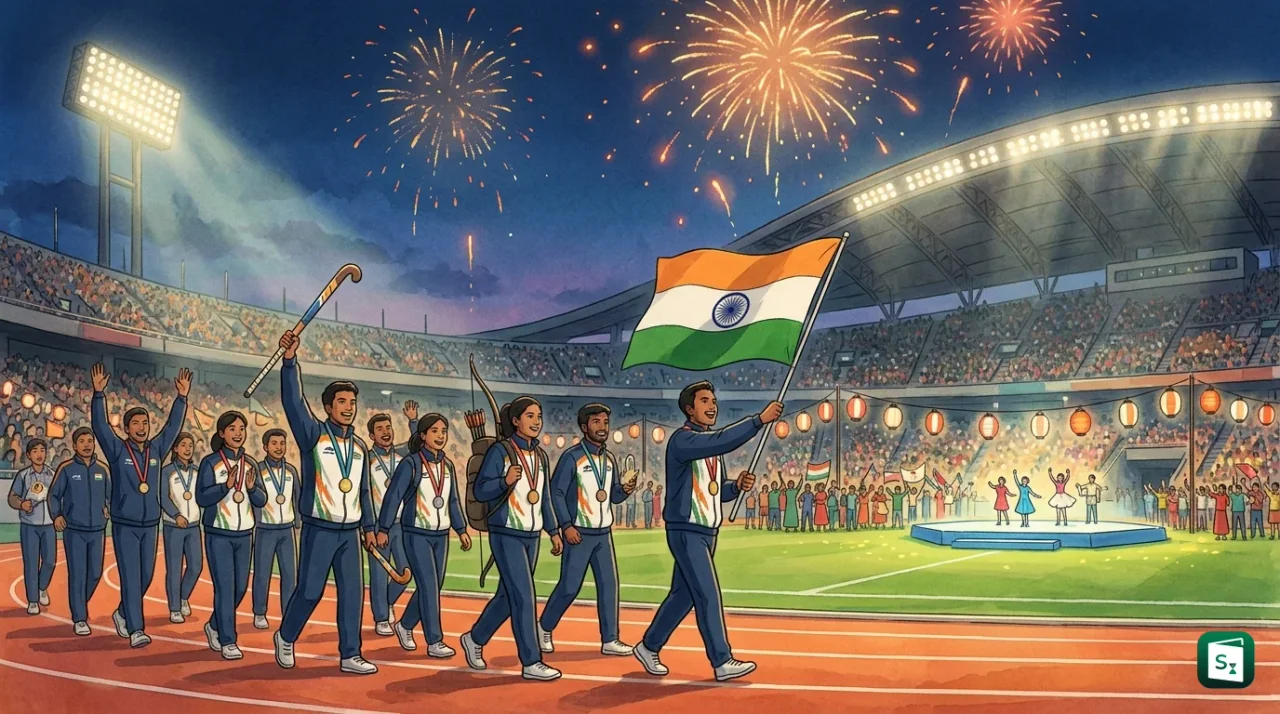
India finished fourth at the 20th Asian Games Aichi-Nagoya 2026 with 85 medals, comprising 21 gold, 27 silver and 37 bronze, after the Games closed on 4 October 2026 at the Nagoya City Mizuho Park Athletic Stadium. China topped the final medal tally with 341 medals, followed by hosts Japan in second place and South Korea in third. The 16 day event, held from 19 September to 4 October 2026 across Aichi Prefecture and Nagoya, also saw India complete a clean sweep in cricket, hockey and kabaddi while archery delivered five golds.
What Is the Asian Games?
The Asian Games, also called Asiad, is a continental multi-sport event for athletes from Asia held every four years. The Olympic Council of Asia organizes the Games. The event is recognized by the International Olympic Committee and is the second largest multi-sport event in the world after the Olympics.
The name Asiad comes from Asia plus the suffix iad, which is used for large sporting festivals like Olympiad. The Games are not held every year. They follow a four year cycle, like the Olympics. The 19th edition at Hangzhou was the only recent exception. It was scheduled for 2022 but was held in 2023 because of the pandemic.
The idea grew from the Far Eastern Championship Games held between 1913 and 1934 and the Asian Relations Conference in New Delhi in 1947. During the 1948 London Olympics, Indian sports administrator Guru Dutt Sondhi proposed a new Asian competition. The Asian Games Federation (AGF) was formally set up on 13 February 1949 in New Delhi. India hosted the first edition in New Delhi in 1951 from 4 to 11 March. Eleven teams took part in 57 events. Japan topped that first medal table.
The AGF ran the Games until 1978. The Olympic Council of Asia (OCA), headquartered in Kuwait City, took charge after its formation in New Delhi in November 1981 and its formal start in 1982. The OCA now has 45 member National Olympic Committees. Its motto for the Asian Games is Ever Onward. India has hosted the Games twice, in 1951 and 1982, both times in New Delhi. Thailand has hosted the most editions, with Bangkok staging the Games in 1966, 1970, 1978 and 1998.
Where and When Were the Aichi-Nagoya 2026 Asian Games Held?
The 20th Asian Games were held in Aichi Prefecture and Nagoya City in Japan from 19 September to 4 October 2026. The opening and closing ceremonies took place at the Nagoya City Mizuho Park Athletic Stadium. The Games featured 43 sports across 53 venues with about 15,000 athletes and officials.
The Games were officially open for 16 days. Some competitions started early. Football began on 10 September and basketball also started before the opening ceremony on 19 September. The closing ceremony took place on 4 October 2026. Athletes from 45 countries and regions took part, along with a Refugee Team.
Most events were held in Nagoya and Aichi. A few events used venues from the Tokyo 2020 Olympics. Swimming and diving were held at the Tokyo Aquatics Centre in Tokyo. Artistic swimming was held in Hamamatsu. Track cycling was held at the Izu Velodrome. Hockey was played at the Gifu Prefectural Green Stadium. The slogan for the Games was Imagine One Asia. The official mascot was Honohon. The name comes from honoho, the Japanese word for flame. Honohon is shown with large eyes and ears shaped like shachihoko, the tiger headed guardian seen on Nagoya Castle.
For Indian followers, three schedules drew the most attention. Cricket in the T20 format was played from 17 September to 3 October at Korogi Athletic Park in Nisshin. Kabaddi was played from 21 to 26 September at the Tokai Citizen Gymnasium. Hockey was played from 18 September to 3 October in Gifu.
Final Medal Tally: China Tops, India Finishes Fourth
The Aichi-Nagoya 2026 medal table was ranked first by gold medals, then by silver medals and then by bronze medals. China finished first for the 12th straight edition. The Chinese team won 169 gold, 89 silver and 83 bronze for a total of 341 medals. This was a record gold haul for China at an overseas Asian Games. Its earlier best outside China was 165 golds at Doha 2006.
Hosts Japan finished second with 83 gold, 95 silver and 91 bronze for 269 medals. South Korea was third with 39 gold, 43 silver and 68 bronze for 150 medals. India was fourth with 21 gold, 27 silver and 37 bronze for 85 medals. Uzbekistan also won 21 golds but had only 25 silvers, so India stayed ahead on the silver count. The final day proved decisive. India won five golds on 3 October, including the mens hockey title, to move from outside the top ten into fourth place.
| Rank | Country | Gold | Silver | Bronze | Total |
|---|---|---|---|---|---|
| 1 | China | 169 | 89 | 83 | 341 |
| 2 | Japan | 83 | 95 | 91 | 269 |
| 3 | South Korea | 39 | 43 | 68 | 150 |
| 4 | India | 21 | 27 | 37 | 85 |
| 5 | Uzbekistan | 21 | 25 | 24 | 70 |
| 6 | Iran | 19 | 18 | 15 | 52 |
| 7 | Thailand | 18 | 13 | 21 | 52 |
| 8 | Kazakhstan | 12 | 24 | 48 | 84 |
| 9 | Hong Kong, China | 11 | 19 | 24 | 54 |
| 10 | Bahrain | 11 | 5 | 6 | 22 |
The 85 medal total is Indias second best result at the Asian Games. The best remains Hangzhou 2022, held in 2023, where India won 107 medals with 28 golds. At Aichi-Nagoya, India won medals in 20 sports. Athletics gave the highest total with 24 medals, while archery gave the highest gold count with five golds. India sent 495 athletes in 36 sports. Shooter Manu Bhaker and kabaddi player Pawan Sehrawat carried the flag at the opening ceremony. Shooter Neeru Dhanda carried the flag at the closing ceremony.
How India Won 85 Medals Across 20 Sports
India won golds in nine sports at Aichi-Nagoya. Archery led with five golds. Shooting and boxing added three golds each. Wrestling, cricket, hockey and kabaddi added two golds each. Athletics and golf added one gold each. This spread shows strength in both team events and individual precision events.
Athletics produced the largest overall haul with 24 medals, but only one gold. Shooting produced 15 medals. Archery produced nine medals. Boxing and wrestling produced six medals each. Squash added five medals without a gold. Sailing added three medals. The rest of the medals came in smaller numbers across golf, badminton, weightlifting, wushu, kurash, mixed martial arts, rowing, sepaktakraw, soft tennis and table tennis.
| Sport | Gold | Silver | Bronze | Total |
|---|---|---|---|---|
| Athletics | 1 | 9 | 14 | 24 |
| Shooting | 3 | 8 | 4 | 15 |
| Archery | 5 | 2 | 2 | 9 |
| Boxing | 3 | 0 | 3 | 6 |
| Wrestling | 2 | 2 | 2 | 6 |
| Squash | 0 | 2 | 3 | 5 |
| Sailing | 0 | 1 | 2 | 3 |
| Cricket | 2 | 0 | 0 | 2 |
| Hockey | 2 | 0 | 0 | 2 |
| Kabaddi | 2 | 0 | 0 | 2 |
| Golf | 1 | 1 | 0 | 2 |
| Weightlifting | 0 | 1 | 0 | 1 |
| Wushu | 0 | 1 | 0 | 1 |
| Badminton | 0 | 0 | 1 | 1 |
| Kurash | 0 | 0 | 1 | 1 |
| Mixed Martial Arts | 0 | 0 | 1 | 1 |
| Rowing | 0 | 0 | 1 | 1 |
| Sepaktakraw | 0 | 0 | 1 | 1 |
| Soft Tennis | 0 | 0 | 1 | 1 |
| Table Tennis | 0 | 0 | 1 | 1 |
| Total | 21 | 27 | 37 | 85 |
The late surge changed the story of the campaign. Until 1 October, India had only ten golds. Wins on 2 and 3 October in archery, boxing, wrestling, golf, cricket and hockey added 11 golds. This late run lifted India from outside the top ten to fourth place. It also made up for a quieter show in shooting and badminton compared with Hangzhou.
Team Gold Rush: Cricket, Hockey and Kabaddi Sweep
India won six golds in team sports. Both the mens and womens teams won in cricket, hockey and kabaddi. No other country matched this sweep at Aichi-Nagoya. All six titles were title defences except the womens hockey crown, which ended a long wait.
Cricket was played in the T20 format. T20 means each side plays a single innings of 20 overs. Cricket has now appeared four times at the Asian Games, in 2010, 2014, 2023 and 2026. The Indian womens team, led by Harmanpreet Kaur, posted 216 for 3 in the final and bowled out Sri Lanka for 69 to win by 147 runs. Smriti Mandhana scored 79. The Indian mens team scored 211 for 6 against Pakistan in the final at Nisshin. Abhishek Sharma made 61 from 28 balls and Tilak Varma made 51 not out from 22 balls. Pakistan replied with 192 for 6. Hasan Nawaz scored 96 from 51 balls for Pakistan. Axar Patel, Washington Sundar and Shivam Dube took two wickets each for India. India won by 19 runs.
Hockey gave India two of its most valuable golds. The womens team beat China 1 to 0 in the final. Lalremsiami scored the only goal. This was Indias first womens hockey gold since 1982, a gap of 44 years. The mens team, led by Harmanpreet Singh, beat Malaysia 5 to 1 in the final. This was Indias first successful defence of the mens hockey title and its fifth mens hockey gold after 1966, 1998, 2014 and 2022. Both hockey golds secured direct qualification for the Los Angeles 2028 Olympics. In hockey at the Asian Games, the winning team earns an automatic Olympic berth.
Kabaddi completed the set. Kabaddi is a contact team sport of Indian origin in which a raider must touch defenders and return without being caught. The Indian womens team beat Iran 37 to 34 to retain the title. The mens team beat Iran 40 to 34 after trailing early. This was the mens ninth gold in ten editions since mens kabaddi joined the Games in 1990. The only gap was 2018, when India took bronze.
Individual Breakthroughs: Archery, Shooting, Boxing, Wrestling, Athletics and Golf
Archery was Indias most successful individual sport with five golds, two silvers and two bronzes. Compound archery uses a bow with pulleys and a magnified sight. Recurve archery uses a simple curved bow and is the Olympic form. India swept all three compound team titles. The womens compound team of Jyothi Surekha Vennam, Prithika Pradeep and Chikitha Taniparthi beat China 238 to 234 in the final. The mens compound team of Sahil Jadhav, Kushal Dalal and T. G. Mani Ratnam beat China 238 to 237. The mixed compound pair of Chikitha and Sahil beat South Korea in a shoot off and secured a quota place for Los Angeles 2028.
The recurve breakthrough was historic. The womens recurve team of Ankita Bhakat, Kirti Sharma and Kumkum Anil Mohod beat South Korea 5 to 3. This was Indias first womens recurve team gold and it ended South Koreas run of seven straight titles. A day later, 17 year old Kumkum from Amravati won the womens individual recurve final against South Koreas Oh Yejin. The match ended 5 to 5. Kumkum shot a 10 in the shoot off while Oh shot an 8. Kumkum became the first Indian woman to win an individual recurve gold at the Asian Games. She finished the Games with two golds and one silver and earned an Olympic quota place.
Shooting added three golds. The 10 metre air pistol is an indoor event shot from ten metres with a 4.5 mm pellet. Kamaljeet and Suruchi Singh won the mixed team title to open Indias gold account. Neeru Dhanda then won the womens trap title. Trap is a shotgun event in which clay targets fly away from the shooter at different angles. Neeru scored 28 in the final, an Asian record. She became the first Indian woman to win an Asian Games gold in any shotgun event. She paired with Kynan Chenai to win the mixed trap title with an Asian record of 34 hits from 40 targets.
Boxing produced Indias best Asian Games result in the sport with three golds. Lovlina Borgohain won the womens 75 kg title on her 29th birthday. She became only the second Indian woman after Mary Kom to win an Asian Games boxing gold. Mary Kom won at Incheon 2014. Parveen Hooda won the womens 65 kg title. Ankush Panghal won the mens 80 kg title in his Asian Games debut.
Wrestling, athletics and golf added the remaining individual golds. Sujeet Kalkal won the mens 65 kg freestyle title. Freestyle wrestling allows holds on the whole body, unlike Greco Roman wrestling. Aman Sehrawat won the mens 57 kg freestyle title. The womens 4x400 metre relay team of Kiran Pahal, M. R. Poovamma, Prachi Choudhary and Vithya Ramraj won gold in athletics. Each runner covered 400 metres. Golfer Pranavi Urs, aged 23 and from Mysuru, won the womens individual title at the Kasugai Country Club with a four round total of 15 under 265. She recovered from a triple bogey on the third hole of the final round with birdies on the sixth, tenth and 13th holes. She finished one shot ahead of Chinas Yin Ruoning, ranked sixth in the world, and Singapores Shannon Tan. This was Indias first womens individual golf gold. Indias earlier individual golf golds came from Lakshman Singh in 1982 and Shiv Kapur in 2002.
MVPs, Closing Ceremony and Doha 2030 Handover
The Olympic Council of Asia named two Most Valuable Players (MVPs) on 4 October 2026. Each received a prize of $25,000. Chinas Yu Zidi was the female MVP. Thailands Puripol Boonson was the male MVP. The awards honour the best overall performances of the Games.
Yu Zidi, aged 13, won three swimming golds. She won the womens 200 metre butterfly in 2 minutes 5.08 seconds, a Games record. She won the womens 200 metre individual medley in 2 minutes 6.10 seconds, an Asian record. She won the womens 400 metre individual medley in 4 minutes 28.56 seconds, another Games record. She became the youngest MVP in Asian Games history. She had already won a bronze at the 2025 World Aquatics Championships at age 12.
Puripol Boonson, aged 20, completed the mens 100 metre and 200 metre double in athletics. He clocked 9.90 seconds in the 100 metre final, a Games record, after running 9.91 seconds in the semi final. He clocked 19.88 seconds in the 200 metre final to equal the Asian record set by Chinas Xie Zhenye in 2019. He also took silver in the mixed 4x100 metre relay. His 100 metre time made him the only finalist to run under ten seconds.
The closing ceremony was held on the evening of 4 October at the Mizuho Park Athletic Stadium. Representatives of the 45 teams and the Refugee Team entered together. The OCA flag was handed to Qatar, the host of the next Asian Games. The 21st Asian Games will be held in Doha in 2030. Doha also hosted the Games in 2006. Qatar presented its 2030 identity and the slogan The Games We Live For. The 22nd edition is scheduled in Riyadh, Saudi Arabia, in 2034.
How Are the Asian Games Different From the Olympics and Asia Cup?
The Asian Games and the Olympics are not the same. The Olympics is a global event run by the International Olympic Committee for athletes from all continents. The Asian Games is a continental event run by the Olympic Council of Asia for athletes from Asia only. The Commonwealth Games is another separate event for members of the Commonwealth of Nations. The Asia Cup in cricket is a much smaller tournament. It involves only top Asian cricket teams and is run by the Asian Cricket Council. The Asian Games cricket event is part of a 43 sport programme and includes developing teams as well.
Cricket at Aichi-Nagoya was played in the T20 format, not the 50 over ODI format. T20 internationals last about three hours. This short format helps multi sport organisers fit the event into a tight schedule. The inclusion of cricket also builds interest ahead of its return to the Olympics at Los Angeles 2028 after a gap of 128 years.
| Event | Organiser | Who Takes Part | How Often | Scope |
|---|---|---|---|---|
| Asian Games | Olympic Council of Asia | 45 Asian teams | Every four years | 43 sports in 2026, including cricket, kabaddi and wushu |
| Olympic Games | International Olympic Committee | More than 200 teams worldwide | Every four years | 30 plus sports, global qualification |
| Commonwealth Games | Commonwealth Games Federation | Commonwealth members | Every four years | Core sports plus host choices |
| Asia Cup Cricket | Asian Cricket Council | Top Asian cricket teams | Every two years in ODI or T20 turn | Only cricket |
| SEA Games | Southeast Asian Games Federation | 11 Southeast Asian nations | Every two years | Sub regional multi sport event |
India first took part in the Asian Games at New Delhi 1951 and has appeared in every edition. India hosted the event in 1951 and 1982. The next chance to improve on the 85 medal haul will come at Doha 2030, where conditions will be closer to home and team sports will again offer direct routes to gold.
Key Takeaways
- India finished fourth at the 20th Asian Games Aichi-Nagoya 2026 with 85 medals (21 gold, 27 silver, 37 bronze).
- China topped the final tally with 341 medals (169 gold), followed by Japan with 269 medals and South Korea with 150 medals.
- The Games were held from 19 September to 4 October 2026 with ceremonies at the Nagoya City Mizuho Park Athletic Stadium and cricket in T20 format.
- Kumkum Mohod became the first Indian woman to win individual recurve archery gold, while Pranavi Urs won Indias first womens individual golf gold.
- Yu Zidi of China (three swimming golds) and Puripol Boonson of Thailand (100m and 200m golds) were named MVPs of the Games.
- The OCA flag passed to Qatar for the 21st Asian Games at Doha 2030, while both Indian hockey teams qualified for the Los Angeles 2028 Olympics.