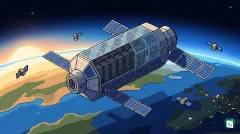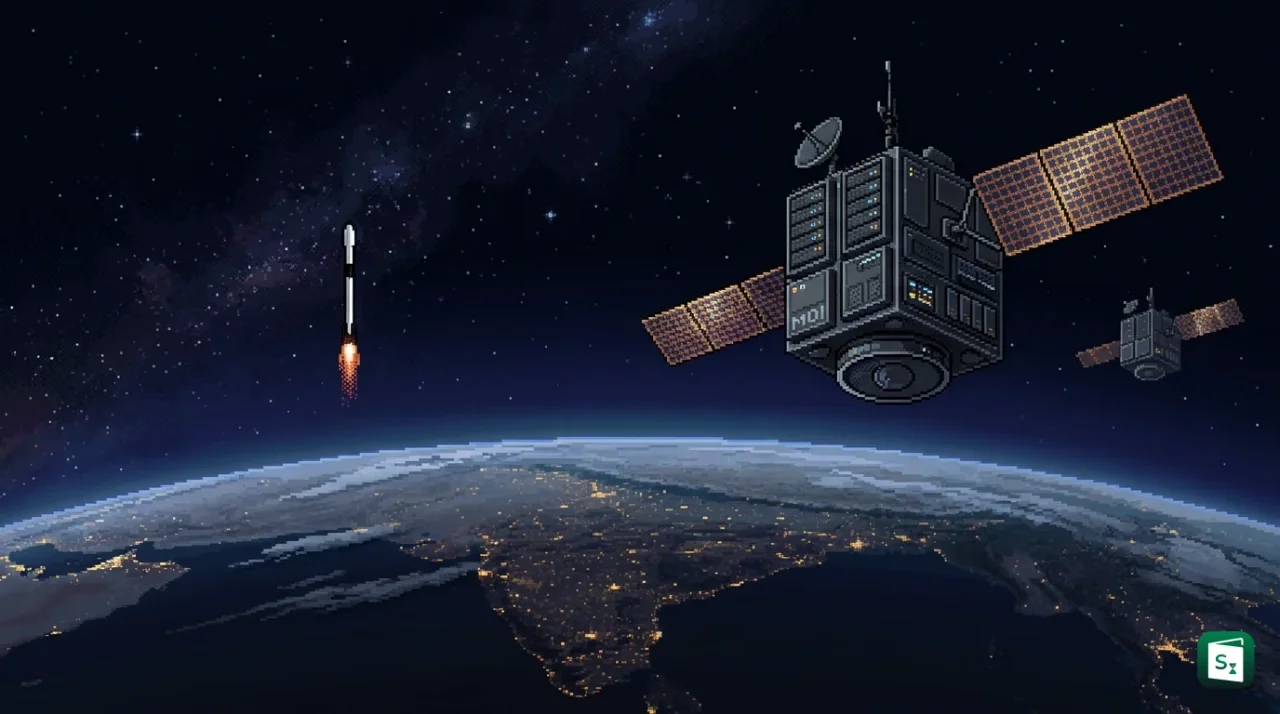
Hyderabad-based TakeMe2Space will launch India’s first networked orbital data centre mission in late 2028 aboard a SpaceX Falcon 9 rocket. The mission will fly two 100 kg MOI satellites that share data and computing work in orbit through laser links. It places India in the global race to move powerful computing off the ground and into space.
What Is an Orbital Data Centre?
An orbital data centre is a data centre placed in Earth orbit instead of inside a building on the ground. It uses solar panels for power, onboard processors and storage for computing, and radio or laser links to send results to Earth. The TakeMe2Space mission will test this idea with two linked satellites that work as one shared computing system.
A ground data centre is a large hall filled with server racks, power backups and cooling plants. A space data centre replaces that hall with a satellite bus, which is the main body of a satellite that carries power, cooling, propulsion and communication systems. The servers sit on this bus and process data close to where satellites collect it.
Space data in this context means Earth observation images, sensor readings and other information collected in orbit. Today, satellites capture far more raw images than they can send down because downlink bandwidth is limited. An orbital data centre analyses images in space and sends down only useful answers, such as flood extent, ship count or crop stress.
What Is Orbital Computing?
Orbital computing means running computer programs directly on satellites in orbit instead of sending all raw data to computers on Earth. It covers onboard processing, storage and sharing of workloads between satellites using high speed links. TakeMe2Space uses its OrbitLab software platform to run artificial intelligence models and analytics aboard its satellites.
The logic is simple. A single Earth observation satellite can generate terabytes of images every day. Sending every frame to a ground station takes time and uses scarce radio bandwidth. If the satellite carries a powerful processor, like a Graphics Processing Unit (GPU), which is a chip designed to handle many calculations in parallel for artificial intelligence tasks, it can read the image, detect a ship or map a flood, and send down a small result file within minutes.
The 2028 mission takes this one step further. Instead of computing on one isolated satellite, two satellites will distribute tasks between them. That shift from single satellite computing to a shared network is what makes the mission networked, and it mirrors how ground data centres link many servers to act as one system.
TakeMe2Space 2028 Mission: Two Satellites Acting as One Computer
TakeMe2Space will fly two MOI (My Orbital Infrastructure) constellation satellites as technology demonstrators for a future orbital data centre. Each spacecraft weighs 100 kg, generates about 1.5 kW of power and carries 10 Nvidia Thor GPUs, 100 TB of storage and a multispectral imager with about 1 metre ground resolution. An optical inter-satellite link, which is a laser beam that carries data between satellites at high speed, will connect the pair so workloads and data can move from one satellite to the other.
The two satellites carry the full building blocks of a small data centre in space. High performance onboard computing handles artificial intelligence tasks. A high capacity power system supports continuous processing. Advanced thermal management removes heat from the chips. Precision pointing hardware keeps both the camera and the laser link stable. The mission will also fly an indigenous Attitude Determination and Control System (ADCS), which is the set of sensors and wheels that control exactly where a satellite points, built with domestically developed reaction wheels, star trackers, fine sun sensors and the company’s StarSense star tracker.
Earth observation is the first use case. Each satellite will capture multispectral images and process them with OrbitLab. Users will receive finished products such as flood maps or ship counts rather than heavy raw frames. This selective downlink saves bandwidth and cuts delivery time from hours to minutes.
Falcon 9 Launch and Waymaker-2 Mission Profile
The TakeMe2Space pair will launch on the Waymaker-2 rideshare mission aboard a SpaceX Falcon 9 rocket in late 2028. Falcon 9 is a partially reusable two stage rocket built by the American company SpaceX. It stands about 70 metres tall, has a diameter of 3.7 metres and can lift about 22,800 kg to low Earth orbit in expendable mode.
Waymaker-2 is part of a dedicated rideshare programme operated by the American firm SEOPS, in which many small satellites share one rocket to cut cost. The mission targets a sun synchronous orbit at about 500 km altitude. A sun synchronous orbit is a near polar orbit in which a satellite passes over any spot at the same local solar time on each visit, which gives steady sunlight for power and consistent lighting for imaging. This orbit suits Earth observation and offers strong solar availability for computing.
RIDE Space Agreement Explained
TakeMe2Space secured its slot on Waymaker-2 through a launch service agreement with RIDE! Space, a Paris based launch mission management firm founded in 2020. RIDE! Space does not build rockets. It finds suitable launches from its network of more than 35 launch providers, buys capacity, handles paperwork, insurance, export control, integration and testing, and guides the customer satellite from booking to separation in orbit.
RIDE! Space has secured large capacity on SEOPS Waymaker missions, including about 1,000 kg on Waymaker-1, and manages rideshare slots for operators from more than 50 countries. For TakeMe2Space, the firm handled procurement of the Falcon 9 slot and end to end mission management. RIDE! Space is backed by the European Space Agency and the French space agency CNES.
TakeMe2Space Journey: From MOI-TD to Six Satellite Constellation
TakeMe2Space was founded in Hyderabad in 2023 by Ronak Kumar Samantray, a software engineer and former co-founder of NowFloats. The company works from Hyderabad with support from Telangana’s prototyping ecosystem and testing support from the Indian National Space Promotion and Authorisation Centre (IN-SPACe), which is India’s agency for promoting and authorising private space activity.
The company’s roadmap has moved in clear steps. In December 2024, it flew MOI-TD (My Orbital Infrastructure Technology Demonstrator) aboard the PSLV-C60 mission and validated onboard computing and its RadShield radiation protection technology during a 14 day demonstration. Its first full satellite MOI-1 was lost in January 2026 when PSLV-C62 suffered a third stage anomaly, though the company reported all its systems were normal at the time of loss.
TakeMe2Space then shifted to faster launch options. MOI-1a was scheduled for 1 October 2026 aboard SpaceX Transporter-18, with orbit injection through a D-Orbit transfer vehicle, while MOI-1b was planned on the Indian Small Satellite Launch Vehicle (SSLV) later in 2026. MOI-1a carries a 117 TOPS GPU with 16 GB RAM and a 9 band multispectral imager, where TOPS means trillion operations per second and measures artificial intelligence processing speed.
The two Waymaker-2 satellites due in 2028 are the next step. They prove networking between spacecraft. After that, TakeMe2Space plans a constellation of 6 satellites to provide daily global coverage with orbital computing by late 2027 as an operational service, and it has spoken of a far larger long term vision of thousands of compute satellites. The company recently raised $5 million in seed funding led by Chiratae Ventures. It also received backing under the IN-SPACe Technology Adoption Fund to develop StarSense, an indigenous artificial intelligence powered star tracker, which is an optical sensor that fixes a satellite’s orientation by matching star patterns. India currently imports almost all such trackers from the United States and Europe.
How Will Orbital Data Centres Be Cooled and Powered?
Orbital data centres in space will be cooled by radiation of heat into space through large radiator panels, since air based cooling does not work in vacuum. TakeMe2Space pairs onboard processors with high performance thermal management, solar power of about 1.5 kW per satellite and radiation hardened design to keep chips within safe temperatures in low Earth orbit.
On Earth, data centres cool servers mainly by moving heat into air or water, which then carries it away. In vacuum there is no air, so heat can leave only as infrared light emitted from a surface. This process follows a physical rule called the Stefan Boltzmann law, which says heat rejection rises sharply with radiator temperature. Spacecraft therefore use metallic or composite radiator panels, fluid loops that carry heat from chips to the panels, and careful pointing to keep radiators facing cold space rather than the Sun or Earth.
Power comes free from the Sun, but it is not simple to use. A solar panel in space can produce five to seven times more energy than the same panel on the ground because sunlight is stronger and more continuous above clouds and night interruptions. Still, satellites in low orbit pass through Earth’s shadow on each 90 minute loop, so batteries must bridge eclipses. Solar cell output also fades by about 0.5 percent to 0.8 percent per year due to ultraviolet exposure and thermal cycling, and electronics must survive radiation, wide temperature swings and microgravity.
The TakeMe2Space design reflects these limits. Its 1.5 kW class satellites are small enough to manage heat with compact radiators and fluid transport, while optical links and distributed tasks prevent one satellite from overheating under peak load. This is why engineers view cooling as the central design challenge for scaling from kilowatt demonstrators to megawatt class orbital data centres.
Are Orbital Data Centres Feasible? Orbital Versus Ground Data Centres
Orbital data centres are technically feasible for specific tasks like onboard image analysis, but full replacement of ground data centres is not yet economic. Early systems suit inference workloads, which use trained artificial intelligence models to analyse new data, because they need less data transfer than training of models. TakeMe2Space therefore focuses first on processing Earth observation data where it is collected.
The promise is clear. Space offers abundant solar energy, no land cost, no water use for cooling and faster delivery of space derived insights. Ground data centres consumed about 4.4 percent of total electricity in the United States in 2023 and face rising power bills, water use and delays in permits and grid connections. Once in orbit, a solar powered satellite generates power without ongoing fuel cost or carbon emissions from operation.
The hurdles are also clear. Launch remains the largest cost, currently around a few thousand dollars per kg on Falcon 9, with future fully reusable rockets aiming for a few hundred dollars per kg. Hardware cannot be repaired easily, chips age fast and radiation can shorten life to about five years. Large radiators, shielding and replacement satellites add mass and cost, and laser links between fast moving satellites are complex to maintain.
| Feature | Ground Data Centre | Orbital Data Centre |
|---|---|---|
| Power source | Grid, diesel backup, onsite solar | Solar panels plus batteries |
| Cooling method | Air and water cooling | Radiator panels emitting heat to space |
| Water use | High for cooling | Zero during operation |
| Maintenance | Engineers can replace parts | Largely fire and forget, replacement by new launch |
| Best workloads today | Training and general cloud computing | Edge processing and inference near data source |
| Main cost driver | Land, power bills, cooling plants | Launch cost, spacecraft hardware, radiators |
Do space data centres make sense today. They make sense where speed matters and downlink is the bottleneck, such as disaster mapping, ship tracking and crop monitoring. They do not yet make sense as a wholesale shift of cloud computing into orbit.
India Space Infrastructure Context and Significance
India’s space programme is anchored by the Indian Space Research Organisation (ISRO), established in 1969 and headquartered in Bengaluru, along with IN-SPACe for private sector authorisation in Ahmedabad and NewSpace India Limited for commercial launches. Key launch centres include Satish Dhawan Space Centre at Sriharikota in Andhra Pradesh and the Vikram Sarabhai Space Centre at Thiruvananthapuram. Ground data handling is supported by the Indian Space Science Data Centre (ISSDC), located at the Indian Deep Space Network campus at Byalalu near Bengaluru.
Private startups now build on this public base. Companies such as Skyroot Aerospace, Agnikul Cosmos, Pixxel and Dhruva Space develop rockets, imaging satellites and deployment services. Hyderabad has emerged as a hub, with Telangana’s T-Works prototyping lab, IIIT Hyderabad’s innovation centre and a large share of new data centre land investments. TakeMe2Space itself built its bus, subsystems, AI Cube computer and imager in house and tested payloads at the IN-SPACe Technical Centre in Ahmedabad.
The significance of the 2028 mission is threefold. First, it demonstrates sovereign compute capability in orbit, which reduces dependence on foreign ground processing chains. Second, it builds domestic supply chains for critical parts such as star trackers, reaction wheels and radiation shielding, in line with self reliance goals. Third, it positions an Indian firm in a fast moving field where American firms such as Starcloud, which flew an Nvidia H100 GPU in November 2025, and Google’s Project Suncatcher prototypes due with Planet Labs by early 2027 are also testing space based computing.
The Way Forward
TakeMe2Space will first complete MOI-1a and MOI-1b in 2026 to prove single satellite computing and imaging. The 2028 Waymaker-2 flight must then prove stable laser networking, shared tasking and thermal control across two high power satellites. Success will clear the path for the planned six satellite operational constellation with complete daily global coverage.
Beyond that, scale will decide impact. Larger constellations need cheaper launches, lighter solar arrays and radiators, stronger radiation tolerance and reliable optical networking. Policy support through IN-SPACe authorisation, access to domestic launch vehicles such as SSLV and PSLV, and continued funding for indigenous components will shape how far India’s orbital computing roadmap advances in the next decade.
Key Takeaways
- TakeMe2Space will launch India’s first networked orbital data centre in late 2028 aboard a SpaceX Falcon 9 on the Waymaker-2 mission to a 500 km sun synchronous orbit.
- Each 100 kg MOI satellite will carry 10 Nvidia Thor GPUs, 100 TB storage, 1.5 kW power and a 1 metre multispectral imager linked by optical inter-satellite links.
- The launch slot was secured through a service agreement with Paris based RIDE! Space, founded in 2020, working with SEOPS for rideshare management.
- Founder Ronak Kumar Samantray started TakeMe2Space in Hyderabad in 2023, after the MOI-TD success in December 2024 and the loss of MOI-1 on PSLV-C62 in January 2026.
- The company is developing the indigenous StarSense star tracker with IN-SPACe Technology Adoption Fund support and plans a 6 satellite operational constellation.