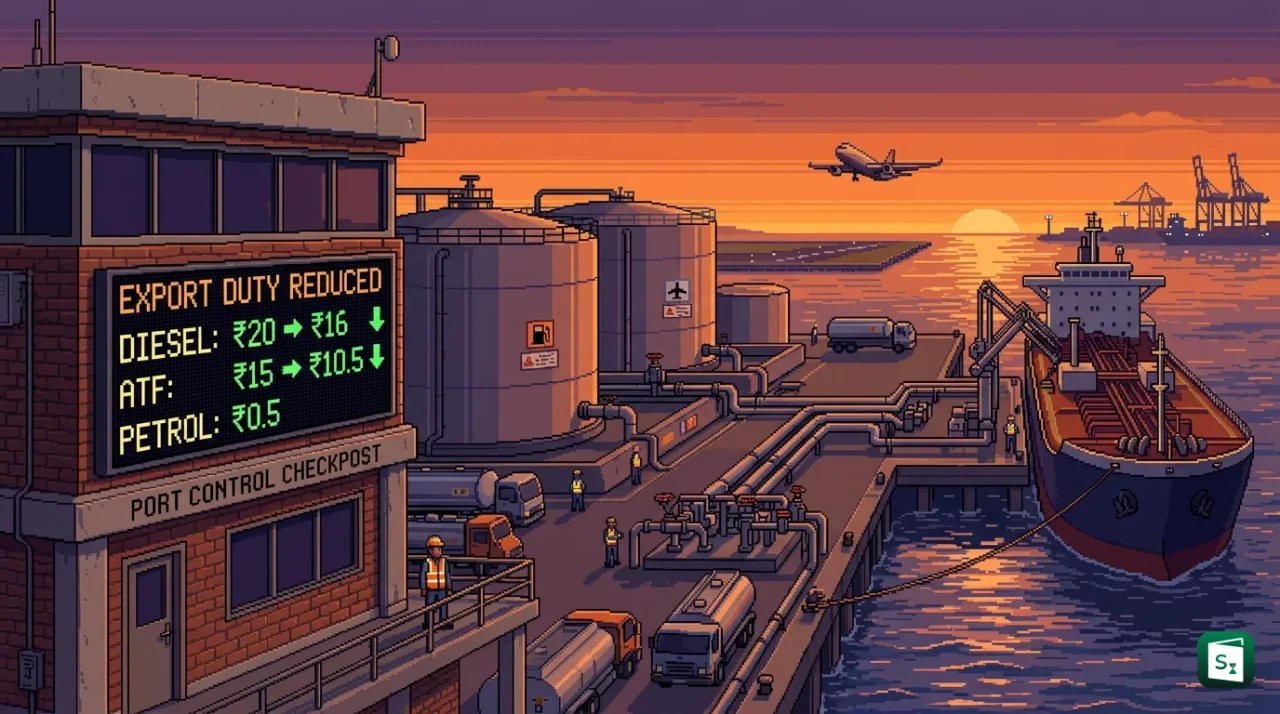
The Ministry of Finance has cut the windfall tax on exports of diesel and Aviation Turbine Fuel (ATF) with effect from October 1, 2026. The export duty on diesel now stands at ₹16 per litre and the levy on ATF at ₹10.5 per litre, while the duty on petrol continues at ₹0.5 per litre for the fortnight. The cut lowers the tax burden on refiners and signals a softening in global product margins that the fortnightly review tracks.
What Is Windfall Tax in India?
The windfall tax in India is a Special Additional Excise Duty (SAED) on extraordinary profits of oil producers and exporters of petrol, diesel and Aviation Turbine Fuel. The Ministry of Finance introduced it on July 1, 2022 to capture super normal gains when global crude and refining margins rise sharply.
A windfall gain is a sudden, unexpected profit that a company earns without extra effort or investment. A windfall profit levy taxes that extra gain. In petroleum, it applies in two forms. One part applies to domestically produced crude oil. The other part applies as an export duty on refined products such as diesel, petrol and ATF.
The Ministry of Finance administers the levy through notifications issued by the Department of Revenue. The Central Board of Indirect Taxes and Customs (CBIC), which handles excise and customs duties, implements the collection at the point of clearance or export. The tax is classified as an indirect tax because the legal burden falls on the producer or exporter, even though market prices decide who finally bears the cost.
India first imposed the levy in July 2022 after the Russia Ukraine conflict pushed crude prices sharply higher and raised refining margins. The government withdrew the levy on December 2, 2024 after global prices cooled. The government reintroduced the levy on March 27, 2026 amid the West Asia crisis to protect domestic supply and to prevent private refiners from diverting fuel to more profitable overseas sales.
Revised Rates From October 1, 2026
The Ministry of Finance notified the new export duties on September 30, 2026 for the fortnight starting October 1, 2026. The Ministry of Finance cut the diesel export duty by ₹4 per litre and the ATF export duty by ₹4.5 per litre. The petrol export duty remains unchanged.
| Product | Duty From September 16, 2026 | Duty From October 1, 2026 | Change |
|---|---|---|---|
| Diesel | ₹20 per litre | ₹16 per litre | Cut of ₹4 per litre |
| Aviation Turbine Fuel (ATF) | ₹15 per litre | ₹10.5 per litre | Cut of ₹4.5 per litre |
| Petrol | ₹0.5 per litre | ₹0.5 per litre | No change |
The September 16 revision had also lowered duties. In that round, the Ministry of Finance had reduced diesel duty to ₹20 per litre from ₹25 per litre and ATF duty to ₹15 per litre from ₹19 per litre. The October 1 revision continues that downward trend.
The revised rates apply only to exports. The Ministry of Finance has confirmed that there is no change in excise duty on petrol and diesel cleared for domestic sale. Domestic pump prices therefore do not change directly because of this notification.
How Is Windfall Tax Calculated and Revised?
The windfall tax rate in India is not fixed in the annual budget. The Ministry of Finance revises export duties every fortnight based on the average international prices of crude oil, petrol, diesel and ATF during the previous two weeks. If global prices and refining margins rise, the levy rises. If they fall, the levy falls.
Refining margin, also called crack spread, is the difference between the price of crude oil and the price of the finished fuel made from it. The levy on diesel, petrol and ATF exports applies when these margins cross high levels. The levy on domestic crude production applies when the global benchmark stays above about $75 per barrel. This method links the tax directly to actual market gains.
The recent trend shows how sensitive the system is. The Ministry of Finance had raised diesel duty to ₹55.5 per litre and ATF duty to ₹42 per litre in April 2026 when prices spiked. Rates then eased through June, July and August as markets cooled. The two cuts in September and October show the same link in reverse. Lower global product prices have led to lower export duties.
The windfall tax is an indirect tax. It is collected as excise duty on production or export, not as income tax on company profits. Companies pay it to the government at the time of clearance. They may adjust export plans or domestic supply based on the final cost.
What Is ATF Fuel and Why Does Its Duty Matter?
Aviation Turbine Fuel, or ATF, is the refined kerosene type fuel used in jet engines of aircraft. ATF powers commercial airlines, cargo planes and defence aircraft, and its price is revised monthly by oil marketing companies based on global benchmarks and exchange rates.
ATF is different from petrol and diesel. Petrol fuels cars and two wheelers. Diesel fuels trucks, buses, farm equipment and trains. ATF serves only aviation. India tracks the ATF price in cities such as Delhi separately because airline costs depend heavily on it. A change in ATF export duty does not directly change the domestic ATF price in India, but it changes the profit a refiner earns from selling jet fuel abroad versus selling it at home.
The windfall tax on diesel is therefore the most closely watched part of the fortnightly review. India is a large diesel exporter, and the diesel export duty shapes refiner behaviour. The windfall tax on petrol has stayed low in recent fortnights, at ₹0.5 per litre or nil, because petrol margins have been softer. The windfall tax on crude oil, levied per tonne on domestic production, targets producers such as the Oil and Natural Gas Corporation (ONGC), which was set up in 1956 and is headquartered in New Delhi. The export duty targets refiners such as Reliance Industries and Nayara Energy, which are the main exporters of diesel and ATF.
Why the Government Levies Windfall Tax on Fuel Exports
The Ministry of Finance levies the export duty for two clear goals. The first goal is to keep enough diesel, petrol and ATF available inside India. The second goal is to take a share of extra profits for public revenue when global prices surge.
This logic matters during supply shocks. When conflict in West Asia raises fears of disruption through the Strait of Hormuz, which carries nearly a fifth of global oil supply, refining margins jump. Private refiners then prefer exports because overseas sales pay more. In 2022 and again in 2026, the government found that some refiners rationed supply to domestic pumps while expanding exports. The export duty removes that extra incentive and nudges fuel toward the home market.
The October cut helps refiners. A lower diesel export duty improves the net return on each litre sold abroad. A lower ATF duty supports jet fuel exports at a time when global aviation demand remains firm. For the government, the cut means slightly lower collection per litre, but it keeps the levy aligned with actual margins. If the levy stayed high while margins fell, exports could become unviable and refinery output could slow.
The impact on households is indirect. Diesel powers freight and farming, so high diesel prices can raise transport and food costs. Petrol powers private vehicles. ATF powers flights. The windfall tax does not set these domestic prices. It only taxes the export leg. Stable domestic supply, however, prevents local shortages that would push retail costs higher.
Key Takeaways
- The Ministry of Finance cut diesel export duty to ₹16 per litre and ATF duty to ₹10.5 per litre from October 1, 2026.
- The petrol export duty was kept unchanged at ₹0.5 per litre for the fortnight starting October 1, 2026.
- The windfall tax is levied as Special Additional Excise Duty (SAED) and is revised every fortnight based on global prices.
- India first imposed windfall tax on July 1, 2022, withdrew it on December 2, 2024, and reintroduced it on March 27, 2026.
- Aviation Turbine Fuel (ATF) is the jet fuel used in aircraft engines and is priced separately from petrol and diesel.