The Union Cabinet, chaired by Prime Minister Narendra Modi, approved a ₹10,000 crore government commitment for the SME Growth Fund (SGF) on 6 October 2026. The amount will flow through an Alternative Investment Fund (AIF) to make direct equity investments in Small and Medium Enterprises (SMEs). The move fills a long standing gap in growth capital and aims to build globally competitive champion enterprises in manufacturing, services and technology.
What Is the SME Growth Fund?
The SME Growth Fund is a government backed equity vehicle announced in Para 28 of the Union Budget 2026-27 for Small and Medium Enterprises. The Union Cabinet approved a ₹10,000 crore central commitment to an Alternative Investment Fund under this framework for direct equity investments in viable and scalable firms.
SME is the short form for Small and Medium Enterprises. These firms sit inside the larger family of Micro, Small and Medium Enterprises (MSMEs), which are defined in India by a composite test of investment in plant and machinery or equipment and annual turnover. The SGF focuses on the upper two rungs of this ladder, the small and medium firms that have crossed the micro stage and now need larger risk capital to expand.
The present MSME classification, which took effect on 1 April 2025, raised both investment and turnover limits to allow growing units to retain benefits for longer. The revised limits were announced in the Union Budget 2025-26 at 2.5 times for investment and two times for turnover over the earlier levels.
| Category | Investment in Plant and Machinery or Equipment | Annual Turnover |
|---|---|---|
| Micro | Up to ₹2.5 crore | Up to ₹10 crore |
| Small | Up to ₹25 crore | Up to ₹100 crore |
| Medium | Up to ₹125 crore | Up to ₹500 crore |
All such units must register on the Udyam Registration portal run by the Ministry of Micro, Small and Medium Enterprises. As of mid 2026, registrations on the Udyam and Udyam Assist platforms had crossed 7.9 crore, with later reports placing the count above 8.7 crore, which shows the scale of formalisation that the SGF will draw upon.
The SGF is not a loan scheme. SME loans and SME finance in India provide debt that must be repaid with interest and often need collateral. The SGF provides patient equity or equity like capital. It takes an ownership stake, shares business risk, stays invested for the long term and helps the firm scale capacity, adopt technology and enter new markets.
What Is an Alternative Investment Fund?
An Alternative Investment Fund is a privately pooled investment vehicle registered with the Securities and Exchange Board of India that collects money from informed investors under a stated policy. The SME Growth Fund uses this AIF route to pool the ₹10,000 crore central commitment and make direct equity investments.
An AIF is governed by the SEBI (Alternative Investment Funds) Regulations, 2012. The Securities and Exchange Board of India (SEBI), which was set up in 1988 and given statutory powers through the SEBI Act, 1992, is headquartered in Mumbai and registers every AIF before it can raise money. The government has chosen this regulated route so that professional fund managers select firms, monitor performance and recycle returns in a transparent manner.
SEBI recognises three broad AIF categories. This classification decides where the fund can invest and whether it can borrow.
| AIF Category | What It Covers | Key Feature |
|---|---|---|
| Category I | Venture capital funds, SME Funds, social venture funds, infrastructure funds | Invests in startups, SMEs and sectors the government treats as socially or economically desirable, no leverage |
| Category II | Private equity funds, debt funds, Fund of Funds such as the Self-Reliant India (SRI) Fund | Cannot borrow except for daily operations, no other investment restrictions |
| Category III | Hedge funds and funds using complex trading strategies | Can use leverage and trade in derivatives, including open ended structures |
The SGF framework provides that the central commitment of ₹10,000 crore will go to an AIF created for this purpose. This design is familiar. The SRI Fund, launched in 2021 with a ₹10,000 crore central anchor, works as a Mother Fund that backs Daughter Funds, which then invest in MSMEs. The SRI Fund had supported 682 MSMEs with investments worth ₹15,442 crore by November 2025, a model that showed how public anchor money can pull in private capital. The SGF now extends the same logic specifically to growth stage small and medium firms.
Why Does India Need Growth Equity for SMEs?
The Union Cabinet note points to a clear structural gap. Existing equity schemes largely support early stage ventures and micro units. A small firm that has proven its product and a medium firm ready to build a new plant sit in a missing middle. Banks hesitate to give long term risk loans without collateral, while venture funds chase young startups. The SGF is meant for this inflection point, when a viable business needs patient capital to scale, innovate, buy technology, acquire a rival or prepare for a stock market listing.
Credit access has improved, but debt alone cannot build champions. Loans through priority sector lending, the Credit Guarantee Fund Trust for Micro and Small Enterprises (CGTMSE) and the Emergency Credit Line Guarantee Scheme, which backed guarantees worth ₹3.61 lakh crore for 1.19 crore borrowers, keep working capital flowing. Equity does a different job. It strengthens the balance sheet, lets the promoter take technology risks and makes later bank borrowing easier. That distinction explains why the Budget speaks of equity, liquidity and professional support as three separate pillars.
The stakes are high because SMEs form the backbone of the economy. The Ministry of Micro, Small and Medium Enterprises places their share at around 31.1 percent of GDP, about 35.4 percent of manufacturing output and 48.58 percent of total exports. The sector includes more than 7.47 crore enterprises and provides livelihoods to nearly 32.8 crore people, which makes it the second largest employer after agriculture. A shortage of growth equity in such a large sector slows capacity creation, technology adoption and entry into global value chains.
Key Features and Focus Areas of the Fund
The Union Cabinet decision sets a single aggregate commitment. The central government will provide ₹10,000 crore to the AIF established under the SGF framework. Professional managers will then make direct equity investments in selected SMEs. The selection test is business viability plus scalability, which means steady revenues, sound governance and a clear plan to grow.
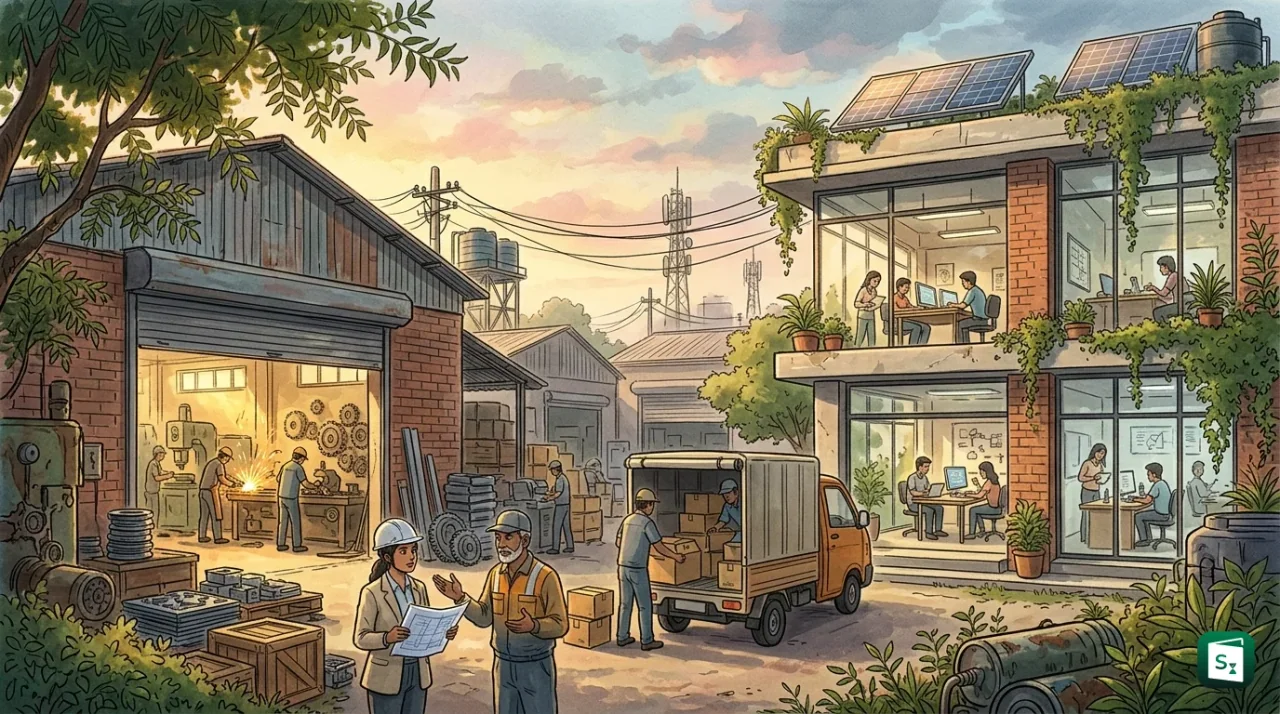
Manufacturing gets the largest share. The Cabinet release states that the majority allocation from SGF will go to small and medium manufacturing focused enterprises. This choice links directly to export competitiveness. Larger plants with modern machines can cut unit costs, meet global quality standards and join supply chains for electronics, auto parts, pharmaceuticals and engineering goods.
Services, technology and innovation driven sectors form the second ring. These include software and digital services, research led firms and companies building new products or processes. Support here helps technology SMEs move from job work to owning intellectual property and brands.
Strategic value chains form the third ring. These are supply networks that matter for self reliance and national capability, such as critical inputs, clean energy components and defence linked spares. The SGF aims to nurture Indian champions in these chains, which means firms with the scale and innovation strength to lead their segment rather than remain small subcontractors.
Place matters as much as sector. The Fund will consider SMEs operating in industrial clusters in Tier II and Tier III cities. Cluster investing spreads capital beyond metros, strengthens local supplier networks and creates high quality jobs closer to workers homes. By backing many firms inside one cluster, the Fund can lift common testing labs, tool rooms and logistics at the same time.
SME Growth Fund in the Wider MSME Support Package
The Union Budget 2026-27 placed the SME Growth Fund inside a three part package for MSMEs. The three parts are equity support, liquidity support and professional support. The Union Cabinet approval of 6 October 2026 operationalises the equity leg of that package, which was announced in Para 28 of the Budget speech by Finance Minister Nirmala Sitharaman.
Equity support has two elements. The first is the ₹10,000 crore commitment for the SME Growth Fund for small and medium firms with scale up potential. The second is a top up of ₹2,000 crore for the Self-Reliant India Fund, which was set up in 2021 and mainly serves micro enterprises with risk capital. Together, the two funds ensure that micro units and growth stage SMEs both have access to equity.
| Budget Pillar | What Was Announced | Purpose |
|---|---|---|
| Equity | SME Growth Fund of ₹10,000 crore plus ₹2,000 crore top up for Self-Reliant India Fund | Long term risk capital for viable firms to expand and list |
| Liquidity | Four measures to strengthen Trade Receivables Discounting System (TReDS) | Faster payment against MSME bills |
| Professional support | Training of Corporate Mitras with professional bodies | Affordable compliance help in smaller towns |
Liquidity support works through TReDS, which is an online platform where MSME suppliers can sell their unpaid bills from large buyers and receive money quickly at a discount. More than ₹7 lakh crore has already flowed to MSMEs through this route. The Budget proposed four further steps. Central public sector enterprises will use TReDS as the mandatory settlement route for purchases from MSMEs. A credit guarantee through CGTMSE will cover invoice discounting on the platform. The Government e-Marketplace (GeM) will be linked with TReDS so that data on government purchases helps lenders assess borrowers faster. TReDS receivables will also be allowed to be pooled into asset backed securities, which creates a secondary market and frees up fresh funds for lending.
Professional support addresses a daily headache for small firms, which is compliance. The Budget proposed that bodies such as the Institute of Chartered Accountants of India (ICAI), the Institute of Company Secretaries of India (ICSI) and the Institute of Cost Accountants of India (ICMAI) design short modular courses to create accredited helpers called Corporate Mitras. These helpers will work mainly in Tier II and Tier III towns and assist MSMEs with filings, accounts and legal paperwork at affordable fees, so owners can focus on production and sales.
Significance for Manufacturing, Exports and Jobs
The Ministry of Finance expects the SME Growth Fund to improve scale, productivity and export competitiveness. When a manufacturing SME adds capacity, it can process larger orders without delays. When it adopts advanced machines and testing systems, rejection rates fall and the product meets the standards demanded by foreign buyers. This is how small suppliers move from local orders to integration into global value chains, which are the cross country production networks where different stages of a product are made in different nations.
Regional balance is a second gain. Industrial clusters in Tier II and Tier III cities often have skilled workers but lack long term capital. Direct equity for firms in these clusters supports balanced industrial growth, strengthens local supply chains and generates employment that does not force migration to large metros. The jobs created in modern manufacturing and technology services tend to be formal, better paid and skill building.
The Fund also deepens the domestic capital market for growth stage firms. India has active early stage funding and a large main stock market, but mid sized unlisted firms often struggle to raise the second round of growth money. A government anchored AIF creates a track record of audited investments, professional governance and exits through listings on platforms such as the BSE SME and NSE Emerge or through strategic sales. This track record can attract pension funds, insurers and private investors to the SME segment in future.
The initiative connects with other national efforts. Public procurement support, digital formalisation through Udyam, ease of doing business reforms and production linked incentive schemes all push firms to grow. The SGF adds the missing equity layer. The stated end goal is the vision of Viksit Bharat 2047, which calls for India to become a developed nation by the centenary of Independence with globally competitive enterprises, innovation led industrialisation and quality employment across regions.
Key Takeaways
- The Union Cabinet approved a ₹10,000 crore commitment for the SME Growth Fund on 6 October 2026 for direct equity investments through the AIF route.
- The Fund was announced in Para 28 of the Union Budget 2026-27 to create champion Indian enterprises in manufacturing, services, technology and strategic value chains.
- The majority allocation from the Fund will go to small and medium manufacturing enterprises, including units in Tier II and Tier III industrial clusters.
- SME stands for Small and Medium Enterprises, defined under the 1 April 2025 norms as investment up to ₹25 crore and turnover up to ₹100 crore for small firms and ₹125 crore and ₹500 crore for medium firms.
- An Alternative Investment Fund is a privately pooled vehicle registered under the SEBI (Alternative Investment Funds) Regulations, 2012, with SEBI established in 1988 and headquartered in Mumbai.
- The Budget package also provides a ₹2,000 crore top up for the Self-Reliant India Fund and four TReDS measures backed by over ₹7 lakh crore in past financing to MSMEs.