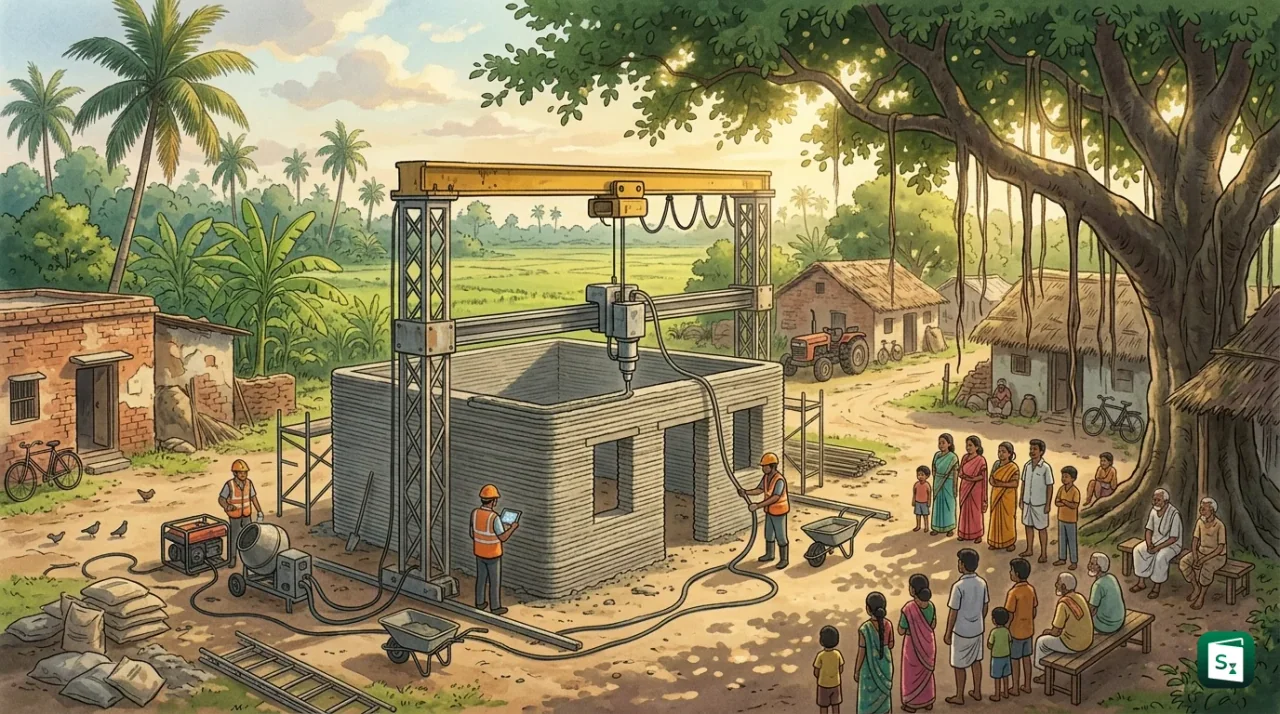
Union Minister for Rural Development Shivraj Singh Chouhan handed over the first instalment of ₹3,600 crore for 3 lakh houses in Andhra Pradesh under the Pradhan Mantri Awas Yojana Gramin 2.0 at Burripalem village in Guntur district on 4 October 2026. At the same event, held with Chief Minister N. Chandrababu Naidu, he laid the foundation stone for India’s first pilot 3D printed house in India project using 3D concrete printing. The pilot will test whether automated printing can deliver faster and cheaper rural homes at national scale.
What Is the PMAY Scheme?
The Pradhan Mantri Awas Yojana Gramin (PMAY-G) is the central rural housing programme of the Ministry of Rural Development, active since 1 April 2016. It gives financial help to houseless families and those living in kutcha or dilapidated homes to build pucca houses with toilets, cooking space and basic amenities.
PMAY-G replaced the earlier Indira Awaas Yojana and raised both the house size and the assistance amount. The minimum plinth area under PMAY-G is 25 square metres, including a separate space for hygienic cooking. This is larger than the 20 square metres provided under the older scheme.
Beneficiaries receive the money directly in their bank accounts through the Public Financial Management System. Selection is based on housing deprivation data from the Socio Economic and Caste Census 2011 and the AwaasPlus 2018 survey, with final lists verified by the Gram Sabha. This process keeps the choice of beneficiaries transparent and village led.
| Support under PMAY-Gramin | Detail |
|---|---|
| Assistance in plain areas | ₹1.20 lakh per house |
| Assistance in hilly, North Eastern and difficult areas | ₹1.30 lakh per house |
| Unskilled wage work through rural employment guarantee | 90 to 95 person days (about ₹27,000 value) |
| Toilet assistance through Swachh Bharat Mission Gramin | ₹12,000 per house |
| Optional bank loan for construction | Up to ₹70,000 at 3 percent interest |
PMAY-G also converges with other welfare programmes for full home benefits. Houses get clean cooking fuel through the Pradhan Mantri Ujjwala Yojana, drinking water through the Jal Jeevan Mission and power access through rural electrification and rooftop solar support. Each house built under the scheme creates about 201 person days of work across skilled and unskilled labour.
What Is PMAY-Gramin 2.0?
The Pradhan Mantri Awas Yojana Gramin 2.0 is the second phase of rural housing approved by the Union Cabinet in August 2024 for FY 2024-25 to 2028-29. It will build 2 crore additional pucca houses for eligible rural families at existing assistance rates with a total outlay of ₹3,06,137 crore.
PMAY-Gramin 2.0 continues the original mission of Housing for All in rural areas. The first phase had set a target of 2.95 crore houses till March 2024. The second phase adds 2 crore more houses, taking the cumulative national target to 4.95 crore houses by March 2029. The government estimates that construction for 2 crore households will benefit nearly 10 crore individuals.
The outlay includes a central share of ₹2,05,856 crore and a state matching share of ₹1,00,281 crore. Incomplete houses from the earlier phase were to be completed in 2024-25 at existing rates. The Ministry of Rural Development allocates annual targets to states, and states then sanction houses after survey and verification.
Beneficiaries track their application through the official PMAYG portal (pmayg.nic.in) and the AwaasPlus survey system. The portal supports the beneficiary list, instalment status check, online application updates and grievance handling. High public interest in the pmayg nic in list, pmay gramin status check and pmay gramin beneficiary list reflects the large rural demand that surrounds the 3D housing pilot.
3 Lakh Houses for Andhra Pradesh Under PMAY-Gramin 2.0
The Ministry of Rural Development handed over the first instalment for Andhra Pradesh at Burripalem village near Tenali in Guntur district on 4 October 2026. Union Minister Shivraj Singh Chouhan and Andhra Pradesh Chief Minister N. Chandrababu Naidu attended the event. The Centre released ₹3,600 crore as the first instalment for 3 lakh rural houses under PMAY-Gramin 2.0.
Officials had first proposed an allocation of about 74,000 to 76,000 houses for the state. The allocation rose to 3 lakh after the state government asked for coverage for every poor rural family without a permanent home. The final package therefore includes around 2.25 lakh newly sanctioned houses in addition to the earlier approved lot.
| Andhra Pradesh package under PMAY-Gramin 2.0 | Figure |
|---|---|
| Total houses in current handover | 3 lakh |
| First instalment released | ₹3,600 crore |
| Venue and date | Burripalem, Guntur, 4 October 2026 |
| Earlier approved lot | About 74,000 houses |
| Newly added houses | About 2.25 lakh houses |
The Union Minister said the Centre would consider sanctioning 6 lakh more houses for Andhra Pradesh in the next stage. The state government has also set a goal to speed up work and hand over pending rural houses by March next year. The large instalment signals the priority given to rural housing in Andhra Pradesh within the national 2 crore target.
What Is 3D Printing Technology and How Does It Work?
Three dimensional concrete printing is an additive manufacturing process for construction. A large computer controlled printer reads a three dimensional digital design and extrudes a special cement based mix layer by layer to form walls and structures without conventional formwork or moulds.
Additive manufacturing builds an object by adding material only where the design needs it. This differs from conventional building, which cuts, casts and assembles separate blocks, bricks and shuttering. In 3D construction printing, a gantry or robotic arm moves on a track and deposits concrete through a nozzle in precise layers. Operators control the path, speed and thickness through software.
India demonstrated this method early at the Indian Institute of Technology Madras. In April 2021, the startup Tvasta Manufacturing Solutions, founded by institute alumni, built India’s first 3D printed house on the campus with support from Habitat for Humanity’s Terwilliger Center for Innovation in Shelter. The single storey unit covered about 600 square feet with a bedroom, hall and kitchen. The team printed the structure in about 5 days and completed the full project in 21 days at a reported cost of about ₹5 to ₹5.5 lakh.
The same principle now guides rural housing use. Concrete 3D printing replaces slow masonry courses and sequential manual labour with a continuous machine process. The printer can produce curved walls, hollow cores for services and custom room sizes from the same digital file. This flexibility helps in mass housing because each unit can be adjusted for plot size or family need without new moulds.
First 3D Concrete Printing Pilot Housing Project at Burripalem
The Ministry of Rural Development will build 177 houses with 3D printed concrete walls in Burripalem and Obulnayudupalem villages near Tenali in Guntur district. The foundation stone was laid at Burripalem on 4 October 2026. The project is described as India’s first pilot housing project that uses 3D Concrete Printing (3DCP) for rural homes under PMAY-Gramin.
A tripartite agreement links the three implementing partners for the pilot. The Union Ministry of Rural Development acts as the funding authority. The CSIR Central Building Research Institute (CBRI), Roorkee provides technology, mix design and technical supervision. The institute, established in 1947 in Roorkee in Uttarakhand, works on building materials, structures and disaster resistant housing under the Council of Scientific and Industrial Research. The Andhra Pradesh government provides land, site preparation and part of the construction cost. Union Minister of State for Rural Development Pemmasani Chandra Sekhar has steered the coordination for the pilot.
| Burripalem 3D housing pilot | Sanctioned detail |
|---|---|
| Villages covered | Burripalem and Obulnayudupalem, Guntur district |
| Total houses | 177 PMAY-G houses |
| Unit mix | 100 units of 25 square metres plus 77 units of 32 square metres |
| Special provision | 32 square metre units are barrier free homes for Persons with Disabilities, each with a household latrine |
| Total outlay excluding taxes | ₹13.93 crore (reported as about ₹14 crore) |
| Central share | ₹9.44 crore |
| State share | ₹4.49 crore |
The central share covers ₹3.40 crore for 3D printing machinery, ₹1.50 crore for CBRI technical supervision and ₹4.54 crore for construction work. The state share covers ₹3.64 crore for land preparation and soil stabilisation and ₹0.85 crore for construction. The pilot period is 18 months, during which the team will develop technical protocols and structural benchmarks for wider use. Officials expect the first set of houses to be ready within six months, while a single residential unit can be printed in about 10 days once the machine, material and foundation are ready.
Is a 3D Printed House Strong and Cheaper?
3D printed houses can be strong and cost effective when the concrete mix, printing parameters and curing follow tested structural norms. Early Indian demonstrations cut construction waste sharply and reduced time from months to days, which lowers labour cost, although machine price and trained operators shape final savings.
Strength depends on material science and supervision, not on the printer alone. The Burripalem pilot tasks CBRI with fixing mix formulations, layer bonding, curing time and load norms before scale up. Conventional rural masonry takes four to six months for a house, while printing of walls can finish in days. Shorter time means lower spending on scaffolding, shuttering, site stay and daily wage cycles.
Cost gains come from three clear channels. Machine printing cuts material waste because concrete flows only on the design path. Developers of the IIT Madras house reported waste at about one third of conventional levels and overall savings of about 30 percent in some configurations. Fewer manual steps also reduce errors and rework. The pilot will test these claims on real PMAY-G designs, including latrines and barrier free access, so that cost per square metre reflects rural conditions and not laboratory conditions.
Limits remain part of the assessment. Printing needs firm and levelled ground, steady power, tested soil stabilisation and trained operators. The Andhra Pradesh share for land preparation shows that foundation work still needs careful civil effort. Long term durability in heavy rain, heat and flood zones will need monitoring through CBRI benchmarks.
Significance and The Way Forward
The Burripalem pilot links speed with inclusion. Of the 177 houses, 77 larger units are reserved as barrier free homes for Persons with Disabilities. This matches the policy aim of covering about 5 percent of beneficiaries from this group at state level under disability rights norms. Each house will have a household latrine, which supports sanitation and dignity along with shelter.
The pilot also creates a national template. If CBRI certifies the printing protocol, mix and structural performance, the same method can extend to other states under PMAY-Gramin 2.0. Faster builds would help states clear waiting lists from the Socio Economic and Caste Census and AwaasPlus. Lower waste and machine precision would also support quality control across remote sites, where supervision is often thin.
The next steps are construction, testing and review. The project team will prepare sites, install the 3D construction printer and print walls under CBRI oversight. Central and state engineers will track cost, time, strength and beneficiary feedback. Results from Burripalem and Obulnayudupalem will guide decisions on machine procurement, training of rural masons as printer operators and model estimates for 3D printed PMAY-G houses in other districts.
Key Takeaways
- The Centre released ₹3,600 crore as first instalment for 3 lakh PMAY-Gramin 2.0 houses in Andhra Pradesh at Burripalem on 4 October 2026.
- India’s first pilot 3D concrete printing housing project will build 177 houses in Burripalem and Obulnayudupalem in Guntur district at about ₹14 crore.
- The pilot includes 100 houses of 25 square metres and 77 barrier free houses of 32 square metres for Persons with Disabilities.
- PMAY-Gramin 2.0, approved in August 2024, targets 2 crore additional houses by March 2029 with an outlay of ₹3,06,137 crore.
- Technical support for the pilot comes from CSIR-CBRI, Roorkee, established in 1947, under a tripartite agreement with the Ministry of Rural Development and Andhra Pradesh.
- India’s first 3D printed house was built at IIT Madras in April 2021 by Tvasta Manufacturing Solutions with a print time of about 5 days.