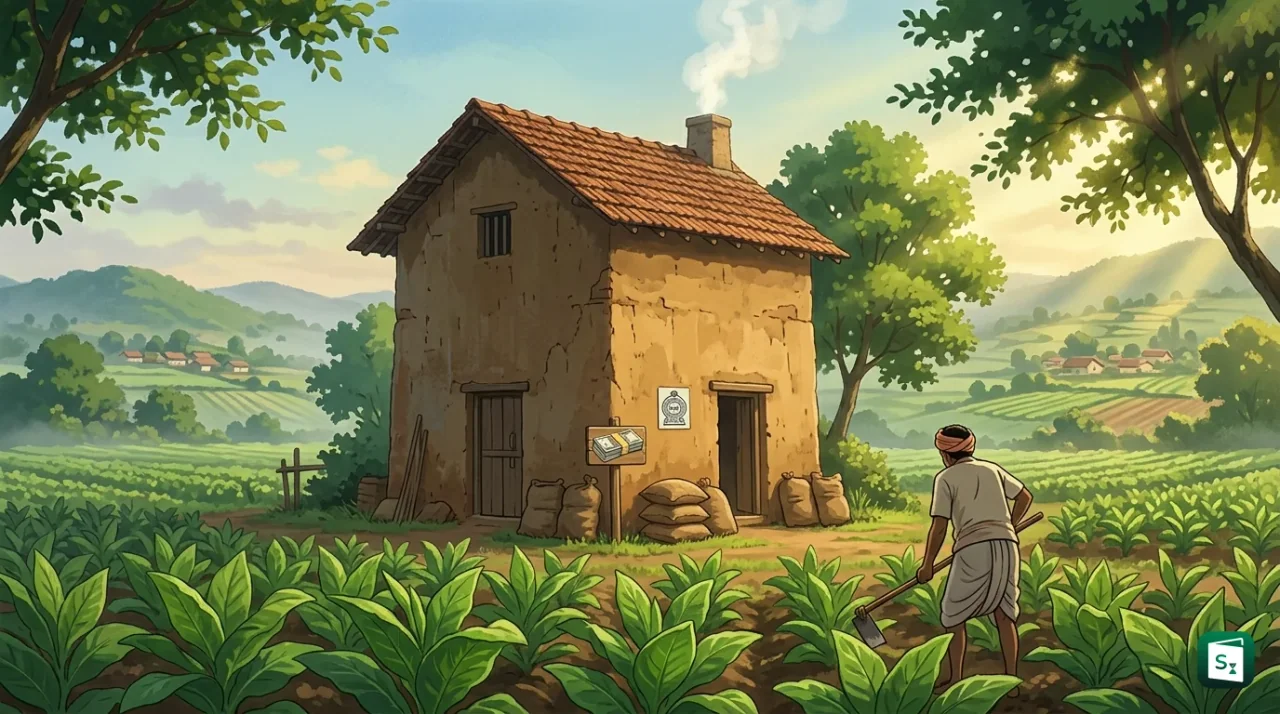
The Central Government has approved a one-time interest free loan of ₹50,000 per barn for Flue-Cured Virginia (FCV) tobacco growers in Andhra Pradesh under the Interest-Free Working Capital Assistance Scheme. Announced by the Ministry of Commerce and Industry on 25 September 2026, the package carries a total outlay of ₹220 crore and will reach about 44,000 growers through direct benefit transfer. It is meant to give immediate cash support during a difficult auction season marked by surplus production and weak prices.
What Is the Interest-Free Working Capital Assistance Scheme?
The Interest-Free Working Capital Assistance Scheme is a one-time central support measure that gives ₹50,000 per curing barn to registered FCV growers in Andhra Pradesh without charging any interest. The Tobacco Board of India will identify eligible growers and the amount will be paid directly into their bank accounts through Direct Benefit Transfer (DBT), which is the system of sending government help straight to the beneficiary without middlemen.
The total financial support under the scheme is about ₹220 crore for nearly 44,000 growers. The money is working capital, which means cash that a farmer uses for day to day needs during the season. The government has said growers can use it to meet household expenses, repay loans taken from banks and cooperatives, buy inputs like fertiliser and fuelwood for the next crop, and avoid borrowing from private moneylenders at high interest.
The Ministry of Commerce and Industry has said this is a one-time intervention linked to changing global market conditions, and not a regular yearly loan. Along with the cash help, the ministry is working with exporters, buyers and grower groups to speed up purchase at auction floors, bring more buyers to the platforms, and push exports of FCV tobacco.
What Is FCV Tobacco and Why Is Barn Assistance Important?
What is FCV tobacco?
Flue-Cured Virginia (FCV) tobacco is a light, bright cigarette grade leaf that is cured with hot air passed through metal flues inside a closed barn. FCV stands for Flue-Cured Virginia. In India it is grown mainly in Andhra Pradesh and Karnataka and sold only through Tobacco Board auctions.
FCV is different from other Indian tobaccos such as bidi, chewing, hookah and cigar tobacco. While those types are mostly sun cured or air cured in the open and sold in the open market, FCV is cured in a special building called a barn. Fresh green leaves are picked in rounds from the bottom of the plant and hung inside the barn for about a week. Heat from a furnace outside travels through metal pipes or flues, so smoke never touches the leaf. The temperature is raised in stages for yellowing, colour fixing, leaf drying and stem drying up to about 74 to 77 degrees Celsius. A clean and controlled cure keeps the bright yellow colour and mild sweet taste that buyers pay more for, while a rushed or damp cure pushes the leaf into low grades.
The barn is also the basic unit for control and support. Every FCV grower and every barn must be registered with the Tobacco Board, which fixes how much area each grower can plant. That is why the new help is calculated per barn. On average, a well managed FCV crop gives 1,800 to 2,500 kg of cured leaf per hectare, but income depends more on grade than on weight. Top bright grades can fetch several times the price of low and off style leaf. Curing also needs a large quantity of fuel such as wood, coffee husk, coconut waste and farm briquettes, with studies showing an average need of about 4.5 kg of fuel for every kg of cured leaf. Cash support per barn therefore directly covers curing costs and working needs tied to that barn.
Why Did Andhra Pradesh FCV Growers Need Support in 2025-26?
The Andhra Pradesh FCV season of 2025-26 saw a sharp gap between the permitted crop and the actual crop. The Tobacco Board had authorised 142 million kg for the state, but production is estimated at 232 to 236 million kg, which means a surplus of nearly 90 to 100 million kg. About 43,586 registered growers planted FCV over 1,14,423 hectares. Excess favourable weather, larger planting and carryover stocks added to the surplus, while global demand stayed weak due to higher production in competing countries, changes in buying, and geopolitical uncertainty that affected trade and shipping.
Auctions for the season started on 25 March 2026 across 16 auction platforms in Andhra Pradesh. After a slow start, about 100 million kg had been auctioned by late September, and 111.64 million kg or about 47.3 percent of the estimated crop had been marketed over 148 auction days by 24 September. Early in the season only 13.5 million kg had moved against more than 50 million kg in the same period last year, and rejections or no bids touched nearly 40 percent at one stage. Conditions improved later, with no bids falling to about 10 percent and weekly sales rising to 10 to 11 million kg.
Prices also fell. The average auction price so far is ₹213.27 per kg against ₹248.86 per kg in 2024-25. In June the average was near ₹233 per kg against ₹259 per kg last year, and by July it had slipped to about ₹217.65 per kg. Top bids fell from ₹456 per kg in Rajahmundry and ₹367 per kg in Prakasam and Nellore last year to about ₹266 per kg and ₹252 per kg this year. Quality NLS tobacco from northern light soils still fetched up to ₹346 per kg in recent sales, which shows that bright grades held value while low grades suffered most.
| Indicator for Andhra Pradesh FCV, 2025-26 | Detail |
|---|---|
| Authorised crop size | 142 million kg |
| Estimated production | 232 to 236 million kg |
| Auctions started | 25 March 2026 on 16 platforms |
| Quantity marketed by late September 2026 | About 100 to 111.64 million kg |
| Average price realised | ₹213.27 per kg against ₹248.86 per kg in 2024-25 |
| Recent weekly sale pace | 10 to 11 million kg with no bids down to 10 percent |
To clear the glut, the Centre relaxed the Tobacco Board Act, 1975 for the 2025-26 season in Andhra Pradesh through a notification dated 24 September 2026. Both excess leaf of registered growers and unauthorised leaf of unregistered growers can now be sold at Tobacco Board auction platforms in an orderly way. The Centre also waived additional service charges on excess tobacco of registered growers, a relief estimated at ₹226 crore. In parallel, the Board has cut the authorised crop for 2026-27 to about 80 to 81 million kg to match production with market demand.
What Is the Tobacco Board of India?
What is the Tobacco Board and which ministry does it come under?
The Tobacco Board of India is a statutory body set up on 1 January 1976 under the Tobacco Board Act, 1975. It works under the Ministry of Commerce and Industry, Department of Commerce, with headquarters at Guntur in Andhra Pradesh, to regulate FCV production and promote exports.
The full name of the law is the Tobacco Board Act, 1975, passed on 19 March 1975 and brought into force on 28 August 1976. It replaced the earlier Tobacco Export Promotion Council to bring order to a market where repeated swings in supply and demand hurt growers. The Board is headed by a Chairperson appointed by the Central Government and has its head office at Sreenivasaraothota, G T Road, Guntur. With central approval it can open offices elsewhere in India and abroad. Its members include officials from the ministries handling commerce, agriculture, finance and industrial development, along with the Indian Council of Agricultural Research and the governments of Andhra Pradesh and Karnataka.
The main work of the Tobacco Board is fixed in Section 8 of the Act. It regulates how much Virginia tobacco is grown and cured based on demand in India and abroad, soil suitability, agro climatic differences, market needs, crop rotation and the size of holdings. It keeps a constant watch on prices in India and abroad so that growers get a fair and stable price. It builds and runs auction platforms and acts as the auctioneer where registered growers sell leaf in a transparent electronic auction. It develops old markets and finds new foreign markets, controls Virginia tobacco marketing and exports, shares useful information with growers and traders, buys leaf when needed to protect growers, promotes grading at the farm level, and supports scientific and economic research for the industry. For other tobaccos beyond Virginia tobacco, it can take up market and export related work on a priority basis.
Where Is Tobacco Grown in India?
Where is tobacco grown in India and which state is the largest producer?
Tobacco is grown in about 15 states in India on 0.45 million hectares with annual output of 750 to 840 million kg. Gujarat is the largest producer of total tobacco, while Andhra Pradesh and Karnataka together produce 99 percent of FCV tobacco, with Andhra Pradesh leading in FCV output.
India is the second largest producer of tobacco in the world after China (as of September 2026) and the second largest exporter of unmanufactured tobacco by quantity after Brazil. For FCV tobacco alone, India is the fourth largest producer after China, Brazil and Zimbabwe. Tobacco covers only about 0.27 percent of the net cultivated area, yet it is a high value commercial crop that brings excise revenue and foreign exchange. In 2023-24, tobacco and tobacco product exports touched ₹12,005.89 crore and rose to about ₹17,192.04 crore or $1,948.98 million over ten years, with exports to more than 120 countries including the UAE, Belgium, Indonesia, the United States and Russia.
Within India, different types grow in different belts. FCV grows on light soils of Karnataka around Mysuru, Hassan and Shivamogga and on light and black soils of Andhra Pradesh in Prakasam, Nellore, Guntur, Krishna, East Godavari and West Godavari. Northern Light Soils (NLS), Southern Light Soils (SLS) and Southern Black Soils (SBS) are the three main FCV zones in Andhra Pradesh. Bidi tobacco grows mainly in Gujarat around Kheda and Anand and near Nipani on the Karnataka and Maharashtra border. Chewing, hookah, cigar, cheroot, burley, oriental, natu and motihari types grow in Uttar Pradesh, Bihar, West Bengal, Tamil Nadu, Telangana and Maharashtra.
| Tobacco segment | Main states and belts |
|---|---|
| FCV or cigarette tobacco, about 190 to 300 million kg | Andhra Pradesh (about 55 percent) and Karnataka (about 44 percent) |
| Bidi tobacco, largest share of total leaf | Gujarat, Nipani belt of Karnataka and Maharashtra |
| Chewing, scented, hookah, cigar and others | Uttar Pradesh, Bihar, West Bengal, Tamil Nadu, Telangana |
Is tobacco farming legal in India?
Yes, tobacco farming is legal in India, but FCV tobacco is strictly controlled. FCV growers and barns must register with the Tobacco Board, grow only the authorised area, and sell only at Board auction platforms, while non FCV types are traded in the open market under general laws.
Growing beyond the permit, curing without registration or selling FCV outside the auction system can attract penalty and cancellation of licence. This legal frame explains why the Centre had to relax the Act to allow excess and unauthorised FCV leaf to be sold on Board platforms in Andhra Pradesh for 2025-26.
How Does the Tobacco Board Auction and Registration System Work?
The Tobacco Board fixes an authorised crop size for each FCV region before sowing after studying Indian and foreign demand. It then gives grower wise permits for area and barns. Growers register themselves and their barns, pay the notified registration fee, and use the Board portal services for grower accounts, licences and sale records. Registration links the farmer, the barn and the permitted quantity, so the Board can track who grew how much and where it is sold.
Sale happens only on Board approved auction floors. The Board acts as the auctioneer and runs transparent electronic auctions where licensed buyers bid bale by bale. Price is found through open bidding based on grade, colour, texture and demand, not through a fixed government price. After grading at the farm and at the floor, bright top grades earn a premium while low, perished and off style grades earn less. The Board watches daily arrivals, average prices, no bid bales and buyer turnout, persuades traders to lift more bales, and publishes auction performance to keep the process open. Exporters also need Board registration for purchase and shipment, which connects farm auctions to foreign contracts for unmanufactured leaf.
This system gives FCV its unique place in farm credit. Banks and cooperatives treat the registered grower record and the auction passbook as proof of crop and income, which helps in getting crop loans. The new interest free barn loan adds to that formal credit by using the same barn registry for DBT payment. It reduces the need to pledge leaf to traders or borrow for curing fuel and labour at high cost.
Significance for Growers, Exports and Rural Economy
For growers, the immediate gain is liquidity at the right time. FCV in Andhra Pradesh supports nearly one lakh farming families plus hired workers for nursery work, transplanting, weeding, priming, curing, grading and transport. When auctions stretch over 150 to 180 days and payments come in parts, families struggle to run homes and prepare nurseries for the next season. A sum of ₹50,000 per barn helps bridge that gap, protects the standing crop investment already made in fertiliser and fuel, and keeps the grower inside the formal auction system instead of making distress sales outside it.
For the tobacco economy, faster marketing helps everyone. FCV accounts for about 85 percent of Indian tobacco exports by volume even though it forms only about 30 percent of total leaf output. Indian FCV exports rose from 1,43,316 tonnes worth ₹5,932.09 crore in 2023-24 to 1,55,050 tonnes worth ₹7,782.98 crore in 2025-26, a growth of 8.19 percent in quantity and 31.20 percent in value. The record Andhra season of 2023-24, when 215.35 million kg sold at a record average of ₹288.65 per kg and earned ₹6,313.58 crore over 178 auction days, shows how much price stability matters. Clearing the 2025-26 surplus quickly will protect India’s image as a steady supplier of value for money leaf to more than 127 countries.
For public health policy, the support sits beside regulation. Tobacco remains a controlled crop with high taxes, including compensation cess and GST on cigarettes and tobacco goods, and strict rules on sale and use. The interest free help does not expand area. It is paired with a sharp cut in next year’s authorised area to stop repeat surplus. In that sense it is a farm income stabiliser within a regulated market, not an incentive to grow more tobacco.
The Way Forward
The Tobacco Board has already announced that the authorised FCV crop in Andhra Pradesh for 2026-27 will be cut to 80 to 81 million kg from 142 million kg. Success will depend on field level follow up so that planting stays within permits. Awareness drives in Prakasam, Nellore, Guntur and Godavari districts, strict barn wise tracking, and timely denial of extra permits will be needed to prevent another cycle of surplus and price fall.
On marketing, the focus is on lifting the rest of the 2025-26 stock without a price crash. Daily coordination with buyers, quick rotation of bales, fewer rejections of fair average quality leaf, and linking auction lots to export orders for the UAE, Belgium, Indonesia, the United States and Russia can keep weekly sales near 10 million kg. Better price discovery for low grades, possibly with support for low grade incentives as discussed by the state government, will help small growers who suffered most this year.
On finance, timely DBT payment and clear repayment terms will decide the impact of the ₹220 crore package. If the loan reaches bank accounts before the next nursery season and repayment is spread over two crop cycles without interest burden, growers can buy inputs on time and reduce private debt. Over the longer term, fuel efficient barns, use of farm waste and coffee husk instead of costly firewood, soil health care and crop rotation will lower curing costs and keep Indian FCV competitive in world markets.
Key Takeaways
- The Centre approved ₹50,000 per barn one-time interest free help for FCV growers in Andhra Pradesh on 25 September 2026 under the Interest-Free Working Capital Assistance Scheme.
- The package covers about 44,000 growers with a total outlay of ₹220 crore paid through Direct Benefit Transfer.
- The Tobacco Board, set up on 1 January 1976 under the Tobacco Board Act, 1975, works under the Ministry of Commerce and Industry and is headquartered at Guntur.
- Andhra Pradesh produced an estimated 232 to 236 million kg of FCV in 2025-26 against an authorised crop of 142 million kg, pulling the average auction price down to ₹213.27 per kg.
- Gujarat is the largest producer of total tobacco in India, while Andhra Pradesh and Karnataka together produce 99 percent of FCV tobacco.
- India is the second largest producer of tobacco after China and the second largest exporter of unmanufactured tobacco after Brazil.