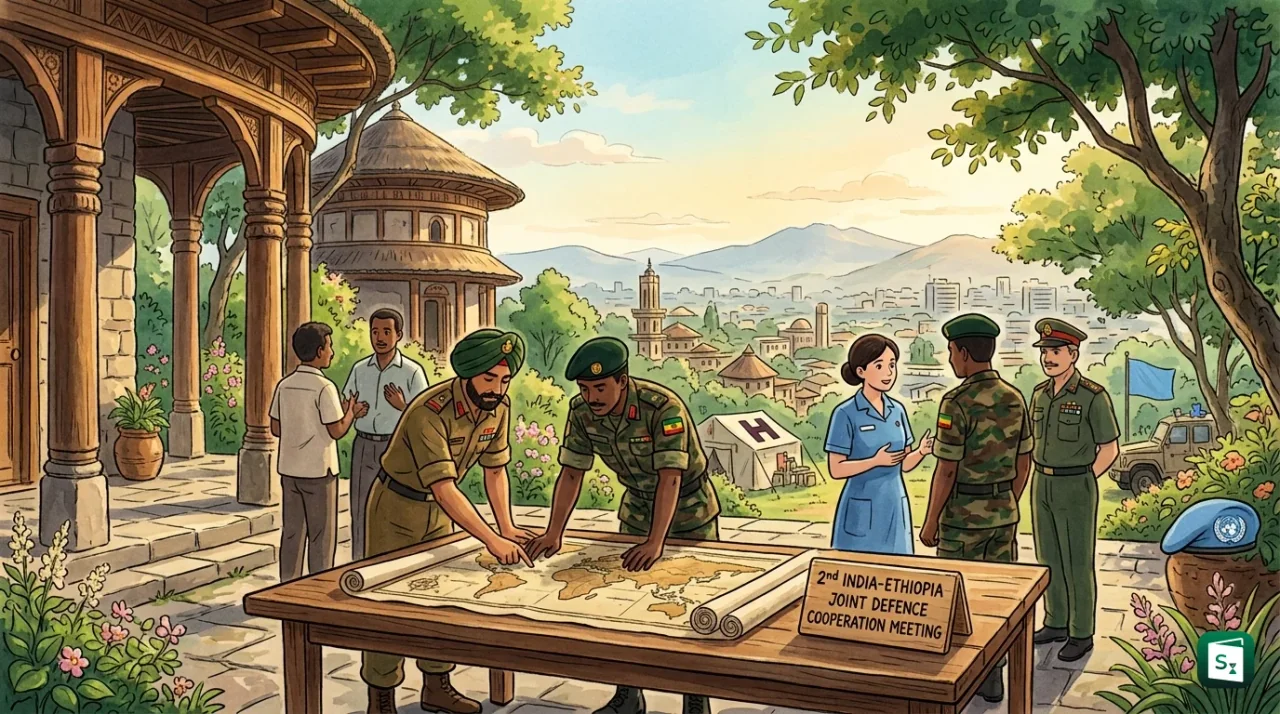
India and Ethiopia held the 2nd Joint Defence Cooperation (JDC) meeting in Addis Ababa on 28 September 2026. The two sides reviewed cooperation in military training, joint exercises, medical cooperation, peacekeeping and defence industries and agreed to deepen it through training exchanges and joint ventures in defence production. The meeting builds on a defence partnership that began in 1958 and was raised to a Strategic Partnership in December 2025.
What Was Decided at the Second Joint Defence Cooperation Meeting?
The 2nd Joint Defence Cooperation meeting took place in Addis Ababa, the capital of Ethiopia, on 28 September 2026. The Indian side was led by Sanjay Kumar, Joint Secretary in the Ministry of Defence. The Ethiopian side was led by Major General Teshome Gemechu, Director General for Defence Foreign Relations and Military Cooperation. Officers from the Department of Defence and Air Headquarters formed part of the Indian delegation, and Devesh Uttam, Ambassador of India to Ethiopia (as of September 2026), also took part in the talks.
The meeting reviewed five main areas of shared interest. These were military training, joint military exercises, medical cooperation between the armed forces, peacekeeping operations, and cooperation in defence industries. A joint military exercise is a planned drill in which the armed forces of two or more countries train together to improve coordination and learn common working methods.
Both sides agreed to expand and deepen cooperation in practical ways. They will increase the exchange of personnel between training institutes, so that officers and instructors from each country can study and teach in the institutions of the other. They will explore joint ventures in defence production, which means Indian and Ethiopian firms working together to make defence equipment. They will also hold more delegation visits and experience sharing interactions, where senior officers discuss field experience and best practices.
| Area of Cooperation | What It Covers |
|---|---|
| Military training | Courses, instructor exchanges and capacity building in military institutions |
| Joint exercises | Combined drills to improve joint working and operational coordination |
| Medical cooperation | Military medicine, health services and medical training for armed forces |
| Peacekeeping | Training and joint preparation for United Nations peacekeeping missions |
| Defence industries | Joint ventures, production and technology sharing in defence manufacturing |
How the Joint Defence Cooperation Mechanism Works
The Joint Defence Cooperation Committee, often shortened to JDC or JDCC, is a formal meeting format between the defence ministries of two countries. It acts as a regular review body that sets targets, tracks progress in existing projects and identifies new areas for work. For India and Ethiopia, the JDC is the main institutional tool to manage the defence relationship.
The India Ethiopia JDC was created under the Defence Cooperation Memorandum of Understanding (MoU) signed in February 2025. A Memorandum of Understanding is a written agreement that records the intent of two sides to work together in specific fields. This MoU was signed on the sidelines of Aero India 2025 by the defence ministers of the two countries. It covers defence industry, joint research and development, cybersecurity, military training and capacity building.
The first JDC meeting was held in New Delhi from 15 to 17 October 2025. It was co-chaired on the Indian side by the Joint Secretary for International Cooperation in the Ministry of Defence and on the Ethiopian side by Major General Teshome Gemechu. That meeting laid the groundwork by reviewing existing training links and discussing wider work in military medicine and defence industry. The second meeting in Addis Ababa on 28 September 2026 carried that process forward by agreeing on deeper training exchanges and possible joint production.
The continuity shows in other recent contacts as well. In early September 2026, Ethiopian Charge d Affaires Nebiyu Tedla met Joint Secretary Amitabh Prasad in New Delhi to discuss training, defence industry collaboration and peacekeeping with a focus on new areas. In May 2026, an Indian military delegation led by Major General Ravroop Singh visited the Ethiopian Defence Peacekeeping Centre and discussed peacekeeping training and counterterrorism methods. In early September 2026, a study group from the National Defence College (NDC), which runs India’s 47-week flagship course in national strategy, also visited Ethiopia.
Where Is Ethiopia and Why Does Its Location Matter?
Where is Ethiopia located in Africa?
Ethiopia is a country in the Horn of Africa in East Africa, lying west of Somalia and sharing land borders with Eritrea, Djibouti, Somalia, Kenya, South Sudan and Sudan. Its capital and largest city is Addis Ababa, which sits almost in the centre of the country and also hosts the headquarters of the African Union.
Ethiopia covers about 1.10 million square kilometres, which makes it the 26th largest country in the world. It is the second most populous country in Africa after Nigeria, with an estimated population of more than 130 million. Addis Ababa, whose name means new flower in the Amharic language, lies at an elevation of about 2,400 metres on the foothills of Mount Entoto. The city is well connected to India, with direct flights linking Addis Ababa to Delhi, Mumbai, Bengaluru, Hyderabad and Chennai.
Is Ethiopia a landlocked country?
Yes, Ethiopia is a landlocked country with zero kilometres of coastline, and it is the most populous landlocked country in the world. It lost its entire Red Sea coastline when Eritrea became formally independent in 1993, so it now depends on ports in neighbours such as Djibouti for sea trade.
Being landlocked shapes both trade costs and security thinking. Ethiopia must move goods through other countries to reach the sea, which raises transport costs and makes port access a strategic issue. This is one reason logistics, maritime awareness and stable regional partnerships matter so much to Addis Ababa, and why cooperation with India on training, peacekeeping and supply chains has added value.
| Basic Fact | Detail |
|---|---|
| Official name | Federal Democratic Republic of Ethiopia |
| Capital | Addis Ababa |
| Location | Horn of Africa, East Africa |
| Area | About 1,104,300 square kilometres |
| Borders | Eritrea, Djibouti, Somalia, Kenya, South Sudan, Sudan |
| Currency | Ethiopian birr (ETB) |
| Time zone | UTC plus 3 hours, about 2.5 hours behind India |
| Population | More than 130 million, second largest in Africa |
| Special status | Member of BRICS since January 2024, host of African Union headquarters |
From 1958 to Strategic Partnership: History of India Ethiopia Ties
India Ethiopia defence ties go back to 1958, when Indian officers began helping to train Ethiopian forces. India also played a role in setting up the Harar Military Academy in Ethiopia in the 1950s. This early training link created a long tradition of classroom and field cooperation that continues through present day exchanges between training institutes.
The wider relationship is even older. Trade links go back more than 2,000 years to the time of the Axumite Empire in the first century, when Indian traders exchanged silk and spices for gold and ivory through the ancient port of Adulis. In the modern era, India established legation level ties in July 1948 after independence and raised them to ambassador level in 1952. Formal diplomatic relations are often dated to 1950. Ethiopia was one of India’s earliest partners in Africa, and the two countries shared common ground in the Non-Aligned Movement. Ethiopia has also supported India’s claim for a permanent seat in a reformed United Nations Security Council.
Economic ties give the defence partnership extra weight. Total bilateral trade stood at $550.19 million in 2024-25, with Indian exports at $476.81 million and imports at $73.38 million. India mainly exports pharmaceuticals, vehicles, machinery, iron and steel products and chemicals, while it imports pulses, oilseeds, spices, leather and gemstones from Ethiopia. More than 675 Indian companies are registered with the Ethiopian Investment Commission, with investments of over $6.5 billion, mainly in manufacturing and pharmaceuticals. Ethiopia benefits from India’s Duty Free Tariff Preference scheme for least developed countries, and the two countries signed a bilateral market access protocol in Geneva on 22 May 2026 as part of Ethiopia’s process of joining the World Trade Organization.
The political high point came during Prime Minister Narendra Modi’s first bilateral visit to Ethiopia on 16 and 17 December 2025. During that visit, the two countries raised the relationship to a Strategic Partnership and signed eight agreements, including cooperation on a data centre and debt restructuring. Modi was also presented with the Great Honor Nishan of Ethiopia, the country’s highest honour. The momentum continued on 12 September 2026, when Modi met Ethiopian Prime Minister Abiy Ahmed Ali in New Delhi on the sidelines of the 18th BRICS Summit and reviewed cooperation in economic ties, defence and security, and capacity building.
India Africa Defence Engagement: The Wider Framework
The Addis Ababa meeting is part of India’s larger plan for working with Africa on defence and security. Two regular platforms guide this work. They are the India Africa Forum Summit for overall political and economic ties and the India Africa Defence Dialogue for defence ties.
The India Africa Forum Summit (IAFS) is the main platform for ties between India and Africa. It was launched in 2008 in New Delhi. The second summit was held in Addis Ababa in 2011, the third in New Delhi in 2015 with all 54 African countries taking part, and the fourth edition was planned around 2026. The summits have announced lines of credit, grants, scholarships and training support, including $10 billion in lines of credit and 50,000 scholarships announced in 2015. Training under the Indian Technical and Economic Cooperation (ITEC) programme, which funds short courses for officials from partner countries, remains a core part of this support.
The India Africa Defence Dialogue (IADD) focuses only on defence. The first India Africa Defence Ministers Conclave was held in Lucknow in February 2020 along with DefExpo 2020 and produced the Lucknow Declaration. The dialogue was then made a regular event every two years along with DefExpo. The second edition was held in Gandhinagar in October 2022 and produced the Gandhinagar Declaration. These declarations call for more training slots, deputation of training teams, joint exercises, maritime security work, counterterrorism cooperation and humanitarian help during disasters. India has also offered fellowships through the Manohar Parrikar Institute for Defence Studies and Analyses (MP-IDSA), a leading New Delhi think tank on strategy and security, to experts from African countries.
Ethiopia fits naturally into this framework. The Ethiopian National Defence Force is one of the largest and most experienced forces in Africa and a regular contributor to United Nations peacekeeping missions, including duties in Somalia and Congo. India is among the largest contributors to United Nations peacekeeping as well. Joint work on peacekeeping training therefore helps both countries prepare better for real missions and builds common working methods for difficult field conditions.
Significance and the Way Forward
For India, closer defence ties with Ethiopia strengthen its presence in the Horn of Africa and the western Indian Ocean region. Ethiopia sits near key sea lanes and crisis zones, and it hosts the African Union in Addis Ababa. A stable and capable Ethiopia helps regional peace, protects trade routes and supports India’s work with the Global South. Defence industry cooperation also matches India’s goal of raising defence exports and building joint production chains instead of simple buyer seller deals.
For Ethiopia, India offers training, affordable technology and a partnership based on shared learning rather than strict conditions. Access to Indian military education, medical systems and manufacturing know-how can help modernise its forces and build local skills. Peacekeeping cooperation is of direct use, since Ethiopian troops serve in demanding United Nations missions where Indian training methods and field experience are widely respected.
The next steps are clear from the official statement. Both sides will move on training institute exchanges, plan delegation visits, share operational experience and study concrete joint venture proposals in defence production. Progress will be reviewed at the next JDC meeting and through related army and air force channels. If these steps stay on schedule, the 1958 training relationship will steadily grow into a fuller defence industry and peacekeeping partnership under the Strategic Partnership framework.
Key Takeaways
- The 2nd Joint Defence Cooperation meeting between India and Ethiopia was held in Addis Ababa on 28 September 2026.
- The meeting was co-chaired by Sanjay Kumar of India and Major General Teshome Gemechu of Ethiopia.
- Cooperation covers military training, joint exercises, medical cooperation, peacekeeping and defence industries, with focus on joint ventures in defence production.
- The JDC mechanism was created under the Defence Cooperation MoU signed in February 2025, with the first meeting held in New Delhi in October 2025.
- India Ethiopia defence ties began in 1958 and were raised to a Strategic Partnership in December 2025.
- Ethiopia is a landlocked country in the Horn of Africa with capital Addis Ababa and currency Ethiopian birr, and it became a BRICS member in January 2024.