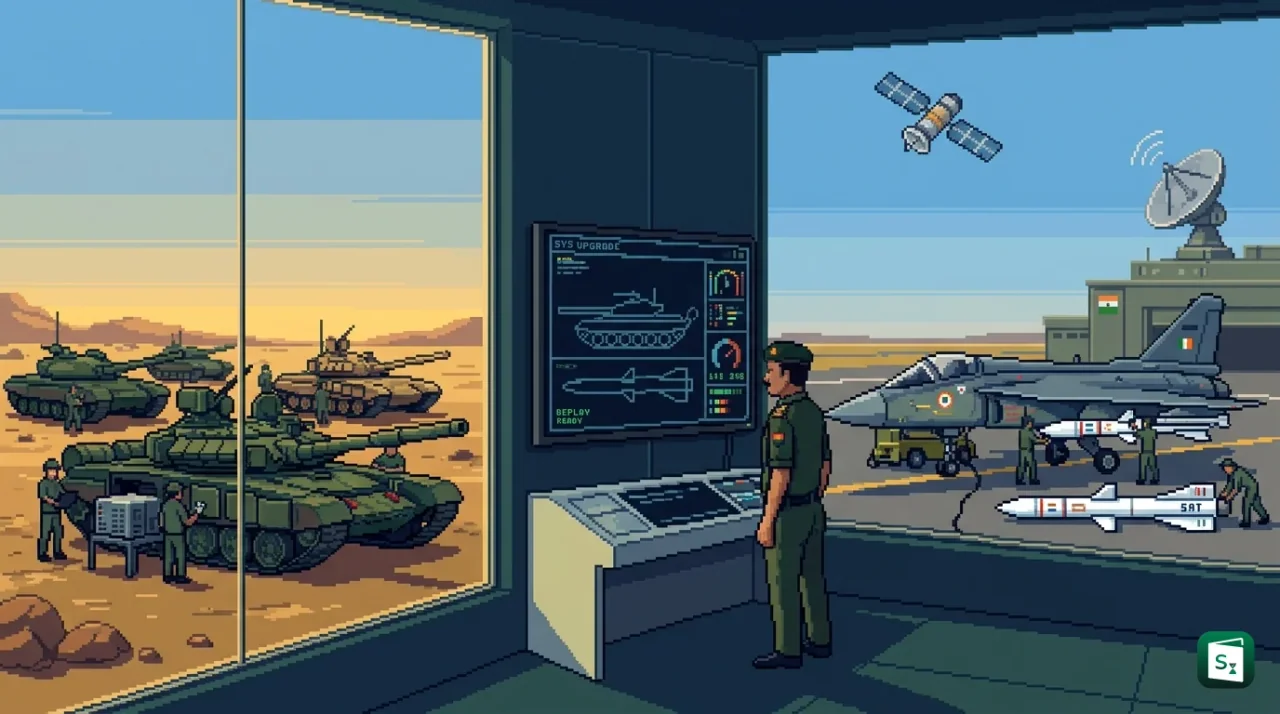
The Ministry of Defence signed two indigenous defence contracts in September 2026, one for the Army and one for the Air Force. On 21 September 2026, the Ministry signed a ₹586 crore deal with Accurate Industrial Controls for 3,257 Auxiliary Power Units for T-72 and T-90 tanks. On 23 September 2026, the Ministry signed a ₹810.79 crore deal with Bharat Dynamics Limited for 160 Satellite Smart Anti Airfield Weapons for the Indian Air Force.
Two Defence Contracts Signed in September 2026
The Ministry of Defence completed both contracts in New Delhi in the presence of Defence Secretary Rajesh Kumar Singh (as of September 2026). The first contract was signed on 21 September 2026 with Accurate Industrial Controls Private Limited. The second contract was signed on 23 September 2026 with Bharat Dynamics Limited (BDL), a public sector company under the Ministry of Defence.
The two deals cover different services and needs. The Auxiliary Power Unit (APU) deal supports the ground fleet of the Indian Army. The Satellite Smart Anti Airfield Weapon (SAT-SAAW) deal adds a precision strike weapon to the Indian Air Force. Both deals use only domestic design and production routes.
| Feature | Tank APU Contract | SAT-SAAW Contract |
|---|---|---|
| Signing date | 21 September 2026 | 23 September 2026 |
| Supplier | Accurate Industrial Controls Private Limited | Bharat Dynamics Limited |
| Quantity | 3,257 units | 160 weapons with associated equipment |
| Total value | ₹586 crore | ₹810.79 crore |
| User service | Indian Army | Indian Air Force |
| Platform | T-72 and T-90 tanks | Jaguar, Hawk and Su-30 MKI aircraft |
| Delivery plan | To be inducted into mechanised formations | Scheduled between 2027-2028 and 2028-2029 |
What Is an APU in Tanks and How Does It Work?
An Auxiliary Power Unit in a tank is a secondary engine that produces electric power for key systems without running the main engine. The Ministry of Defence states that tank APUs power the fire control system, firing circuit, gun stabilisation system and other ancillaries during silent watch and stationary deployment.
An Auxiliary Power Unit (APU) is a compact generator fitted inside or on an armoured vehicle. In simple terms, it works like a small inverter generator for a house. The main tank engine is very large and burns a lot of fuel. The APU is much smaller and uses only a small amount of fuel to make electricity for electronics and weapons control.
This matters in battle because tanks often wait in one position for long hours for observation or ambush. If the crew keeps the main engine on, the tank makes loud noise and gives out a large heat signal. The enemy can detect both easily. The APU allows the crew to switch off the main engine and still keep the gun systems, sights and radios fully active. This state is called silent watch.
The Ministry of Defence has said that the induction of indigenously developed APUs will strengthen the operational readiness, reliability and sustainability of mechanised formations. In practical terms, this means tanks can stay deployed longer, need less fuel supply and face fewer breakdowns of electrical systems.
T-72 Ajeya and T-90 Bhishma: The Army Tank Fleet
The Indian Army uses the T-72 Ajeya and the T-90 Bhishma as its main battle tanks. Ajeya means unconquerable in Sanskrit. Bhishma is named after the guardian warrior in the Mahabharata. Both tanks are of Russian and Soviet origin but are now largely built and maintained in India at the Heavy Vehicles Factory at Avadi in Tamil Nadu.
The T-72 entered Indian service in the late 1970s as a replacement for older Centurion and Vijayanta tanks. India later produced the T-72M1 version under licence as the Ajeya Mk1 and Mk2. The Army holds an estimated 1,800 to 2,400 T-72 tanks, many of which are now being upgraded with new sights and systems to serve till around 2040.
The T-90S Bhishma was ordered after 2001 to counter modern threats and to add heavier protection and firepower. The tank weighs 46.5 tonnes and uses a 1,000 horsepower V-92S2 diesel engine with a top speed of about 60 km per hour. The crew has three members, the commander, the gunner and the driver, helped by an automatic loader for the 125 mm smoothbore gun. In May 2026, the factory at Avadi delivered the 1,000th indigenously manufactured T-90 with more than 90 percent domestic content.
| Feature | T-72 Ajeya | T-90 Bhishma |
|---|---|---|
| Origin | Soviet Union design, licence built in India | Russian design, licence built in India |
| Role in Army | Older workhorse, large numbers for plains and deserts | Frontline backbone, more than 1,000 in service |
| Main gun | 125 mm smoothbore gun | 125 mm smoothbore gun with missile firing ability |
| Weight and mobility | About 41 to 42 tonnes, diesel engine | 46.5 tonnes, 1,000 horsepower engine |
| Current plan | Partial upgrade to extend life, 96 tanks fitted with new thermal sights | 464 upgraded Mk III tanks ordered, deliveries from 2024 |
The order for 3,257 APUs matches the scale of this combined fleet. It shows that the Army wants a common power unit solution for both tank types rather than separate imports for each type.
What Is the Smart Anti Airfield Weapon?
The Smart Anti Airfield Weapon is an Indian precision guided glide bomb designed to destroy enemy airfield targets from a distance. The Defence Research and Development Organisation states that the 125 kg weapon strikes runways, bunkers and radars up to 100 km away without exposing the aircraft to danger.
SAAW stands for Smart Anti Airfield Weapon. It is a long range, standoff, precision air to surface weapon. Standoff means the pilot can release the bomb far away from the target and turn back safely. The bomb then glides to the target on its own using foldable wings and satellite guidance. This keeps the aircraft outside the range of most enemy air defence guns and short range missiles.
The SAT-SAAW is the satellite navigation version of this weapon. SAT stands for satellite. It uses an inertial navigation system guided by GPS and NavIC. NavIC is the Navigation with Indian Constellation, the Indian regional satellite navigation system operated by the Indian Space Research Organisation. The production version has an accuracy of less than seven metres with satellite guidance and less than three metres when fitted with a seeker.
| Specification | Detail |
|---|---|
| Full name | Satellite Smart Anti Airfield Weapon |
| Type | Air to ground precision guided glide bomb |
| Weight and size | 125 kg, length 1.85 metres |
| Range | 90 to 100 km depending on release height and speed |
| Warhead | High explosive and penetration warhead, about 80 kg, for runways and bunkers |
| Targets | Runways, taxiways, hangars, reinforced bunkers, radar sites |
| Launch platforms | Jaguar, Hawk and Su-30 MKI |
| Guidance | Satellite navigation with inertial system, future electro optical seeker option |
The weapon was designed and developed by the Defence Research and Development Organisation (DRDO), mainly by the Research Centre Imarat (RCI) in Hyderabad. The SAAW project was approved in 2013 as the first fully indigenous anti airfield weapon. It was first tested in 2016 from Jaguar and Su-30 aircraft and later from the Hawk-i jet. By January 2021, the DRDO had completed nine successful trials, including tests off the Odisha coast and at Chandan range in Rajasthan.
Bharat Dynamics Limited and the SAT-SAAW Supply Chain
The Ministry of Defence has placed the SAT-SAAW order with Bharat Dynamics Limited (BDL). BDL stands for Bharat Dynamics Limited. It was incorporated on 16 July 1970 as a public sector company under the Ministry of Defence and is headquartered in Hyderabad, Telangana. BDL was created to build guided missiles in India and served as the prime production agency for the Integrated Guided Missile Development Programme.
BDL now works as a weapon system integrator for the armed forces. Its product list includes the Akash surface to air missile system, the Astra beyond visual range air to air missile, anti tank guided missiles such as Milan-2T, Konkurs-M and Nag, and underwater weapons such as light weight and heavy weight torpedoes built at Visakhapatnam. BDL has units at Hyderabad, Bhanur and Ibrahimpatnam in Telangana and at Visakhapatnam in Andhra Pradesh, with a new unit planned at Amravati in Maharashtra.
The SAT-SAAW system will have 60 percent indigenous content. The Ministry has specifically listed three indigenised sub systems as part of this push. These are the Inertial Measurement Unit which senses movement and direction, the Long Impact Delay Fuse which lets the warhead pierce concrete before exploding, and the Twin Store Carrier which allows one aircraft pylon to carry multiple bombs. A Su-30 MKI can carry 20 to 32 SAAW bombs using a four round Smart Quad Rack, so a small number of aircraft can damage a large airfield in one strike.
The delivery of the 160 weapons is scheduled between 2027-2028 and 2028-2029. The associated equipment in the contract covers ground handling, mission planning and storage systems needed by the Indian Air Force to use the weapon safely.
Make in India Link: Make-II and Buy IDDM Route
Both contracts use domestic procurement routes that give first priority to Indian design. The APU contract is a product of the Make-II procedure. Make-II stands for industry led research and development. Under this route, Indian companies build a prototype with their own money without government funding. If the prototype passes Army trials, the Ministry places a production order. The Ministry has said that this APU order shows how this system can convert local innovation into bulk supply.
The SAT-SAAW contract was placed under the Buy Indian IDDM category. IDDM stands for Indigenously Designed, Developed and Manufactured. This is the top priority category under the defence purchase rules. It requires the product to be designed in India with a high share of domestic parts. The Army had issued an expression of interest for 3,257 APUs for T-72M1 and T-90S tanks after an approval in October 2019. The SAT-SAAW award now follows the same logic of replacing imports with home built systems.
The Ministry has linked both deals to the vision of Viksit Bharat 2047 and Aatmanirbhar Bharat, which means a developed and self reliant India. The practical benefit is a stronger local supply chain of small firms, startups and component makers for tank sub systems and guided weapons. This reduces dependence on foreign spares, shortens repair time and keeps maintenance skills inside the country.
Why These Deals Matter for Army and Air Force Readiness
The Ministry of Defence has said that the APU induction will improve the readiness of mechanised formations. Mechanised formations are the armoured regiments and mechanised infantry battalions that move and fight in tanks and combat vehicles. India fields more than 60 such armoured regiments with T-90, T-72 and Arjun tanks. When electrical systems get steady power without engine strain, tanks can hold positions longer in deserts and high altitude areas, fire accurately at night and stay linked by radio.
The SAT-SAAW induction will help the Indian Air Force continue its own operations while stopping enemy air activity. In any conflict, airfields are among the first targets because aircraft need runways to take off. A weapon that can crater runways, break taxiways, destroy hangars and hit radar sites from 100 km away allows India to shut down an enemy airbase at the start of operations. Because the launch aircraft stays far away, the risk to pilots and costly fighter jets is low.
Together, the two contracts show a clear pattern. The Army is securing the mobility and endurance of its existing tank fleet while the future tank project develops. The Air Force is adding low cost, high volume precision weapons that can be used in large numbers. Both moves lower import needs and build a domestic base for the next cycle of upgrades.
Key Takeaways
- The Ministry of Defence signed a ₹586 crore contract on 21 September 2026 for 3,257 Auxiliary Power Units for T-72 and T-90 tanks.
- The Ministry of Defence signed a ₹810.79 crore contract on 23 September 2026 for 160 SAT-SAAW weapons with Bharat Dynamics Limited for the Indian Air Force.
- An Auxiliary Power Unit powers the fire control system, firing circuit and gun stabilisation system without running the main tank engine.
- The Smart Anti Airfield Weapon is a 125 kg glide bomb with a 90 to 100 km range that targets runways, hangars and radars.
- SAT-SAAW was designed by DRDO’s Research Centre Imarat in Hyderabad and can be launched from Jaguar, Hawk and Su-30 MKI aircraft.
- Bharat Dynamics Limited, incorporated on 16 July 1970 and headquartered in Hyderabad, will deliver SAT-SAAW between 2027-2028 and 2028-2029 with 60 percent indigenous content.