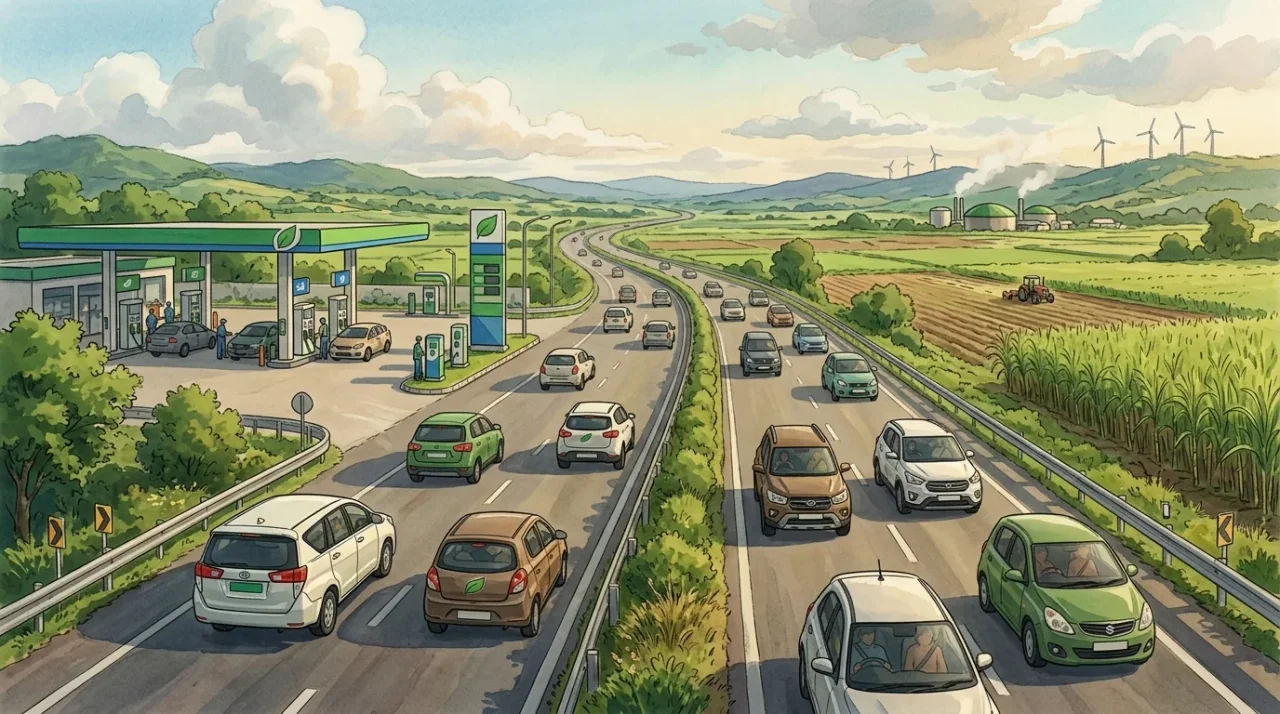
The Ministry of Power has notified the Corporate Average Fuel Economy (CAFE)-III norms for passenger vehicles, which will apply from 1 April 2027 to 31 March 2032. The rules tighten the fleet average fuel target from 3.996 litres per 100 km to 3.3273 litres per 100 km while giving clear relief for E20 petrol, flex fuel, CNG and electric vehicles. This five year framework will shape how carmakers balance mileage, ethanol blending and clean technologies in India.
What Is CAFE-III Norms in India?
The CAFE-III norms are fleet level fuel efficiency standards for passenger vehicles in India for 2027 to 2032. They limit the sales weighted average petrol equivalent fuel use and carbon dioxide emissions of each maker. The Ministry of Power notified the norms and the Bureau of Energy Efficiency administers compliance.
Corporate Average Fuel Economy means the average fuel use of all eligible cars sold by one maker in a year. It does not require every model to meet the same number. A maker can sell some heavier or less efficient models if the overall sales mix stays within the allowed average. This fleet approach rewards makers that sell more efficient, hybrid, gas based and electric models.
The norms apply to M1 category motor vehicles manufactured or imported for sale in India. M1 means a motor vehicle with at least four wheels used to carry passengers, with not more than eight seats in addition to the driver seat and with gross vehicle weight not exceeding 3,500 kg under the Central Motor Vehicles Rules, 1989. In practice this covers hatchbacks, sedans, sport utility vehicles and multi purpose vehicles. Invalid carriages, special purpose vehicles and vehicles exempted from type approval are kept outside the scope.
The institutional roles are clearly divided. The Ministry of Power notifies the standards under the Energy Conservation Act, 2001. The Bureau of Energy Efficiency (BEE), established in 2002 under the same Act and functioning under the Ministry of Power from New Delhi, handles the credit system and compliance assessment. The Ministry of Road Transport and Highways (MoRTH) enforces testing, reporting methods, conformity of production and calculation of carbon neutrality and technology concessions under the Central Motor Vehicles Rules.
CAFE-III builds on two earlier phases. CAFE-I operated from 2017-18 to 2021-22 with an industry benchmark around 130 grams of CO2 per km. CAFE-II began in 2022-23 with a benchmark around 113 grams per km and a reference weight of 1,082 kg. All major makers met the early targets. CAFE-III replaces the existing norms from 1 April 2027 and moves to year wise tightening instead of a single flat target for five years.
Fuel Consumption Benchmarks From 2027 to 2032
The heart of CAFE-III is a progressively stricter fuel use ceiling for each maker. At the reference weight of 1,229 kg, the allowed average falls from 3.996 litres per 100 km in 2027-28 to 3.3273 litres per 100 km in 2031-32. This is an efficiency gain of about 16.7 percent over five years. In carbon terms this equals a fall from about 94.8 grams of CO2 per km to about 78.9 grams per km.
Each maker gets its own target based on the average weight of the cars it sells. The formula is Annual Average Fuel Consumption Standard equals a multiplied by (W minus b) plus c. Here W is the sales weighted average unladen mass in kg, b is the fixed reference weight of 1,229 kg, a is the yearly slope and c is the yearly base target. A heavier sales mix gives a slightly higher allowance, while a lighter sales mix must meet a stricter number.
| Financial year | Base target c in litres per 100 km | CO2 equivalent in grams per km | Slope a |
|---|---|---|---|
| 2027-28 | 3.9960 | 94.8 | 0.00158 |
| 2028-29 | 3.8600 | 91.5 | 0.00152 |
| 2029-30 | 3.7585 | 89.1 | 0.00148 |
| 2030-31 | 3.5313 | 83.7 | 0.00139 |
| 2031-32 | 3.3273 | 78.9 | 0.00131 |
The reference weight has been raised from 1,082 kg to 1,229 kg, a rise of about 13.6 percent. The increase reflects the growing share of heavier sport utility vehicles in India. The slope has also been flattened compared with earlier drafts. This gives lighter fleets relatively more headroom and makes targets tougher for very heavy fleets. For example, a fleet averaging 909 kg faces about 82.8 grams per km in 2027-28, while a fleet averaging 1,400 kg is allowed about 101.2 grams per km in the same year.
All targets are measured in petrol equivalent litres per 100 km on the Modified Indian Driving Cycle (MIDC), which is the present laboratory driving cycle for type approval in India. Fuel use of each model is derived from its approved tailpipe CO2 figure. One gram of CO2 per km equals 0.04217 litres per 100 km for petrol, and diesel, LPG, CNG and electricity figures are converted to petrol equivalent using fixed factors. From 1 April 2027, makers must declare CO2 for every model on both MIDC and the Worldwide Harmonised Light Vehicles Test Procedure (WLTP), which is a global laboratory cycle that reflects real driving more closely. The factor for shifting the CAFE target from MIDC to WLTP will be notified separately after studying the reported data.
Carbon Neutrality Factors for E20, Flex Fuel and CNG Vehicles
A flex fuel vehicle means a vehicle that can run on petrol or on a high blend of petrol and ethanol up to 85 percent ethanol (E85) or even 100 percent ethanol (E100). A standard E20 fuel means petrol blended with 20 percent ethanol. E85 is a high ethanol fuel with about 80 to 85 percent ethanol and the rest petrol, meant only for specially designed flex fuel vehicles. These fuels matter because ethanol comes mainly from sugarcane, maize, damaged foodgrains and other biomass, so part of the carbon released from the exhaust is treated as part of a natural cycle.
India has scaled up ethanol blending at speed. Blending rose from less than 1.5 percent in 2013-14 to 20 percent in 2025-26, meeting the national target five years ahead of schedule under the Ethanol Blended Petrol Programme. Ethanol procurement grew from about 38 crore litres to more than 1,000 crore litres, while production capacity rose from about 421 crore litres in 2014 to about 2,000 crore litres in 2026. The roadmap was guided by NITI Aayog and the National Policy on Biofuels, 2018, which was amended in 2022 to advance the E20 deadline and widen feedstocks. E85 retail pilots began in June 2026 from 48 outlets, with plans to reach about 500 outlets by December 2026 and about 5,000 outlets by December 2027.
CAFE-III recognises this shift through Carbon Neutrality Factors (CNF). A Carbon Neutrality Factor is a fixed percentage cut applied to the declared tailpipe CO2 of a model before fleet averaging. It rewards fuels with lower lifecycle carbon without changing the laboratory emission test itself.
| Vehicle fuel type | Carbon Neutrality Factor on declared CO2 |
|---|---|
| Petrol approved for E20 or higher blends, including strong hybrids and plug in hybrids | 8 percent |
| Flex fuel ethanol vehicles, including flex fuel strong hybrids | 22.3 percent |
| CNG vehicles | 5 percent or notified Compressed Biogas blending percentage, whichever is higher |
| Diesel vehicles | Notified biofuel blending percentage as specified by the petroleum ministry |
The effect is direct. A petrol car declared at 100 grams per km and approved for E20 counts as 92 grams per km. The same car as a flex fuel ethanol model counts as about 77.7 grams per km. A CNG car declared at 100 grams counts as 95 grams, and the benefit will rise if the notified Compressed Biogas (CBG) blending share crosses 5 percent. CBG is purified biogas from waste and biomass with properties similar to CNG. Its blending in city gas is being raised in steps to 5 percent by 2028-29 under the SATAT initiative, launched in 2018, and the GOBARdhan programme for waste to energy.
Super Credits and Fuel Saving Technologies
CAFE-III gives extra weight to cleaner powertrains through volume derogation factors, also called super credits. A super credit allows one clean vehicle to be counted as more than one vehicle while calculating the fleet average. This pulls the average down and helps makers that sell more electric and hybrid models.
| Vehicle technology | Volume factor for fleet counting |
|---|---|
| Battery electric vehicles and range extended electric vehicles | 3.0 |
| Plug in hybrids and flex fuel strong hybrids | 2.5 |
| Strong hybrids | 1.6 |
| Flex fuel ethanol vehicles | 1.1 |
A battery electric vehicle (BEV) runs only on a battery charged from external power. A range extended electric vehicle (REEV) is mainly driven by an electric motor with a small engine to extend range. A plug in hybrid (PHEV) has both an engine and a larger battery that can be charged externally. A strong hybrid (SHEV) pairs an engine with a motor and battery but cannot be plugged in, while a mild hybrid only assists the engine. Under the factors, 10,000 battery electric cars count as 30,000 cars in the average, while 10,000 flex fuel cars count as 11,000 cars. Hydrogen fuel cell vehicles have been kept outside this benefit structure.
The second compliance route is technology credit. The list of recognised fuel saving technologies has grown from 4 to 12. The eligible set includes automatic start stop, tyre pressure monitoring, regenerative braking, transmissions with six or more speeds, efficient 12 volt or 48 volt alternators, mild hybrid motor generators, exterior LED lighting, advanced glazing, electric water pumps, pulse width modulation controlled radiator fans, high efficiency air conditioning and solar reflective paint. Each approved technology gives a concession of 1 gram of CO2 per km, subject to a cap of 9 grams per km per maker per year. The full cap equals a fuel benefit of about 0.3795 litres per 100 km. During the first compliance block makers will claim these benefits on self declaration, while from the second block they must support claims with validated test results under procedures set by MoRTH.
Compliance, Pooling and Penalties
The Ministry of Power will judge each maker every year, but final action will be taken block wise. A maker that beats its allowed average earns credits. A maker that exceeds the limit builds debits. Both are recorded in a maker specific passbook as grams of CO2 per km multiplied by units sold. Credits and debits can be carried forward within a block, while unused credits lapse at the end of the block. The five year period is split into a three year block from 2027-28 to 2029-30 and a two year block from 2030-31 to 2031-32.
Makers have three flexible routes to close a gap. They can use carried forward credits from a better year in the same block. They can form a pool with up to three makers, where the pool is treated as one maker for compliance and a nominated pool manager handles reporting and any penalty. A maker can join only one pool in a reporting year. They can also trade surplus credits with another maker on mutually agreed terms or buy credits from BEE to clear debits.
| Financial year | Buyout price per gram of CO2 per km |
|---|---|
| 2027-28 | ₹2,500 |
| 2028-29 | ₹3,000 |
| 2029-30 | ₹3,500 |
| 2030-31 | ₹4,000 |
| 2031-32 | ₹4,500 |
The yearly calendar is fixed. The designated testing agency compiles maker data and reports to BEE by 30 September of the assessment year. Trading and BEE buyouts are allowed only in a 30 day window from 1 to 31 October. The final passbook reaches BEE before 30 November. Makers must also file state wise sales data each year. Makers that make or import fewer than 1,000 eligible vehicles in a year are treated as small volume makers. They are exempt from meeting the specific target but must still report average fuel use. Any failure at the end of a block is dealt with under Sections 26 to 28 of the Energy Conservation Act, 2001, which provide for penalties for non compliance with energy consumption standards.
Why CAFE-III Matters for Industry and Small Cars
The most debated part of CAFE-III was the treatment of small cars. An earlier draft had proposed a direct cut of 3 grams of CO2 per km for small petrol cars weighing up to 909 kg with engines up to 1,200 cc and length below four metres. That fixed concession has been removed in the final notification after sharp differences within the industry. Makers of lighter small cars supported special relief, while makers with heavier sport utility portfolios opposed it.
The final rules help lighter cars through the formula itself rather than a separate quota. The flatter slope and higher reference weight give lighter fleets more headroom. A fleet averaging 909 kg now gets about 9 percent more allowance in 2027-28 and nearly 17 percent more in 2031-32 compared with the September 2025 draft curve. In practical terms the small car target for that weight moves from about 54.1 grams per km under the old draft with concession to about 63.7 grams per km without a separate concession but on an easier curve. Heavier fleets around 1,800 kg face slightly tighter numbers than before.
It helps to separate CAFE from emission standards for pollutants. Bharat Stage VI (BS6) norms, in force from 1 April 2020, set per vehicle limits for pollutants such as carbon monoxide, hydrocarbons, nitrogen oxides and particulate matter. CAFE norms set a sales average limit for fuel use and carbon dioxide. A car must meet BS6 to be sold at all, while CAFE judges the maker on the combined average of everything sold. The two systems work together, one for clean air in each street and the other for lower fuel use and carbon across the fleet.
The stakes are large. Transport uses a major share of imported crude. Ethanol blending alone has already saved more than ₹1.84 lakh crore in foreign exchange and replaced about 302 lakh metric tonnes of crude. BEE estimates that CAFE action saved about 6.9 million tonnes of CO2 between 2017-18 and 2022-23. Tighter mileage, wider use of E20 and flex fuel models, growth of CNG and biogas blending, and faster adoption of electric and hybrid models together support energy security, cleaner city air and the long term goal of net zero by 2070. The next steps to watch are the separate WLTP conversion factor, the roadmap beyond E20 toward higher blends, expansion of E85 outlets and CBG supply, and how makers use pooling and trading to manage costs.
Key Takeaways
- The Ministry of Power notified CAFE-III norms for M1 passenger vehicles for the period 1 April 2027 to 31 March 2032.
- The fleet fuel benchmark tightens from 3.996 litres per 100 km in 2027-28 to 3.3273 litres per 100 km in 2031-32, a gain of about 16.7 percent.
- The reference weight for target calculation rises from 1,082 kg to 1,229 kg, with no separate small car concession in the final rules.
- Carbon Neutrality Factors grant 8 percent relief for E20 and higher petrol blends, 22.3 percent for flex fuel ethanol vehicles, and 5 percent or notified CBG share for CNG vehicles.
- Battery electric and range extended vehicles get a 3.0 super credit, while recognised fuel saving technologies rise from 4 to 12 with up to 9 grams per km credit.
- Compliance runs in 3 year and 2 year blocks with pooling up to three makers, credit trading and BEE buyouts priced from ₹2,500 to ₹4,500 per gram per km.