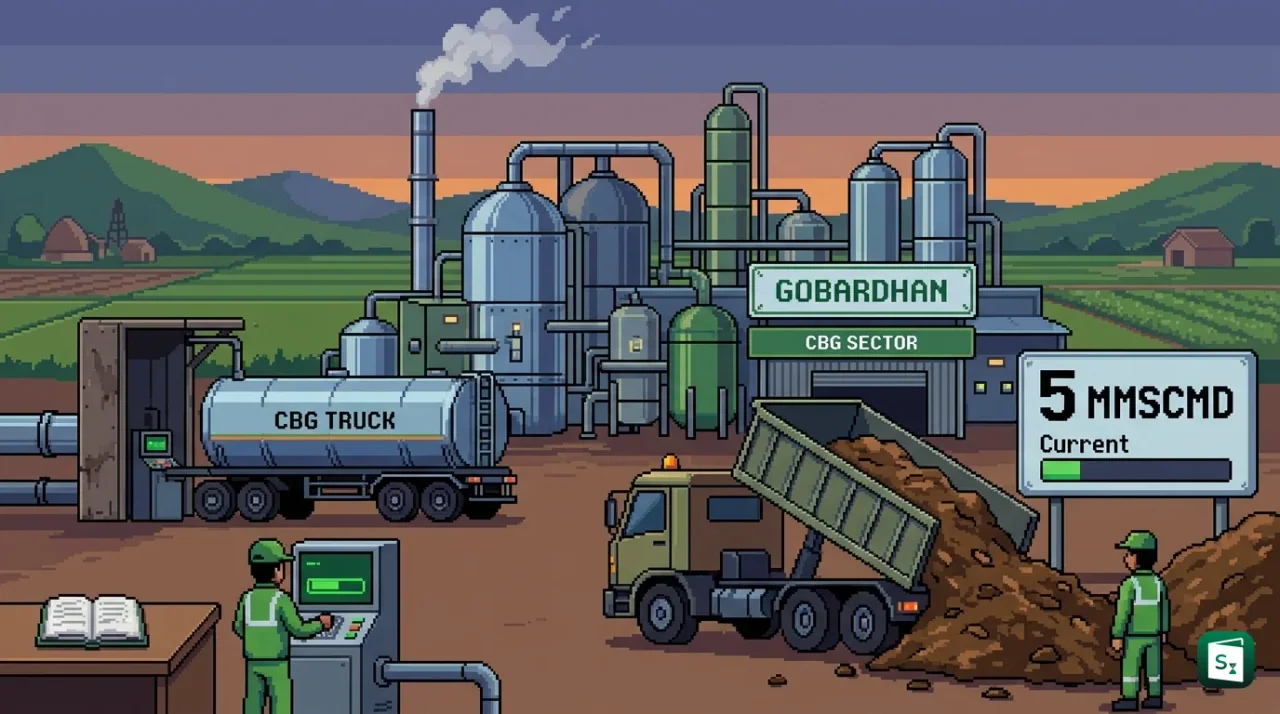
Union Minister for Petroleum and Natural Gas Hardeep Singh Puri launched the GOBARdhan Central Sector Scheme for Compressed Biogas (CBG) on 1 October 2026 at Bharat Mandapam in New Delhi. The scheme, approved by the Union Cabinet on 6 August 2026 with an outlay of ₹23,731 crore for FY27 to FY36, aims to raise domestic CBG output nearly tenfold to 5 MMSCMD. It promises assured purchase, stable prices and capital help to turn farm waste and cattle dung into income, clean fuel and fewer imports.
What Is the GOBARdhan Scheme?
The GOBARdhan Scheme is a Central Sector Scheme called the National Circular Bioenergy Scheme to build a complete market for Compressed Biogas in India. The word GOBARdhan stands for Galvanizing Organic Bio-Agro Resources Dhan and signals wealth from cattle dung, farm residue and other organic waste. The scheme runs for ten years from FY27 to FY36 with full central funding of ₹23,731 crore.
A Central Sector Scheme is fully funded and guided by the central government, unlike schemes where states share the cost. GOBARdhan follows this model. The Ministry of Petroleum and Natural Gas administers the new scheme and brings the full CBG value chain onto one platform. That chain covers feedstock collection, gas production, pipeline transport, sale of gas and sale of organic manure.
The core idea is waste to wealth through a circular economy. Agricultural residue, cattle dung, press mud from sugar mills, food waste, municipal organic waste and sewage sludge become inputs for clean fuel. The same process also gives Fermented Organic Manure (FOM) and liquid manure for farms. So one plant produces both energy and soil nutrients while cutting dumping, burning and methane release from rotting waste.
When Was GOBARdhan Launched and Which Ministry Implements It?
The Union Cabinet chaired by Prime Minister Narendra Modi approved the new GOBARdhan Central Sector Scheme on 6 August 2026. The Ministry of Petroleum and Natural Gas issued operational guidelines on 15 September 2026, gave effect to the scheme from 1 September 2026 and formally launched it on 1 October 2026 through Minister Hardeep Singh Puri.
The Ministry of Petroleum and Natural Gas is the nodal ministry for the new scheme. This is a clear shift from the earlier arrangement. The original GOBAR-Dhan initiative was launched in April 2018 as part of the Swachh Bharat Mission (Grameen) for village cleanliness and solid and liquid waste management. The Department of Drinking Water and Sanitation under the Ministry of Jal Shakti coordinated that umbrella effort, with the Ministry of New and Renewable Energy, the Department of Animal Husbandry and Dairying and other departments running their own parts.
The CBG part of that work was spread across four ministries. The government has now placed the full CBG programme under one ministry to speed up decisions, keep one portal and one handbook, and give investors and lenders a single point of contact. The older village biogas and sanitation work continues under its own system, while the ₹23,731 crore CBG mission moves under the petroleum ministry.
What Is Compressed Biogas and How Is It Different From Biogas?
Compressed Biogas, called CBG or Bio-CNG in India, is purified biogas that has been compressed at high pressure for use as fuel. The Ministry of Road Transport and Highways permits CBG as an automotive fuel, and CBG with more than 90% methane works in the same vehicles, pipelines and stoves that use Compressed Natural Gas, with no engine change needed.
Raw biogas forms when bacteria break down organic matter without oxygen. This breakdown is called anaerobic digestion. Raw biogas has only 55 to 65% methane and 30 to 40% carbon dioxide, plus hydrogen sulphide, moisture and other impurities. It burns with a low calorific value of about 19.5 MJ per kg and can corrode engines.
CBG makers clean this gas. They remove carbon dioxide, hydrogen sulphide and water using methods such as water scrubbing, pressure swing adsorption and membrane separation. They then press the clean methane to about 200 to 250 bar and store it in cylinders or feed it into gas pipelines. Yes, biogas can be compressed after this cleaning, and that cleaned and pressed gas is CBG.
| Feature | Raw Biogas | Compressed Biogas (CBG) |
|---|---|---|
| Methane content | 55 to 65% | More than 90% |
| Carbon dioxide | 30 to 40% | Less than 4% |
| Hydrogen sulphide | 0.1 to 4% | Less than 16 ppm |
| Moisture | 1 to 2% | Near zero |
| Calorific value | About 19.5 MJ per kg | 47 to 52 MJ per kg |
| Quality rule | No fuel standard | Must meet BIS IS 16087:2016 |
CBG has clear end uses. It can run cars, buses, trucks and tractors as a direct replacement for CNG. It can join city gas networks for piped cooking gas in homes and for commercial kitchens. Industry can burn it for heat in place of natural gas. It can also generate power and, through steam reforming, serve as a feedstock for green hydrogen. Each CBG plant also gives solid and liquid organic manure that can reduce the use of chemical fertilisers.
Six Pillars of the GOBARdhan Central Sector Scheme
The GOBARdhan Central Sector Scheme joins six kinds of support into one framework. The aim is to fix the three problems producers raised for years, which are uncertain demand, unstable prices and high upfront cost. The six parts cover purchase, price, capital help, pipelines, loans and local innovation.
| Pillar | What the Government Will Do |
|---|---|
| CBG Offtake Assurance | City Gas Distribution entities will buy CBG to meet the CBG blending obligation |
| CBG Pricing Framework | Administered price of ₹2,110 per MMBtu with long term visibility till at least March 2036 |
| Capital Assistance | Upfront help for greenfield and brownfield CBG plants and allied equipment |
| Pipeline Infrastructure | Help to link plants and clusters to trunk pipelines and city gas networks |
| Credit Guarantee Support | Cover for term loans to MSME CBG projects through NCGTC |
| CBG Ecosystem Challenge Fund | Help for district plans, feedstock mapping, technology and manure value addition |
Offtake assurance turns the blending rule into real demand. City gas companies must meet a CBG obligation of 3% in FY27, 4% in FY28 and 5% from FY29 onwards in the CNG transport and PNG domestic segments. Every plant will be linked to a buyer through the city gas network or a trunk pipeline, including through the extended CBG-CGD synchronisation arrangement with GAIL. In FY26, CBG sales in these two segments reached 1.05% against a target of 1%, and oil marketing companies bought about 96,500 tonnes of CBG, more than twice the FY25 level.
The pricing framework gives a government backed administered price of ₹2,110 per MMBtu, equal to about ₹98 per kg. The price will hold for a minimum ten year horizon. The government has said this level is about 30% higher than prevailing global prices and equal to about 20 to 21 dollars per MMBtu. The design protects households from sudden shocks through budget support and a market based cost sharing method, while giving producers steady revenue to plan loans and expansion.
GOBARdhan Scheme Subsidy and CBG Plant Cost
Capital assistance under GOBARdhan lowers the heavy first cost of a CBG plant. Eligible greenfield projects can receive up to ₹2 crore per tonne per day (TPD) of installed CBG capacity. The help is not limited to the digester and gas cleaning unit. It also covers feedstock aggregation machines, Fermented Organic Manure and Liquid Fermented Organic Manure processing units and manure value addition equipment.
Brownfield expansion also qualifies. Additional capacity built with fresh investment can receive support at 50% of the greenfield rate, within project ceilings. Existing biogas units that are upgraded to make CBG can receive ₹0.60 crore per TPD, subject to a cap of ₹5 crore per project, while the overall ceiling per project across the two main capital parts is ₹30 crore. The detailed operational guidelines issued in September 2026 fix the exact eligibility, timelines and documents for each case.
Pipeline help tackles evacuation, which is the cost of moving gas from the plant to the buyer. The scheme will fund up to 80% of eligible capital cost for pipelines that connect a CBG cluster to a trunk pipeline network. Standalone plants that connect to a city gas network can receive up to 50% of eligible capital cost. This support builds on the earlier Development of Pipeline Infrastructure scheme of ₹994.50 crore, under which 19 plants were already linked by pipeline.
Credit help targets small producers. The National Credit Guarantee Trustee Company will manage a fund with an outlay of ₹625 crore. The fund will cover 85% of the term loan for new MSME CBG projects, up to ₹20 crore per project and up to ₹25 crore for women led MSMEs. Loans can run up to 15 years with an 18 month moratorium, and lenders cannot seek collateral on the guaranteed part. The window stays open till 31 December 2030 or till guaranteed loans reach ₹15,000 crore.
Unified GOBARdhan Portal and GOBARdhan Handbook
The Unified GOBARdhan Portal is the single digital window for the scheme. Any person or company that runs a biogas, CBG or Bio-CNG plant, or plans to set one up, can register on the portal and obtain a registration number. That number is needed to seek benefits from the government. The portal brings applications, tracking, plant location data and payment steps onto one system, which reduces the need to approach several ministries separately.
The portal already shows the scale of interest. As on 6 August 2026, a total of 1,908 CBG and Bio-CNG plants were registered. Of these, 217 plants were commissioned with an installed capacity of more than 1,700 tonnes per day, equal to about 0.4 MMSCMD, while 339 plants were under construction. The portal also adds GIS mapping to help planners link plants with feedstock areas, city gas networks and trunk pipelines.
The GOBARdhan Handbook, also released on 1 October 2026, is the ready guide for producers, banks, cooperatives and local officials. It explains the six components, eligibility rules, application steps, technical standards and manure value chain in simple form. Together, the portal and handbook aim to make the ten year scheme transparent and predictable for a first time rural entrepreneur as well as a large private investor.
From SATAT to GOBARdhan: How the CBG Ecosystem Has Grown
The new scheme builds on the Sustainable Alternative Towards Affordable Transportation (SATAT) initiative. The petroleum ministry launched SATAT on 1 October 2018 to set up CBG plants and to ask oil and gas marketing companies to buy the gas for use as auto and industrial fuel. SATAT set a bold goal of 5,000 plants and 15 million tonnes of CBG by 2023, with long term purchase deals at a floor price that was later held at ₹46 per kg till March 2029.
Progress was slow in the early years. Only 58 plants were working by March 2023, and about 188 plants were working by January 2026 against 1,550 registrations at that time. Feedstock collection, high plant cost, weak pipeline links and uneven purchase of manure held back growth. The government added support in steps. These steps included Market Development Assistance for organic manure, the Biomass Aggregation Machinery scheme of ₹564.75 crore for straw collection machines, the pipeline infrastructure scheme and Central Financial Assistance under the National Bioenergy Programme of the Ministry of New and Renewable Energy, which was established in 1992 and is headquartered in New Delhi.
GOBARdhan collects these scattered supports into one national plan. The Budget announcement of 2023 for 500 new waste to wealth plants, including 200 CBG plants with an investment of ₹10,000 crore, and the later phased CBG blending mandate from FY26, set the stage. The new ten year framework now gives the same producer assured demand, a fixed price, capital help, a pipeline link and a loan cover together, instead of one help at a time.
Why GOBARdhan Matters: Energy Security, Economy and Environment
India meets nearly 50% of its natural gas need through imports (as of August 2026). The import bill for liquefied natural gas was about $15.2 billion in FY25. A large share of this gas passes through the Strait of Hormuz, which carries 55 to 60% of Indian LNG imports and has seen repeated disruptions. Home grown CBG can replace part of this imported gas because it is chemically similar to natural gas and fits into the same pipelines, city gas networks and vehicles.
The government expects strong economic returns over the ten year period. Domestic CBG output is to rise from 0.4 MMSCMD to around 5 MMSCMD. Clean gas will displace about 10 million tonnes of fossil fuel. Forex savings are placed at more than ₹40,000 crore. The CBG industry is expected to add more than ₹75,000 crore to GDP and create more than 1.5 lakh jobs across feedstock supply, transport, plant operation and manure sales. The Indian Biogas Association has said that even 1,500 working plants could cut the gas import bill by about $5 billion.
Rural incomes and farming gain directly. Paddy straw that is now burnt in several northern states can be baled and sold to plants. Cattle dung can earn dairy farmers a second income. The scheme is expected to produce about 250 million tonnes of organic fertiliser over the period, which can supplement chemical fertilisers and cut part of the fertiliser import bill that stood near $18 billion in FY25. Cleaner waste handling will also cut more than 40 million tonnes of carbon dioxide emissions. Minister Puri summed up this shift by saying farmers will move from being food givers to also being energy givers.
The Way Forward
The next test is ground level delivery. The petroleum ministry will need to ensure that city gas companies actually buy the full obligated share and that the ₹2,110 per MMBtu price reaches producers on time. Pipeline links for clusters and standalone plants must move fast, because gas without evacuation cannot earn revenue. Banks will need to use the 85% cover to lend to small developers and build a repayment record that makes CBG a normal infrastructure asset.
The CBG Ecosystem Challenge Fund will support the softer links. It will fund feedstock mapping, biomass aggregation, district level CBG plans, technology suited to Indian straw and dung, better plant operation, manure enrichment and training of operators and technicians. Success will also depend on sale of manure. If FOM and liquid manure gain trust among farmers and fetch a fair price, plant incomes will stabilise. If CBG scales as planned, it will help India raise the share of natural gas in its energy mix to 15% by 2030 from about 6 to 7% at present and support the wider goals of energy security and self reliance.
Key Takeaways
- GOBARdhan stands for Galvanizing Organic Bio-Agro Resources Dhan and is the National Circular Bioenergy Scheme, a Central Sector Scheme run by the Ministry of Petroleum and Natural Gas.
- The Union Cabinet approved the scheme on 6 August 2026 with an outlay of ₹23,731 crore for FY27 to FY36, and Minister Hardeep Singh Puri launched it on 1 October 2026 with the Unified Portal and Handbook.
- The scheme targets nearly tenfold growth in CBG output from 0.4 MMSCMD to 5 MMSCMD to replace about 10 million tonnes of fossil fuel.
- Producers get an administered CBG price of ₹2,110 per MMBtu for ten years and assured purchase linked to a blending obligation of 3% in FY27, 4% in FY28 and 5% from FY29 in CNG transport and PNG domestic supply.
- Eligible greenfield plants get capital help up to ₹2 crore per TPD, while MSME projects get 85% credit guarantee up to ₹20 crore through NCGTC.
- The programme is expected to save over ₹40,000 crore in forex, add over ₹75,000 crore to GDP, create over 1.5 lakh jobs, cut over 40 MT of CO2 and produce 250 MMT of organic fertiliser.