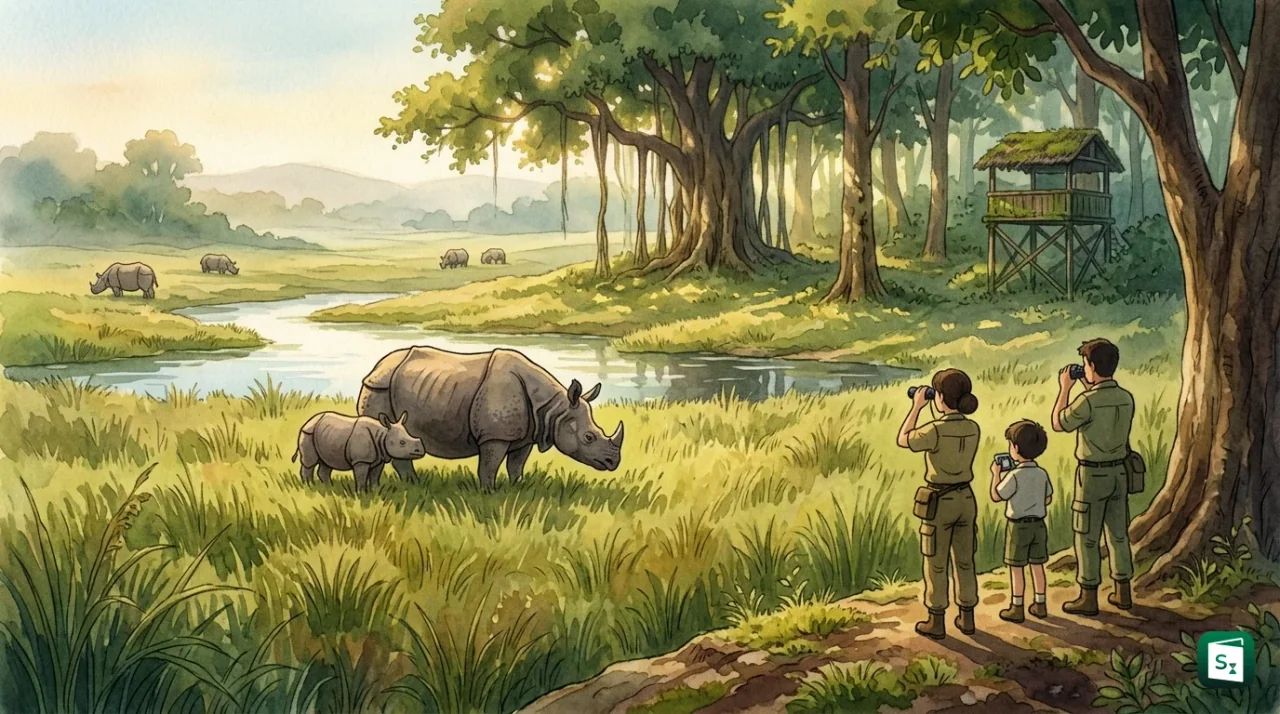
World Rhino Day is observed across the world on 22 September every year to draw attention to the protection of the five surviving rhinoceros species. The 2026 observance placed a special focus on India, where the greater one-horned rhinoceros has recovered to 4,075 animals globally, with Assam sheltering nearly 80 percent of them. On the same day, the Prime Minister announced Project Rhino, a new central support programme for rhino range states.
What Is World Rhino Day?
World Rhino Day is an annual global observance held on 22 September to celebrate rhinoceroses and to build public support for their protection. It brings together forest departments, conservation groups, zoos, schools and local communities to spread awareness about habitat loss, poaching and falling rhino numbers. The day also raises funds and volunteer support for field protection, monitoring and community programmes in Africa and Asia.
The observance covers all five surviving rhino species, three in Asia and two in Africa. Zoos and parks mark the day with guided walks, classroom projects, poster displays and fundraising events. In India, the focus falls mainly on the greater one-horned rhinoceros (Rhinoceros unicornis), the country’s largest rhino species, and on Assam’s Kaziranga landscape which holds most of the world population.
When Is World Rhino Day and How Did It Begin?
World Rhino Day is celebrated on 22 September every year. The date is fixed, so the day falls on the same calendar date each year to keep global campaigns aligned.
The idea was first announced by WWF-South Africa in 2010. WWF, the Worldwide Fund for Nature, is a global conservation body founded in 1961 and headquartered in Gland, Switzerland. Its South Africa office proposed a dedicated day to draw attention to rising rhino poaching. The proposal grew into a worldwide campaign in 2011 after Lisa Jane Campbell of Chishakwe Ranch in Zimbabwe joined hands with Rhishja Cota, founder of the conservation group Annamiticus. Campbell was already planning events for September 2011 and contacted Cota after finding her work online. Together they shaped the day as a celebration of all five species, both online and through field events.
Early observances focused on South Africa, home to most of the world’s white and black rhinos. Peaceful gatherings, school activities and fundraisers outside parks and in cities called for stronger action against horn trade. Since then the network has widened to include Asian range countries such as India, Nepal and Indonesia, along with zoos and wildlife groups across Europe and North America.
What Are the Five Rhino Species?
The world has five surviving rhino species. They are the white rhino, black rhino, greater one-horned rhino, Javan rhino and Sumatran rhino found across Africa and Asia in grasslands, floodplains and dense tropical forests.
Fewer than 27,000 rhinos remain in the wild (as of September 2026). Three of the five species are listed as Critically Endangered on the IUCN Red List of Threatened Species. IUCN, the International Union for Conservation of Nature, is a global body headquartered in Gland, Switzerland that assesses extinction risk. The table below gives a clear picture of each species.
| Species | Scientific Name | Main Range | Estimated Population | IUCN Status |
|---|---|---|---|---|
| White rhino | Ceratotherium simum | Southern Africa, mainly South Africa | 15,752 | Near Threatened |
| Black rhino | Diceros bicornis | Eastern and southern Africa | 6,788 | Critically Endangered |
| Greater one-horned rhino | Rhinoceros unicornis | India and Nepal | 4,075 | Vulnerable |
| Javan rhino | Rhinoceros sondaicus | Ujung Kulon National Park, Java, Indonesia | 50 | Critically Endangered |
| Sumatran rhino | Dicerorhinus sumatrensis | Sumatra and Kalimantan, Indonesia | 34 to 47 | Critically Endangered |
The white rhino is the most numerous species. Its numbers fell from more than 21,000 in 2012 to about 15,942 in 2021 due to heavy poaching, rose to 17,464 in 2023 and then dropped again to 15,752 at the end of 2024. The black rhino has recovered from a low of about 2,300 in the mid 1990s to 6,788, after falling from nearly 100,000 in 1960. One subspecies, the western black rhino, was declared extinct in 2011.
The Asian picture is mixed. The greater one-horned rhino has grown from fewer than 200 in the early 1900s to more than 4,000 today. The Javan and Sumatran rhinos face a far sharper crisis. Only one wild population of Javan rhinos survives in a single park. Poaching gangs killed an estimated 18 to 26 Javan rhinos between 2019 and 2023, cutting the population by about one third. Sumatran rhinos have fallen from nearly 300 in 2000 to fewer than 50, with habitat loss for palm oil and paper pulp adding to poaching pressure.
Where Are Rhinos Found in India?
The greater one-horned rhino in India lives mainly in the floodplains of the Brahmaputra and in the Terai grasslands. Assam holds the core population, while smaller populations live in West Bengal, Uttar Pradesh and Bihar.
India holds 3,323 greater one-horned rhinos, while Nepal holds 752, taking the global total to 4,075. Assam alone holds 3,260 animals, or nearly 80 percent of the world total. Kaziranga National Park in Assam holds more than 2,600 rhinos, which is over two thirds of the global population. Kaziranga is a UNESCO World Heritage Site since 1985 and a Tiger Reserve since 2007. It was first notified as a reserve forest in 1905 to save the rhino when only about twenty pairs remained.
Other key homes in Assam include Orang National Park with 125 rhinos, Pobitora Wildlife Sanctuary with 107 rhinos and Manas National Park with more than 50 rhinos. Manas had lost almost all its rhinos during the unrest of the 1990s and has been rebuilt through translocation from Kaziranga. In West Bengal, Jaldapara National Park reported growth of 44 rhinos in its 2025 survey and Gorumara National Park added nine animals. In Uttar Pradesh, the reintroduced herd in Dudhwa National Park now counts about 50 rhinos. Rhinos have also returned to parts of Bihar’s Valmiki landscape.
This heavy concentration in one park creates risk. Floods, disease or a sudden rise in poaching in Kaziranga could affect most of the species at once. The Brahmaputra floods renew grasslands each year but can also kill animals and push them toward highways and villages. That is why managers now speak of a meta population approach, where Kaziranga, Orang, Manas, Pobitora and Laokhowa Burhachapori function as one connected network rather than isolated pockets.
What Is Rhino Poaching and Why Does Horn Trade Persist?
Rhino poaching means the illegal killing or drugging of a rhino to cut off its horn. Poachers often use high calibre guns, traps or tranquiliser darts, remove the horn and leave the animal to bleed to death. The horn is then moved through criminal networks to foreign markets.
Rhino horn is made of keratin, the same protein found in human hair and nails. It has no proven medicinal value. Demand survives because of false beliefs about cures and because carved horn products such as bangles, dagger handles and display pieces serve as symbols of wealth. This myth at the root of the crisis is a central message of World Rhino Day campaigns.
All five rhino species are listed in the appendices of CITES, the Convention on International Trade in Endangered Species of Wild Fauna and Flora. CITES is a global agreement signed in 1973 and in force since 1975 that controls cross border trade in wild plants and animals. Commercial international trade in rhino horn is prohibited. In India, the greater one-horned rhino is also protected under Schedule I of the Wildlife (Protection) Act, 1972, which gives it the highest level of legal protection.
Enforcement has tightened in recent years. The CITES Rhinoceros Enforcement Task Force met in Pretoria in May 2025 with officers from 21 countries to plan joint action against poaching gangs. African records show 516 poaching incidents in 2024, with more than 81 percent reported from South Africa. In Indonesia, police secured convictions with prison terms up to 12 years against a gang that killed Javan rhinos in Ujung Kulon. Global seizure data for 2021 to 2023 shows an estimated 676 to 853 horns entering illegal trade each year.
Rhino Conservation in India: From Indian Rhino Vision 2020 to Project Rhino
India’s recovery rests on decades of strict field protection, habitat expansion and movement of animals to new homes. Kaziranga’s rise from a few dozen animals in 1908 to more than 2,600 today shows what steady guarding, local support and legal action can achieve.
The Indian Rhino Vision 2020, launched in 2005, set a goal of 3,000 rhinos in Assam by 2020 spread across at least seven protected areas. It was run by the Assam Forest Department with WWF India, the International Rhino Foundation and the United States Fish and Wildlife Service. The main tool was wild to wild translocation, which means capturing rhinos in Kaziranga or Pobitora and releasing them in parks where numbers had fallen. Between 2008 and 2021, 22 rhinos were moved to Manas. The programme closed in April 2021 after Assam crossed the 3,000 mark and Manas gained a breeding herd.
The next stage is Indian Rhino Vision 2.0, which aims for 4,500 to 5,000 rhinos in Assam by 2030 held in at least three connected meta populations. The plan proposes moving ten rhinos to Manas to improve genetic health and about twenty rhinos to Laokhowa and Burhachapori over two to three years. It also links Orang, Burhachapori, Laokhowa and Kaziranga into a single landscape of about 1,600 square kilometres along the Brahmaputra.
On 22 September 2026, the central government initiated Project Rhino to give financial and technical support to range states for protection, habitat management, genetic improvement and study of population trends. The focus states include Assam, West Bengal, Bihar and Uttar Pradesh. Key tasks include stronger surveillance, grassland restoration, corridor safety during floods and genetic monitoring to prevent inbreeding. A forensic tool called RhoDIS India, the Rhino DNA Index System anchored at the Wildlife Institute of India in Dehradun, builds a DNA profile for individual rhinos. It helps match a seized horn to a specific poached animal and guides which animals to move for healthy breeding.
Results are visible. Assam recorded zero known poaching in 2022, the first such year since the 1970s, and repeated zero poaching in 2025. Manas has recorded zero poaching of rhinos and tigers for three straight years. In the mid 2010s Assam lost nearly 30 rhinos in a single year. Better intelligence, joint police and forest task forces, drones, dog squads and fast track courts have cut that toll sharply. The destruction of 2,479 seized horns in Assam sent a clear signal that stockpiles will not return to trade.
Key Takeaways
- World Rhino Day is observed on 22 September every year and was first announced by WWF-South Africa in 2010.
- The first global celebration in 2011 was shaped by Lisa Jane Campbell and Rhishja Cota to cover all five rhino species.
- Fewer than 27,000 rhinos remain in the wild, with white, black, greater one-horned, Javan and Sumatran as the five surviving species.
- The greater one-horned rhino numbers 4,075 globally, with 3,260 in Assam and over 2,600 in Kaziranga National Park.
- Kaziranga National Park, a UNESCO World Heritage Site since 1985, holds more than two thirds of the world’s greater one-horned rhinos.
- Project Rhino, initiated on 22 September 2026, gives central support to range states for protection, habitat management and genetic monitoring.