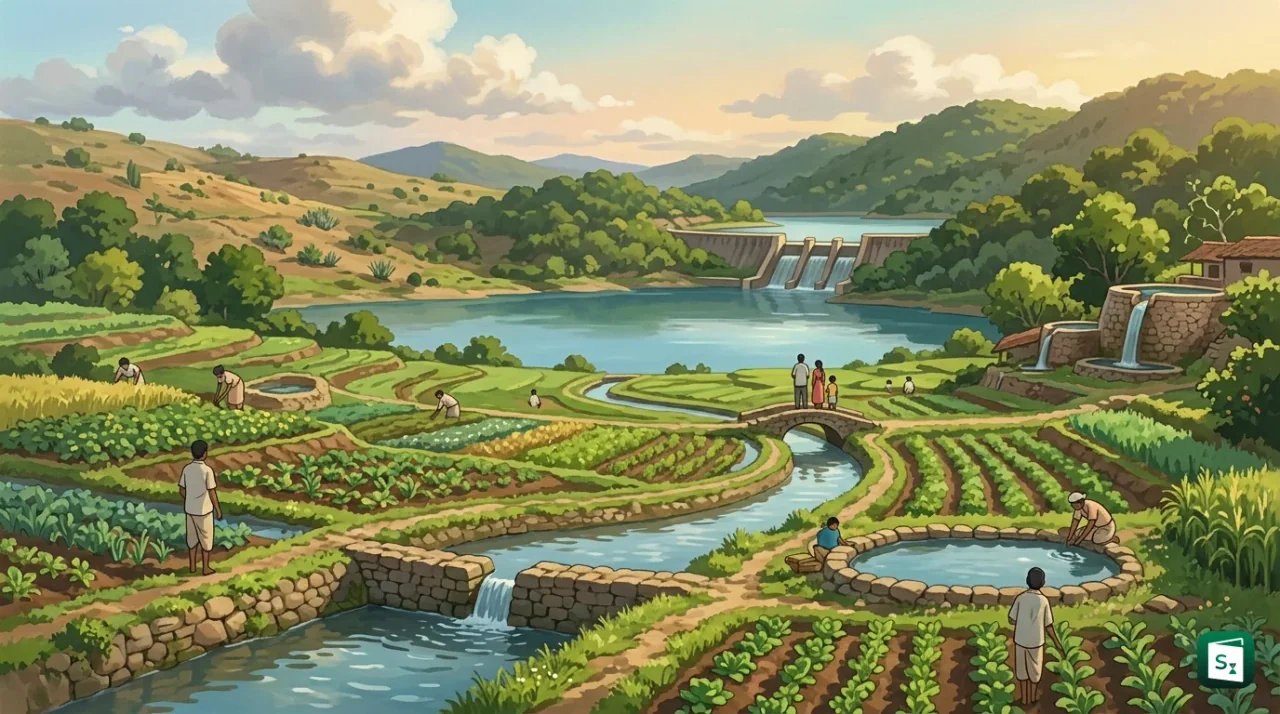
The 9th India International Water Week 2026 was held from 22 to 26 September 2026 at Bharat Mandapam in New Delhi on the theme Climate Resilient Water Management. Organised by the Ministry of Jal Shakti, the event was inaugurated by Vice President C. P. Radhakrishnan and brought together 7,224 delegates and 227 exhibitors from India and abroad. It was the first edition to use the title India International Water Week, signalling a shift from a national event to a global platform for water cooperation.
What Is India International Water Week and When Was the 2026 Edition Held?
The India International Water Week is India’s flagship global conference and exhibition on water resources. The 9th edition, known as IIWW 2026, was held from 22 to 26 September 2026 at the Convention Centre and Hall No. 14 of Bharat Mandapam, Pragati Maidan, New Delhi on the theme Climate Resilient Water Management.
Climate resilient water management means planning and running water systems in a way that they can face floods, droughts, erratic rainfall and rising demand without breaking down. The systems must be able to predict risks, adjust during stress and recover quickly after extreme events. This idea shaped every discussion at IIWW 2026, from village ponds to large dams and city supply networks.
The structure of IIWW 2026 was spread over five days. The conference and exhibition ran from 22 to 25 September, followed by field visits and study tours on 26 September. The exhibition covered about 7,000 square metres in Hall No. 14 and gave companies, start-ups, research institutes and government agencies space to show new products and solutions. Union Jal Shakti Minister C. R. Patil had launched the event’s brochure and website on 22 April 2026 at Shram Shakti Bhavan in New Delhi, and registrations for delegates and exhibitors were handled through the portal indiawaterweek.in.
How the Event Evolved Since 2012
India’s international water event was first conceptualised in 2012 as India Water Week. The aim was to create a regular forum where policy makers, scientists, industry and communities could discuss water scarcity, share technology and shape sustainable use. The Ministry of Jal Shakti now describes it as a multidisciplinary platform for dialogue, knowledge sharing and business partnerships.
Eight editions were held under the name India Water Week in 2012, 2013, 2015, 2016, 2017, 2019, 2022 and 2024. Each edition carried a specific focus that tracked India’s changing water priorities, from food and energy linkages to equity and cooperation. The 8th edition in 2024 was held from 17 to 20 September at Bharat Mandapam on the theme Partnerships and Cooperation for Inclusive Water Development and Management, and it was inaugurated by President Droupadi Murmu.
| Edition | Year and Dates | Theme |
|---|---|---|
| 1st | 10 to 14 April 2012 | Water, Energy and Food Security: Call for Solutions |
| 2nd | 2013 | Efficient Water Management: Challenges and Opportunities |
| 3rd | 2015 | Water Management for Sustainable Development |
| 4th | 2016 | Water for All: Striving Together |
| 5th | 2017 | Water and Energy for Inclusive Growth |
| 6th | 2019 | Water Cooperation: Coping with 21st Century Challenges |
| 7th | 1 to 5 November 2022 | Water Security for Sustainable Development with Equity |
| 8th | 17 to 20 September 2024 | Partnerships and Cooperation for Inclusive Water Development and Management |
| 9th | 22 to 26 September 2026 | Climate Resilient Water Management |
The 2026 edition marks an important change in branding. Earlier editions used the short name India Water Week. From 2026, the official title became India International Water Week, or IIWW. The change reflects wider foreign participation, with around 150 countries invited, country forums, and partner country arrangements. The Netherlands and German Cooperation joined as partner countries in 2026, and participation finally reached 7,224 delegates, higher than the expected 5,000.
Who Organises the Event
The Ministry of Jal Shakti organises the India International Water Week. The Ministry of Jal Shakti was formed in May 2019 by merging the Ministry of Water Resources, River Development and Ganga Rejuvenation with the Ministry of Drinking Water and Sanitation. It works through two departments, the Department of Water Resources, River Development and Ganga Rejuvenation and the Department of Drinking Water and Sanitation. The Ministry is headquartered in New Delhi at Shram Shakti Bhavan and is headed by Cabinet Minister C. R. Patil (as of September 2026).
The Department of Water Resources, River Development and Ganga Rejuvenation acts as the nodal arm for the conference. It is supported by its attached and subordinate bodies such as the Central Water Commission, the Central Ground Water Board, the National Institute of Hydrology at Roorkee, the Central Water and Power Research Station at Pune and the National Mission for Clean Ganga. Central ministries, state governments, research institutions, industry bodies and international organisations join as partners. For IIWW 2026, about six central ministries and 14 states and Union Territories joined as partners, and 84 central ministries and departments and 36 states and Union Territories were invited.
The conference design shows this joint working. IIWW 2026 hosted 49 sessions that included a Ministerial Plenary, a Global Water Leaders Plenary, a Water Leaders Forum, a Country Forum, a Practitioners Forum, a Thematic Forum, a Youth Forum and a Start-up Forum. Special sessions brought in ministries, young professionals, school children, non-governmental groups and case studies of success from the field.
Seven Sub Themes Under Climate Resilient Water Management
The central theme of IIWW 2026 was broken into seven sub themes for the Thematic Forum. These sub themes guided the call for papers, panel talks and the final recommendations. They cover rules, sharing, people, risks, money, ecology and human needs in one frame.
| Sub Theme | What It Covers |
|---|---|
| Inclusive and Equitable Water Governance | Fair rules, clear rights and stronger local bodies for sharing water within and across states |
| Collaboration for Optimal Use of Water Resources | Joint work among states, sectors and countries to get more value from every drop |
| Technology and Community for Water Security | Remote sensing, GIS, sensors, artificial intelligence and village participation working together |
| Water in Climate Related Risk | Flood and drought forecasts, early warning, glacial lake monitoring and erratic rainfall studies |
| Innovative Financing Models for Water Infrastructure and Modernisation | Public private partnerships, private capital and new funds for dams, canals and city networks |
| Sustainable Water Resources Management | Groundwater recharge, wetland care, reservoir care and river basin planning |
| Water for People and Planet | Safe drinking water, sanitation and healthy ecosystems for present and future generations |
The choice of climate resilience as the main theme fits recent Indian experience. Erratic monsoon rainfall, urban floods, prolonged dry spells and rapid groundwater use have raised pressure on dams, cities and farms. Annual groundwater recharge in India rose from 432 billion cubic metres in 2017 to 448.52 billion cubic metres in 2025, but distribution remains uneven across regions. The sub themes therefore link science with finance and community action, so that plans can move from reports to working projects on the ground.
What Happened at IIWW 2026 in New Delhi
The Ministry of Jal Shakti opened IIWW 2026 on 22 September 2026 at Bharat Mandapam. Vice President C. P. Radhakrishnan led the inauguration in the presence of Union Minister C. R. Patil, Ministers of State V. Somanna and Raj Bhushan Choudhary, senior secretaries and ambassadors from partner nations. The Vice President called for integrated water management through innovation and collective action and underlined the role of river linking to handle differences in rainfall across time and regions.
The Ministerial Plenary on Country Perspectives on Climate Resilient Water Management set the tone for moving from relief after disasters to readiness before them. The debate covered climate informed dams and canals, flood and drought control, digital hydrology, early warning systems, nature based solutions and water use efficiency. India shared its cooperation with Venezuela, the Netherlands and Denmark and with bodies such as the World Bank. The message was to move from only sharing knowledge to creating knowledge together.
Practical outcomes were visible on the sidelines. A bilateral meeting between India and the Netherlands led to two tripartite memorandums for the Kalpasar project of the Gujarat government. One memorandum linked the Central Water Commission and Gujarat with Deltares of the Netherlands for technical support on planning and design. The second linked the same Indian agencies with TU Delft for capacity building and training. A Country Forum on joint Indo Danish solutions explored urban flooding, storm water control, drones, robotics and digital decision tools.
The scale of participation set a new record for the event. The organisers reported 7,224 delegates, 227 exhibitors and 119 paper presentations. A parallel Second International WASH Conference ran from 22 to 24 September under the Department of Drinking Water and Sanitation. WASH stands for Water, Sanitation and Hygiene. The WASH meet focused on sustaining rural water supply, community roles, digital tools and steady institutions. The valedictory session on 25 September was chaired by C. R. Patil and presented a brief report with recommendations on participatory governance, reuse of treated wastewater, data driven rules, groundwater recharge, multi hazard warning and river basin methods.
Policy Backing: National Water Mission and Flagship Programmes
The National Water Mission gives the policy base for IIWW. The National Water Mission is one of the eight missions under the National Action Plan on Climate Change, which was released in 2008. The Mission document was approved in 2011. Its main goal is conservation of water, reduction of wastage and fair sharing across and within states through integrated management.
The Mission works through five clear goals. The first is a full water database in the public domain and study of climate impact on water. The second is action by citizens and states for conservation. The third is special care for stressed and over exploited blocks. The fourth is a rise in water use efficiency by 20 percent. The fifth is basin level planning, which means managing each river from source to sea as one unit. The Mission also backs the National Water Mission Awards for excellence in saving and managing water.
IIWW 2026 linked these goals to live programmes. The Jal Jeevan Mission, launched in 2019, now reports tap water in about 81.5 percent of rural homes. The Vice President noted that in Jharkhand rural tap coverage rose from about 7 percent to 37 percent during his tenure as Governor. Other programmes cited at the event included the Pradhan Mantri Krishi Sinchayee Yojana for field irrigation, Atal Bhujal Yojana for community groundwater care, Namami Gange for river cleaning, Jal Shakti Abhiyan: Catch the Rain, Mission Amrit Sarovar, Jal Sanchay Jan Bhagidari, the Ken Betwa river link, the Dam Rehabilitation and Improvement Project and the National Hydrology Project. Together they show how India is trying to join central funding, state action and village participation in one chain.
How Is India Water Week Different From World Water Day and World Water Week?
Readers often mix three similar names. They differ in organiser, timing and purpose. A clear comparison helps avoid errors in recall.
World Water Day is celebrated on 22 March every year. It has been a United Nations observance since 1993 and is coordinated by UN Water. The 2026 campaign is called Where water flows, equality grows and focuses on water and gender. The campaign is led by UNICEF and UN Women and supports Sustainable Development Goal 6 on safe water and sanitation for all.
World Water Week is a separate global meet held in Stockholm and organised by the Stockholm International Water Institute, which is known as SIWI. The 2026 edition is scheduled for 23 to 27 August 2026 on the theme Water for People and Progress. It draws policy makers, firms and civil groups from many nations. Other editions such as the Singapore International Water Week and Cairo Water Week run on their own cycles.
| Event | Organiser | Dates in 2026 | Theme in 2026 |
|---|---|---|---|
| India International Water Week | Ministry of Jal Shakti, India | 22 to 26 September, New Delhi | Climate Resilient Water Management |
| World Water Day | UN Water | 22 March, global | Where water flows, equality grows (Water and Gender) |
| World Water Week | Stockholm International Water Institute (SIWI) | 23 to 27 August, Stockholm | Water for People and Progress |
India Water Week is therefore a multi day conference and exhibition hosted by India, World Water Day is a one day global awareness day fixed on 22 March, and World Water Week is Sweden’s annual global water conference in August. India’s event feeds into the same global aim of water security but through India’s own schemes, river systems and community models.
Key Takeaways
- The 9th India International Water Week 2026 was held from 22 to 26 September 2026 at Bharat Mandapam, New Delhi on the theme Climate Resilient Water Management.
- The event was organised by the Ministry of Jal Shakti, which was formed in May 2019, and inaugurated by Vice President C. P. Radhakrishnan.
- India’s water event was first conceptualised as India Water Week in 2012, and 2026 was the first edition branded as India International Water Week.
- IIWW 2026 recorded 7,224 delegates, 227 exhibitors and 119 papers across 49 sessions and seven sub themes.
- The National Water Mission, approved in 2011 under the National Action Plan on Climate Change, targets a 20 percent rise in water use efficiency.
- World Water Day is observed every year on 22 March, while World Water Week 2026 was held from 23 to 27 August in Stockholm by SIWI.