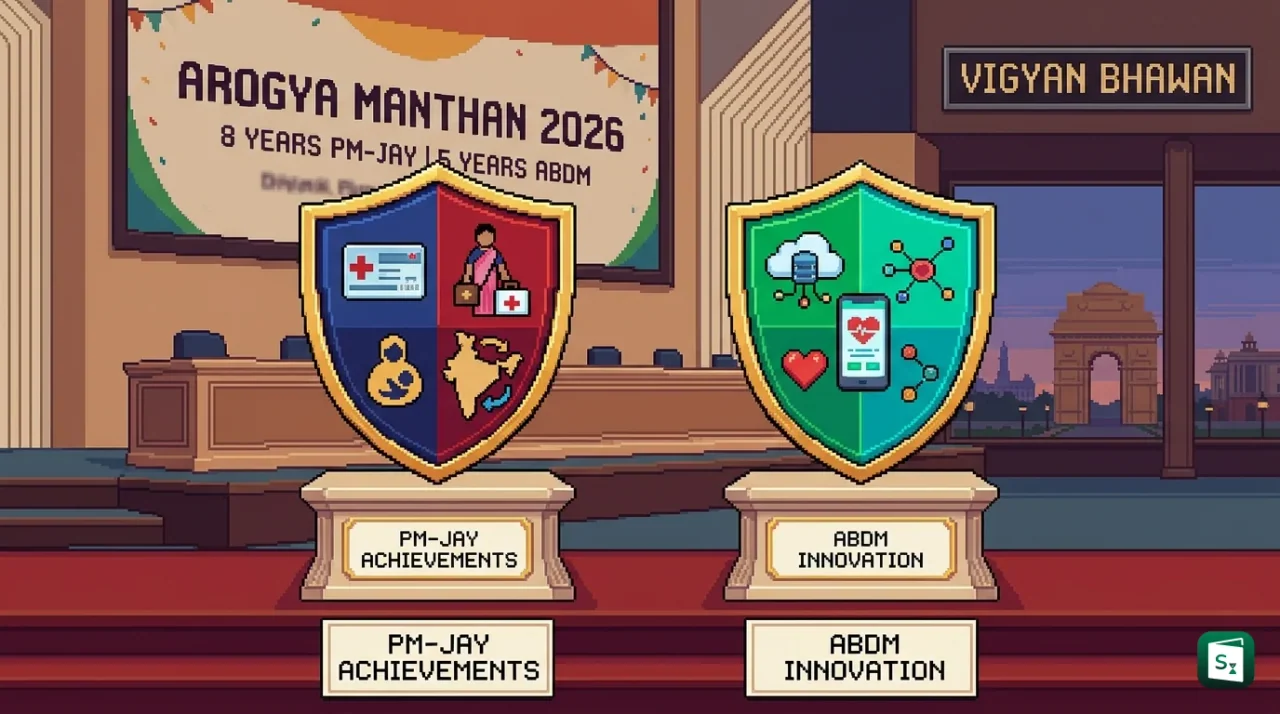
Union Health Minister Jagat Prakash Nadda inaugurated Arogya Manthan 2026 on 25 September 2026 at Vigyan Bhawan in New Delhi. The event organised by the National Health Authority marked eight years of the Ayushman Bharat Pradhan Mantri Jan Arogya Yojana (AB PM-JAY) and five years of the Ayushman Bharat Digital Mission (ABDM). Top performing states and Union Territories were honoured for Ayushman card saturation, inter-state portability claim settlement and digital health adoption.
What Is Arogya Manthan 2026?
Arogya Manthan 2026 is the annual review celebration organised by the National Health Authority (NHA) to track the progress of India’s two flagship health programmes. The 2026 edition was held on 25 September 2026 at Vigyan Bhawan in New Delhi and was inaugurated by Union Minister for Health and Family Welfare and Chemicals and Fertilizers Jagat Prakash Nadda.
The NHA is the apex body that implements the Ayushman Bharat Pradhan Mantri Jan Arogya Yojana and builds the digital health ecosystem under the Ayushman Bharat Digital Mission. The NHA functions as an attached office of the Ministry of Health and Family Welfare with full functional autonomy. It was formed on 2 January 2019 as the successor to the National Health Agency, which had worked as a registered society since 23 May 2018. The NHA is headed by a Chief Executive Officer of the rank of Secretary to the Government of India and is governed by a board chaired by the Union Health Minister. The NHA headquarters is located in New Delhi.
The 2026 event brought together senior central and state officials, public and private hospitals, insurance companies, digital health firms, researchers and development partners. The discussions focused on claim processing, fraud control, quality of care, continuity of treatment and wider use of digital health tools. New initiatives to strengthen health assurance and digital health, including the National Healthcare Providers Registry Mobile App, were also introduced during the programme.
What Is Ayushman Bharat PM-JAY?
The Ayushman Bharat Pradhan Mantri Jan Arogya Yojana (AB PM-JAY) is India’s flagship health assurance scheme that gives cashless hospital treatment to poor and vulnerable families. It provides a cover of ₹5 lakh per family per year for secondary and tertiary care, which means treatment for serious illnesses that need hospital admission and surgery. The Ayushman Card issued under the scheme is the identity document that lets a beneficiary get this cashless treatment at any empanelled hospital.
The Prime Minister launched AB PM-JAY on 23 September 2018 at Ranchi in Jharkhand. It forms the financial protection arm of the wider Ayushman Bharat programme. The other arms are Ayushman Arogya Mandirs for primary care, the Ayushman Bharat Digital Mission for digital health records, and the PM Ayushman Bharat Health Infrastructure Mission (PM-ABHIM) for hospitals, laboratories and critical care blocks. AB PM-JAY and Ayushman Bharat are therefore not separate rivals. AB PM-JAY is the insurance part inside the larger Ayushman Bharat umbrella.
The scale of AB PM-JAY makes it the world’s largest publicly funded health assurance scheme. The scheme now covers more than 60 crore beneficiaries. As of 21 September 2026, over 48.51 crore Ayushman Cards had been created, which is about 33 percent of India’s population. Through a network of over 38,000 empanelled public and private hospitals, the scheme has funded 13.25 crore hospital admissions worth ₹2.03 lakh crore. The benefit package covers 1,961 procedures across 27 medical specialities, including medicine, surgery, cardiology, orthopaedics and oncology. There is no waiting period once a family is enrolled.
Families were first identified using the Socio-Economic Caste Census (SECC) 2011, based on housing, income and job criteria in rural and urban areas. The base was first fixed at 10.74 crore families from the bottom 40 percent of the population and later revised to 12 crore families. In March 2024 the cover was extended to about 37 lakh families of Accredited Social Health Activists (ASHAs), Anganwadi Workers (AWWs) and Anganwadi Helpers (AWHs). By 21 September 2026, more than 44.81 lakh Ayushman Cards had been created for these frontline workers.
On 11 September 2024 the Union Cabinet extended AB PM-JAY to all senior citizens aged 70 years and above, irrespective of income. These elders receive a distinct Ayushman Vaya Vandana Card. Those from families already covered get an extra top-up of up to ₹5 lakh per year for themselves, while all other elders get a family cover of up to ₹5 lakh per year. The expansion covers about 6 crore senior citizens in 4.5 crore families. By 21 September 2026, more than 1.36 crore Vaya Vandana Cards had been issued. Beneficiaries can check eligibility, search their names and download the card through the PM-JAY beneficiary portal and the Ayushman App using mobile number, ration card or Aadhaar based eKYC.
What Is the Ayushman Bharat Digital Mission?
The Ayushman Bharat Digital Mission (ABDM) is the national programme that creates a single digital health ecosystem for patients, doctors, hospitals, pharmacies, laboratories and insurers. It was launched on 27 September 2021 and is implemented by the National Health Authority. The mission allows health records to move securely from one hospital to another with the consent of the patient.
The core of ABDM is the Ayushman Bharat Health Account (ABHA), which is also called the ABHA Card or ABHA ID. ABHA stands for Ayushman Bharat Health Account. It is a 14-digit unique health number for every citizen. Once a person creates an ABHA ID, hospital visits, lab reports and prescriptions can be linked to it and viewed through a personal health record app. An ABHA ID is different from an Ayushman Card. The Ayushman Card proves eligibility for free treatment under PM-JAY, while ABHA is a digital health identity open to every citizen.
ABDM is built on open registries and consent based exchange. The Health Facility Registry (HFR) lists verified hospitals, clinics, pharmacies and blood banks. The Healthcare Professionals Registry (HPR) lists verified doctors, nurses and other caregivers. The Health Information Exchange and Consent Manager (HIE-CM), the Unified Health Interface (UHI) and the National Health Claims Exchange (NHCX) allow records and insurance claims to flow safely between providers after the patient gives time-bound consent.
Adoption has grown fast. As of 20 July 2026, over 94.87 crore ABHA IDs had been created, with 5.36 lakh health facilities on the HFR and 10.09 lakh healthcare professionals on the HPR. By mid 2026, more than 104 crore health records were linked to over 93 crore ABHA accounts. Women hold 49.75 percent of all ABHA accounts. The Scan and Share QR service, launched in 2022, has cut outpatient registration time from nearly one hour to two to five minutes, with over 23.21 crore tokens issued by June 2026. The revamped Aarogya Setu 2.0, launched on 29 June 2026, now works as a personal health record app. Lightweight tools such as eSushrut Lite HMIS help small clinics digitise records, while the Digital Health Incentive Scheme pays hospitals and technology firms for joining the ecosystem.
States and UTs Honoured at Arogya Manthan 2026
Arogya Manthan 2026 recognised the best performing states and Union Territories under AB PM-JAY and ABDM. The awards were grouped by size of state and by type of work, so that large states, small states and Union Territories were judged in separate lanes.
Under AB PM-JAY, the first set of awards honoured card saturation among frontline workers. Andhra Pradesh won in the large state group, Sikkim won in the small state group, and Jammu and Kashmir won in the Union Territory group for creating the highest share of Ayushman Cards for ASHAs, Anganwadi Workers and Anganwadi Helpers.
The second set of awards under AB PM-JAY honoured efficient settlement of inter-state portability claims. Chhattisgarh, Maharashtra and Gujarat were recognised in this group. Portability lets a migrant worker or any beneficiary from one state get cashless treatment at an empanelled hospital in another state. As of 30 June 2026, 29.05 lakh inter-state admissions had been authorised with an approved value of over ₹8,383.97 crore.
Under ABDM, two types of digital work were honoured. Bihar, Ladakh and Dadra and Nagar Haveli were named top performers among model districts, where the full set of ABDM tools is tested first before wider rollout. Chandigarh, Assam and Uttar Pradesh were honoured for the highest use of ABDM enabled Health Management Information Systems (HMIS) in sub-centres, which are the village level first contact points that maintain outpatient, immunisation and maternal health data.
| Award Group | Winners |
|---|---|
| AB PM-JAY, highest Ayushman Card saturation among ASHAs, AWWs and AWHs | Andhra Pradesh (large state), Sikkim (small state), Jammu and Kashmir (UT) |
| AB PM-JAY, inter-state portability claim settlement | Chhattisgarh, Maharashtra, Gujarat |
| ABDM, top model districts | Bihar, Ladakh, Dadra and Nagar Haveli |
| ABDM, highest ABDM enabled HMIS use in sub-centres | Chandigarh, Assam, Uttar Pradesh |
Why Card Saturation, Portability and Digital Records Matter
Card saturation among ASHAs, Anganwadi Workers and Helpers carries weight beyond numbers. These three groups form the backbone of village health, nutrition and immunisation work. They visit homes daily, yet many of them earlier lacked assured hospital cover for their own families. Full card coverage gives them financial protection and also makes them living examples who can explain the Ayushman Card download, status check and hospital list to other families.
Inter-state portability solves a practical problem for migrant workers. A worker from Chhattisgarh employed in Maharashtra or Gujarat can fall ill far from home. Without portability, the family would pay from savings or borrow money. With portability, the same Ayushman Card works in any empanelled hospital across India. Fast claim settlement between states keeps hospitals willing to admit such patients. This is why the NHA tracks portability settlement speed as a separate award measure.
Digital records in sub-centres change the quality of primary care. A Health Management Information System (HMIS) is software that stores patient visits, diagnoses, medicines and referrals in digital form. An ABDM enabled HMIS links each entry to the ABHA ID of the patient. A doctor in a district hospital can then see past treatment with consent and avoid repeat tests. Model districts test this full chain of ABHA creation, facility registry, staff training and record linking in a few districts first. States that perform well show that even small sub-centres can run paperless systems, which reduces waiting time and builds a lifelong health history for citizens.
Key Takeaways
- Arogya Manthan 2026 was inaugurated on 25 September 2026 at Vigyan Bhawan, New Delhi by Union Health Minister Jagat Prakash Nadda.
- The event marked 8 years of AB PM-JAY, launched on 23 September 2018, and 5 years of ABDM, launched on 27 September 2021.
- AB PM-JAY provides ₹5 lakh per family per year cashless cover and has funded 13.25 crore admissions worth ₹2.03 lakh crore through over 38,000 hospitals.
- Andhra Pradesh, Sikkim and Jammu and Kashmir won top awards for Ayushman Card saturation among ASHAs, AWWs and AWHs, while Chhattisgarh, Maharashtra and Gujarat won for portability claim settlement.
- Bihar, Ladakh and Dadra and Nagar Haveli led in ABDM model districts, and Chandigarh, Assam and Uttar Pradesh led in ABDM enabled HMIS use in sub-centres.
- The National Health Authority, formed on 2 January 2019 and headquartered in New Delhi, implements both AB PM-JAY and ABDM.