The Indian Council of Agricultural Research (ICAR) and the Food Corporation of India (FCI) signed a Memorandum of Understanding (MoU) on 30 September 2026 to research alternative fumigation technologies for wheat and rice. The two-year Phase-I project will be implemented by the Ludhiana-based Central Institute of Post-Harvest Engineering and Technology (CIPHET) with support from the Department of Food and Public Distribution. The pact aims to replace failing chemical fumigants with safer nitrogen and carbon dioxide based methods to protect India’s vast central grain stocks.
What Is ICAR and What Is FCI?
The ICAR FCI MoU brings together India’s lead farm research network and its largest grain handling agency. One partner creates the science. The other guards the national stock. Their roles explain why this agreement matters for food security in India.
What Is ICAR in Agriculture?
The Indian Council of Agricultural Research (ICAR) is the apex body for farm research and education in India. It works under the Department of Agricultural Research and Education of the Ministry of Agriculture and Farmers Welfare. ICAR guides 113 institutes and 74 farm universities across the country.
ICAR was first set up on 16 July 1929 as the Imperial Council of Agricultural Research following the report of the Royal Commission on Agriculture. The Council has its headquarters in New Delhi at Krishi Bhavan. The Union Minister of Agriculture serves as the President of the ICAR Society, while the Director General, who is also the Secretary of the Department of Agricultural Research and Education, leads daily work. Research is guided through eight divisions covering crop science, horticulture, animal science, fisheries, natural resource management, farm engineering, education and extension.
What Is FCI?
The Food Corporation of India (FCI) is the central public agency that buys, stores, moves and distributes food grains for the government. It works under the Department of Food and Public Distribution. FCI buys wheat and rice at Minimum Support Price and supplies them for ration and welfare schemes.
FCI was established on 14 January 1965 under the Food Corporations Act, 1964. The FCI headquarters is located in New Delhi. The Corporation performs five core tasks of purchase, storage, movement, distribution and sale on behalf of the central government. FCI grain forms the backbone of the National Food Security Act system and other welfare schemes. In 2024-25, the Corporation procured 222 lakh metric tonnes of wheat and 337 lakh metric tonnes of rice. Covered storage capacity with FCI and state agencies stood at 872.22 lakh metric tonnes as on 31 March 2025.
The research under the new MoU will be done by the Central Institute of Post-Harvest Engineering and Technology (CIPHET), the ICAR institute for post harvest technology based in Ludhiana. CIPHET was established on 3 October 1989 on the Punjab Agricultural University campus. A second campus for fruits and vegetables was opened at Abohar on 19 March 1993. The institute leads work on grain processing, storage structures, value addition and loss reduction.
Why Fumigation Is Required for Stored Wheat and Rice
FCI and Central Warehousing Corporation warehouses hold millions of tonnes of wheat and rice for many months. Warm and humid conditions in much of India help insects breed fast inside bags, silos and godowns. If insects are not stopped, they eat the grain, reduce weight, spoil quality and leave waste that makes food unfit for people.
Common storage pests of wheat and rice include beetles and moths that feed inside whole grains and others that attack broken grain and flour. A short list of major pests helps show the scale of the problem.
| Storage Pest | Scientific Name | Main Damage |
|---|---|---|
| Rice weevil | Sitophilus oryzae | Bores into whole rice, wheat and maize grains and hollows them from inside |
| Lesser grain borer | Rhyzopertha dominica | Attacks whole wheat and rice grains and causes high weight loss |
| Khapra beetle | Trogoderma granarium | Feeds on stored wheat and rice and leaves skins and waste that spoil grain |
| Rice moth | Corcyra cephalonica | Larvae web and feed on broken rice, wheat flour and bags |
Post harvest losses in cereals in India are estimated at 4.65 percent to 5.99 percent, with storage forming a large share. Farm level stores lose grain to insects, rodents and fungi. Central pool stocks face the same risk on a much larger scale. Fumigation is required because surface sprays cannot reach insects hidden deep inside grain stacks and closed silos.
How Is Fumigation Done and Is It Safe?
Fumigation is a pest control method that fills a sealed store with gas to kill insects at all life stages. The gas enters grain bags or silos and stops insect breathing and growth. After a fixed exposure time, the store is aired to remove residues before workers handle grain.
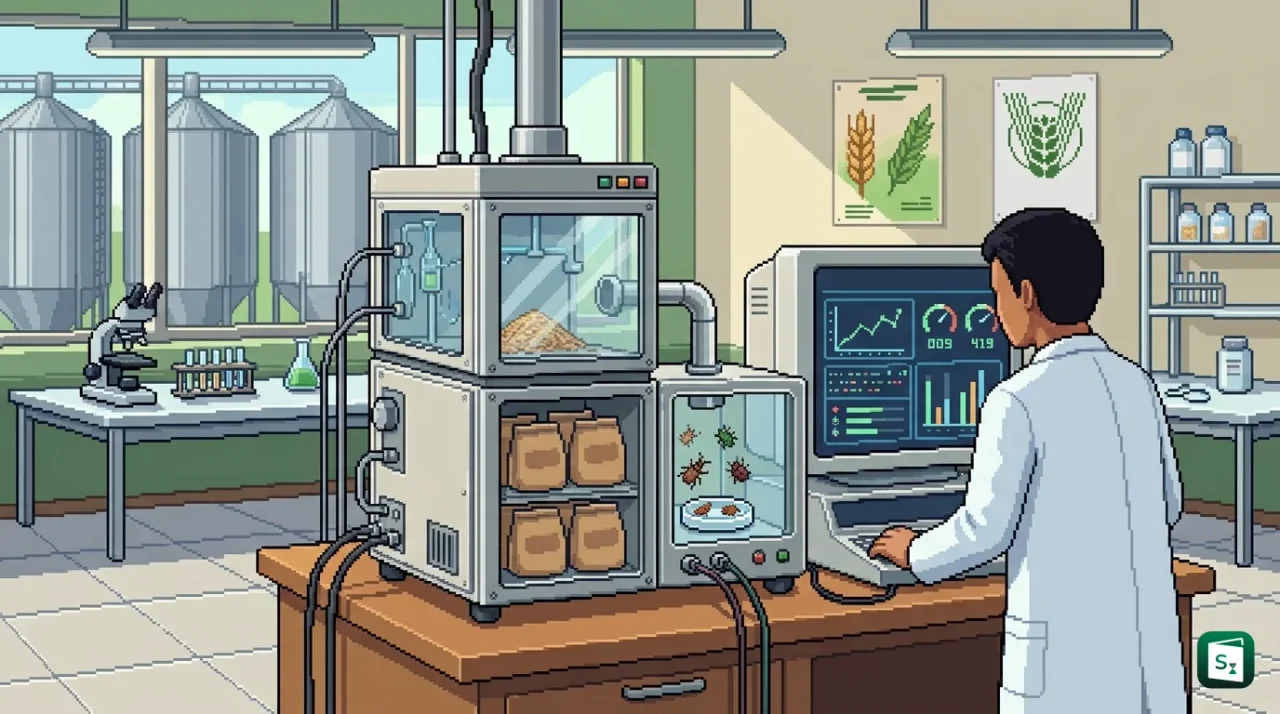
In practice, the ICAR CIPHET team seals the test silo, stack or hermetic cover and releases a measured dose of gas. Sensors track gas level, temperature and humidity to keep the dose lethal for pests through the full exposure period. Staff wear full face masks with correct canisters and gloves during release and testing. The store stays closed for days to kill eggs, larvae, pupae and adults. Then the store is opened and ventilated. Grain is checked in depot labs before release.
Fumigation can be safe when sealed, measured and ventilated under trained control. It becomes risky when sealing is poor, doses are low or workers enter without protection. Poor practice also leaves some insects alive. Those survivors can develop resistance and pass it to the next generation.
Three Trials Under the Two Year Phase I Project
The ICAR FCI agreement creates a two-year Phase-I pilot. The Department of Food and Public Distribution supports the study. ICAR CIPHET Ludhiana will lead the science, while FCI will provide warehouse access, grain stocks and quality control support.
The MoU was signed by Dr. Nachiket Kotwaliwale, Director of ICAR CIPHET, and Dr. A. K. Sinha, Executive Director for Quality Control in FCI. Senior leaders present included Dr. M. L. Jat, Secretary of the Department of Agricultural Research and Education and Director General of ICAR. Deputy Directors General for Agricultural Engineering and Crop Science, officers from the Department of Food and Public Distribution and FCI quality control managers also attended. Dr. Sandeep Mann of ICAR CIPHET will serve as lead investigator.
Phase-I will test three gas based options that avoid full dependence on conventional chemicals. Each trial matches a gas to a real storage condition used by FCI.
| Trial | Gas System | Storage Condition | Crop Covered |
|---|---|---|---|
| Trial 1 | Nitrogen gas above 99 percent purity | Wheat held in metal silos | Wheat |
| Trial 2 | Combined carbon dioxide and phosphine gas | Wheat and rice held in bags in FCI and Central Warehousing Corporation warehouses | Wheat and rice |
| Trial 3 | Carbon dioxide gas | Wheat and rice held in bags enclosed in hermetic covers | Wheat and rice |
Nitrogen and carbon dioxide act mainly by creating a low oxygen atmosphere. Insects cannot breathe and grow in very high nitrogen or carbon dioxide levels. Phosphine, which is hydrogen phosphide released from aluminium phosphide tablets, poisons insect cells. When carbon dioxide is mixed with a small amount of phosphine, the mixture can work faster and at a lower phosphine dose. This combined effect is called synergy. Hermetic covers add a further seal around bag stacks to hold the gas for the full period.
The trials will measure insect death at all stages, grain quality, germination where relevant, moisture, residues and worker exposure. Results will be used to write clear dose, sealing time and airing steps for large godowns and steel silos.
Why the Shift Away From Aluminium Phosphide and Malathion Matters
For decades, India’s grain reserves have depended on aluminium phosphide (ALP) tablets and the spray insecticide malathion. ALP releases phosphine gas after contact with moisture in air. Malathion is sprayed on bags and surfaces. Both are cheap and easy to carry. That ease led to very wide and repeated use.
Repeated low dose use with poor sealing has created strong phosphine resistance. Pest resistance frequency has reached 72 percent to 100 percent in key Indian states. Resistant insects survive normal doses. Managers then repeat fumigation or raise the dose. That cycle raises cost, time and chemical load. It also increases breathing risk for depot workers. Phosphine can irritate the lungs and harm health when inhaled in closed spaces without protection.
Residues and environmental load add a second concern. Extra cycles leave more residues in grain and dust. Runoff and vented gas add to wider ecological pressure. Methyl bromide, the other classic global fumigant, is already restricted because it harms the ozone layer and is kept mainly for quarantine and pre-shipment use. India now lists only phosphine and methyl bromide as registered fumigants, so a new domestic option is urgent.
Nitrogen and carbon dioxide offer a cleaner path. Both gases are inert in nature and leave no toxic chemical residue when used correctly. They do not damage the ozone layer in the way methyl bromide does. Their success, however, depends on airtight storage such as steel silos and sealed hermetic covers. The ICAR FCI project will test whether these systems can give full pest kill at commercial scale in Indian heat and humidity.
Post Harvest Technology and Food Security Stakes in India
Safe storage links farm output to ration shops. India recorded foodgrain output of 353.96 million tonnes in 2024-25. FCI buys a large share at Minimum Support Price (MSP), which is the assured price the government pays to protect farmers from distress sales. The grain is then moved across states and issued at Central Issue Prices under the National Food Security Act and other welfare schemes. Any loss in store directly cuts the grain available for this chain.
Post harvest technology covers every step after cutting the crop. It includes drying, cleaning, grading, packing, transport, storage and processing. Post harvest management aims to hold moisture at safe levels, stop insects and fungi and keep quality during long storage. FCI now uses scientific godowns, the ANNA DARPAN supply chain portal and depot labs linked to headquarters for real time quality checks. Traditional cover and plinth storage has been reduced in favour of covered depots and steel grain silos.
| Storage System | How It Works | Role in Central Pool |
|---|---|---|
| Covered godowns | Brick and steel warehouses with ventilated bag stacks | Main scientific storage for FCI and state agencies |
| Steel silos | Tall metal bins for bulk grain with controlled aeration | Growing bulk system with 22.75 lakh metric tonnes now active and more capacity under build |
| Cover and plinth | Brick base with tarpaulin cover for short term outdoor stacks | Older open system now being replaced |
A reliable fumigation procedure matters for all three systems. Clean grain in silos can be ruined by one resistant pest pocket. Bag stacks in humid zones need gas that can pass through jute or HDPE and reach the centre of the stack. Hermetic covers promise a low cost seal for existing warehouses. CIPHET Ludhiana has earlier studied storage losses in FCI, state and central warehouses and advised on norms for proper care. Its pulse storage work with the Department of Consumer Affairs shows how lab science can shape national stock norms.
The Way Forward: Phase II Trials and Region Specific SOPs
The ICAR FCI research will move in two stages. Phase-I is a two-year pilot under controlled FCI conditions. Phase-II will be a one-year multi-location trial across varied agro-climatic zones. Hot dry zones, humid coastal zones and cold northern zones create different pest pressure and gas behaviour. Tests in each zone will show the right dose and holding time for local heat and moisture.
The end product will be region specific Standard Operating Procedures (SOPs). An SOP is a written step by step rule for field staff. The new SOPs are expected to fix the gas concentration, sealing method, exposure days, safety checks and airing time for each storage type. Clear SOPs will help FCI standardise commercial use of nitrogen, carbon dioxide and combined carbon dioxide with phosphine across depots.
The larger aim is a scientifically tested, scalable and sustainable alternative to full chemical fumigation. Success would cut pest resistance, lower worker exposure, reduce environmental harm and limit fumigant residues in wheat and rice. It would also give India home grown data to update grain storage policy and strengthen long term food security.
Key Takeaways
- ICAR and FCI signed the MoU on 30 September 2026 to research alternative fumigation for storage pests in wheat and rice.
- The two-year Phase-I project will be implemented by ICAR CIPHET Ludhiana with support from the Department of Food and Public Distribution.
- Phase-I will test nitrogen above 99 percent in silos, combined carbon dioxide and phosphine in warehouse bags, and carbon dioxide in hermetic covers.
- Phosphine resistance has reached 72 percent to 100 percent in key states after long use of aluminium phosphide and malathion.
- ICAR was established on 16 July 1929 in New Delhi and FCI was established on 14 January 1965 under the Food Corporations Act, 1964.
- A one-year multi-location Phase-II will follow Phase-I to frame region specific Standard Operating Procedures for national use.