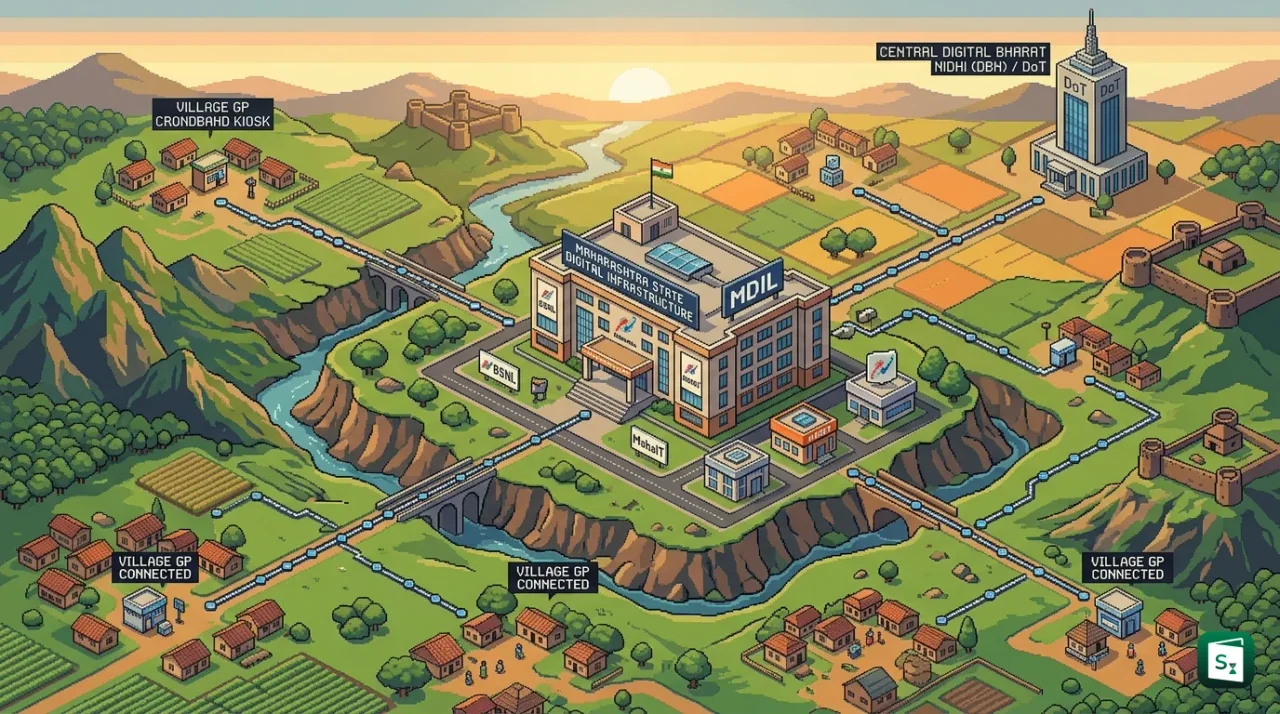
Digital Bharat Nidhi (DBN) under the Department of Telecommunications signed an agreement on 1 October 2026 at Sanchar Bhawan, New Delhi to implement the Amended BharatNet Program (ABP) in Maharashtra under the State-led model. The pact brings together the Maharashtra government, MahaNet Digital Infrastructure Ltd (MDIL), Bharat Sanchar Nigam Ltd (BSNL) and the Maharashtra Information Technology Corporation Ltd (MahaIT). Backed by ₹10,520 crore in central support, it will cover 28,237 Gram Panchayats and extend on-demand connectivity to 15,799 villages.
What Is BharatNet?
BharatNet is the central government’s flagship rural broadband program to take high speed optical fibre to every Gram Panchayat and, on demand, to surrounding villages. The Department of Telecommunications runs the program, Bharat Broadband Network Ltd built the initial network, and Digital Bharat Nidhi funds it as a national asset open to all service providers.
BharatNet works mainly as a middle mile network. It carries fibre from the block headquarters, which is the sub district administrative centre, to the Gram Panchayat, which is the village council. Private mobile operators, internet providers, cable operators and government agencies can then use this backbone to deliver last mile services to homes, schools, health centres and offices. The goal is not only to lay cable but to make services like e-governance, online education, telemedicine, digital payments and agricultural advisories usable in rural areas.
The network is described as one of the world’s largest rural telecom projects. It was designed to give non-discriminatory access, which means any eligible operator can lease bandwidth or dark fibre on the same terms. Dark fibre refers to laid optical fibre that is not yet lit with transmission equipment and can be leased to operators for their own use. This design keeps policy with the Department of Telecommunications, execution with dedicated agencies, and service delivery open to competition.
What Is the Amended BharatNet Program?
The Amended BharatNet Program (ABP) is the redesigned phase of BharatNet approved by the Union Cabinet on 4 August 2023 to upgrade, consolidate and expand the earlier network. The Department of Telecommunications implements ABP to provide robust, future ready broadband to all Gram Panchayats and on-demand connectivity to non-Panchayat villages with assured upkeep.
The earlier phases had laid fibre to about 2.14 lakh Gram Panchayats, but many links used linear topology and suffered cuts, poor upkeep and weak use. Linear topology lays fibre in a single straight line, so one cut can disconnect all sites beyond the break. ABP changes this model. It upgrades the network to ring topology with Internet Protocol Multi Protocol Label Switching (IP-MPLS) routers at blocks and Panchayats. In a ring, fibre loops back on itself, so traffic can travel by an alternate path if one section fails.
The national scope of ABP covers optical fibre connectivity to about 2.65 lakh Gram Panchayats in ring design and about 3.8 lakh non-Panchayat villages on demand. It also provides for 1.5 crore rural Fibre to the Home (FTTH) connections, which are high speed fibre links directly into homes and institutions. The total approved outlay for ABP is ₹1,39,579 crore.
The biggest structural shift is maintenance. ABP follows a design, build, operate and maintain model for 10 years, with about three years for construction and seven years for upkeep. Bharat Sanchar Nigam Ltd (BSNL), the state owned telecom operator established in 2000 and headquartered in New Delhi, acts as the single Project Management Agency for operation and maintenance. Implementation follows two tracks. The BSNL-led model covers 1,67,727 Gram Panchayats in 21 states and five Union Territories, while the State-led model covers 97,336 Gram Panchayats in seven states. Maharashtra follows the State-led track.
What Is Digital Bharat Nidhi?
Digital Bharat Nidhi (DBN) is the central fund that pays for telecom access in rural, remote and other underserved areas where private operators would not invest on their own. The Department of Telecommunications administers DBN as an attached office, and the Administrator of DBN selects implementing agencies and disburses funds for schemes like BharatNet.
DBN is the successor to the Universal Service Obligation Fund (USOF). USOF came into effect on 1 April 2002 and received statutory backing through the Indian Telegraph (Amendment) Act, 2003. Under the Telecommunications Act, 2023, which received presidential assent on 24 December 2023, USOF became Digital Bharat Nidhi. The Telecommunications (Administration of Digital Bharat Nidhi) Rules, 2024 now govern its working.
The fund is built from levies paid on telecom authorisations, earlier known as the Universal Access Levy on adjusted gross revenue. Money collected is first credited to the Consolidated Fund of India and then credited to DBN after parliamentary approval. The balance does not lapse at the end of the financial year. DBN can provide full funding, partial funding, co-funding or risk support on a case to case basis.
The mandate is wider than laying towers or fibre. DBN supports access and delivery of telecom services, pilot projects and consultancy for underserved areas, research and development in telecom, and introduction of new telecom technologies and products. It funds BharatNet, the 4G Saturation Project, mobile coverage in aspirational districts, Left Wing Extremism areas, Himalayan and border areas, islands and the North East. Any network built with DBN support must be shared on an open and non-discriminatory basis.
Maharashtra Agreement Under the State-Led Model
The Maharashtra agreement was signed on 1 October 2026 at Sanchar Bhawan in New Delhi. The five signatories are Digital Bharat Nidhi under the Department of Telecommunications, the Government of Maharashtra, MahaNet Digital Infrastructure Ltd, Bharat Sanchar Nigam Ltd and the Maharashtra Information Technology Corporation Ltd.
The signing took place in the presence of Shyamal Misra, Administrator of Digital Bharat Nidhi, Virendra Singh, Secretary of the Maharashtra Department of Electronics, Information Technology and Artificial Intelligence, S. Buveneswari, Managing Director of MahaIT, Papa Sudhakara Rao, Director for Enterprise Business in BSNL, and Dinesh Kumar Garg, Deputy Director General for ABP Implementation in the Department of Telecommunications, along with senior officers of the three organisations.
Under the State-led model, the state arm implements the project while the centre funds and guides it. MahaNet Digital Infrastructure Ltd (MDIL) is the implementing agency in Maharashtra. The Maharashtra Cabinet cleared the creation of MDIL as a Special Purpose Vehicle in June 2026. A Special Purpose Vehicle is a separate company created to carry out a specific project with clear ownership and accounts. MDIL is chaired by the Administrator of Digital Bharat Nidhi and includes senior officers from the state revenue, rural development, finance, and information technology departments, along with four central nominees. The existing Phase I and Phase II fibre assets in the state move to MDIL on an as is where is basis, while past disputes and liabilities stay with the earlier agencies.
Maharashtra Information Technology Corporation Ltd (MahaIT) is the state nodal information technology agency. MahaIT anchors e-governance integration and field coordination with district and village bodies. BSNL provides project management support, bandwidth and national operating experience. This mix is meant to combine central finance and technical standards with faster local clearances for right of way, which is the legal permission to lay underground cable along roads and public land.
Scope and Funding for Maharashtra
The central government has approved ₹10,520 crore in financial support for the Maharashtra segment. The amount covers capital work for fibre upgradation and equipment, operation and maintenance for 10 years, and viability gap support for rural home connections. Viability gap support is a grant that bridges the gap between project cost and revenue in areas where commercial returns are low.
The Maharashtra scope totals 28,237 Gram Panchayats, plus on-demand village coverage. As of June 2026, about 24,575 Gram Panchayats in Maharashtra were already connected under the earlier phases. The new program upgrades that base and fills gaps.
| Component in Maharashtra | Coverage |
|---|---|
| Phase I Panchayats to be upgraded from linear to ring topology | 15,171 |
| Phase II Panchayats to be covered | 12,740 |
| Newly created Panchayats added | 326 |
| Total Gram Panchayats in scope | 28,237 |
| Non-Panchayat villages to be connected on demand | 15,799 |
| Expected rural home fibre connections with central support | More than 9 lakh |
The upgrade from linear to ring topology is meant to cut downtime. Field reviews had found that only about half the connected Panchayats stayed reliably up under the old build and maintain approach. The ring allows traffic to reroute during a fibre cut, which is common during road work and monsoon damage. The program also mandates armoured cable, power backup at Panchayat sites, videography of trenching, Geographic Information System mapping and quality testing.
The connectivity will support e-governance delivery, online education, telemedicine, digital payments and citizen services in rural and remote pockets. Rural fibre will also provide backhaul for mobile towers, which is the high capacity link that connects a mobile tower to the core network. This linkage helps the 4G Saturation Project, which aims to bring mobile signals to uncovered villages, because a fibre fed tower can carry more data at stable speeds.
BharatNet Phase 3 and Last Mile Delivery
BharatNet Phase 3 is the current construction and service stage that is now called the Amended BharatNet Program. BharatNet began as the National Optical Fibre Network approved on 25 October 2011 to link 2.5 lakh Gram Panchayats. Bharat Broadband Network Ltd, incorporated on 25 February 2012, executed the work. Phase I, completed in December 2017, connected about one lakh Panchayats using fibre leased from BSNL, RailTel and PowerGrid plus newly laid fibre. Phase II, approved on 19 July 2017 with an outlay of ₹42,068 crore, used a mix of fibre, radio and satellite and three tracks, namely state led, central public sector led and private led. The 2023 amendment keeps the fibre base but shifts the test from kilometres laid to uptime, upkeep and actual use.
BharatNet Udyami Scheme and FTTH Services
Fibre to the Home, usually shortened to FTTH, means an optical fibre line runs directly into a home, school, health centre or office and delivers high speed broadband through a small optical terminal. BharatNet offers FTTH to rural homes and institutions using its middle mile backbone.
The BharatNet Udyami (BNU) model engages local entrepreneurs to provide these connections. A BharatNet Udyami is a village level operator who takes the connection from the Panchayat point to homes, handles installation and collects a share of revenue. The centre provides subsidy support so that installation charges stay low and the monthly plan remains affordable. High speed FTTH is now listed on the UMANG platform, which is the unified government app for citizen services. To take a connection, a resident can approach the local Udyami, Common Service Centre or BSNL field unit in a BharatNet covered Panchayat and request activation. No separate installation charge applies under the DBN funded offer, and the user pays only the monthly subscription from activation.
BharatNet Pragati Portal and Monitoring
The BharatNet Pragati Portal is the live dashboard that tracks every kilometre of cable laid, every Panchayat upgraded and daily network availability. The dashboard is displayed for review in the communications minister’s office and is used for weekly reviews with implementing agencies and monthly reviews at higher levels. Each state has a dedicated Network Operations Centre feeding into national centres in Delhi and Bengaluru. For Maharashtra, this system will track the 28,237 Panchayats, the 15,799 on-demand villages and service level performance of the Project Implementing Agency selected through tender. A tender is the open bidding process through which the implementing agency is chosen for design, supply, laying, testing and long term maintenance.
When Was BharatNet Launched? Timeline and Background
BharatNet was formally approved on 25 October 2011 as the National Optical Fibre Network and renamed BharatNet after the Digital India push. Digital India is the flagship program launched in 2015 to expand digital infrastructure, digital services and digital literacy. The table below places the Maharashtra agreement in that longer journey.
| Year | Milestone |
|---|---|
| 2011 | Union Cabinet approves National Optical Fibre Network to connect 2.5 lakh Gram Panchayats |
| 2012 | Bharat Broadband Network Ltd (BBNL) incorporated as Special Purpose Vehicle |
| 2015 | Program gains pace under Digital India and is renamed BharatNet |
| 2017 | Phase I completed in December; modified strategy for Phase II approved in July |
| 2018 | MahaNet Phase II work in Maharashtra awarded for packages covering about 13,000 Panchayats |
| 2022 | Union Cabinet approves merger of BBNL with BSNL |
| 2023 | Union Cabinet approves Amended BharatNet Program on 4 August; Telecommunications Act creates Digital Bharat Nidhi |
| 2024 | Administration of Digital Bharat Nidhi Rules notified |
| 2026 | Maharashtra Cabinet clears MDIL in June; DBN signs Maharashtra ABP agreement on 1 October |
In Maharashtra, Phase II was earlier branded MahaNet and executed through MahaIT with agencies laying about 38,000 km of fibre across districts. The new agreement folds those assets into a single ring based network with decade long maintenance, which addresses the audit finding that construction without assured upkeep left many sites service ready on paper but inactive in practice.
Significance and Way Forward
The Maharashtra pact matters because the state has about 28,000 Gram Panchayats spread across Vidarbha, Marathwada, Konkan, Khandesh and western Maharashtra, with terrain that ranges from coastal strips to plateau and forest belts. Reliable middle mile fibre lets district administrations run land records, ration delivery, school content and health referrals online without depending on weak mobile signals. For citizens, the visible gain will be more than nine lakh home fibre links and stronger access to online classes, teleconsultations and digital payments.
The road ahead will be decided at the last mile. MDIL must complete a detailed project report and bid process, appoint a Project Implementing Agency and set up a state Network Operations Centre with service level penalties for downtime. BSNL must align bandwidth, repair chains and Udyami onboarding so that a lit Panchayat converts into working home connections. Progress will show on the Pragati dashboard in kilometres laid, Panchayats upgraded and daily availability, which allows direct comparison with state led programs in Gujarat, Andhra Pradesh and Tamil Nadu. If execution holds, BharatNet in Maharashtra can shift from a cable laying record to a service network that carries daily governance, learning and commerce.
Key Takeaways
- Digital Bharat Nidhi signed the Maharashtra Amended BharatNet agreement on 1 October 2026 at Sanchar Bhawan, New Delhi under the State-led model.
- The program covers 28,237 Gram Panchayats in Maharashtra, including upgrade of 15,171 Phase I Panchayats to ring topology and connectivity for 15,799 villages on demand.
- The centre approved ₹10,520 crore in support for Maharashtra, expected to enable more than nine lakh rural home fibre connections.
- The Amended BharatNet Program was approved on 4 August 2023 to build ring topology networks with 10-year operation and maintenance.
- Digital Bharat Nidhi, the successor to the Universal Service Obligation Fund under the Telecommunications Act, 2023, funds BharatNet as an attached office of the Department of Telecommunications.