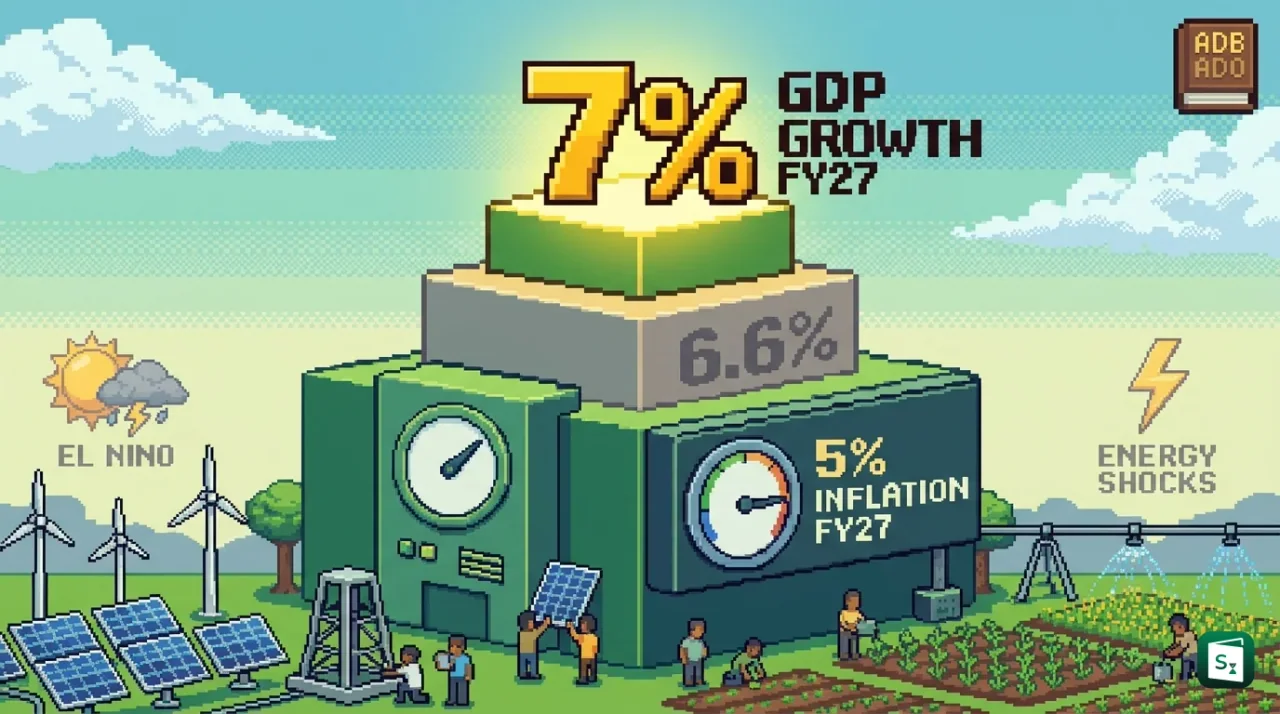
The Asian Development Bank (ADB) raised its India GDP growth forecast for FY27 to 7 percent in its Asian Development Outlook September 2026 report. The new forecast is 40 basis points higher than the 6.6 percent estimate made in July 2026 and follows stronger than expected growth of 7.8 percent in the April to June quarter. The report also lowered the FY27 inflation forecast to 5 percent while warning that prolonged energy shocks and El Nino remain key risks.
What Is India GDP in 2026 and What Did ADB Forecast for FY27?
The Asian Development Bank’s Asian Development Outlook September 2026 forecasts India’s Gross Domestic Product (GDP) growth at 7 percent for FY27 and inflation at 5 percent for the same year. FY27 means financial year 2026-27, which runs from 1 April 2026 to 31 March 2027. The growth forecast is an increase of 40 basis points from the 6.6 percent forecast made in the July 2026 outlook.
The September outlook is titled Navigating Prolonged Energy Shocks and El Nino. It is one of the four annual updates of ADB’s flagship Asian Development Outlook (ADO), which tracks growth and inflation across developing Asia and the Pacific. For India, the September 2026 edition raised the FY27 growth estimate to 7 percent and cut the FY28 growth estimate to 7.1 percent from 7.3 percent, mainly because the higher FY27 base leaves less room for a jump next year.
The upgrade matters because India is currently the world’s fastest growing major economy and the world’s fourth largest economy in nominal terms at around $4.3 trillion in 2026, close to Japan and behind the United States, China and Germany. GDP is the total value of all final goods and services produced inside a country in a given period. When India’s GDP grows at 7 percent, it means the total output of the economy, after removing price changes, is 7 percent larger than in the previous year.
The Asian Development Bank (ADB) is a multilateral development bank founded in 1966 and headquartered in Manila, Philippines. ADB is owned by 69 members, of which 50 are from Asia and the Pacific. India is a founding member and its fourth largest shareholder. ADB started lending operations to India in 1986 and opened its India Resident Mission in New Delhi in 1992. The President of ADB is Masato Kanda (as of September 2026) and the Country Director for India is Mio Oka.
Why Did ADB Raise the FY27 Growth Forecast to 7 Percent?
The main reason for the upgrade is stronger than expected performance in the first quarter of FY27. India’s real GDP grew by 7.8 percent year on year in the April to June 2026 quarter, according to data released by the Ministry of Statistics and Programme Implementation (MOSPI). This was higher than the 6.9 percent growth recorded in the same quarter last year and higher than the 7 percent growth that had been expected for the quarter.
The Asian Development Bank said the first quarter expansion was supported by robust investment demand, steady private consumption and solid growth in manufacturing and services. Fixed investment grew by nearly 11.9 percent in real terms, while private consumption grew by 7.1 percent. On the production side, services remained the main driver with growth of 10 percent. Within services, financial, real estate and professional services grew by 12.1 percent. Government consumption grew by 4.3 percent, and exports grew by 12 percent.
The Asian Development Bank also pointed to three cushions that limited the damage from the West Asia conflict. First, supply disruptions were smaller than feared. Second, capital inflows held up. Third, higher input costs were not fully passed on to retail prices, which protected household budgets. Strong tax collections, low interest rates in the early part of the year and rising household incomes added further support.
For the rest of FY27 and FY28, the Asian Development Bank expects domestic demand to remain the main engine of growth. Central government capital expenditure is budgeted to rise by 11.5 percent in FY26 (the budget for 2026-27), which supports roads, railways, ports and logistics. Supportive fiscal and monetary policies, healthier balance sheets of companies and banks, and reforms to improve logistics and labour flexibility are expected to encourage private investment. An expected once in a decade revision of government salaries and pensions in the next financial year is also expected to lift consumption in FY28.
Technology and trade add another layer of support. The Asian Development Bank expects electronics exports to stay healthy and services exports to grow faster than imports as global demand for technology services rises with higher investment in artificial intelligence. Trade agreements with the United Kingdom and the European Union are expected to support net exports in FY28. The report expects net exports to contribute positively to GDP growth in both FY27 and FY28, even though imports of capital and intermediate goods will also rise with stronger domestic demand.
Inflation Forecast for FY27 at 5 Percent
The Asian Development Bank lowered its inflation forecast for India for FY27 to 5 percent from 5.2 percent estimated in July 2026. The report said the recent rise in prices has been more gradual than expected, with limited transfer of higher global energy prices to retail consumers. The inflation forecast for FY28 has been kept unchanged at 4 percent, on the assumption that energy prices cool and farm supply improves with a normal monsoon.
Inflation in India is measured by the Consumer Price Index (CPI), which tracks retail prices paid by households. Food has a weight of nearly one third in the index, so changes in vegetable, cereal and edible oil prices move the headline number quickly. In June 2026, headline CPI inflation rose to 4.4 percent after staying below target for 16 months, mainly due to higher food and fuel prices. By August 2026, headline CPI had risen to 4.82 percent, with food inflation at 5.95 percent.
The 5 percent annual forecast for FY27 sits at the top of the comfort zone. The Reserve Bank of India follows a target of 4 percent CPI inflation with a tolerance band of 2 percent to 6 percent set under the monetary policy framework. The August 2026 monetary policy review projected the same annual average of 5 percent for FY27, with inflation rising to 4.7 percent in the second quarter, peaking at 5.9 percent in the third quarter and easing to 5.5 percent in the fourth quarter. Core inflation, which removes volatile food and fuel prices, is projected at 4.3 percent for FY27, which suggests that demand pressure is still contained and the current rise is mainly a supply side problem.
The Asian Development Bank noted that the fiscal deficit is expected to stay around 4.3 percent of GDP in FY27 despite higher fertiliser subsidy spending and fuel tax cuts. Strong direct tax collections and extra receipts from oil export taxes and duties on precious metals are supporting government revenue. If inflation stays high, the central bank may need to raise the policy repo rate, which is the rate at which it lends short term funds to banks. The repo rate stands at 5.25 percent (as of September 2026) with a neutral policy stance.
What Are the Risks From Prolonged Energy Shocks and El Nino?
The title of the September 2026 outlook points to the two biggest risks for the forecast. The first risk is prolonged energy shocks linked to the conflict in West Asia and the Middle East. The second risk is weather disruption linked to El Nino.
Higher crude oil, gas and fertiliser prices raise costs for transport, industry and farming. India imports a large share of its crude oil, liquefied natural gas and cooking gas, so a long period of high global prices can push up wholesale prices and then feed into retail inflation. It can also widen the import bill, pressure the rupee and force the government to spend more on subsidies. The Asian Development Bank said volatile trade and financial conditions, along with uncertain capital flows, could weigh on exports and investment if geopolitical tension continues.
El Nino is a warming of surface waters in the central and eastern Pacific Ocean that changes wind patterns and often weakens the Indian summer monsoon. The monsoon season from June to September provides nearly 70 percent of India’s annual rainfall. Farming accounts for about 18 percent of GDP and supports nearly half of all workers, so weak rain quickly affects crop output, rural income and food prices.
The 2026 monsoon has already been uneven. June ended with a rainfall deficit of nearly 39.8 percent, July recovered to near normal levels, and the all India deficit was still 14.7 percent below normal as of 13 September, with larger shortfalls in central and southern India. The India Meteorological Department (IMD), which was established in 1875 and functions under the Ministry of Earth Sciences, had forecast seasonal rainfall at around 92 percent of the Long Period Average. The World Meteorological Organization (WMO), the weather body of the United Nations headquartered in Geneva, Switzerland, warned of an 80 to 90 percent chance that El Nino would develop and strengthen through August to November 2026.
A weak monsoon can reduce output of rice, cotton, soybean, pulses and oilseeds in the kharif season and lower soil moisture for winter wheat and rapeseed. It can also cut hydropower generation, which meets about 6 percent of power supply, and raise local food prices for onions, potatoes and tomatoes. The central review in July 2026 updated contingency plans for 262 vulnerable districts and asked departments to track buffer stocks of rice, wheat and pulses and ensure fertiliser supply for the rabi season.
How Does the ADB Forecast Compare With RBI and Other Agencies?
The Asian Development Bank is more optimistic on growth for FY27 than the central bank. The Reserve Bank of India (RBI), which is India’s central bank established in 1935 and headquartered in Mumbai, raised its FY27 real GDP forecast to 6.7 percent in August 2026 from 6.6 percent in June. The RBI kept the policy repo rate unchanged at 5.25 percent with a neutral stance and projected CPI inflation at 5 percent for FY27, the same as the ADB forecast.
The September upgrades by ADB came in the same week as similar moves by other global agencies after the strong first quarter data. The table below places the main FY27 forecasts together for easy comparison.
| Agency | FY27 GDP Growth Forecast | FY27 Inflation Forecast | Note |
|---|---|---|---|
| ADB (September 2026) | 7 percent (up from 6.6 percent in July) | 5 percent (down from 5.2 percent) | Sees FY28 growth at 7.1 percent, inflation at 4 percent |
| RBI (August 2026) | 6.7 percent (up from 6.6 percent) | 5 percent (down from 5.1 percent) | Repo rate at 5.25 percent, Q3 inflation peak at 5.9 percent |
| S and P Global Ratings (September 2026) | 7 percent (up from 6.6 percent) | 5.1 percent | Expects 25 basis point rate rise to 5.5 percent |
| Fitch Ratings (September 2026) | 6.9 percent (up from 6.4 percent) | Headline at 5.5 percent in December 2026 | Sees FY28 growth at 6.5 percent |
| OECD (September 2026) | 7.1 percent (up by 80 basis points) | Not separately revised in this round | Highest FY27 estimate in this group |
| World Bank (June 2026) | 6.6 percent (up by 10 basis points) | Flagged energy price risk to finances | Sees FY28 growth at 7.2 percent |
The key message from the comparison is simple. Most forecasters agree that India will grow close to 7 percent in FY27 and remain the fastest growing major economy, but all of them flag the same two threats of high oil prices and poor rain. Rating agencies expect the Reserve Bank of India to raise rates by at least 25 basis points later in 2026 if food and fuel inflation stays high. One basis point is one hundredth of a percentage point, so 40 basis points equal 0.40 percentage point and 25 basis points equal 0.25 percentage point.
What Is GDP and How Is It Calculated in India?
What is the GDP of India. GDP means Gross Domestic Product. It is the total market value of all final goods and services produced within the borders of a country during a specific period, usually a quarter or a year. It does not count work done by Indians abroad, and it does not count intermediate goods twice. GDP growth is important because it shows whether jobs, incomes and tax revenue are likely to expand.
How is GDP calculated in India. The Ministry of Statistics and Programme Implementation (MOSPI) publishes GDP data through the National Statistics Office (NSO). MOSPI releases First Advance Estimates in January, Second Advance Estimates in February, Provisional Estimates in May and Revised Estimates over the next two years. Quarterly data are released with a lag of about two months. The next quarterly release after the April to June quarter, covering July to September 2026, is scheduled for 30 November 2026.
India currently uses 2011-12 as the base year for constant price estimates. Base year means the reference year whose prices are used to remove the effect of inflation. Real GDP uses base year prices and shows true change in volume. Nominal GDP uses current prices and includes both volume and price change. The gap between the two is captured by the GDP deflator. The government plans to shift the base to 2022-23 from February 2026 to reflect changes in consumption, sector weight and new activities.
GDP can be viewed from two sides. Gross Value Added (GVA) at basic prices measures output minus intermediate inputs in each sector. GDP at market prices equals GVA plus net taxes on products (taxes minus subsidies). The table below explains the difference in simple terms.
| Concept | What It Measures | Example for India |
|---|---|---|
| GVA at basic prices | Value created by producers after subtracting raw materials and services used | Tertiary sector GVA grew 10 percent in Q1 FY27 |
| Net taxes on products | Indirect taxes minus subsidies on goods and services | A rise in tax collection adds to GDP even if GVA is flat |
| GDP at market prices | GVA plus net taxes, the headline growth number | Headline Q1 FY27 growth was 7.8 percent on GDP basis |
| Real GDP | GDP at constant 2011-12 prices, inflation removed | Real GDP in Q1 FY27 was ₹81.36 lakh crore |
| Nominal GDP | GDP at current prices, inflation included | Nominal GDP in Q1 FY27 was ₹88.27 lakh crore, up 10.3 percent |
Is India GDP growing. Yes. Real GDP grew by 7.8 percent in Q1 FY27, by 7.7 percent in full FY26 and by 7.1 percent in FY25. Private final consumption forms about 56 percent of GDP, while gross fixed capital formation, which measures investment in machines, buildings and infrastructure, forms about 34 percent. Steady growth in both parts explains why forecasters describe domestic demand as resilient.
India GDP Growth Rate in the Last 10 Years
India’s growth record helps place the 7 percent FY27 forecast in context. Growth slowed during the pandemic year, rebounded sharply the next year and then settled in the range of 7 to 8 percent in recent years. The table below shows annual real GDP growth for recent financial years based on MOSPI estimates and ADB and RBI releases.
| Financial Year | Real GDP Growth | Context |
|---|---|---|
| FY21 (2020-21) | Minus 5.8 percent | Contraction during the pandemic |
| FY22 (2021-22) | 9.7 percent | Sharp rebound from a low base |
| FY23 (2022-23) | 7.0 percent | Return to normal growth path |
| FY24 (2023-24) | 7.3 percent (revised from 7.2 percent) | Services and investment led recovery |
| FY25 (2024-25) | 7.1 to 7.2 percent | Steady growth despite global slowdown |
| FY26 (2025-26) | 7.7 to 7.8 percent | Provisional estimates show broad based expansion |
| FY27 (2026-27) | 7 percent (ADB forecast), 6.7 percent (RBI forecast) | Forecast year, Q1 growth at 7.8 percent |
In dollar terms, India’s GDP rose from about $3.15 trillion in 2021 to $3.76 trillion in 2024 and $3.95 trillion in 2025. The International Monetary Fund (IMF), which was established in 1944 and is headquartered in Washington D.C., United States, estimated India’s nominal GDP at about $4.3 trillion in 2026. On purchasing power parity, which adjusts for price differences across countries, India is the third largest economy at over $16 trillion.
When will India GDP reach 5 trillion dollars. At the current pace, most forecasters expect India to cross the $5 trillion mark by 2028 and to move past Germany to become the third largest economy in nominal terms. The government’s long term goal under Viksit Bharat 2047 is a $30 trillion economy by 2047, when India marks 100 years of independence. High and stable growth of around 7 percent, along with low and stable inflation, is seen as the bridge to that goal because it raises per capita income, which is still low at under $3,000 in nominal terms despite the large total size.
Key Takeaways
- The Asian Development Outlook September 2026 raised India’s FY27 GDP growth forecast to 7 percent from 6.6 percent projected in July 2026.
- India’s real GDP grew by 7.8 percent in Q1 FY27 (April to June 2026), with services growing by 10 percent and financial services by 12.1 percent.
- The FY27 inflation forecast was lowered to 5 percent from 5.2 percent, while the FY28 inflation forecast was retained at 4 percent.
- The FY28 GDP growth forecast was cut to 7.1 percent from 7.3 percent, mainly due to a higher base in FY27.
- The Asian Development Bank, founded in 1966 and headquartered in Manila, counts India as a founding member and fourth largest shareholder.
- The Reserve Bank of India projects 6.7 percent GDP growth and 5 percent inflation for FY27 with the repo rate at 5.25 percent.