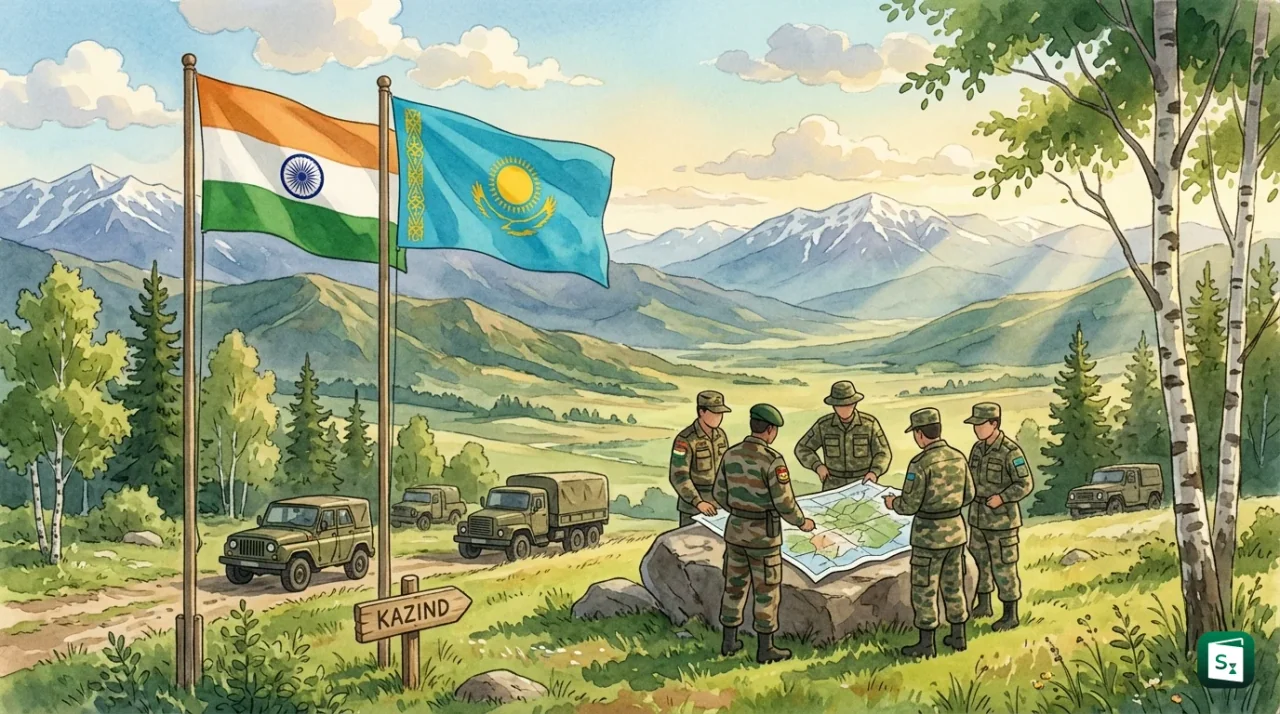
A 60 member Indian Armed Forces contingent reached Oskemen in Kazakhstan on 28 September 2026 for the ninth edition of Exercise Kazind 2026, the annual India Kazakhstan joint military exercise. The drill is being held from 28 September to 11 October 2026 with troops led by a battalion of the Garhwal Rifles on the Indian side and personnel from the Land Forces on the Kazakhstan side. The focus this year is joint counter terrorism operations in semi urban and mountainous terrain under a United Nations mandate.
What Is the Kazind Exercise 2026?
The Kazind Exercise 2026 is the ninth edition of the annual bilateral joint military exercise between India and Kazakhstan. The Ministry of Defence states its core mandate as building interoperability for joint counter terrorism operations in a sub conventional environment under a United Nations mandate. The 2026 edition runs from 28 September to 11 October 2026 in Oskemen, Kazakhstan.
The word sub conventional needs a clear meaning. It refers to conflicts that fall below full scale war, such as terrorist attacks, insurgency and armed infiltration across difficult terrain. Kazind trains both armies to plan and fight together in such situations, using common tactics, communication procedures and equipment drills.
The United Nations mandate is the legal base for the drill. Kazind is practised under Chapter VII of the UN Charter, which deals with action to maintain or restore peace. In practice, this means the soldiers rehearse tasks that a UN peacekeeping or peace enforcement force may be asked to do, such as protecting civilians, neutralising armed groups and securing key sites.
Where Was Kazind 2026 Held and Who Took Part?
The Ministry of Defence selected Oskemen, Kazakhstan as the venue for Kazind 2026. Oskemen, also spelled Ust Kamenogorsk, is the administrative centre of the East Kazakhstan Region in the eastern part of the country near the Altai mountains. The location falls under the Regional Command East of the Armed Forces of Kazakhstan, which hosted the opening ceremony on 29 September 2026.
The opening ceremony was presided over by Major General Zhenis Maralov, Chief of Regional Command East. Senior officers of Kazakhstan and Colonel Pankaj Vidyarthi, Defence Attaché of India to Kazakhstan, attended the event. The Indian contingent commander, Colonel Arun Dev Singh Jamwal, joined the Kazakh commander in addressing the troops and wishing both sides a safe and full training cycle.
Each side fielded 60 personnel in Kazind 2026. The Indian side was led by a battalion of the Garhwal Rifles, with additional personnel from other arms and services and the Indian Air Force (IAF). The Kazakhstan side was drawn mainly from its Land Forces. The equal strength allows both sides to form mixed tactical groups and practise joint command in an equal setting.
| Contingent Detail | India | Kazakhstan |
|---|---|---|
| Strength | 60 personnel | 60 personnel |
| Lead unit | Battalion of the Garhwal Rifles | Units of the Land Forces |
| Supporting elements | Other arms and services plus Indian Air Force personnel | Regional Command East host units |
| Exercise dates | 28 September to 11 October 2026 | 28 September to 11 October 2026 |
| Venue | Oskemen, Kazakhstan | Oskemen, Kazakhstan |
The Garhwal Rifles is one of the oldest infantry regiments of the Indian Army. The regiment was raised in 1887 and its regimental centre is at Lansdowne in Pauri Garhwal, Uttarakhand. Soldiers are recruited mainly from the Garhwal hills, and the regiment is known for mountain warfare. Its war cry is Badri Vishal Lal Ki Jai, which means victory to the sons of Lord Badrinath, and its motto is Yudhaya Krit Nishchaya, which means fight with determination.
What Did the Troops Train For in Oskemen?
The Indian Army states that Kazind 2026 centres on joint counter terrorism operations in semi urban and mountainous terrain. Semi urban terrain means small towns, villages and built up areas on the edge of cities, where terrorists can hide among houses and narrow lanes. Mountainous terrain adds steep slopes, thin air and limited roads, which make movement and supply very hard. Training in both settings helps soldiers shift from street level room clearing to high altitude patrols without losing coordination.
A major theme in 2026 is air mobility and drones. Unmanned Aerial Systems (UAS) are aircraft flown without a pilot on board, used for watching ground movement, guiding troops and spotting targets. Counter UAS means tools and drills to detect, jam or bring down hostile drones. Both armies are practising the integrated use of UAS and counter UAS, so surveillance, protection and strike tasks work as one system and not as separate skills.
The field drills are close to real tasks. The two contingents are rehearsing joint responses to terrorist actions, raids, search and destroy missions and cordon and search operations. In a cordon and search operation, troops surround an area to stop escape and then search it house by house. The troops are also practising the securing of helipads and landing sites and Special Heliborne Operations, in which soldiers are inserted by helicopter directly into or near a target area for a quick strike.
To manage these tasks, the exercise has set up a Joint Command Post and an Intelligence and Surveillance Centre. The Joint Command Post is a combined headquarters where Indian and Kazakh officers plan together, share maps and issue common orders. The Intelligence and Surveillance Centre collects inputs from patrols, drones and sensors and turns them into a single ground picture. The training will end with a validation exercise, a full dress test in which both contingents apply all rehearsed tactics against a simulated terrorist threat.
From Prabal Dostyk to Kazind: How the Exercise Has Grown
The Kazind exercise began in 2016 as Exercise Prabal Dostyk. Prabal Dostyk means robust friendship in Hindi. The first edition was a platoon level drill held in the Karaganda region of Kazakhstan from 3 to 17 September 2016, with troops practising counter terrorism and counter insurgency tasks in rural and semi urban settings. The second edition, Prabal Dostyk 2017, was held at Bakloh in Himachal Pradesh and closed on 14 November 2017.
After the second edition, the two sides upgraded the drill to a company level exercise and renamed it Exercise Kazind in 2018. Kazind combines the first syllables of Kazakhstan and India. The upgrade meant larger contingents, more complex missions and helicopter based operations. In 2023, the exercise became a bi service drill with the inclusion of the Indian Air Force, which added air mobility and close air support practice to the ground drills.
The exercise is now held every year, in India and Kazakhstan by turn. The recent cycle shows this pattern clearly. The sixth edition, Kazind 2022, was held at Umroi in Meghalaya from 15 to 28 December 2022. The seventh edition, Kazind 2023, was held at Otar in Kazakhstan from 30 October to 11 November 2023. The eighth edition, Kazind 2024, was held at the Surya Foreign Training Node in Auli, Uttarakhand from 30 September to 13 October 2024, with a battalion of the Kumaon Regiment leading the 120 member Indian side.
| Edition | Year | Venue | Key Feature |
|---|---|---|---|
| 1st as Prabal Dostyk | 2016 | Karaganda, Kazakhstan | Platoon level start |
| 2nd as Prabal Dostyk | 2017 | Bakloh, Himachal Pradesh | Second platoon level edition |
| Renamed as Kazind | 2018 | Alternating venues | Upgraded to company level |
| 6th as Kazind 2022 | 2022 | Umroi, Meghalaya | Defence cooperation focus |
| 7th as Kazind 2023 | 2023 | Otar, Kazakhstan | Bi service drill with Air Force |
| 8th as Kazind 2024 | 2024 | Auli, Uttarakhand | Kumaon Regiment led Indian side |
| 9th as Kazind 2026 | 2026 | Oskemen, Kazakhstan | 60 personnel each side, drone and heliborne focus |
Why Does Kazind Matter for India Kazakhstan Defence Relations?
The India Kazakhstan joint military exercise sits inside a wider strategic partnership. India was among the first countries to recognise Kazakhstan after the break up of the Soviet Union, with formal diplomatic ties established in 1992. The two countries signed a Strategic Partnership in 2009 and an agreement on Defence and Military Technical Cooperation in 2015. A joint memorandum signed in December 2002 already provides for officer training, joint military industrial projects and cooperation between defence industries.
Kazakhstan is central to this partnership because it is the largest economy in Central Asia and a major source of energy. Astana is the capital of Kazakhstan. The country holds large reserves of oil, gas and minerals and produces more than 40 percent of the world uranium (as of September 2026). For India, which is expanding civilian nuclear power from about 8.78 gigawatts toward a target of 100 gigawatts by 2047, steady uranium supply is critical. Kazakhstan supplied 2,100 tonnes of uranium during 2009 to 2014 and 5,000 tonnes during 2015 to 2019 through Kazatomprom, the national nuclear company, working with the Nuclear Power Corporation of India and the Department of Atomic Energy. Bilateral trade has more than doubled from 1.2 billion dollars in 2018 to about 2.4 billion dollars, making Kazakhstan the largest trade partner of India in Central Asia.
Defence ties also fit the regional security picture. Both countries are members of the Shanghai Cooperation Organisation (SCO), which was founded in 2001 and is headquartered in Beijing, and both take part in the India Central Asia Dialogue. The Dialogue brings India together with all five Central Asian states, namely Kazakhstan, Uzbekistan, Kyrgyzstan, Tajikistan and Turkmenistan. At the fourth Dialogue in June 2025, the ministers backed stronger links through the International North South Transport Corridor (INSTC) and the Chabahar Port in Iran. India announced a 1 billion dollar line of credit in 2020 for priority projects in the region and held the first India Central Asia Summit in January 2022. These links matter because India has no direct land border with Central Asia and needs reliable routes for trade and energy.
Kazind also holds a clear place in the calendar of joint military exercises of India. The Indian Army holds bilateral drills with many partners to build specific skills for deserts, jungles, mountains and seas. Kazind is the dedicated mountain and counter terrorism drill with Central Asia, just as other drills serve other fronts and terrains. This specialisation gives it lasting value. It keeps procedures common, builds trust between junior leaders and prepares both sides to work together in UN operations or regional stabilisation tasks at short notice.
Key Takeaways
- The 9th edition of Exercise Kazind 2026 between India and Kazakhstan was held from 28 September to 11 October 2026 in Oskemen, Kazakhstan.
- The Indian side fielded 60 personnel led by a battalion of the Garhwal Rifles, while Kazakhstan fielded 60 personnel mainly from its Land Forces.
- Kazind trains for joint counter terrorism operations in a sub conventional environment under Chapter VII of the UN Charter.
- The drill began in 2016 as Exercise Prabal Dostyk and was renamed Exercise Kazind in 2018 after upgrade to company level.
- The Garhwal Rifles was raised in 1887 and its regimental centre is at Lansdowne in Uttarakhand.
- Kazakhstan is India’s largest trade partner in Central Asia and supplies more than 40 percent of the world uranium used in part for India’s civilian nuclear programme.