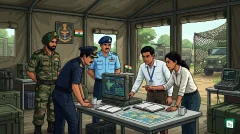
Infantry Day is observed by the Indian Army every year on 27 October. It marks the landing of the 1st Battalion of the Sikh Regiment at Srinagar airfield on 27 October 1947, the first military action of independent India. The troops held back Pakistan backed tribal invaders and saved Srinagar from capture.
What Is Infantry in the Indian Army?
The infantry is the branch of the Army in which soldiers fight mainly on foot to capture and hold ground. The Indian Army describes infantry as its largest fighting arm and calls it the Queen of Battle.
An infantry battalion is the basic fighting unit of this arm. A battalion has several rifle companies and usually has about 800 soldiers. Several battalions that share a common history, uniform, war cry and training centre form an infantry regiment. A regiment is not a unit that fights together as one block. Its battalions are posted separately under different brigades, divisions and corps.
| Term | Simple Meaning |
|---|---|
| Infantry | Soldiers who fight on foot and hold ground |
| Infantry battalion | Basic fighting unit with rifle companies |
| Infantry regiment | Parent family of battalions with shared history and centre |
| Infantry soldier | The individual foot soldier in a battalion |
The Indian Army has 27 infantry regiments, including the Sikh Regiment, Punjab Regiment, Madras Regiment, Rajput Regiment, Jat Regiment, Maratha Light Infantry, Kumaon Regiment, Garhwal Rifles, Dogra Regiment and the Gorkha Rifles groups. Newer all India units include the Brigade of the Guards, raised in 1949, and the Mechanised Infantry Regiment, raised in 1979, whose troops move in armoured vehicles. The Parachute Regiment, with its Special Forces battalions, provides the airborne part of the infantry.
Why Is Infantry Day Celebrated on 27 October?
Infantry Day is celebrated on 27 October because Indian infantry troops first landed in Srinagar on that date in 1947. That landing stopped Pakistan backed invaders from capturing Srinagar and protected Jammu and Kashmir. The day honours the courage of all foot soldiers who died in service.
The day is also called Shaurya Diwas. Shaurya means valour in Hindi, so the name means a day of bravery. It reminds citizens that infantry soldiers bear the main burden in every war and in counter insurgency duties.
The chain of events was short and urgent. On 22 October 1947, thousands of armed raiders from the tribal areas of the North West Frontier Province entered Jammu and Kashmir. The force, often called kabailis or lashkars, moved along the Jhelum Valley towards Baramulla and Srinagar. The small state forces of Maharaja Hari Singh resisted but could not stop them. Baramulla fell and the raiders turned toward Srinagar.
Maharaja Hari Singh sought military help from India. India agreed on the condition that the princely state accede to India. The Maharaja signed the Instrument of Accession on 26 October 1947. The Governor General, Lord Mountbatten, accepted it on 27 October 1947. This legal step made Jammu and Kashmir a part of the Dominion of India and cleared the way for Indian troops to fly to Srinagar the same morning.
How 1 Sikh Landed in Srinagar and Saved the Airfield
The 1st Battalion of the Sikh Regiment (1 Sikh) received the order to move on the night of 26 October. The battalion was then on internal security duty in Gurgaon near Delhi. Only two of its four companies were available at once. One battery of the 13 Field Regiment joined them in an infantry role to add strength.
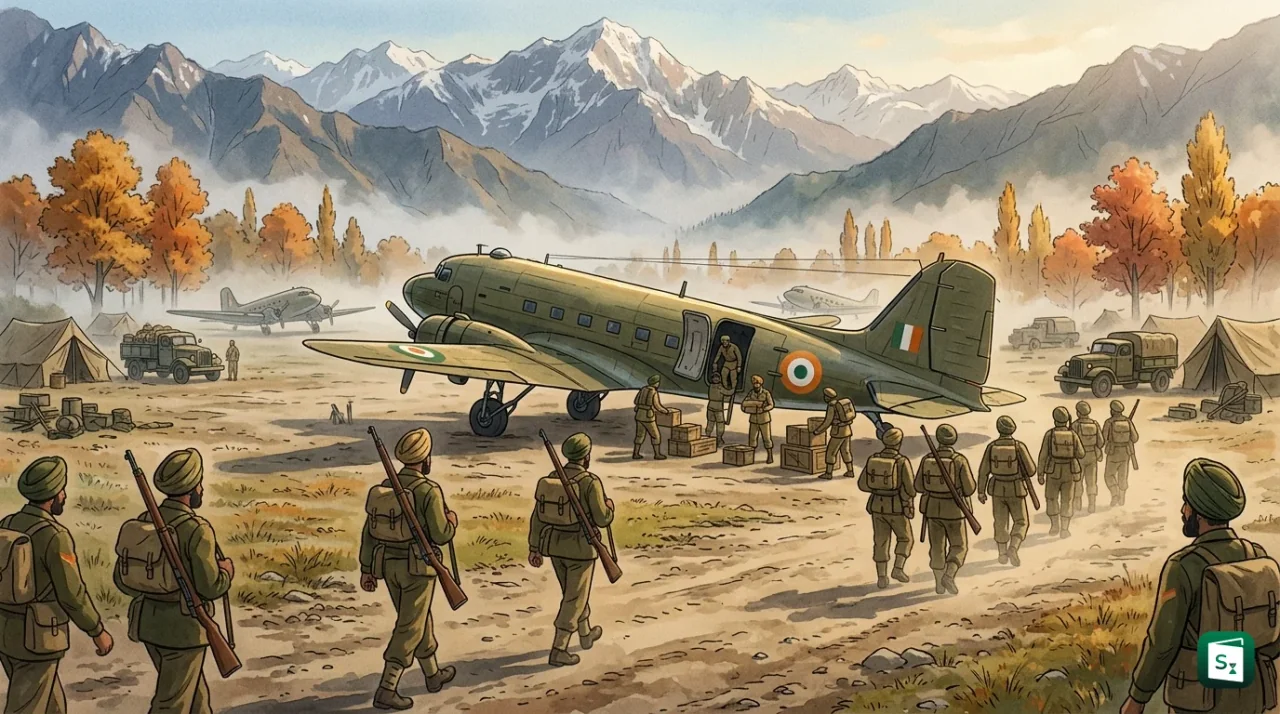
All troops gathered at Palam airfield in Delhi before dawn on 27 October. The Indian Air Force assembled seven Dakota aircraft, the military version of the Douglas DC-3. Only two Dakotas belonged to the Air Force. The rest came from civil airlines and private owners, including aircraft made available by Biju Patnaik, who later became Chief Minister of Odisha. In the cockpit of the lead aircraft was Air Commodore Mehar Singh, known in the Air Force as Baba Mehar Singh.
The first Dakota landed at Srinagar, then a dirt strip at Budgam, at about 8.30 in the morning. More sorties followed through the day. The men carried rifles, light machine guns, mortars and small packs of ammunition, food and winter clothing. Each flight was packed to fight at once on landing if needed.
Lt Col Dewan Ranjit Rai first secured the airfield and the civil wireless station. He then sent one company toward Baramulla, which was already burning, and held another company for a flag march in Srinagar city. The march calmed residents and firmly showed that Indian troops had arrived.
The fight soon shifted to the Srinagar to Baramulla road. The raiders numbered a few thousand and had machine guns and mortars. The small Indian force, about 150 men forward of Srinagar, took position on high ground near Baramulla. On 28 October the raiders attacked in strength. Rai ordered a careful withdrawal to Pattan and then to Shalateng, about midway to Srinagar, to keep his force intact and gain time.
That delay proved decisive. The stand at Pattan and Shalateng on 28 and 29 October wasted two vital days for the raiders. During that time more battalions, including the 1 Kumaon, 1 Punjab and guns of the artillery, landed in Srinagar. The 161 Brigade took command under Brigadier J. C. Katoch and later Brigadier L. P. Sen. The Battle of Shalateng on 7 November finally broke the raiders. For this action 1 Sikh received the Battle Honour Srinagar. The battalion later became the 4th Battalion of the Mechanised Infantry Regiment.
Who Was Lt Col Dewan Ranjit Rai?
Lt Col Dewan Ranjit Rai commanded 1 Sikh during the landing. He decided to meet the raiders far from Srinagar rather than wait at the airfield. He led reconnaissance himself and moved with his forward troops near Baramulla and Pattan.
He was killed while directing the withdrawal on 27 October 1947. He became the first recipient of the Maha Vir Chakra, the second highest wartime gallantry award of India. The honour recognised his leadership in stopping the invaders long enough for reinforcements to build up and save Srinagar.
Infantry Regiments of the Indian Army
Infantry is the oldest arm in any army. The present regiments trace their roots to the armies of the East India Company at Bengal, Madras and Bombay. After the revolt of 1857, the British raised many new units from Punjab and from Gorkha recruits. Those old lineages still live in regimental names, mottos and war cries.
Today the regiments follow different recruitment systems. Some draw from a single community or area, some mix fixed communities in separate companies, and newer all India units take recruits from across the country. The table lists major examples that appear often in news and history.
| Regiment | Raised | Regimental Centre |
|---|---|---|
| Punjab Regiment | 1761 origins | Ramgarh Cantonment, Jharkhand |
| Maratha Light Infantry | 1768 | Belagavi, Karnataka |
| Sikh Regiment | 1846 | Ramgarh Cantonment, Jharkhand |
| Jammu and Kashmir Rifles | 1821 origins | Jabalpur, Madhya Pradesh |
| Jammu and Kashmir Light Infantry | 1947 | Srinagar, Jammu and Kashmir |
| Madras Regiment | 1758 | Wellington, Tamil Nadu |
| Rajputana Rifles | 1775 | Delhi Cantonment |
| Gorkha Rifles groups | 1815 onwards | Sabathu, Shillong, Varanasi and Lucknow |
Since independence the infantry has fought in every major operation. Its record includes the 1947 to 1948 Kashmir operations, the 1962 war with China, the 1965 and 1971 wars with Pakistan, the 1999 Kargil conflict, Operation Pawan in Sri Lanka, Operation Rakshak in Punjab and Jammu and Kashmir, and Operation Snow Leopard in eastern Ladakh. The arm also leads counter insurgency duties in the north and northeast and guards both the Line of Control and the Line of Actual Control.
How Shaurya Diwas Is Observed Across India
The main national function is held at the National War Memorial in New Delhi. The Chief of the Army Staff lays a wreath at the Amar Chakra. Senior officers, veterans and families of fallen soldiers attend. Decorated veterans also lay wreaths on behalf of the infantry. In 2024 the 78th Shaurya Diwas was marked with the Chief of Defence Staff and the Army Chief together paying homage. In 2025 the Army marked the 79th Infantry Day with a similar wreath ceremony.
Units across commands hold their own tributes. Southern Command holds a wreath ceremony at its war memorial in Pune. Infantry schools and regimental centres hold sainik sammelans, band displays, runs and seminars. Recent programmes include the Field Marshal K. M. Cariappa Memorial Seminar in Lucknow, the Shauryaveer Run in Delhi Cantonment, felicitation of Veer Naris and Veer Matas, and release of an Infantry Magazine on new capabilities.
Srinagar holds special events. For the 75th anniversary in 2022, the Army held Shaurya Diwas at the old Budgam airfield in Srinagar, where the Dakotas had landed in 1947. A vintage Dakota was displayed and scenes from the landing were re enacted. The message of the day stays constant. It honours the foot soldier, recalls the first rescue of Srinagar, and renews the pledge to protect the unity and borders of the country.
Key Takeaways
- Infantry Day is observed every year on 27 October by the Indian Army.
- The day is also called Shaurya Diwas, which means a day of valour.
- The 1st Battalion of the Sikh Regiment, led by Lt Col Dewan Ranjit Rai, landed at Srinagar on 27 October 1947 in the first military action of independent India.
- The landing followed the Instrument of Accession signed by Maharaja Hari Singh on 26 October 1947 and accepted on 27 October 1947.
- Infantry is the largest fighting arm of the Indian Army, known as the Queen of Battle, with 27 infantry regiments.