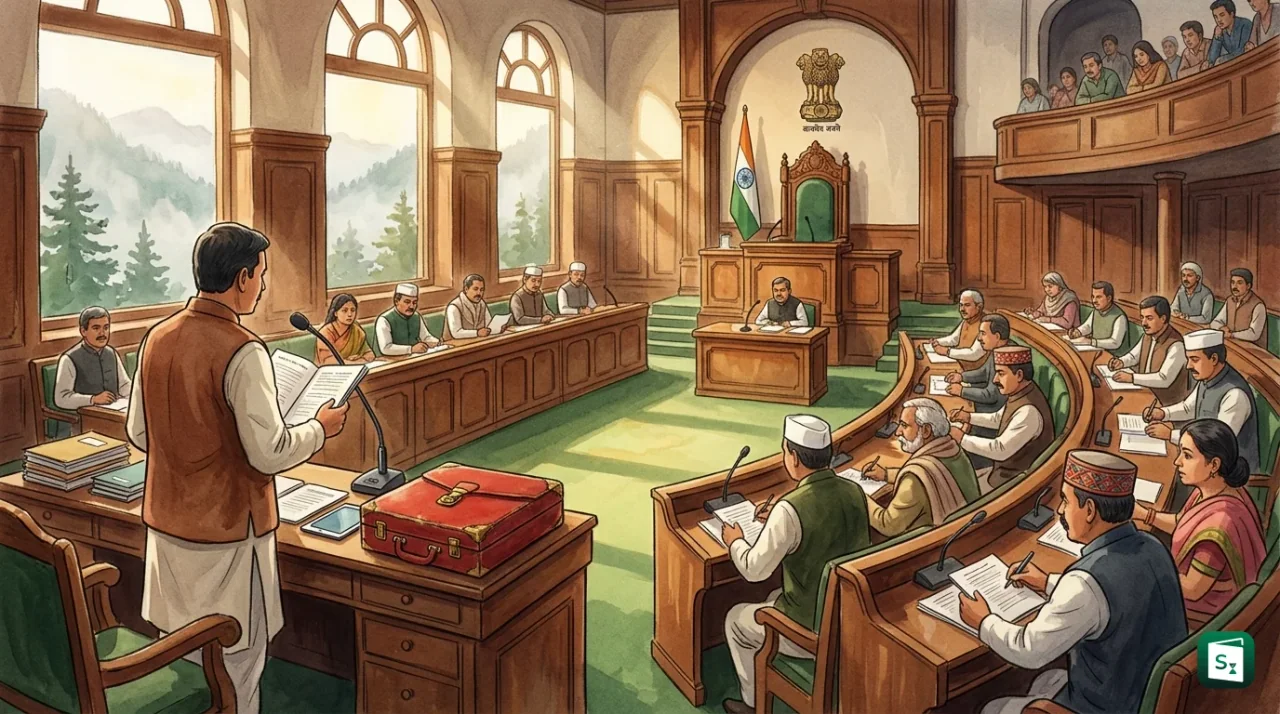
Uttarakhand Chief Minister Pushkar Singh Dhami presented a supplementary budget of ₹7,844.18 crore for 2026-27 in the Vidhan Sabha at Bhararisain, Gairsain on 27 October 2026. Dhami also holds the finance portfolio. The extra funds raise the yearly budget to about ₹1,19,547 crore and focus on the 2027 Haridwar Kumbh, farmers, local bodies and health.
What Is a Supplementary Budget?
A supplementary budget is an additional demand for funds presented during a financial year when the amount approved in the annual budget proves insufficient or new spending becomes necessary. The Uttarakhand government uses it to meet extra costs and fund new schemes without waiting for the next annual budget.
The Constitution provides for this step under Article 205, which deals with supplementary, additional or excess grants for states. The article says the Governor must place a fresh statement before the state legislature if sanctioned funds fall short or if spending is needed on a new service that was not part of the annual budget. The same procedure that applies to the annual budget under Articles 202, 203 and 204 applies here. The Assembly discusses the demands and passes an appropriation law to allow withdrawal from the Consolidated Fund of the State.
In practice, a supplementary demand arises in two common situations. An existing scheme needs more money than estimated, for example due to higher procurement or pending contractor dues. Or a new need appears during the year, such as preparations for a major event or relief after a disaster. Uttarakhand regularly uses the winter session at Gairsain or Dehradun to seek such approval before the financial year closes on 31 March.
How Big Is the Uttarakhand Supplementary Budget for 2026-27?
The Uttarakhand supplementary budget for 2026-27 totals ₹7,844.18 crore. Chief Minister Dhami tabled it in the Uttarakhand Legislative Assembly at Bhararisain on 27 October 2026. The House passed it on 28 October, along with nine other bills, before Speaker Ritu Khanduri adjourned the session.
The breakup between day to day spending and asset creation is important for understanding state finances. Revenue expenditure covers salaries, subsidies, pensions and running costs. Capital expenditure creates lasting assets such as roads, dams, schools and other public works.
| Head | Amount |
|---|---|
| Revenue expenditure | ₹3,679.86 crore |
| Capital expenditure | ₹4,164.32 crore |
| Total supplementary demand | ₹7,844.18 crore |
The annual budget for 2026-27, presented by Dhami on 9 March 2026, had proposed total spending of ₹1,11,703.21 crore. This was Dhami’s first budget after taking charge of the finance portfolio. With the supplementary demands, the total budget size for the year rises to ₹1,19,547.39 crore.
The main budget had estimated revenue expenditure of about ₹64,989 crore and a revenue surplus of about ₹2,536 crore. Dhami said the government had kept a revenue surplus position while maintaining fiscal discipline and transparency. He linked the extra spending to the goal of a developed and self reliant Uttarakhand by 2047, in line with the national target of developed India by 2047. The state’s Gross State Domestic Product (GSDP), which measures the total value of goods and services produced in the state, rose from about ₹2.55 lakh crore in 2022 to a projected ₹3.82 lakh crore in 2026-27.
Where Will the Additional ₹7,844 Crore Be Spent?
The supplementary demands spread funds across farming, local governments, water, health, education and preparations for large religious gatherings. The government said part of the money will complete schemes already announced in the general budget and part will fund new and expanded work.
| Sector | Key Allocation |
|---|---|
| Food grain procurement under Annapurti Scheme | ₹1,100 crore for paddy and wheat at support prices |
| Support to rural and urban local bodies | ₹721 crore after raising their tax share |
| Infrastructure under Special Assistance to States for Capital Investment | ₹500 crore |
| Jal Jeevan Mission dues to contractors | ₹300 crore for rural piped water works |
| Power transmission and distribution | ₹270 crore |
| Digital learning in schools and colleges | ₹200 crore |
| Medical colleges at Pithoragarh and Rudrapur | About ₹160 crore |
| Health cover for staff under Golden Card Scheme | ₹125 crore |
| Gairsain water supply dam project | ₹122 crore |
| Health cover for citizens under Atal Ayushman Scheme | ₹100 crore |
Agriculture received the single largest share. The ₹1,100 crore provision will ensure timely payment of Minimum Support Price (MSP), the assured price the government pays farmers, for paddy and wheat. Separate provisions support climate resilient farming and the development of Khurpiya Farm for modern farm methods and jobs.
Drinking water and infrastructure account for another large block. The ₹300 crore for the Jal Jeevan Mission, the central scheme to give tap water to every rural home, will clear pending payments so village supply work does not stop. The ₹500 crore under special assistance will fund capital works, while ₹122 crore will push the Gairsain dam to solve long term water shortage in the summer capital area.
Why Local Bodies, Farmers and the 2027 Kumbh Get Priority?
Stronger Funds for Panchayats and Towns
The supplementary budget proposes to raise the share of local bodies in the state’s own tax revenue from 10.5 percent to 12.5 percent. This follows the recommendations of the Sixth State Finance Commission, set up under Articles 243-I and 243-Y of the Constitution to review the finances of panchayats and municipalities. The commission is headed by former chief secretary N. Ravishankar and covers the five year period starting 1 April 2026.
The state has set aside ₹721 crore for this higher devolution. The money will give village panchayats, municipal corporations, municipalities and town panchayats more resources for roads, street lights, drinking water, sanitation and waste management. Dhami said pre budget consultations with farmers, women, youth and entrepreneurs over the last five years had shaped this focus on local needs.
Countdown to the Haridwar Kumbh in 2027
About ₹290 crore is earmarked for the Haridwar Kumbh Mela 2027, now described by the state as Divya Kumbh. The mela administration has fixed a four month period from 14 January to 20 April 2027 with 10 major bathing days. Three baths will be observed as Amrit Snan on 6 March for Mahashivratri, 8 March for Phalgun Amavasya and 14 April for Mesh Sankranti.
The government expects a far larger gathering than the 2010 and 2021 melas. The 2021 event was curtailed due to the Covid pandemic. The new funds will cover permanent and temporary works, ghat beautification and facilities for pilgrims. A separate ₹30 crore is provided for the Haridwar Ganga Corridor and ₹20 crore for the Nanda Raj Jat Yatra, the long pilgrimage honouring Goddess Nanda Devi that involves route building and pilgrim amenities.
Health, Education and Support for Youth and Women
Health gets linked provisions. The Atal Ayushman Scheme, which gives cashless treatment to all resident families, receives ₹100 crore to keep services running and clear pending claims. The Golden Card Scheme, which gives cashless care to serving and retired state employees, receives ₹125 crore. About ₹160 crore is set aside for medical education buildings, including colleges at Pithoragarh and Rudrapur.
Education and youth programmes receive ₹200 crore for digital learning in schools and higher institutions. The budget also provides ₹35 crore for a sports university, ₹15 crore as prize money for international medal winners and support for athlete training, scholarships and coaching for competitive examinations. A women’s sports college and the Mukhyamantri Yuva Bhavishya Nirman Yojana for skill and career support are also covered.
Women and social welfare schemes get targeted sums. These include honorarium support for Bhojan Mata, the cooks who prepare midday meals in schools, funds for anganwadis and the Poshan Abhiyaan nutrition programme, and ₹27 crore for destitute widow pensions. Farmer pensions and other social security pensions are also prioritised.
Key Takeaways
- Uttarakhand Chief Minister Pushkar Singh Dhami presented a ₹7,844.18 crore supplementary budget for 2026-27 in the Vidhan Sabha at Bhararisain on 27 October 2026.
- The demand includes ₹4,164.32 crore under capital expenditure and ₹3,679.86 crore under revenue expenditure, taking the total yearly budget to ₹1,19,547.39 crore.
- A supplementary budget is authorised under Article 205 of the Constitution when sanctioned funds prove insufficient or new spending needs arise during the year.
- The budget proposes to raise local bodies’ share in state tax revenue from 10.5 percent to 12.5 percent on the recommendation of the Sixth State Finance Commission, with ₹721 crore set aside.
- About ₹290 crore is provided for the Haridwar Kumbh Mela 2027, scheduled from 14 January to 20 April 2027 with 10 bathing festivals including three Amrit Snans.