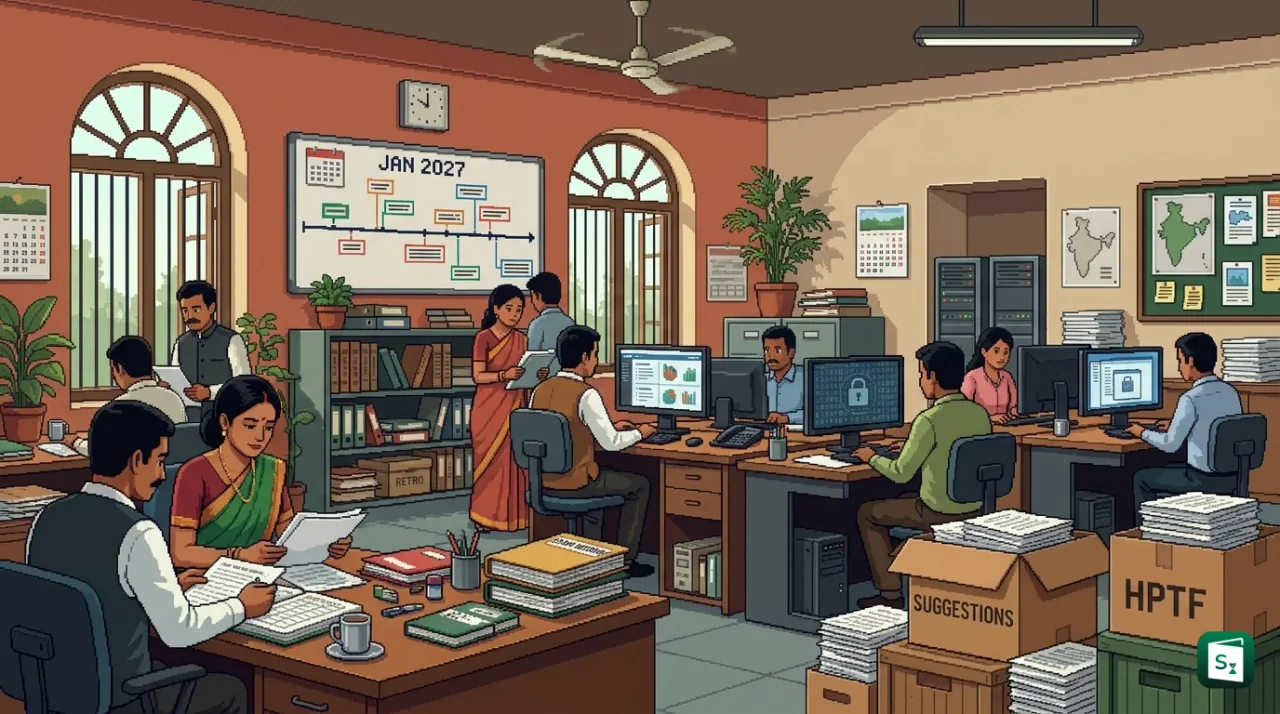
The central government has extended the tenure of the High Powered Task Force on examination reforms till January 2027. The six member panel headed by Infosys co-founder Nandan Nilekani was set up in July 2026 after the NEET UG paper leak controversy and was earlier expected to submit its report by October 2026. The extension will give the panel more time to study over 50,000 suggestions from students, teachers and institutions and finalise steps to make national entrance exams secure and leakproof.
What Is the High Powered Task Force on Examination Reforms?
The High Powered Task Force (HPTF) on examination reforms is a six member expert panel set up by the central government in July 2026 to recommend complete reforms for the conduct, security, design and governance of public examinations in India, including examinations held by the National Testing Agency (NTA). Prime Minister Narendra Modi announced the panel on 26 July 2026, a day after student protests at Jantar Mantar in Delhi and the resignation of then Union education minister Dharmendra Pradhan over the NEET UG paper leak controversy. The government notified the panel through the Cabinet Secretariat and asked it to suggest ways to build a secure, transparent, equitable and future ready examination system.
The task force is examining institutional systems, exam integrity, use of technology, exam infrastructure, access for all social groups and student well being. Its public notice of 28 August 2026 invited suggestions on ten areas, including conduct and security of exams, exam design, governance and accountability, prevention and redressal of malpractices, use of secure computer based testing, creation of exam centres, inclusive access across regions and languages, transparency and grievance redressal, and student well being.
What Is a Task Force in India?
A task force in India is a small, time bound group of experts created by the government to study a specific problem and suggest practical solutions within a fixed deadline. Unlike a permanent committee or commission, a task force stops work once it submits its report. It is different from a working group, which usually handles routine coordination, and from a standing committee, which works on a continuing basis. The HPTF follows this model, as it has a clear chairperson, defined terms of reference and a deadline of January 2027 to submit its recommendations.
Why Was the Tenure Extended Till January 2027?
The government has extended the tenure of the Nilekani panel till January 2027 because stakeholder consultations are still underway. The panel was first expected to submit its report by October 2026. Officials said the government has also filed an affidavit in the Supreme Court listing the progress made by the panel so far, as the court is hearing petitions on NEET UG and wider examination reforms.
The need for more time is linked to the scale of public response. The task force has received over 50,000 suggestions from students and candidates, parents, teachers and academic institutions, exam conducting bodies, subject experts, technology professionals and industry organisations. Suggestions were invited in English, Hindi and regional languages through a dedicated portal, a helpline, WhatsApp and email, with the initial last date fixed as 13 September 2026. The panel has also consulted former ISRO chairman K Radhakrishnan, who headed the earlier 2024 committee on NTA reforms, to avoid repeating past work and to build on what has already been implemented.
Who Are the Six Members of the Task Force?
The HPTF brings together experts from technology, space, intelligence, education and administration. The government chose this mix so that question paper security, digital systems, centre logistics and education policy could be examined together.
| Member | Background and Present Role |
|---|---|
| Nandan Nilekani, Chairperson | Co-founder of Infosys and founding chairperson of the Unique Identification Authority of India (UIDAI). He led the rollout of Aadhaar, the 12 digit biometric identity system, and helped shape the Unified Payments Interface (UPI). |
| S Somanath | Former chairperson of the Indian Space Research Organisation (ISRO) from 2022 to 2025. He led the organisation during the Chandrayaan 3 Moon landing and work on the Small Satellite Launch Vehicle. |
| Tapan Deka | Former director of the Intelligence Bureau (IB). A 1988 batch IPS officer, he has long experience in counter terrorism, intelligence coordination and action against organised malpractice networks. |
| V Kamakoti | Director of IIT Madras. A computer scientist known for work on computer architecture, cyber security and India’s first indigenous microprocessor Shakti. |
| Anita Karwal | Former Union education secretary and former chairperson of the Central Board of Secondary Education (CBSE). She was closely involved with the National Education Policy 2020. |
| Amrit Lal Meena | Former Chief Secretary of Bihar and former Secretary in the Ministry of Coal. A 1989 batch IAS officer, he is the logistics expert on the panel. |
What Is the Mandate of the Nilekani Panel?
The Nilekani panel has to recommend how to make India’s public examinations leakproof, technology driven and trusted by students. The central idea is to reduce human handling of question papers and to break the economic incentive to steal and sell a single paper. The panel is studying measures to strengthen data security, candidate verification, centre management and coordination with states and police.
Three technology proposals are under active discussion. First, the panel may suggest separation of roles so that one private service provider does not handle paper setting, centre management and conduct of the same exam. Second, it is looking at stronger encryption, multi layer access control, real time audit trails and CCTV linked monitoring at centres. Third, it supports a wider shift to computer based testing (CBT), where candidates answer on computers instead of pen and paper sheets.
How the Proposed Secure Question Vault Will Work
The most discussed proposal is a secure digital question vault linked to a large question bank. Subject experts would prepare individual questions through the year instead of setting a complete paper for a specific exam date. Each question would be checked, verified, translated into required languages and stored in encrypted form.
At the time of the exam, software would pick questions at random from this pool based on a fixed blueprint of syllabus, question type and difficulty. For example, a pool of one lakh questions could supply a paper of 20 to 30 questions for a Staff Selection Commission test. Even paper setters would not know which questions would appear on the final day. The selected questions would be encrypted and sent digitally to centres shortly before the start, and candidates would access them only after login. The Staff Selection Commission (SSC) already uses a similar method for its computer based recruitment tests.
How the Radhakrishnan Committee Links to the Nilekani Panel
The Nilekani task force is not the first panel on this subject. After the NEET UG 2024 paper leak, the Ministry of Education set up a seven member High Level Committee of Experts on 22 June 2024 headed by former ISRO chairman K Radhakrishnan. The committee held 23 full day sittings, received over 37,000 responses on MyGov and submitted its report on 21 October 2024 with 101 recommendations.
The Radhakrishnan report mapped weaknesses across the full testing life cycle, from paper setting and printing to transport, centre allotment, frisking, OMR handling and result declaration. It said the NTA had stretched itself by taking up many recruitment exams and depended heavily on outsourced vendors. It recommended that NTA should focus mainly on entrance exams, hire permanent domain staff, create 10 dedicated verticals, set up state and district coordination committees on the pattern of elections, and build 400 to 500 computer based centres with Kendriya Vidyalayas and Navodaya Vidyalayas.
Its key technology ideas were Computer Assisted Secure Pen and Paper Testing, in which encrypted papers are sent to servers at centres and printed just before the exam, and DIGI EXAM authentication on the lines of Digi Yatra using Aadhaar, biometrics and AI checks at application, test and admission stages. It also suggested multi session testing spread over days, multi stage testing for NEET UG on the pattern of JEE Main and Advanced, and a long term move to computer adaptive testing.
By mid 2026, about 60 short term recommendations had been acted upon, but 21 of 41 long term structural changes were still pending. A High Powered Steering Committee, also headed by Radhakrishnan, was asked to monitor implementation. The Nilekani panel covers much of the same ground on security and technology but has a wider scope. It has to review the entire exam ecosystem beyond NTA and examine the legal and statutory framework of NTA, which is at present only a registered society under the Societies Registration Act, 1860.
What Is the NTA and Why Does Its Reform Matter?
The National Testing Agency (NTA) is an autonomous testing body under the Department of Higher Education in the Ministry of Education. The Union Cabinet approved its creation in November 2017 and it became operational on 5 September 2018. It took over exams earlier held by the Central Board of Secondary Education (CBSE) and now conducts JEE Main, NEET UG, CUET, UGC NET, CMAT and GPAT. Since its start it has held more than 240 examinations for over 5.4 crore candidates. Its reform matters because a single failure affects lakhs of students and shakes trust in the whole admission system.
The legal response to paper leaks is already in place. Parliament passed the Public Examinations (Prevention of Unfair Means) Act, 2024, which came into force on 21 June 2024. The law defines leakage of papers and answer keys, tampering with OMR sheets and computer systems, fake websites and fake exams as unfair means. Individuals face three to five years in jail and a fine up to ₹10 lakh, while organised crime in exams can draw five to 10 years in jail and a minimum fine of ₹1 crore. The law covers exams held by UPSC, SSC, Railway Recruitment Boards, IBPS, NTA and central ministries.
Why NEET Will Move to Computer Based Test Mode From 2027
NEET UG is the entrance test for MBBS, BDS and AYUSH courses and draws more than 22 lakh candidates each year. It was the only major NTA exam still held in pen and paper OMR mode in 2026. After the cancellation of NEET UG 2026 held on 3 May and a retest on 21 June, the government announced that NEET UG will be held in computer based test mode from 2027. The NTA informed the Supreme Court in May 2026 that the shift follows the Radhakrishnan recommendation and will bring all major NTA exams onto the CBT platform. CBT allows encrypted delivery close to exam time, multi shift testing with normalisation of scores, and better on screen monitoring.
What Is Nandan Nilekani Famous For?
Nandan Nilekani, born in Bengaluru in 1955, is famous as the co-founder of Infosys, the company he started in 1981 with N R Narayana Murthy and five others and led as chief executive from 2002 to 2007. He is famous in public life as the founding chairperson of the Unique Identification Authority of India (UIDAI) from 2009 to 2014 with the rank of Cabinet minister, where he led the rollout of Aadhaar, the world’s largest biometric identity programme now held by more than 130 crore residents. He also helped design the Unified Payments Interface (UPI), chaired work on the electronic toll system FASTag and the technology architecture for the Goods and Services Tax (GST), authored Imagining India, and received the Padma Bhushan in 2006. His background in building secure digital systems at population scale is the reason the government chose him to lead exam reforms.
Key Takeaways
- The High Powered Task Force on examination reforms headed by Nandan Nilekani has been extended till January 2027 to submit its report.
- The six member panel was set up in July 2026 after the NEET UG paper leak and has received over 50,000 suggestions from stakeholders.
- The panel proposes a secure question vault with random selection from a large bank and digital delivery to centres just before the exam.
- The earlier K Radhakrishnan committee, set up on 22 June 2024, submitted 101 recommendations on 21 October 2024, including CBT and DIGI EXAM authentication.
- NEET UG will move to computer based test mode from 2027, covering more than 22 lakh candidates each year.