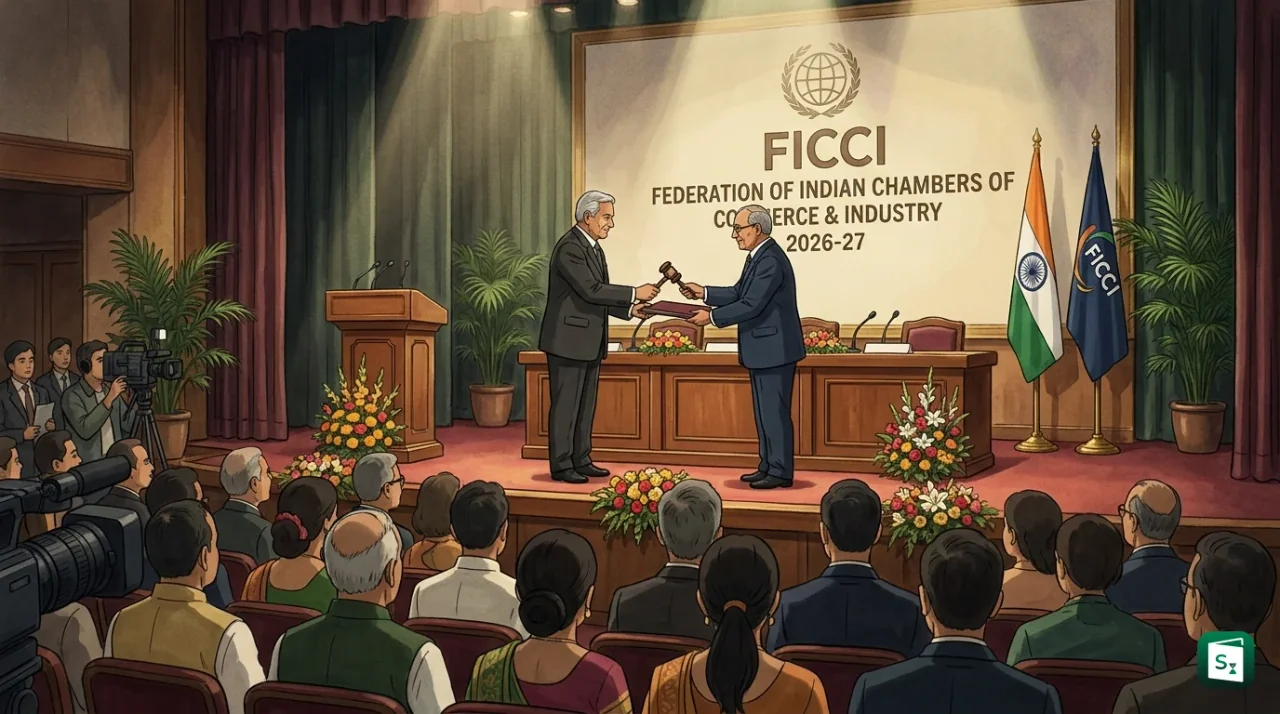
The Federation of Indian Chambers of Commerce and Industry (FICCI) has named Vijay Sankar, Chairman of The Sanmar Group, as its President Elect for 2026-27. The decision was announced at the FICCI National Executive Committee meeting in Mumbai on 29 October 2026. Sankar, currently Senior Vice President of FICCI, will succeed Anant Goenka after the Annual General Meeting and Annual Convention in New Delhi on 18 and 19 November 2026.
Who Is Vijay Sankar?
Vijay Sankar is the Chairman of The Sanmar Group, a Chennai headquartered industrial group with a turnover of about $1.6 billion. The group operates in chemicals and speciality chemicals, engineering technologies and steel castings, and shipping. It has factories in Tamil Nadu and Karaikal, along with plants in Mexico, the United States and Egypt.
Sankar holds a Bachelor of Commerce degree from Loyola College, Chennai. He is a qualified Chartered Accountant and holds a Master of Business Administration from the J L Kellogg Graduate School of Management, Northwestern University in the United States. He took charge of the operational management of the Sanmar Group and led its expansion into overseas markets.
Sankar is the Non-Executive Chairman of Chemplast Sanmar Ltd, the listed chemicals arm of the group. He serves as an independent director on the boards of TVS Motor Company Ltd and Larsen and Toubro Ltd. His earlier board roles include Transport Corporation of India, Oriental Hotels and The KCP Ltd.
He was President of the Indian Chemical Council from 2018 to 2020. He is Vice President of the Tamil Nadu Tennis Association. He is the Honorary Consul General of Denmark in Chennai, with jurisdiction over Tamil Nadu, Andhra Pradesh, Telangana, Kerala, Karnataka and Puducherry. He earlier served as Honorary Consul of Spain in Chennai for close to ten years.
Sankar is active in public health and education work. He is a trustee of the Childs Trust Hospital and Voluntary Health Services in Chennai. He serves on the board of governors of the Medical Research Foundation of Sankara Nethralaya and on the governing body of the Cancer Institute in Adyar.
How Was Vijay Sankar Chosen as FICCI President Elect?
FICCI National Executive Committee announced Vijay Sankar as President Elect on 29 October 2026 at its meeting in Mumbai. FICCI follows a fixed leadership ladder. A leader serves first as Vice President, then as Senior Vice President, and then as President Elect before taking charge as President.
Sankar joined the FICCI leadership as Vice President in November 2024. FICCI elevated him to Senior Vice President in November 2025, when Anant Goenka took over as President for 2025-26. Puneet Dalmia, Managing Director and Chief Executive Officer of Dalmia Bharat, joined the leadership as Vice President at the same time.
Sankar will take charge as President at the end of the 99th Annual General Meeting and Annual Convention on 18 and 19 November 2026 in New Delhi. Anant Goenka is the Vice Chairman of the RPG Group, a $5.2 billion group with interests in tyres, infrastructure, information technology, pharma and plantations. Goenka had led CEAT as Managing Director from 2012 to 2023.
What Is FICCI?
The Federation of Indian Chambers of Commerce and Industry (FICCI) is India’s oldest and largest apex business organisation. It is a non-government and not-for-profit body that speaks for Indian business and industry and advises the government on economic policy.
FICCI uses the full form Federation of Indian Chambers of Commerce and Industry. FICCI was established in 1927. The decision was taken through a resolution at the fourth session of the Indian Industrial and Commercial Congress in Calcutta, held from 31 December 1926 to 2 January 1927. Sir Purshotamdas Thakurdas moved the resolution. It was supported by leaders including Pandit Madan Mohan Malaviya. The office started work on 1 February 1927 from the premises of the Indian Merchants Chamber in Bombay. Two years later, the name was changed to add the word Industry, to show that it represented both trade and industry. G D Birla and Purshotamdas Thakurdas are counted among its key founders.
FICCI is headquartered at Federation House, Tansen Marg, New Delhi. Its secretariat shifted permanently to New Delhi in December 1936. The present headquarters building was dedicated to the nation by Prime Minister Jawaharlal Nehru in 1958.
FICCI is not a government organisation. It is not a statutory body. It draws members from private and public companies, small firms and multinational companies. Through regional chambers and associations, it reaches more than 2,50,000 companies. It works through expert committees, joint business councils with foreign partners, trade fairs, business delegations and flagship events such as FICCI FRAMES for media and entertainment. It also presents pre-Budget suggestions to the Finance Ministry every year. Because it tries to influence public policy on behalf of business, political science texts often describe FICCI as a pressure group.
How Does FICCI Differ From CII and ASSOCHAM?
India has three main apex industry chambers. FICCI, the Confederation of Indian Industry (CII) and the Associated Chambers of Commerce and Industry of India (ASSOCHAM) all give policy suggestions to the government. They differ in age, history and membership base.
| Body | Full Form | Founded | Base |
|---|---|---|---|
| FICCI | Federation of Indian Chambers of Commerce and Industry | 1927 | Over 2,50,000 companies through regional chambers |
| CII | Confederation of Indian Industry | 1895 as Engineering and Iron Trades Association, present form in 1992 | Direct members from industry plus lakhs of indirect members through associations |
| ASSOCHAM | Associated Chambers of Commerce and Industry of India | 1920 | Claims over 4,50,000 members, with a large share of small and medium firms |
FICCI is the oldest apex body in its present national form and is closely linked to the freedom movement. CII grew out of an engineering industry association and became very active after the economic liberalisation of 1991. ASSOCHAM presents itself as a knowledge chamber with a strong small business network. All three are part of the Industry Standards Forum with stock exchanges and the Securities and Exchange Board of India for disclosure norms.
Why Does This Appointment Matter in FICCI Centenary Year?
Vijay Sankar will lead FICCI in its centenary year. FICCI began work in February 1927, so the 2026-27 term leads the chamber into its 100th year. The centenary gives added weight to the new President’s agenda on manufacturing growth, ease of doing business and trade.
The appointment brings a Tamil Nadu based industrialist to the top post after more than two decades. The last such President was A C Muthiah in 2002-03. Sankar heads a group rooted in Chennai and South India, with plants in Tamil Nadu and Karaikal in Puducherry. His elevation improves regional balance in a body that is headquartered in New Delhi and often led by Mumbai and Delhi based groups.
The choice also puts a chemicals and manufacturing leader at the helm. The Sanmar Group works in speciality chemicals, engineering products, steel castings and shipping. These are sectors linked to industrial safety, quality standards and global supply chains. Sankar’s past as head of the Indian Chemical Council adds subject depth to this role.
Key Takeaways
- FICCI named Vijay Sankar as President Elect for 2026-27 on 29 October 2026 at its National Executive Committee meeting in Mumbai.
- Sankar will succeed Anant Goenka as FICCI President after the Annual General Meeting on 18 and 19 November 2026 in New Delhi.
- Sankar is Chairman of the Chennai headquartered Sanmar Group, with a turnover of about $1.6 billion across chemicals, engineering, steel castings and shipping.
- FICCI stands for the Federation of Indian Chambers of Commerce and Industry, established in 1927 and headquartered at Federation House, New Delhi.
- Sankar is the first Tamil Nadu based industrialist to head FICCI since A C Muthiah in 2002-03, and he will lead the chamber in its centenary year.