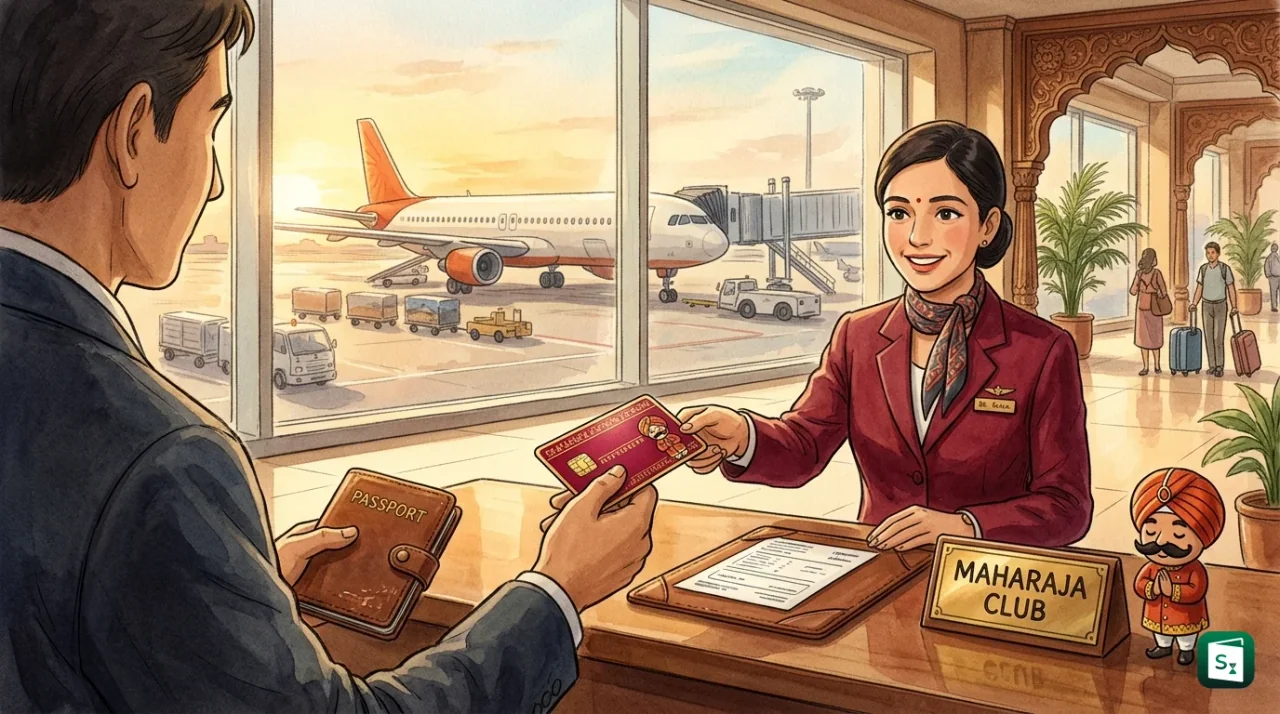
Air India, SBI Card and Visa announced a partnership on 28 October 2026 to develop a new co-branded credit card for members of Air India’s Maharaja Club loyalty programme. The Visa powered card will reward everyday spending as well as travel and lifestyle spending with Maharaja Points. It is the first Air India co-branded card of the Tata era since the airline returned to the Tata Group in January 2022.
What Is Maharaja Club in Air India?
The Maharaja Club is Air India’s frequent flyer and loyalty programme where members earn Maharaja Points on flights and partner spending and redeem them for free award flights and cabin upgrades. Membership is free, points stay valid for active flyers, and tier status unlocks lounge access and priority services.
The programme began in 1994 as Flying Returns, one of India’s oldest frequent flyer schemes. Air India joined the Star Alliance in 2014, which widened earning and redemption to partner airlines. After the Tata Group takeover, Air India redesigned the programme in 2024 with a simpler structure, renamed tiers and a new identity.
In November 2024, members of Vistara’s Club Vistara programme were moved into Maharaja Club when Vistara merged with Air India. Since the 2024 redesign, Air India says Maharaja Club has added more than five million new members.
Maharaja Club Membership, Points and Tiers
Maharaja Club membership is complimentary. There is no enrolment fee or annual fee to join. Members start at the Red tier and move up by collecting Tier Points or by completing a set number of flights in the previous 365 days.
Members earn two types of points. Maharaja Points are reward credits that can be spent on flights and upgrades. Tier Points decide tier status and cannot be spent. Both are earned on eligible Air India and Air India Express flights, while Tier Points are also earned on 25 other Star Alliance airlines.
| Tier | Tier Points Needed | Flights Needed in 365 Days |
|---|---|---|
| Red | Entry tier | Entry tier |
| Silver | 15,000 Tier Points, with at least 4,500 on Air India or Air India Express | 20 flights, with at least 4 on Air India or Air India Express |
| Gold | 30,000 Tier Points, with at least 9,000 on Air India or Air India Express | 45 flights, with at least 8 on Air India or Air India Express |
| Platinum | 45,000 Tier Points, with at least 13,500 on Air India or Air India Express | 60 flights, with at least 12 on Air India or Air India Express |
Higher tiers earn more Maharaja Points on the same ticket. Red members earn 6 points per ₹100 of eligible fare, Silver members earn 8 points, Gold members earn 9 points and Platinum members earn 10 points. Members earn 6 Tier Points per ₹100 in all tiers. Bookings made directly on the Air India website or app earn 2 extra Maharaja Points per ₹100.
Maharaja Points can be used on Air India, Air India Express and 25 Star Alliance airlines covering 104 destinations across North America, Europe including the United Kingdom, Australia, the Middle East, Africa and Asia. Points can also be earned through more than 100 partner brands in hotels, retail, lifestyle and financial services. Domestic award flights now start from 1,500 points, while one way international awards start from 35,000 points for Europe, 40,000 points for the United States and Australia, and 50,000 points for Canada. Points remain valid as long as the member takes at least one eligible flight every 24 months. Points can also be bought at ₹1.50 per point, up to 2,00,000 points in a defined window.
What the New Air India SBI Card Partnership Offers
Air India and SBI Card announced the partnership on 28 October 2026 to develop a new co-brand Visa powered credit card programme. Visa is the payment network partner, while SBI Card will be the issuer and Air India will link rewards to Maharaja Club.
The card is designed as a travel first product. Air India says holders will earn rewards on everyday purchases as well as on travel and lifestyle spending, and those rewards will build Maharaja Club balances. The aim is to make Maharaja Club the loyalty currency of choice for frequent flyers and regular spenders.
Air India Chief Commercial Officer Nipun Aggarwal said the goal is to build India’s most compelling travel credit card, matching a modernising fleet and expanding global network with a strong loyalty ecosystem. SBI Card Managing Director and Chief Executive Officer Salila Pande, who took charge on 1 April 2025, said the card will suit changing customer preferences for travel linked spending.
The partners have not yet disclosed the launch date, joining fee, annual fee, welcome bonus, earn rate or card variants. No product page or terms sheet has been published yet. Those details will decide the real value of the card, including how many Maharaja Points a holder earns per ₹100 and how lounge access and milestones work.
Old Air India SBI Signature and Platinum Cards Explained
This is not the first Air India and SBI Card partnership. SBI Card earlier issued two co-branded cards, the Air India SBI Signature Card and the Air India SBI Platinum Card, launched in 2013 when the loyalty programme was called Flying Returns. Both ran on the Visa network.
SBI Card stopped issuing both cards from 10 October 2024, just before Vistara merged into Air India. Existing holders kept their cards and benefits, but new customers could not get them. The new Maharaja Club card is therefore a revival after a gap of about two years.
Both old cards earned SBI Reward Points that converted to Maharaja Points at 1 reward point to 1 Maharaja Point. Earning rates were cut from 31 March 2025. The table below shows the current terms for existing holders.
| Feature | Signature | Platinum |
|---|---|---|
| Annual fee | ₹4,999 plus tax | ₹1,499 plus tax |
| Welcome gift on fee payment | 20,000 points | 5,000 points |
| Anniversary gift | 5,000 points | 2,000 points |
| Earn on Air India tickets booked on airline channels | 10 points per ₹100 | 5 points per ₹100 |
| Earn on other spending | 4 points per ₹100 | 2 points per ₹100 |
| Annual milestone bonus | 20,000 points at ₹5 lakh, 30,000 more at ₹10 lakh, 50,000 more at ₹20 lakh | 5,000 points at ₹2 lakh, 10,000 more at ₹3 lakh |
| Domestic lounge visits | 8 per year, up to 2 per quarter | 4 per year, up to 1 per quarter |
Earlier, Signature earned 30 points per ₹100 on Air India tickets and Platinum earned 15 points. Those higher rates no longer apply. Fuel, cash advances, wallet loads and instalment conversions earn no points, though fuel gets a 1 percent surcharge waiver on transactions from ₹500 to ₹4,000, capped at ₹250 per statement cycle.
First Co-Branded Card Since Air India Privatisation
The new card is the first Air India co-branded credit card since privatisation. The Tata Group, through its subsidiary Talace Private Limited, took full control of Air India and Air India Express on 27 January 2022 in a deal valued at about $2.4 billion, including debt takeover. Air India had been state owned for 69 years before the return to the Tata Group, which had founded the airline in 1932 as Tata Airlines.
After the takeover, the Tata Group consolidated four airlines into two. Low cost carriers Air India Express and AIX Connect, earlier AirAsia India, merged on 1 October 2024. Full service carriers Air India and Vistara merged on 12 November 2024. Vistara had been a 51:49 joint venture between Tata Sons and Singapore Airlines since 2013. After the merger, Singapore Airlines holds 25.1 percent in the enlarged Air India Group.
The combined group now operates about 300 aircraft, with more than 8,300 flights per week to 55 domestic and 48 international destinations. The consolidation is part of the five year transformation plan Vihaan.AI, which aims to build a world class global airline with modern fleet, new cabin products and wider network.
Air India is also expanding ancillary revenue, which means income beyond ticket sales from services like loyalty, cards and partners. A strong co-branded card supports that plan by keeping flyers inside the Maharaja Club system and giving the airline regular spending data and partner income.
Who Are SBI Card and Visa?
SBI Cards and Payment Services Limited is India’s largest pure play credit card issuer and the country’s second largest credit card issuer overall. It is a non banking financial company and a subsidiary of the State Bank of India. It is not a government department, though its promoter is India’s largest public sector bank.
The company was set up in May 1998 as a joint venture between State Bank of India and GE Capital. It is headquartered in Gurugram, Haryana. In March 2020, it became the first pure play credit card company to list on Indian stock exchanges. It trades as SBICARD on the NSE and BSE.
SBI Card had about 22.2 million cards in force in April 2026, with a market share of about 19 percent. Its portfolio covers premium, travel, shopping, lifestyle and corporate cards, along with many co-branded cards with banks, retailers and travel brands.
Visa Inc. is a global payments technology company that runs one of the world’s largest electronic payment networks. A co-branded card is a credit, debit or prepaid card created jointly by an issuer bank, a brand and a network. Here SBI Card is the issuer, Air India is the brand and Visa is the network that processes payments worldwide.
Visa has worked in India for more than four decades and supports about 300 million cards in the country through banks and financial technology partners. Globally, Visa supports more than 700 co-branded programmes. It brings fraud protection, global acceptance and data tools that help issuers and airlines design reward structures and track spending patterns.
Why Co-Branded Travel Cards Matter in India
A co-branded credit card links everyday spending to a favourite brand. The cardholder earns brand rewards on all purchases, the brand keeps a loyal customer, and the bank gets higher card use and spending data. Airline cards convert airfares, hotel stays and grocery bills into future flights.
India’s credit card market had about 106.88 million cards, with HDFC Bank as the largest issuer, followed by ICICI Bank, SBI Card and Axis Bank. Co-branded cards made up 12 to 15 percent of cards in 2023-24. Visa estimates the share could rise to 20 to 25 percent by 2027-28, growing twice as fast as regular cards.
Engagement is the reason. Industry data shows co-branded cards have activation rates near 70 percent, compared with about 50 percent for regular cards. Transactions are about 30 percent higher and spending per card is about 20 percent higher. Popular examples include the Amazon Pay ICICI Bank card and the Flipkart Axis Bank card in online shopping.
For airlines, the stakes are high. IndiGo leads domestic traffic, while the enlarged Air India Group competes on international routes and premium service. A well designed Maharaja Club card that offers strong point value, simple redemption and useful lounge and baggage benefits can pull high spending travellers away from rival cards and keep them flying Air India and Air India Express.
Key Takeaways
- Air India, SBI Card and Visa announced a new Maharaja Club co-branded credit card on 28 October 2026.
- The new card is the first Air India co-branded card since privatisation to the Tata Group on 27 January 2022.
- Maharaja Club, started as Flying Returns in 1994 and redesigned in 2024, has four tiers of Red, Silver, Gold and Platinum with free membership.
- Old Air India SBI Signature and Platinum cards stopped new issuance on 10 October 2024 and now earn 10 and 5 points per ₹100 on airline bookings.
- SBI Cards and Payment Services Limited, set up in 1998 and headquartered in Gurugram, is India’s largest pure play credit card issuer.