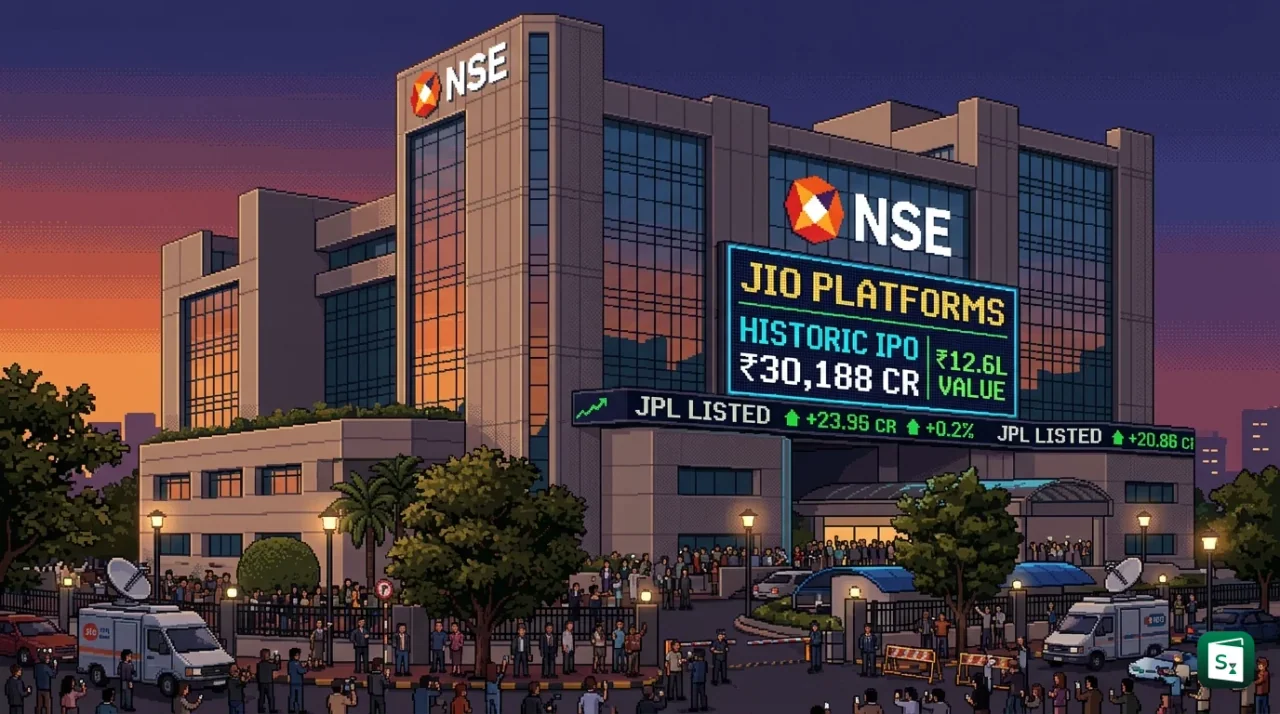
Jio Platforms Ltd listed its shares on the National Stock Exchange and Bombay Stock Exchange on 28 October 2026 after completing India’s largest Initial Public Offering worth ₹30,188 crore. The shares debuted at ₹1,358 against an issue price of ₹1,119, giving the company a market value of about ₹12.6 lakh crore. With this listing, Jio Platforms became India’s second most valuable listed company, behind only its parent Reliance Industries Ltd.
What Is Jio Platforms and What Does It Do?
Jio Platforms Ltd is the digital services arm of Reliance Industries Ltd (RIL). RIL created Jio Platforms in 2019 as a holding company for its telecom and digital businesses. The company is headquartered in Mumbai.
Its main subsidiary is Reliance Jio Infocomm Ltd, which launched mobile services in September 2016. The operator serves more than 533 million customers as of June 2026, which makes it India’s largest mobile operator. It reported 268.5 million 5G customers and 27.1 million home broadband users through JioFiber and JioAirFiber as of March 2026, the highest in both segments in India.
Jio Platforms is not only a telecom company. It offers mobile and fixed broadband connectivity along with entertainment apps such as JioTV+, JioSaavn and JioGames, cloud services such as JioAICloud and JioPC, smart home products, and enterprise services such as private 5G, cloud, Internet of Things solutions and managed network services. The company describes itself as an AI-native digital services firm and offers AI products such as JioBrain for consumers and businesses.
RIL held 66.43% in Jio Platforms before the IPO and remains the promoter with 64.48% after listing. The other large shareholders are Jaadhu Holdings, an affiliate of Meta, with 9.69%, and Google International with 7.50%. Other investors include Saudi Arabia’s Public Investment Fund, KKR, Vista Equity Partners, Silver Lake, Mubadala, General Atlantic and the Abu Dhabi Investment Authority, all of whom invested in 2020 when Jio Platforms raised about ₹1.52 lakh crore from 13 investors.
How Big Was the Jio Platforms IPO?
The Jio Platforms IPO raised ₹30,188 crore, which makes it the largest IPO in India till date. It crossed the previous record of ₹27,870 crore set by Hyundai Motor India in October 2024. The earlier record holder before that was the Life Insurance Corporation of India (LIC), which raised ₹20,557 crore in 2022.
The public issue opened on 21 October 2026 and closed on 23 October 2026. Bidding by anchor investors took place on 19 October 2026. The price band was fixed at ₹1,065 to ₹1,119 per share, and the final issue price was fixed at the top end at ₹1,119. The lot size was 12 shares, so a minimum retail application needed ₹13,428.
| IPO Fact | Detail |
|---|---|
| Issue size | ₹30,188 crore after employee discount |
| Type of issue | Fully fresh issue of about 27 crore shares, with no offer for sale |
| Face value | ₹10 per share |
| Listing date | 28 October 2026 on NSE and BSE |
| Employee discount | ₹54 per share, with final employee price at ₹1,065 |
The issue was fully subscribed within 100 minutes on the opening day. Overall subscription reached 22.19 times. Total demand across the public issue and anchor book crossed ₹7.4 lakh crore. Public bids alone stood at about ₹4.9 lakh crore from more than 1.38 crore applications, the first time any Indian IPO crossed one crore applications.
Institutional demand was very strong. The portion reserved for qualified institutional buyers was subscribed about 70.55 times, with bids worth nearly ₹3.87 lakh crore. Retail investors filed over 1.05 crore applications and the retail portion was subscribed 2.72 times. Eligible RIL shareholders filed 21.62 lakh applications under a separate shareholder quota, while large high net worth investors filed over 3.5 lakh applications, both new records.
The IPO was entirely a fresh issue. This means RIL, Meta, Google and other existing investors did not sell any shares. Jio Platforms plans to use up to ₹27,500 crore from the proceeds to repay or prepay borrowings of Reliance Jio Infocomm, with the balance kept for general corporate purposes.
How Did Jio Platforms Shares Perform on Listing Day?
Jio Platforms shares listed at ₹1,358 on both NSE and BSE on 28 October 2026. This was a premium of 21.36% over the issue price of ₹1,119. An investor who received one lot of 12 shares made a listing gain of nearly ₹2,900.
The shares rose further during the day. Jio Platforms closed its first trading session at about ₹1,417 to ₹1,419, up nearly 27% from the issue price. At listing, the company commanded a market capitalisation of about ₹12.5 lakh crore, which later crossed ₹13 lakh crore during the day. In dollar terms, this valued the firm at about $131 billion to $137 billion.
At the issue price itself, Jio Platforms already had an implied valuation of about ₹10.3 lakh crore, or more than $100 billion. This placed it in a small group of founder led firms that crossed $100 billion valuation at the time of listing.
On listing, Jio Platforms became India’s second most valuable listed company. It moved ahead of Bharti Airtel, which had a market value of about ₹12.08 lakh crore, and HDFC Bank, valued at about ₹10.67 lakh crore. Only RIL, valued at about ₹15.6 lakh crore to ₹15.9 lakh crore, ranked higher. The strong debut also made Jio Platforms one of the most valuable telecom firms in the world and set the stage for its possible entry into benchmark indices such as the Nifty 50.
Why Did Reliance Group Overtake Tata Group After the Listing?
The listing added more than ₹12.5 lakh crore to the market value of the Reliance Group. This pushed the combined market capitalisation of Reliance Group listed firms past ₹30 lakh crore, or about $318 billion. The Tata Group, with 18 listed firms including Tata Consultancy Services, Tata Motors, Trent and Titan, had a combined value of about ₹25 lakh crore to ₹26 lakh crore. As a result, the Reliance Group became India’s most valuable business conglomerate, a position the Tata Group had held for most of the past decade.
Before the Jio Platforms listing, the Reliance Group had a combined value of about ₹18 lakh crore. RIL alone accounted for about ₹16 lakh crore, while Jio Financial Services contributed a little over ₹1 lakh crore. The group has 11 to 13 listed firms, including Network18 Media, Just Dial, Hathway Cable, DEN Networks and Sterling and Wilson Renewable Energy. RIL and Jio Platforms together now account for nearly 95% of the group value.
The table below shows the order after the listing day, based on exchange and market data.
| Conglomerate | Combined Market Value | Key Listed Firms |
|---|---|---|
| Reliance Group | More than ₹28 lakh crore to ₹30 lakh crore | RIL, Jio Platforms, Jio Financial Services |
| Tata Group | About ₹25 lakh crore to ₹26 lakh crore | TCS, Tata Motors, Trent, Titan |
| Adani Group | More than ₹17 lakh crore | Adani Enterprises, Adani Ports, Adani Power |
| HDFC Group | Nearly ₹14 lakh crore | HDFC Bank |
At about $318 billion, the combined value of Reliance linked firms was close to the market value of the United States retailer Home Depot and above firms such as SAP, Netflix and Toyota at that time. Within India, two Reliance Group firms now hold the top two positions by market value, with RIL at number one and Jio Platforms at number two.
Where Does the NSE IPO Fit in the Record IPO Season?
The National Stock Exchange of India (NSE) listed its shares in September 2026 after a wait of nearly a decade. NSE, which is headquartered in Mumbai and started equity trading in 1994, is India’s largest stock exchange and the world’s largest derivatives exchange by number of contracts. It is regulated by the Securities and Exchange Board of India (SEBI), which was set up in 1988 and given statutory powers through the SEBI Act, 1992.
NSE filed its draft papers on 17 June 2026 and received SEBI’s clearance on 4 September 2026. The issue opened on 17 September 2026, closed on 21 September 2026, and listed around 24 September 2026. The price band was ₹1,700 to ₹1,785 per share. At the top end, the issue size was ₹22,569 crore through sale of 12.64 crore shares.
The NSE IPO was entirely an offer for sale. This means existing shareholders such as the State Bank of India, Bank of Baroda, General Insurance Corporation and others sold part of their holdings, and NSE itself received no fresh funds. This is different from the Jio Platforms IPO, which was entirely a fresh issue and where all funds came to the company.
At the time of its listing, the NSE issue was India’s second largest IPO after Hyundai Motor India. Within a month, the Jio Platforms issue of ₹30,188 crore moved to the top spot. Together, the two listings made 2026 a record year for India’s primary market, with the country’s largest telecom technology listing and its largest stock exchange listing taking place within weeks of each other.
Key Takeaways
- Jio Platforms raised ₹30,188 crore through India’s largest IPO, listing on 28 October 2026 at ₹1,358 against an issue price of ₹1,119.
- At listing, Jio Platforms was valued at about ₹12.6 lakh crore, making it India’s second most valuable company after Reliance Industries Ltd.
- The IPO was subscribed 22.19 times and drew over 1.38 crore applications, the first Indian IPO to cross one crore applications.
- After the listing, the Reliance Group crossed ₹30 lakh crore in combined value and overtook the Tata Group as India’s most valuable conglomerate.
- The NSE IPO worth ₹22,569 crore listed in September 2026 as a pure offer for sale, with NSE receiving no fresh funds.