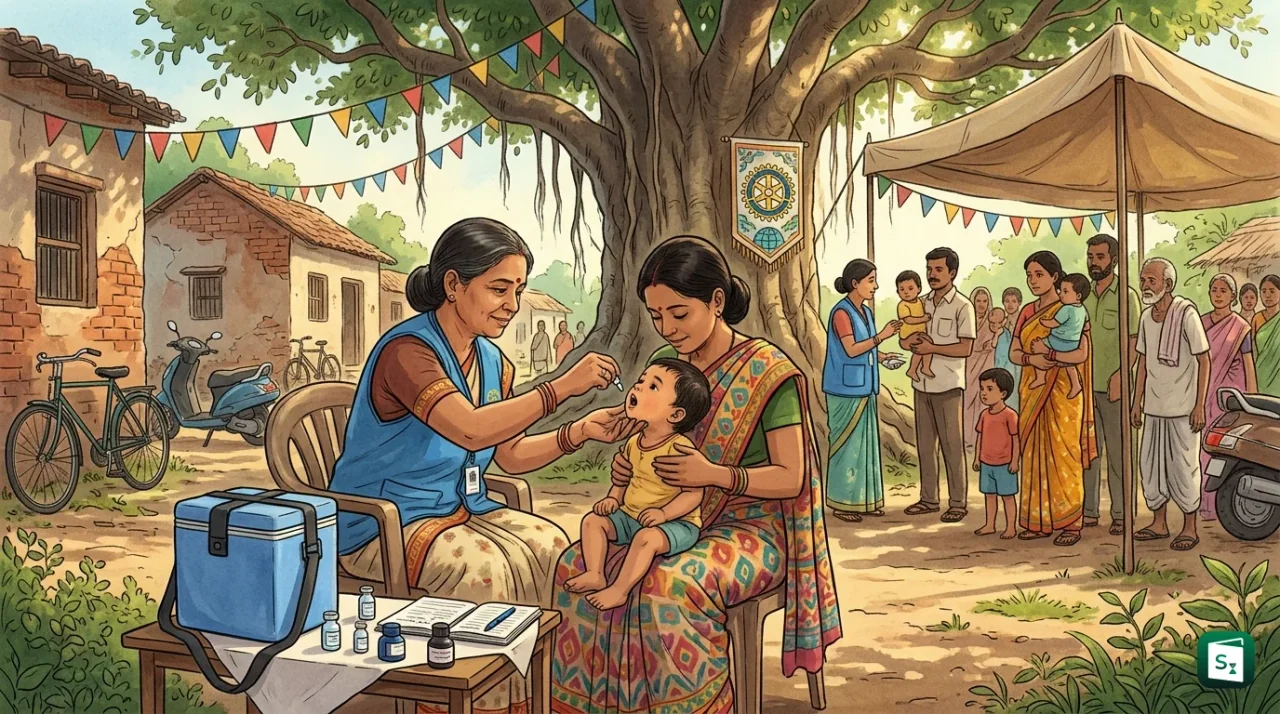
World Polio Day is observed on 24 October 2026 under the theme One day, one focus, Ending polio for good. Rotary International started the day to honour Jonas Salk, who developed the first successful polio vaccine in 1955. It draws attention to the last pockets of wild poliovirus and to India’s polio free status since 2014.
What Is Polio and How Does It Spread?
Poliomyelitis, commonly called polio, is a highly infectious viral disease that mainly affects children below five years of age. The disease is caused by the poliovirus, which is an enterovirus that enters the body through the mouth and multiplies in the intestine. From the intestine, the virus can invade the nervous system and destroy motor nerve cells in the spinal cord and brain stem.
There are three distinct types of wild poliovirus: wild poliovirus type 1 (WPV1), type 2 (WPV2) and type 3 (WPV3). All three types cause the same symptoms, but they are genetically different and have to be stopped separately. The incubation period is usually 7 to 10 days, though it can range from 4 to 35 days.
The poliovirus spreads mainly through the faecal oral route. It lives in the throat and intestines of an infected person and passes out through stool. A healthy person can get infected by drinking contaminated water, eating contaminated food, or putting a contaminated finger or toy in the mouth. The virus can also spread through droplets from a cough or sneeze, though this is less common. An infected person can pass the virus to others a few days before symptoms appear and for up to six weeks through stool, even if that person shows no symptoms.
Most infections cause no illness. Up to 90 percent of infected people show no symptoms at all. About one in four infected people develops mild flu like signs such as fever, headache, sore throat, tiredness, nausea and stomach pain, which clear up in 2 to 5 days.
In a small share of cases, the disease becomes serious. About 1 to 5 out of 100 infected people develop meningitis, which is inflammation of the covering of the brain and spinal cord. About 1 in 200 infections leads to irreversible paralysis, usually in the legs, which can appear within a few hours. Among those who develop paralysis, 5 to 10 percent die when the breathing muscles stop working.
There is no cure for polio. Treatment can only ease symptoms through rest, heat therapy, physiotherapy and medicines to relax muscles. Polio is contagious, but it can be prevented for life by giving polio vaccines multiple times in childhood.
Why Are Polio Drops Given Orally to Children?
The oral polio vaccine (OPV) is given as two drops in the mouth because it creates protection exactly where the poliovirus enters and grows, which is the gut. When a child swallows OPV, the weakened live virus multiplies in the intestine and triggers local gut immunity. This gut immunity stops the wild virus from multiplying and passing out in stool, so it breaks the chain of transmission. The injected vaccine alone protects the child from paralysis but allows more silent spread, which is why drops are central to eradication campaigns.
Two scientists gave the world the two main polio vaccines. American physician Jonas Salk developed the first successful vaccine in 1955, which was the inactivated polio vaccine (IPV). IPV contains killed poliovirus and is given by injection. American microbiologist Albert Sabin developed the live oral vaccine in 1961, which was later used as trivalent OPV against all three virus types. OPV became the main tool for mass campaigns because it is cheap, easy to give without a needle, and spreads limited immunity even to close contacts through vaccine virus shed in stool.
The two vaccines work in different ways, so many countries use both together.
| Feature | Oral Polio Vaccine (OPV) | Inactivated Polio Vaccine (IPV) |
|---|---|---|
| Virus type | Live weakened virus | Killed virus |
| How given | Drops in the mouth | Injection in the arm or leg |
| Main strength | Builds gut immunity and stops transmission | Builds strong blood immunity and stops paralysis |
| Use in campaigns | Preferred for Pulse Polio rounds and outbreak response | Used in routine immunisation to strengthen protection |
| Safety note | Very rarely can mutate and cause vaccine derived poliovirus | Cannot cause polio because the virus is dead |
India uses a combined schedule under the Universal Immunisation Programme. Children receive OPV at birth (called OPV-0), then at 6, 10 and 14 weeks, with a booster at 16 to 24 months. Children also receive fractional IPV by intradermal injection at 6 and 14 weeks and again at 9 to 11 months. During every Pulse Polio round, all children below five years receive an extra OPV dose, even if they have already completed routine doses.
Why Is World Polio Day Observed on 24 October?
World Polio Day is observed every year on 24 October by Rotary International and its partners. Rotary International established the day to commemorate the birth of Jonas Salk, the leader of the team that developed the first successful polio vaccine. Member clubs, health workers and volunteers use the day to review progress, raise funds and remind parents that timely vaccination is the only lasting protection.
Rotary International began its fight against polio in 1979 with a project to immunise six million children in the Philippines. In 1985, Rotary International launched PolioPlus, its global programme to support immunisation, with an initial pledge of 120 million dollars. Rotary International then joined the World Health Organization (WHO), UNICEF and the United States Centers for Disease Control and Prevention to launch the Global Polio Eradication Initiative (GPEI) in 1988.
The theme for 2026 is One day, one focus, Ending polio for good. The message places three clear tasks before governments and communities. These are vaccinating every child including those in remote and border areas, detecting poliovirus early through stool and sewage surveillance, and keeping families, health workers and local leaders fully involved. In Ethiopia, WHO described the 2026 theme as a joint pledge by GPEI partners to protect every child and build a polio free future.
How Did India Become Polio Free?
India once accounted for about 60 percent of global polio cases. In 1995, India launched the Pulse Polio Immunisation Programme for children below five years of age. The first large campaign had been held in Delhi on 2 October 1994. The programme used repeated National Immunisation Days (NIDs) and Sub National Immunisation Days (SNIDs), during which more than 170 million children received OPV in a single round with the help of about 24 lakh vaccinators and 1.5 lakh supervisors. The slogan Do Boond Zindagi Ki became the face of the campaign, and children were vaccinated at homes, schools, railway stations, bus stands, religious gatherings and border posts.
The effort produced a sharp fall in cases. India reported 741 cases in 2009, 42 cases in 2010 and only one case in 2011. The last wild polio case in India was reported from Howrah in West Bengal on 13 January 2011. WHO removed India from the list of endemic countries in February 2012. After three years with no wild poliovirus transmission and strong surveillance, WHO certified India as polio free on 27 March 2014, along with the rest of the South East Asia Region.
| Year | Milestone in India |
|---|---|
| 1988 | India joins the Global Polio Eradication Initiative resolution of the World Health Assembly |
| 1994 | First large Pulse campaign in Delhi on 2 October |
| 1995 | Nationwide Pulse Polio Immunisation Programme starts with OPV |
| 2011 | Last wild polio case in Howrah, West Bengal on 13 January |
| 2012 | India removed from endemic country list in February |
| 2014 | WHO certifies India and the South East Asia Region as polio free on 27 March |
| 2015 | Injectable IPV introduced in routine immunisation |
| 2016 | India shifts from trivalent OPV to bivalent OPV (types 1 and 3) with IPV cover for type 2 |
India has kept the protection in place after certification. The country still holds one NID and two SNIDs every year to keep population immunity high. Protection is tracked through Acute Flaccid Paralysis (AFP) surveillance in children and through testing of sewage samples, which can reveal silent circulation. The Government of India treats any wild polio case as a public health emergency and posts vaccination teams at international borders. Lessons and staff from the polio network were later used to strengthen routine immunisation through programmes such as Mission Indradhanush, which was launched in 2014 to raise full immunisation coverage to 90 percent in low coverage districts.
Where Does Polio Still Remain in the World?
The Global Polio Eradication Initiative began in 1988 when about 350,000 children were paralysed by polio every year across 125 countries. Since then, more than 3 billion children have received OPV in 122 countries through the work of Rotary International, WHO, UNICEF, the United States Centers for Disease Control and Prevention and the Bill and Melinda Gates Foundation. Wild polio cases have fallen by more than 99 percent. More than 20 million people who would otherwise have been paralysed are able to walk today.
Two of the three wild virus strains have been fully wiped out.
| Wild Virus Type | Status | Last Detection |
|---|---|---|
| Type 2 (WPV2) | Declared eradicated in September 2015 | Aligarh, Uttar Pradesh, India in 1999 |
| Type 3 (WPV3) | Declared eradicated in October 2019 | Northern Nigeria in November 2012 |
| Type 1 (WPV1) | Still circulating | Endemic in Pakistan and Afghanistan |
Only WPV1 now spreads naturally, and it remains endemic in Pakistan and Afghanistan, mainly along two cross border corridors linking eastern Afghanistan with Khyber Pakhtunkhwa and southern Afghanistan with Quetta and Karachi. WHO regions have been cleared step by step. The Americas were certified polio free in 1994, the Western Pacific Region in 2000, and the South East Asia Region in 2014. Africa was certified free of indigenous wild poliovirus in August 2020.
The final challenge comes from two sources. The first is continued WPV1 transmission in the two endemic countries, where missed children, refusals, population movement and insecurity allow the virus to survive. The second is outbreaks of circulating vaccine derived poliovirus (cVDPV), which occur when weakened vaccine virus spreads for a long time among under immunised children and regains the ability to cause paralysis. Sensitive AFP surveillance and sewage testing, rapid outbreak campaigns with type specific and novel oral vaccines, and high routine coverage remain the core tools to close these gaps.
Key Takeaways
- World Polio Day is observed on 24 October every year, and the 2026 theme is One day, one focus, Ending polio for good.
- Rotary International established World Polio Day to honour Jonas Salk, who developed the first successful inactivated polio vaccine in 1955.
- Albert Sabin developed the oral polio vaccine in 1961, which builds gut immunity and became the main tool for mass eradication campaigns.
- India reported its last wild polio case in Howrah, West Bengal on 13 January 2011 and was certified polio free on 27 March 2014.
- Wild poliovirus type 2 was declared eradicated in 2015 and type 3 in 2019, leaving only type 1 endemic in Pakistan and Afghanistan.