The SAMHiTA Palm Leaf Manuscript Digitisation Project was launched on 23 October 2026 at the Gangaramaya Temple in Colombo through cooperation between India and Sri Lanka. The India International Centre (IIC) in New Delhi is implementing the project with grant assistance from the Government of India to digitise 100 ancient manuscripts. The project aims to preserve shared Buddhist and intellectual heritage and make fragile ola leaf texts accessible through a digital archive.
What Is a Manuscript and Why Are Palm Leaf Manuscripts Important?
A manuscript is a handwritten text created before the spread of modern printing. In Indian history, manuscripts are primary sources for religion, philosophy, law, medicine, mathematics, astronomy, grammar and art. Historians use them to reconstruct how ideas travelled and changed across centuries.
A palm leaf manuscript is a manuscript written or incised on processed leaves of palm trees. In Sri Lanka, such leaves are called ola leaves. They usually come from the talipot palm, known as Corypha umbraculifera, and the palmyra palm, known as Borassus flabellifer. The leaves are cut, boiled with herbal materials, dried in sun, polished on a smooth wooden roller and trimmed to size. A sharp metal stylus is then used to incise letters, and natural black paste is rubbed in to make the script readable.
Palm leaf manuscripts are different from inscriptions. Inscriptions are texts carved on hard surfaces such as stone, rock walls, pillars or copper plates for public display. Manuscripts are portable texts on palm leaf, birch bark, paper or cloth, meant for study, copying and teaching. Both are historical sources, but manuscripts preserve longer works such as religious canons and treatises.
These manuscripts are fragile. Heat, humidity, fungus, insects and repeated handling can crack leaves, fade letters and stick pages together. The normal life of a palm leaf is often three to four centuries unless it is conserved or recopied. Digitisation creates high resolution images and a detailed catalogue, so scholars can read and compare texts without touching the originals.
What Is Project SAMHiTA?
Project SAMHiTA stands for South Asian Manuscript Histories and Textual Archive. The SAMHiTA initiative creates a relational database and open digital archive of Indian and South Asian manuscripts held in libraries and repositories outside India, in partnership with the institutions that hold them.
The word samhita in Sanskrit means collection or compilation. In Vedic literature, Samhita refers to the verse collection portion of each Veda, such as the Rigveda Samhita, which contains hymns. The modern project name SAMHiTA reuses the same idea of bringing together, but it is not a Vedic text. It is a research and preservation programme run by the India International Centre (IIC) in New Delhi.
SAMHiTA focuses on texts scattered across Asia, Europe and North America. Many Indic manuscripts moved out of the subcontinent between the 2nd and 3rd centuries CE through Buddhist and trade networks to places such as Central Asia, Tibet, China, Japan and Southeast Asia. From the 18th century, European collectors also carried large numbers to Western libraries. SAMHiTA maps these holdings, catalogues them and shares data on PANDiT, the Prosopographical Database of Indic Texts and Records, which links texts, authors, places and manuscripts for researchers.
The public portal already lists more than 3,219 published manuscripts from over 57 public collections. Partner repositories include the British Library in London, the Bodleian Libraries at Oxford, the Bibliotheque nationale de France in Paris, the University of Tokyo and the University of Pennsylvania. The Ministry of External Affairs supports this work through its heritage and development partnership mandate, which covers cultural restoration in Sri Lanka, Myanmar, Vietnam, Bhutan and other partner countries.
What Was Launched at Gangaramaya Temple in Colombo?
The SAMHiTA Palm Leaf Manuscript Digitisation Project at Gangaramaya Temple was launched on 23 October 2026. The Gangaramaya Temple signed a Memorandum of Understanding (MoU) with the India International Centre in July 2026. The temple is the first institution in Sri Lanka to join SAMHiTA.
The launch ceremony included a progress review, media briefing and site visit at the temple. High Commissioner of India to Sri Lanka Santosh Jha attended the event along with chief incumbent Venerable Dr. Kirinde Assaji Thero, Venerable Dr. Pallegama Rathnasara Thero, trustees of the temple and Project Adviser Prof. Gamini Ranasinghe with his team of Sri Lankan experts. The digitisation work is already underway and is expected to be completed by the end of November 2026.
The first phase covers 100 historic palm leaf manuscripts preserved at the temple. The selected texts mainly contain Sutta and Abhidhamma material related to Buddhist philosophy, along with records of religious traditions, languages and cultural practices. Temple authorities have clarified that the originals will remain in temple custody, and texts on traditional medicine and other restricted local knowledge are not part of this set.
How 100 Manuscripts Will Be Digitised and Catalogued
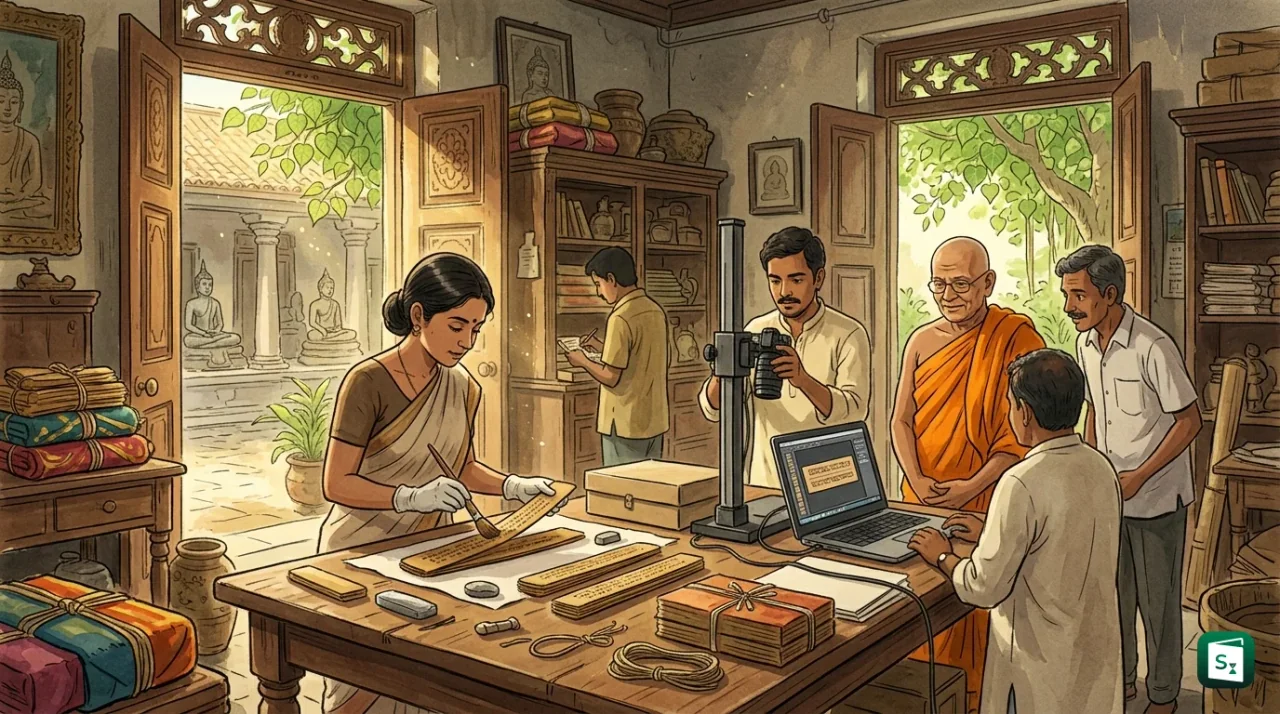
The Sri Lankan expert team handles the manuscripts inside the temple premises. The process has four clear steps. First, conservators clean and stabilise each fragile leaf. Second, technicians capture high resolution digital images of both sides of every leaf. Third, cataloguers record metadata such as title, language, script, subject and physical condition. Fourth, the images and records are organised for open access through the SAMHiTA and PANDiT platforms, with ownership retained by the temple.
| Step | Action at the Temple |
|---|---|
| Selection | Panel of scholars and temple leadership selected 100 Sutta and Abhidhamma manuscripts |
| Conservation | Gentle cleaning and stabilisation to prevent further cracking and fungal damage |
| Imaging | High resolution photography of each leaf to create a faithful digital copy |
| Cataloguing | Entry of language, script, content summary and storage details in a searchable database |
Who Are the Institutions Behind the Project?
The India International Centre (IIC) is a non official institution in New Delhi that promotes study and exchange on culture, public affairs and international understanding. The idea for the centre emerged in 1958 after talks between then Vice President S. Radhakrishnan and American philanthropist John D. Rockefeller III. The centre was registered in 1959 and inaugurated on 22 January 1962 by Radhakrishnan. Its founding team included C. D. Deshmukh as founder president and Kamaladevi Chattopadhyaya as the first vice president. The IIC stands on a 4.76 acre site near Lodi Gardens and now hosts research programmes through its International Research Division. Project Director Dr. Sudha Gopalakrishnan, former founder director of the National Mission for Manuscripts, leads SAMHiTA.
The Gangaramaya Temple is one of the oldest Buddhist temples in Colombo, located near Beira Lake. Scholar monk Hikkaduwe Sri Sumangala Nayaka Thera founded the temple in the late 19th century, with construction starting around 1885. His chief pupil Devundara Sri Jinaratana expanded it into a centre of learning, collected rare ola leaf books and printed the Pansiya Panas Jataka, the collection of 550 former lives of the Buddha. The temple later grew under Galboda Gnanissara Thera. Today the complex includes a vihara, cetiya, Bodhi tree, museum, library, vocational training centre and the Seema Malaka assembly hall on the lake. The temple is reported to hold about 1,500 palm leaf manuscripts, of which more than 1,100 have been conserved.
The Government of India provides grant assistance for the Colombo work through the High Commission of India in Colombo. The digitisation itself is carried out by Sri Lankan experts under temple supervision, so the physical handling and scholarly selection remain local.
How SAMHiTA Fits Into Indias Larger Manuscript Architecture
The National Mission for Manuscripts was launched on 7 February 2003 by Prime Minister Atal Bihari Vajpayee. The Ministry of Culture is the implementing ministry and the Indira Gandhi National Centre for the Arts (IGNCA) in New Delhi serves as the nodal agency. The mission surveys, documents, conserves, digitises and publishes manuscripts held by institutions and private collectors. India is estimated to hold five to ten million manuscripts, often described as the largest such wealth in the world.
The Gyan Bharatam Mission is the expanded successor to that mission. Finance Minister Nirmala Sitharaman announced the mission in the Union Budget 2025-26 for survey, documentation and conservation of manuscript heritage. The Standing Finance Committee has sanctioned Rs 491.66 crore for the period 2025 to 2031. The current year allocation is Rs 60 crore, raised from Rs 3.5 crore for the earlier mission. The mission aims to cover more than one crore manuscripts and build a National Digital Repository using artificial intelligence, optical character recognition and cloud storage.
About 3.5 lakh manuscripts covering more than 3.5 crore folios have already been digitised under this national effort, with over 1.35 lakh records on the portal. More than 40 cluster and independent centres and 28 states and union territories have joined the network.
SAMHiTA complements this domestic work abroad. While Gyan Bharatam secures manuscripts inside India, SAMHiTA secures South Asian manuscripts held outside India and links both efforts through shared cataloguing standards and open access.
Why the Project Matters for India Sri Lanka Cultural Relations
The Colombo project protects a shared Buddhist inheritance. Buddhism travelled from India to Sri Lanka more than two thousand years ago and shaped language, art and monastic learning in both countries. The Gangaramaya manuscripts preserve the words of the Buddha, monastic rules and philosophical analysis in Pali and related scripts. Digital copies let monks, students and researchers study the same text in Colombo, New Delhi and beyond.
The project also builds trust through custodianship. The originals stay at the temple. The digital data is shared openly but ownership of the images and catalogue records remains with Gangaramaya. This model answers a common concern in heritage work. Communities keep control while the world gains access.
For India, the project extends cultural diplomacy beyond monuments. The High Commission has invited other Sri Lankan temples, libraries and museums to join SAMHiTA with Indian grant support. In February 2026, the sacred Devnimori Relics of the Buddha from India were displayed at Gangaramaya, drawing large numbers of devotees. The October digitisation launch continues that arc from relic veneration to knowledge preservation. If more collections join, scholars will be able to trace how texts moved between India and Sri Lanka and how copyists adapted them over time.
Key Takeaways
- The SAMHiTA Palm Leaf Manuscript Digitisation Project was launched on 23 October 2026 at Gangaramaya Temple in Colombo.
- Gangaramaya Temple signed an MoU in July 2026 and became the first Sri Lankan institution to join SAMHiTA.
- The first phase will digitise 100 manuscripts, mainly Sutta and Abhidhamma texts, with completion expected by end of November 2026.
- SAMHiTA stands for South Asian Manuscript Histories and Textual Archive and is implemented by the India International Centre, established through inauguration in 1962.
- The National Mission for Manuscripts was launched in 2003, while its successor Gyan Bharatam Mission was announced in the Union Budget 2025-26 with Rs 491.66 crore for 2025 to 2031.