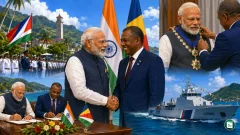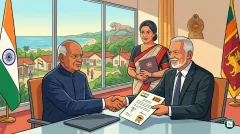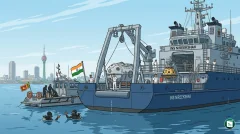
Defence Minister Rajnath Singh undertook a three day official visit to Sri Lanka from 8 to 10 September 2026, the first visit by an Indian Defence Minister to the island nation in 38 years. In Colombo, the Defence Minister met President Anura Kumara Dissanayake and Prime Minister Harini Amarasuriya to review the full range of bilateral ties. The visit produced three defence MoUs, the virtual inauguration of three Bailey Bridges built by Indian engineers, and a fresh push for joint maritime security in the Indian Ocean Region.
Who Is India’s Defence Minister Rajnath Singh?
Rajnath Singh is India’s Defence Minister and a senior leader who heads the Ministry of Defence in New Delhi. He has held the defence portfolio since 31 May 2019 and leads policy on military modernisation, defence production and international defence cooperation.
Rajnath Singh was born on 10 July 1951 at Bhabhaura village in Chandauli district, Uttar Pradesh. He earned an M.Sc. in Physics from Gorakhpur University and worked as a lecturer of physics at K.B. Post Graduate College in Mirzapur. He represents Lucknow in the Lok Sabha and has earlier served as Union Home Minister from 2014 to 2019, Chief Minister of Uttar Pradesh in 2000 to 2002, and national president of the Bharatiya Janata Party. The Defence Minister led a high level delegation of senior officials from the Ministry of Defence and the Ministry of External Affairs during the Colombo visit. He was received at Bandaranaike International Airport on 8 September by Sri Lanka’s Deputy Defence Minister Major General (Retd) Aruna Jayasekara and Indian High Commissioner Santosh Jha.
India Sri Lanka Relations: Background to the 2026 Visit
India Sri Lanka relations rest on close geography, shared history and strong people to people links. Sri Lanka is an island nation in the Indian Ocean, separated from India by the Palk Strait, and Colombo is its executive and judicial capital. India follows a Neighbourhood First policy, which gives priority to stability and growth in neighbouring countries, and the vision of MAHASAGAR (Mutual and Holistic Advancement for Security and Growth Across Regions), which calls for collective security and growth across the Indian Ocean Region.
The bilateral defence framework received a major push during Prime Minister Narendra Modi’s visit to Colombo on 5 April 2025. India and Sri Lanka signed their first umbrella Defence Cooperation MoU, valid for five years, along with six other agreements on energy, digital links, health and trade. That package included the plan to develop Trincomalee as an energy hub, the Sampur solar power project and power grid connectivity. The Dissanayake government also repeated its assurance that Sri Lankan territory would not be used in any manner harmful to India’s security.
Humanitarian support has deepened this partnership in recent years. India assisted Sri Lanka during the economic crisis of 2022 with credit lines and essential supplies. After Cyclone Ditwah struck in late 2025, India launched Operation Sagar Bandhu as a first responder. Indian ships including INS Vikrant, Indian Air Force Mi-17 helicopters, an 80 member National Disaster Response Force team and an Army field hospital near Kandy delivered relief. India supplied more than 1,100 tonnes of relief material and about 14.5 tonnes of medicines. External Affairs Minister S. Jaishankar then announced a $450 million reconstruction package, with $350 million as a concessional line of credit and $100 million as grants, for roads, railways, bridges, houses, health, education and agriculture. The September 2026 visit by the Defence Minister is the first ministerial step to put the 2025 defence framework into action through concrete projects.
What Happened During the Colombo Meetings?
The Defence Minister of India held detailed talks with the top leadership of Sri Lanka in Colombo on 9 September 2026. The Defence Minister conveyed greetings from Prime Minister Narendra Modi and congratulated President Dissanayake on the completion of two years of his government. Both sides described each other as civilisational twins, close neighbours and maritime partners who would work together for development and for peace in the region.
Where Is Colombo Located?
Colombo is the executive and judicial capital of Sri Lanka and is located on the western coast of the island on the Indian Ocean. It houses the President’s House, government ministries, foreign missions and the Port of Colombo. Sri Jayawardenepura Kotte is the legislative capital of Sri Lanka.
In the meeting with President Anura Kumara Dissanayake, the two leaders reviewed defence, economic, maritime and regional cooperation. President Dissanayake thanked India for relief under Operation Sagar Bandhu and for the reconstruction package. The Defence Minister said India treats help to Sri Lanka as a responsibility, not a favour, and as a first responder in a crisis. The two leaders then virtually inaugurated the three Bailey Bridges and exchanged the three MoUs.
Later the same day, the Defence Minister called on Prime Minister Harini Amarasuriya. Their discussion focused on development cooperation, education, information technology, infrastructure, innovation and cultural links. The Defence Minister underlined capacity building as a key pillar and described India and Sri Lanka as sister democracies with a shared heritage. He also noted the role of women leaders in both countries as a symbol of democratic strength.
The visit also included wider engagements. On 8 September, the Defence Minister addressed the Indian diaspora in Colombo and said India would stand firmly with Sri Lanka in times of crisis. He attended a deck reception on board INS Udaygiri, an indigenously built stealth guided missile frigate, at Colombo port from 8 to 11 September 2026. During that event, India handed over spares for the Indra Mk-II radar for the Sri Lanka Air Force, spares for the Sri Lanka Navy ship Sayura and inflatable targets to strengthen daily operations. The ship’s crew also held training, sports and beach cleaning activities with the Sri Lanka Navy in support of the Clean Sri Lanka Campaign.
Three Defence MoUs and the L70 Gun Upgrade
The Defence Minister of India and President Dissanayake exchanged three MoUs in Colombo on 9 September 2026. These are the first detailed agreements signed under the umbrella Defence Cooperation MoU of April 2025.
| MoU | What It Covers | Why It Matters |
|---|---|---|
| Upgrade of six 40mm L70 guns for the Sri Lanka Air Force | Modernisation of existing guns under a Government of India grant | Strengthens air defence of critical assets in Sri Lanka |
| Academic cooperation between National Defence Colleges | Knowledge sharing between India’s National Defence College in New Delhi and Sri Lanka’s National Defence College | Builds long term links in military education and strategy |
| National Cadet Corps youth exchange | Formal framework for NCC cadet exchanges, including participation in annual NCC events in New Delhi | Connects young cadets and builds people to people ties |
The L70 gun package is the most significant of the three. The 40mm L70 is a towed anti aircraft gun first designed by Sweden’s AB Bofors in the late 1940s and inducted by India in the early 1960s. It fires about 300 rounds per minute with a muzzle velocity of about 1,000 metres per second and has an effective range of 3 to 4 km. India later produced the gun under licence at the Gun Carriage Factory in Jabalpur.
Sri Lanka received 24 L70 systems from India between 2000 and 2006. India has already serviced 18 systems free of cost in recent years. The new MoU covers the upgrade and maintenance of the remaining six guns held by the Sri Lanka Air Force. The upgraded guns will protect critical sites against low flying threats, including small drones and unmanned systems.
The Indian experience shows why the upgrade is valuable. Since 2017, Bharat Electronics Limited (BEL) has upgraded more than 200 L70 guns for the Indian Army with electric drives, a digital ballistic computer, thermal imagers, daylight television cameras, laser rangefinders and new fire control systems. These guns can now work day and night, track fast targets and fire proximity fused ammunition that bursts near a drone. The same upgraded guns played a key role in stopping drone swarms along India’s western border in May 2025. Sri Lanka will gain a similar low cost, proven layer of short range air defence without buying a new missile system.
Bailey Bridges Built by the Indian Defence Forces
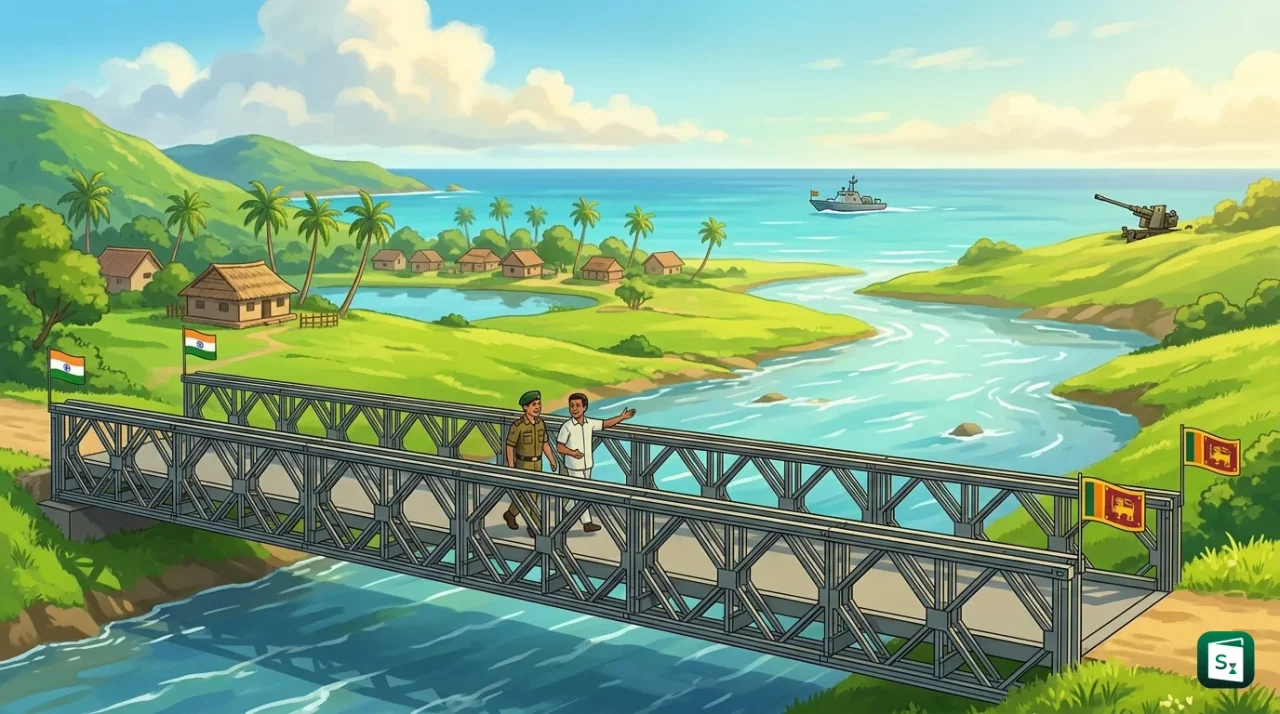
The Defence Minister of India and President Dissanayake virtually inaugurated three Bailey Bridges during the Colombo meeting. The bridges were built in Kurunegala and Batticaloa by an Indian Army Engineer Task Force working with the Sri Lanka Army Engineers under the $450 million post Ditwah rehabilitation package. One of the completed bridges at Kaballawa in Kurunegala is 100 feet long and 17 feet wide and was built between 22 and 24 August 2026.
What Is a Bailey Bridge?
A Bailey Bridge is a prefabricated steel bridge made of ready panels that soldiers can join quickly without heavy machines. It was first designed for military use in the Second World War. Armies use it to restore road links fast after floods, cyclones or war damage.
These bridges fill an urgent need after Cyclone Ditwah washed away roads and crossings in several provinces. India sent about 214 tonnes of bridge components to Colombo in February 2026. A grant of $30 million from the total package is set aside only for Bailey and permanent bridges. Indian teams have surveyed more than 40 damaged bridge sites across seven provinces and are helping Sri Lanka’s Road Development Authority with repairs to roads and culverts.
Earlier results show the impact. In March 2026, India and Sri Lanka inaugurated a 240 feet long Bailey Bridge on the Chilaw Thoduwawa Road in Puttalam district, the longest extra wide bridge installed by India in this phase. India had earlier supplied four sets of Bailey Bridges, with two installed in Kilinochchi district and two on the Kandy Ragala Road. Around 15 Bailey Bridges are planned in the coming weeks to restore links for villages, schools, temples and farms that were cut off by the cyclone.
Regional Maritime Security Cooperation in the Indian Ocean
Maritime security means keeping sea lanes safe, open and lawful so ships can move freely and trade can grow. For India and Sri Lanka, this covers the sea area around the island, the Palk Strait and the wider Indian Ocean Region where a large share of the world’s oil and container traffic passes.
During the Colombo visit, the Defence Minister of India said secure sea lanes, freedom of navigation, respect for international law and unhindered maritime trade must remain central goals. He spoke at the Sri Lankan Ministry of Defence on the theme of India Sri Lanka maritime cooperation and civilisational partnership. He proposed that India and Sri Lanka move toward a joint and integrated Maritime Domain Awareness system that would give both countries real time information about ships near the island.
Such a system would link navies, coast guards and other agencies to track illegal fishing, suspicious vessels, narcotics trafficking, smuggling and terrorism. India offered help in capacity building, joint exercises and training through mobile training teams on board ships like INS Udaygiri. The visit of INS Udaygiri itself, commanded by Captain Vikas Sood, showed this method in practice, with joint training on search and seizure, experience sharing and supply of spares. This cooperation fits India’s Neighbourhood First policy and MAHASAGAR vision, and it responds to shared concerns about extra regional activity in waters close to Sri Lanka.
Why the Visit Matters and the Way Forward
The September 2026 visit matters because it closes a gap of nearly four decades in defence minister level contact. The last such visit took place in 1988. Since then, prime ministers, presidents and service chiefs have met often, but the defence minister level was missing. The visit signals that the April 2025 umbrella pact is now moving from words to projects.
For Sri Lanka, the gains are practical. The upgraded L70 guns improve protection of airfields and ports at low cost. The Bailey Bridges restore daily travel and markets in cyclone hit districts. Training links between defence colleges and youth exchanges build skills and trust for the future. For India, closer maritime awareness around Sri Lanka helps secure trade routes and check unlawful activity near its southern coast.
The next steps are clear from official statements. Both sides will review the five year Defence Cooperation MoU through regular defence dialogues. More Bailey Bridges will be completed under the $30 million bridge grant. The L70 upgrade will move to execution under the Indian grant. Naval port calls, joint exercises and work on a shared maritime information grid are expected to continue, with the welfare of people and the safety of the region as the stated guide.
Key Takeaways
- Defence Minister Rajnath Singh visited Sri Lanka from 8 to 10 September 2026, the first Indian Defence Minister visit in 38 years.
- The Defence Minister met President Anura Kumara Dissanayake and Prime Minister Harini Amarasuriya in Colombo to review bilateral ties.
- India and Sri Lanka exchanged three defence MoUs covering L70 gun upgrade, National Defence College cooperation and NCC youth exchange.
- India will upgrade six 40mm L70 guns of the Sri Lanka Air Force under a Government of India grant to strengthen air defence.
- The two leaders virtually inaugurated three Bailey Bridges in Kurunegala and Batticaloa built by the Indian Army Engineer Task Force.
- INS Udaygiri visited Colombo from 8 to 11 September 2026 and India proposed a joint Maritime Domain Awareness system for real time shipping information.