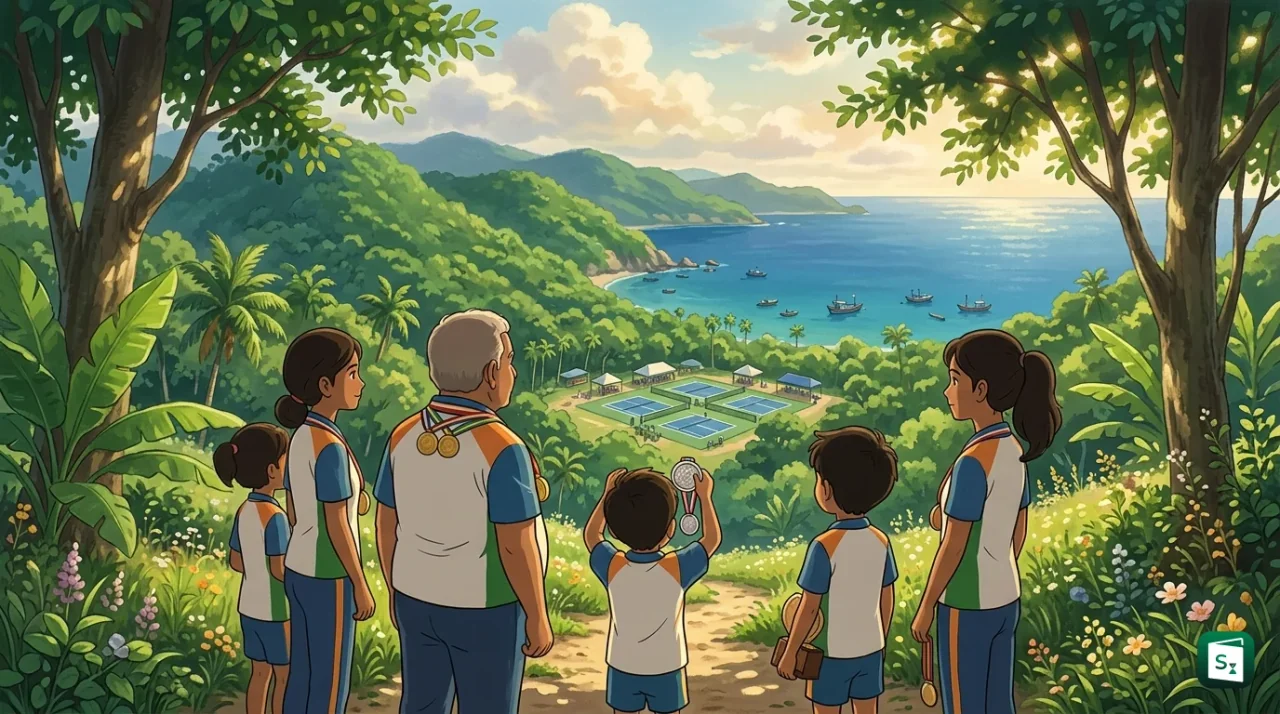
India finished fourth among 82 nations at the 4th edition of the Pickleball World Cup, held in Da Nang, Vietnam, from August 30 to September 6, 2026. The Indian contingent, sent by the Indian Pickleball Association (IPA), returned with 41 medals: seven gold, 17 silver, and 17 bronze. This was a big jump for India, which had finished seventh at the previous edition of the tournament.
What Is the Pickleball World Cup?
The Pickleball World Cup is the flagship international team and individual championship for pickleball, a fast-growing racquet sport. The 2026 edition in Da Nang was the fourth time the event was held and the first time it took place in Asia. It ran for eight days, from August 30 to September 6, 2026, and the host city built the event around seven venues and 97 courts.
The championship has two parts. The National Team Event decides the overall World Cup title, with countries fielding squads across several age and skill brackets. The International Tournament is an open individual competition in which any registered player can enter. Organisers reported more than 11,400 matches across 69 categories in the individual draw alone.
The competition is structured around five main categories:
| Category | Age Group | Nature |
|---|---|---|
| Kids | Under-14 | Team and individual |
| Juniors | Under-18 | Team and individual |
| Open | Senior (all ages) | Elite pro-level team |
| Seniors | 50+ and 60+ | Age-group team and individual |
| Masters | Older veterans | Team event |
The 2026 World Cup set two Guinness World Records: the most countries and territories represented by athletes at a single host location, and the most valuable trophy of its kind. This edition also drew roughly 5,000 registered participants, making it the largest pickleball gathering ever held.
What Is Pickleball and How Is It Played?
Pickleball is a paddle sport played by two or four players on a court the size of a doubles badminton court. Players use a smooth-faced paddle to hit a hollow, perforated plastic ball over a net. It is often described as a mix of tennis, badminton, and table tennis, and it is easy to learn but can become fast and tactical at higher levels.
The sport was invented in 1965 on Bainbridge Island, Washington, in the United States. Three friends, Joel Pritchard, Bill Bell, and Barney McCallum, created it as a backyard game for their families. The first official rulebook was published by the United States Amateur Pickleball Association (now USA Pickleball) in 1984. In 2022, Washington State named pickleball its official state sport.
The playing area has fixed dimensions that are the same for singles and doubles:
| Feature | Specification |
|---|---|
| Court size | 20 feet wide by 44 feet long |
| Net height at centre | 34 inches |
| Net height at sidelines | 36 inches |
| Non-volley zone (kitchen) | 7 feet from the net on each side |
A few rules give the sport its distinctive character. Every serve must be made underhand and hit diagonally into the opponent’s service court. The two-bounce rule requires the ball to bounce once on each side before players may volley. Players may not volley the ball while standing in the non-volley zone, commonly called the kitchen, which prevents tall players from simply smashing every point at the net. Games are usually played to 11 points, and a team must win by at least two points.
Pickleball has become one of the world’s fastest-growing sports because the equipment is cheap, the court is small, and players of very different ages can compete together. This is why the World Cup fielded categories from Under-14 kids to 60+ veterans at the same event.
How India Performed in Da Nang
India’s campaign was led by the Indian Pickleball Association (IPA), which is recognised by the Ministry of Youth Affairs and Sports as the National Sports Federation (NSF) for pickleball in the country. India fielded 48 athletes in the team events and more than 130 players entered the individual categories.
The table below shows India’s final medal count at the 2026 World Cup:
| Medal | Count |
|---|---|
| Gold | 7 |
| Silver | 17 |
| Bronze | 17 |
| Total | 41 |
India finished fourth on the overall medal tally. India had finished seventh at the previous edition with 25 medals, so the 2026 campaign added 16 more medals. The country’s best team result was in the Kids event, where the Under-14 side took silver. The Open team, led by Harsh Mehta, lost to eventual champions the United States in the quarter-finals.
Hosts Vietnam dominated the event, finishing on top with 271 medals, including 116 golds. South Korea finished second and the United States third. Vietnam’s gold count was roughly ten times that of the second-placed nation, showing the depth of the sport in the host country.
India’s Gold Medallists and Star Performers
India’s seven golds came from a mix of veteran and teenage players, which underlined the growing depth of the sport in the country.
Bhushan Akut was the standout performer. He became the first Indian player to win a hat-trick of gold medals at the World Cup, taking the 60+ men’s singles, 60+ men’s doubles, and 60+ mixed doubles titles. He was also India’s flag bearer at the opening ceremony and captained the 60+ squad. In the 60+ men’s singles final, he beat fellow Indian Ashok Rohira, who took silver.
Purvansh Patel, a 17-year-old from Ahmedabad, won gold in the Boys Under-18 Singles on his World Cup debut, beating Malaysia’s Dzarif Dzakwan in a three-game final. Fayrouz Zaidi won the women’s singles 40+ title, Vivek Reddy took gold in the men’s singles 40+ category after defeating Vietnam’s top player, and Kiran Salian won the men’s singles 50+ event.
In the team events, the Indian Kids team captained by Veer Shah won silver. Shah was also named the Best Captain in the Kids category, a rare individual honour for an Indian at the tournament.
India’s Fast Start on Day One
India began the tournament strongly on August 30, winning 11 medals on the opening day itself. The haul included two golds, six silvers, and three bronzes. Bhushan Akut won the first gold in the 60+ men’s singles, beating Ashok Rohira in an all-Indian final. Vivek Reddy won the second gold of the day in the 40+ men’s singles category.
In the team event league stage, the Indian pro squad remained unbeaten. India beat Antigua and Barbuda and Israel by 6-0 margins and then defeated the Czech Republic 5-1. Each team tie consisted of six matches: women’s doubles, men’s doubles, two mixed doubles matches, women’s singles, and men’s singles. Based on the strength of these results, IPA president Suryaveer Singh Bhullar said after the first day that the team was confident of climbing higher on the medal table.
Growth of Pickleball in India and the Global Stage
Pickleball has expanded quickly in India in recent years, with courts appearing in major cities such as Mumbai, Delhi, Chennai, Bengaluru, Hyderabad, and Jaipur. The Indian Pickleball Association (IPA) governs national rankings, sanctions tournaments, and runs player development programmes. It is recognised by the Ministry of Youth Affairs and Sports as the National Sports Federation for the sport.
A major step in the sport’s domestic growth was the launch of the Indian Pickleball League (IPBL), the country’s first franchise-based pickleball league. It features six teams: Bengaluru Blasters, Chennai Super Warriors, Capital Warriors Gurgaon, Hyderabad Royals, Lucknow Leopards, and Mumbai Smashers. The league gives Indian players a professional platform and a pathway to international competition.
Internationally, pickleball is still building a unified governance structure. The World Pickleball Federation (WPF) unites national federations across five continental confederations and is working toward recognition within the Olympic Movement. Under the Asia Federation of Pickleball, India is one of 24 member nations. No pickleball body has yet been recognised by the International Olympic Committee (IOC), and the sport must first meet the Olympic Charter’s conditions, including a single recognised world governing body.
IPA CEO Aditya Khanna said after the Da Nang campaign that the focus would now shift to building grassroots pickleball across India. With a fourth-place finish, a hat-trick of golds from a veteran, and a teenage world champion in Purvansh Patel, the 2026 World Cup gave India both immediate results and a promising pipeline for the future.
The next edition of the World Cup is expected to build on the record numbers seen in Da Nang, where 82 nations and thousands of athletes took part. For India, the challenge will be to convert its strong age-group performances into a top-three finish in the team events.
Key Takeaways
- India finished fourth among 82 nations at the 4th Pickleball World Cup held in Da Nang, Vietnam, from August 30 to September 6, 2026.
- India won 41 medals: seven gold, 17 silver, and 17 bronze, improving on its seventh-place finish at the previous edition.
- Hosts Vietnam topped the medal tally with 271 medals, including 116 golds, followed by South Korea and the United States.
- Bhushan Akut became the first Indian to win a hat-trick of World Cup golds, claiming the 60+ men’s singles, doubles, and mixed doubles titles.
- Purvansh Patel, a 17-year-old from Ahmedabad, won the Boys Under-18 Singles gold on his World Cup debut.
- The Indian Kids team, captained by Veer Shah, won silver, and Shah received the Best Captain award in the Kids category.
- Pickleball was invented in 1965 on Bainbridge Island, Washington, and the first official rulebook was published in 1984.
- The Indian Pickleball Association (IPA) is recognised by the Ministry of Youth Affairs and Sports as the National Sports Federation for pickleball in India.