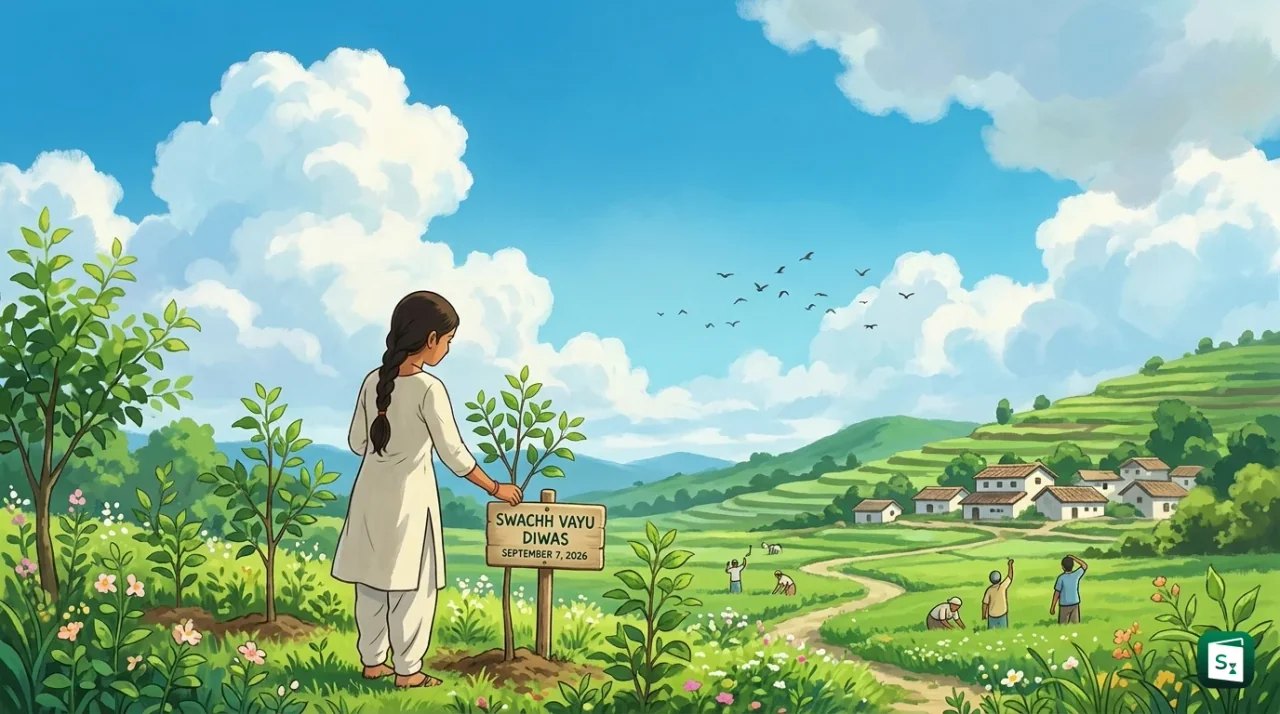
The world observed the seventh International Day of Clean Air for Blue Skies on 7 September 2026 under the theme Clean Air for Climate Action. The United Nations Environment Programme (UNEP) facilitated the global observance, while India marked the day as Swachh Vayu Diwas with national awards for clean air performance. The 2026 focus links air pollution control directly with climate action, based on growing evidence that joint action protects health and strengthens economies.
What Is the International Day of Clean Air for Blue Skies?
The International Day of Clean Air for Blue Skies is a United Nations observance held every year on 7 September to promote international cooperation for cleaner air. The UN General Assembly created it through Resolution 74/212 in December 2019, and the first observance was held in 2020.
The proposal was led by the Republic of Korea. The Second Committee of the United Nations General Assembly adopted the draft by consensus on 26 November 2019, and the full Assembly adopted Resolution 74/212 on 19 December 2019. The resolution designated 7 September as the annual date, starting in 2020, and invited all member states, UN bodies, regional organisations and civil society to observe it according to national priorities.
The resolution asked UNEP, which is headquartered in Nairobi, Kenya and was established in 1972, to facilitate the observance in collaboration with other relevant organisations. The Climate and Clean Air Coalition (CCAC), a voluntary partnership of more than 200 governments and organisations working to cut short lived climate pollutants, has played a central coordinating role since 2019. The World Health Organization (WHO), headquartered in Geneva and founded in 1948, has also supported activities through the BreatheLife campaign. The first observance in 2020 was held largely online because of the COVID-19 pandemic. The 2026 observance was the seventh edition.
Why Is Clean Air Important for Health, Economy and Climate?
Clean air is important because polluted air damages the lungs, heart and brain and slows economic growth. Air pollution causes millions of premature deaths each year and raises health costs, lowers worker productivity and harms crops, while cleaning the air improves health, saves money and supports a stable climate.
Clean air means air that meets health based quality standards and contains very low levels of harmful particles and gases. The most tracked pollutants are PM10 and PM2.5, which are particles with diameter of 10 micrometres or less and 2.5 micrometres or less, along with nitrogen dioxide, sulphur dioxide, ozone and carbon monoxide. These pollutants enter the blood through the lungs and increase the risk of asthma, heart attacks, strokes, diabetes, dementia and poor lung growth in children.
The health toll remains very high. In the message for the 2026 day, the UN Secretary General stated that air pollution contributed to 6.4 million premature deaths in the previous year, along with 5.5 million new cases of childhood asthma and millions of additional cases of diabetes, dementia and heart disease. The burden falls most heavily on poor communities, children, older people and those living near traffic, industry and waste burning sites.
The economic case was the central message in 2026. New analysis from UNEP and the CCAC found that every dollar invested in proven clean air solutions returns about 15 dollars in benefits through lower medical costs, higher productivity and avoided crop and ecosystem damage. Action that cuts fossil fuel use, methane leaks, black carbon from incomplete burning, and hydrofluorocarbons used in cooling cleans the air quickly and also slows near term warming. This is why faster movement away from fossil fuels is described as one of the quickest ways to gain both cleaner air and climate stability.
Clean Air for Climate Action: The 2026 Theme
The theme for 2026 was Clean Air for Climate Action. It calls for tackling air pollution and climate change together, instead of treating them as separate problems, because many sources such as vehicles, power plants, industries, farms, households and waste release both air pollutants and climate warming gases.
The centrepiece of the 2026 campaign was a new UNEP Spotlight Report titled Hidden Assets: The Economic and Health Case for Climate and Clean Air Action, based on the Global Economic Assessment of Integrated Climate and Clean Air Action. The assessment studies the costs and benefits of 25 integrated measures across energy, industry, transport, agriculture, households and waste using combined climate, air quality, health and economic models. It aims to give finance and planning ministries, businesses and development partners a single economic framework to decide on investments that deliver clean air, health and climate gains at the same time.
The global commemoration was facilitated by UNEP with support from the CCAC. Programmes were held in Bangkok for Asia and the Pacific with the UN Economic and Social Commission for Asia and the Pacific (ESCAP), in Beijing to open China Clean Air Week 2026, and in New York at the UN Headquarters with support from the Permanent Mission of Korea. The message for the day urged governments, businesses, financial institutions and communities to move from commitment to action, from isolated steps to integrated approaches, and from undercounting costs to counting every benefit.
National Clean Air Programme: India’s Institutional Framework
When Was the National Clean Air Programme Launched?
The National Clean Air Programme was launched by the Ministry of Environment, Forest and Climate Change in January 2019. It covers 130 non-attainment and million-plus cities in 24 states and union territories and aims to cut PM10 levels by up to 40 percent by 2025-26 over 2017 levels.
The National Clean Air Programme (NCAP) is India’s first national strategy for air quality management in cities. Non-attainment cities are cities that did not meet the National Ambient Air Quality Standards (NAAQS) for five consecutive years from 2011 to 2015. The programme is anchored by the Ministry of Environment, Forest and Climate Change (MoEFCC) and implemented with the Central Pollution Control Board (CPCB), state boards, urban local bodies and other central ministries dealing with roads, petroleum, renewable energy and housing.
The original goal was to cut PM10 and PM2.5 by 20 to 30 percent by 2024, using 2017 as the base year. In 2022 the target was revised to achieve up to 40 percent reduction in PM10 or meet the annual NAAQS limit of 60 micrograms per cubic metre by 2025-26. Each city prepares a City Action Plan with short term and long term steps such as paving of roads, greening of open areas, control of road dust and construction waste, better solid waste management, control of vehicular and industrial emissions, promotion of electric vehicle charging, and creation of urban forests including Miyawaki plantations. Source apportionment studies to identify local pollution sources have been completed in 119 cities.
Funding is linked to performance. A performance based grant of ₹16,423.56 crore was provided to 130 cities from 2019-20 to 2025-26. Data for 2025-26 show early gains. Out of the covered cities, 108 cities recorded lower PM10 than in 2017-18, 72 cities cut levels by more than 20 percent, 26 cities cut levels by more than 40 percent, and 14 cities met the national standards, compared with only 6 cities in 2017-18.
Air Pollution Control and Air Quality Monitoring in India
India’s legal backbone for air pollution control is the Air (Prevention and Control of Pollution) Act, 1981, which came into force on 16 May 1981 after being enacted on 29 March 1981. The Act was passed following the UN Conference on the Human Environment held in Stockholm in 1972 and was amended in 1987. It provides for the creation of boards, declaration of air pollution control areas, and powers to set emission standards and issue directions to industries and authorities.
The apex technical body is the Central Pollution Control Board (CPCB). CPCB was first set up in September 1974 under the Water (Prevention and Control of Pollution) Act, 1974 and was later given powers under the Air Act. It functions under MoEFCC and is headquartered in New Delhi. It lays down standards for air pollutants, automobile exhaust and industrial emissions, runs national monitoring networks and advises the central government and union territory administrations. It coordinates with State Pollution Control Boards (SPCBs) and Pollution Control Committees, which implement the law in states and union territories.
For daily public information, CPCB runs the National Air Quality Index (AQI) and networks of manual stations and Continuous Ambient Air Quality Monitoring Stations (CAAQMS). The AQI converts pollutant readings into six colour coded categories from Good to Severe, which are widely reported for Indian cities especially in October and November when stubble burning, low wind and winter inversion raise pollution in the north. In the National Capital Region, the Commission for Air Quality Management (CAQM) coordinates emergency steps such as the Graded Response Action Plan (GRAP) based on AQI levels. The National Green Tribunal (NGT), set up in 2010 and headquartered in New Delhi, hears environmental disputes and can direct authorities to act on air quality violations.
Swachh Vayu Diwas and Swachh Vayu Sarvekshan 2026 Rankings
In India the global day is observed as Swachh Vayu Diwas, which means Clean Air Day. The main national event in 2026 was organised in New Delhi by MoEFCC on 7 September 2026. It was presided over by Justice Prakash Shrivastava, Chairperson of the National Green Tribunal, along with senior officials including the Environment Secretary, the Chairperson of CAQM and the Chairperson of CPCB. Mayors, district collectors and municipal commissioners of winning cities attended the event. On the occasion the ministry released a Compendium of Best Management Practices under NCAP to help other cities copy successful steps.
The awards given on the day were the 5th Swachh Vayu Sarvekshan Awards. The Swachh Vayu Sarvekshan is a competitive ranking of cities under NCAP based on actions taken, not only on pollution readings. The framework was released in 2022-23. It scores cities on control of road dust, solid waste management, vehicular emissions, industrial pollution, construction and demolition waste, other emissions such as diesel generator sets and commercial units, and information and public awareness activities. The ranking covers 130 cities in three population groups. Selection involves self assessment by cities, approval by the state level monitoring committee, evaluation by CPCB, field verification by independent committees and final choice of the best performers.
The 2026 results placed Lucknow at the top among million plus cities with 198 marks out of 200. The city was recognised for adding electric vehicles to the municipal waste fleet, use of mechanised sweeping machines to control road dust and remediation of legacy waste sites. Indore stood second and Jabalpur stood third. Delhi stood at rank 30 and Mumbai at rank 37 in this group, while Chennai, Jamshedpur, Kota, Kolkata and Madurai were among the lowest ranked cities.
| Category | Population | Top Three Cities in 2026 |
|---|---|---|
| Category 1 | More than 10 lakh | 1. Lucknow (198), 2. Indore, 3. Jabalpur |
| Category 2 | 3 lakh to 10 lakh | 1. Rourkela (198.5), 2. Firozabad and Guntur, 3. Amravati |
| Category 3 | Less than 3 lakh | 1. Kalinga Nagar (198.5), 2. Angul (196.5), 3. Talcher (193.5) |
Rourkela in Odisha made a sharp rise to first place in Category 2 after ranking 19th in 2025, scoring 198.5. Kalinga Nagar in Jajpur district of Odisha topped Category 3 with the same score, with Angul second and Talcher third, showing a strong performance by Odisha’s industrial cities. The 2026 edition introduced ward level awards for the first time to reward local action. In the ward group with population above 30,000, Ward 70 of Lucknow stood first, followed by Ward 60 of Bhopal and Ward 7 of Nashik. Wards of Bhubaneswar, Vijayawada, Prayagraj, Rourkela and Nalgonda were also recognised in other ward categories, underlining the role of neighbourhood level planning and citizen participation.
Key Takeaways
- The International Day of Clean Air for Blue Skies is observed every year on 7 September and was first observed in 2020 under UN Resolution 74/212.
- The theme for 2026 was Clean Air for Climate Action, highlighting integrated action on air pollution and climate change.
- The National Clean Air Programme was launched in January 2019 and targets up to 40 percent reduction in PM10 by 2025-26 over 2017 levels in 130 cities.
- India observes the day as Swachh Vayu Diwas, and the 5th Swachh Vayu Sarvekshan Awards were given on 7 September 2026 in New Delhi.
- Lucknow, Rourkela and Kalinga Nagar topped the 2026 Sarvekshan in Category 1, Category 2 and Category 3 respectively.
- The Central Pollution Control Board, set up in 1974 and headquartered in New Delhi, implements the Air Act, 1981 with state boards.