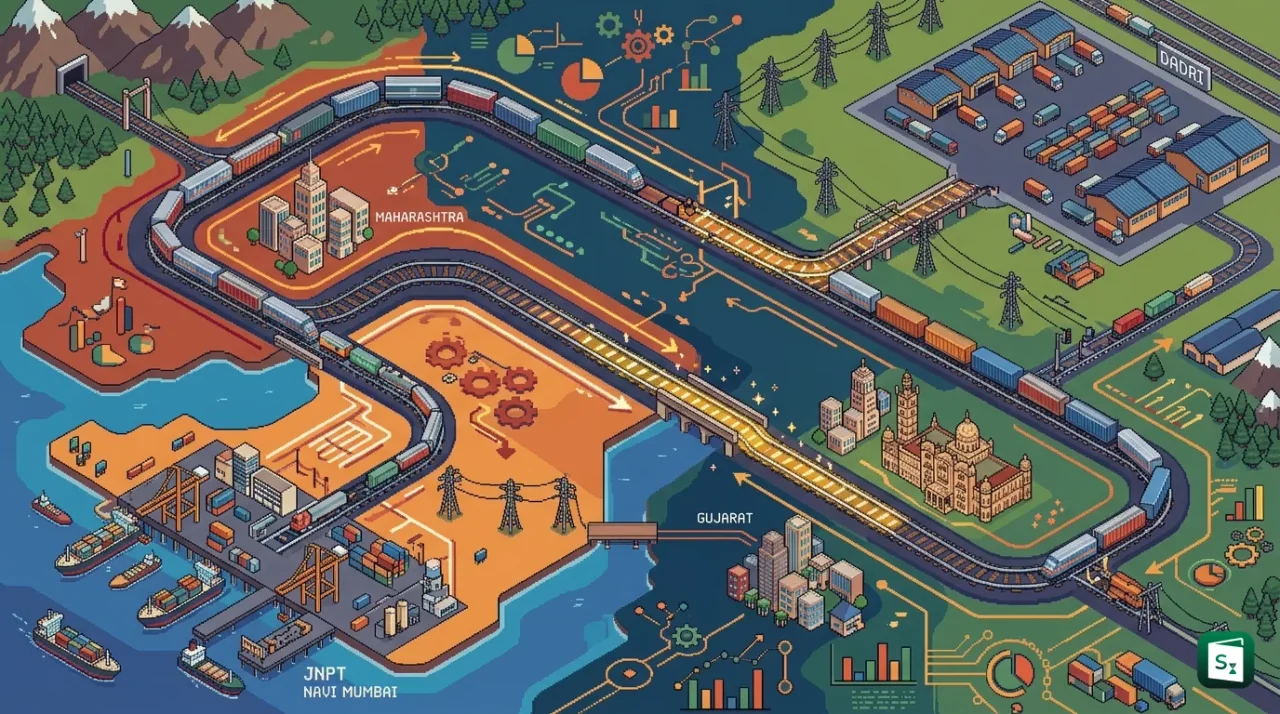
Prime Minister Narendra Modi inaugurated the final three sections of the Western Dedicated Freight Corridor (WDFC) and launched development projects worth more than ₹35,000 crore in Vadodara, Gujarat. The newly commissioned stretches, built at a cost of over ₹20,700 crore, complete India’s 2,843-km Dedicated Freight Corridor (DFC) network. The event marks the linking of the Jawaharlal Nehru Port Trust near Mumbai with Dadri in Uttar Pradesh through an uninterrupted, freight-only rail route.
What Is the Western Dedicated Freight Corridor?
A dedicated freight corridor is a railway line built only for goods trains, with no passenger traffic. This allows heavier, longer and faster freight trains to run without delays caused by stopping passenger services. By separating goods movement from passenger movement, the corridors free up space on the existing rail network and cut the cost of moving cargo.
The Western Dedicated Freight Corridor runs 1,506 km from Dadri in Uttar Pradesh to the Jawaharlal Nehru Port Trust (JNPT) at Nhava Sheva near Mumbai. It passes through Haryana, Rajasthan, Gujarat and Maharashtra, and is designed mainly for container traffic. It directly connects the industrial belt of northern and western India with the country’s busiest container port.
The corridor supports double-stack container operations, where two containers are stacked on one flat wagon. This nearly doubles the cargo carried by a single train. The tracks are fully electrified and built for 25-tonne axle loads, meaning they can bear heavier wagons than ordinary lines. The DFC network is also designed for trains up to 1,500 metres long.
The concept of dedicated freight corridors grew out of a simple problem. The Golden Quadrilateral and its two diagonals make up only about 16% of India’s rail network, but they carry over 52% of passenger traffic and nearly 58% of freight revenue traffic. Line utilisation on these busy routes often crossed 115% to 150% of capacity. The result was chronic congestion, slower trains and rising logistics costs. The DFC project was designed as a long-term structural answer to this congestion, and it was approved to move long-haul bulk and container cargo from road to rail.
The Three Final Sections and the ₹35,000 Crore Package
At the event in Vadodara, held under the banner of the NaMo for Viksit Bharat programme, the Prime Minister dedicated a set of rail, road, housing, water supply and urban development projects worth more than ₹35,000 crore. The completion of the WDFC was the centrepiece of the programme. A double-stack container freight train was also flagged off from JNPT to Vadodara, carrying cargo equal to more than 250 trucks in a single journey.
The three newly commissioned WDFC sections together span 326 route kilometres and were developed at a cost of more than ₹20,700 crore.
| Section | Route |
|---|---|
| New Sanand (North) to New Makarpura | Gujarat |
| New Umbergaon to New Saphale | Maharashtra |
| New Saphale to New JNPT | Maharashtra |
With these three sections operational, the entire 1,506-km WDFC is now complete. Together with the 1,337-km Eastern Dedicated Freight Corridor (EDFC), which runs from Ludhiana in Punjab to Sonnagar in Bihar, the total DFC network stands at 2,843 km. The two corridors now handle an average of more than 443 freight trains per day. The average transit time between Dadri and JNPT has dropped from around 66 hours to about 58 hours.
Beyond the freight corridor, the Prime Minister laid foundation stones for three railway projects covering 329 km at a cost of more than ₹9,700 crore. These are the Vadodara-Ratlam third and fourth railway lines, the gauge conversion of the Miyagam Karjan-Choranda-Malsar section, and the doubling of the Vishwamitri-Dabhoi section. These projects aim to raise passenger and freight capacity and strengthen connectivity between Gujarat and Madhya Pradesh.
Three National Highway projects worth around ₹1,780 crore were also launched. These include six-laning of the Kamrej-Chalthan section of NH-48, new bridges over the Tapi and Narmada rivers on the Vadodara-Surat stretch of NH-48, and grade-separated structures at the Abhava, Mindhola and Khajod junctions on NH-53. Six-lane flyovers at Kandari Chokdi and Luvara Patia were inaugurated as well.
The package also included Gujarat government projects worth around ₹2,600 crore. These cover Phase II of the Vadodara Urban Development Authority Ring Road, a 110 MW floating solar project at Kadana Dam, and a new office building for the Vadodara Municipal Corporation. Housing projects under the Pradhan Mantri Awas Yojana and a water-supply project for 11 villages in eastern Vadodara were inaugurated too.
Who Builds and Runs the Dedicated Freight Corridors?
The Dedicated Freight Corridor Corporation of India Limited (DFCCIL) is the agency that plans, builds and operates the corridors. It was set up in October 2006 as a special purpose vehicle under the Companies Act, 1956, and works under the administrative control of the Ministry of Railways. It functions as an infrastructure manager that gives non-discriminatory access to rail operators.
The Golden Quadrilateral and its diagonals were heavily saturated, and the share of railways in India’s freight traffic had fallen sharply, from about 83% in 1950-51 to 35% in 2011-12. Much of this traffic shifted to roads, which pushed up logistics costs. DFCCIL was created to reverse this trend by building high-capacity, high-speed, freight-only corridors. The Eastern and Western corridors were approved by the Cabinet in 2008, and in June 2015 the project received formal sanction at a total cost of about ₹1,24,000 crore.
The corridors are financed mainly through external loans. Japan, through the Japan International Cooperation Agency (JICA), financed a large part of the WDFC through Official Development Assistance. The World Bank supported a section of the Eastern corridor. The project saw slow progress for several years because of delays in land acquisition and contract finalisation, and work was put on a fast track after 2014 with regular monitoring and higher capital expenditure.
Analogy · Roads Versus Rails Expand analogy
A truck can carry a few dozen tonnes over a long distance, but a single double-stack freight train can carry the load of hundreds of trucks. Moving goods by rail in bulk is cheaper and cleaner per tonne than moving them by road. The DFC is built to make that bulk movement reliable.
Key institutional facts are worth noting. DFCCIL is headquartered in New Delhi, and its corridors are built to Indian broad gauge (1,676 mm) with 25 kV AC overhead electrification. The WDFC is the world’s first fully electrified freight corridor designed for routine double-stack container operations at this scale.
Why the JNPT Link Matters for Trade and Logistics
The final sections give the Jawaharlal Nehru Port Authority (JNPA) a direct, dedicated freight link to northern India. Until now, cargo moving to and from the port depended on Mumbai’s crowded conventional rail network. The dedicated route now allows containers to move directly between the port and industrial centres in Gujarat, Rajasthan, Haryana, Delhi-NCR and western Uttar Pradesh without competing with passenger trains.
This matters because JNPT is one of India’s busiest container-handling ports, and its cargo drives a large share of the country’s export-import (EXIM) trade. Faster and more predictable rail movement can lower logistics costs, cut transit times and ease pressure on roads and the existing rail lines. Feeder links also connect or are planned to connect the WDFC with other Gujarat ports such as Mundra, Kandla, Pipavav and Hazira.
The corridor is a key part of the Delhi-Mumbai Industrial Corridor, a planned industrial belt along the route. Logistics parks, cargo terminals and freight terminals are being built around it to create a port-to-factory freight grid. The government has also focused on reducing India’s logistics costs, which are estimated at around 13% of GDP, higher than the global average. Shifting long-haul freight from road to rail is central to that goal.
How the DFC Fits Into PM Gati Shakti
The Dedicated Freight Corridor is a flagship component of the PM Gati Shakti National Master Plan, which the Union Cabinet approved in October 2021. PM Gati Shakti is a digital platform that links infrastructure planning across ministries for roads, railways, ports, airports, waterways and industrial corridors, so that projects are planned together instead of in isolation.
The plan aims to break departmental silos, avoid duplicate spending and improve last-mile connectivity to economic zones. It uses satellite imagery and a GIS-based platform for route planning, land acquisition and project monitoring. The master plan covers 16 ministries and an investment pipeline of over ₹100 lakh crore. The completion of the freight corridors is a direct outcome of this coordinated approach to infrastructure.
The DFC also supports the government’s environmental goals. Rail freight produces far lower emissions per tonne-kilometre than road freight, so a modal shift to rail helps cut greenhouse gases. The corridors are fully electrified, and DFCCIL is also expanding the use of renewable energy. In the Union Budget 2026, the government announced a new 2,052-km Dankuni-Surat dedicated freight corridor through West Bengal, Odisha, Chhattisgarh, Madhya Pradesh, Maharashtra and Gujarat. Its Detailed Project Report is being prepared.
What the Completion Means Going Forward
The completion of the DFC network is a major step in India’s plan to raise the railways’ share in freight movement and lower the overall cost of logistics. By separating freight from passenger traffic, the corridors free up capacity for more passenger trains and speed up the movement of goods. This supports manufacturing competitiveness and export growth.
Several challenges remain. The corridors must attract steady container and bulk traffic to justify their cost. Last-mile links to ports, mines and industrial clusters need to be completed so that the benefits reach the widest set of users. The proposed new corridors, including the Dankuni-Surat line, will require large funding and timely land acquisition, the two issues that slowed the original project for years.
For now, the focus is on operations and on drawing more traffic onto the network. The government’s aim is to move long-haul bulk commodities, container traffic and industrial freight from road to rail, reduce logistics costs and improve supply chain efficiency. The completion of the Western and Eastern corridors marks the end of one long phase and the start of a larger push to expand the freight rail backbone across the country.
Key Takeaways
- Prime Minister Narendra Modi inaugurated the final three sections of the Western Dedicated Freight Corridor in Vadodara, Gujarat, and launched projects worth more than ₹35,000 crore.
- The three new sections cover 326 route kilometres and were built at a cost of more than ₹20,700 crore.
- The WDFC runs 1,506 km from Dadri in Uttar Pradesh to JNPT near Mumbai, while the EDFC runs 1,337 km from Ludhiana to Sonnagar; together they form a 2,843-km network.
- The Dedicated Freight Corridor Corporation of India Limited (DFCCIL) was set up in October 2006 under the Ministry of Railways and is headquartered in New Delhi.
- The DFC network now carries an average of more than 443 freight trains per day, and the Dadri-JNPT transit time has come down from about 66 hours to around 58 hours.
- The WDFC is the world’s first fully electrified freight corridor built for routine double-stack container operations, with 25-tonne axle loads and trains up to 1,500 metres long.
- The DFC is a flagship component of the PM Gati Shakti National Master Plan, approved in October 2021, which links infrastructure planning across 16 ministries.