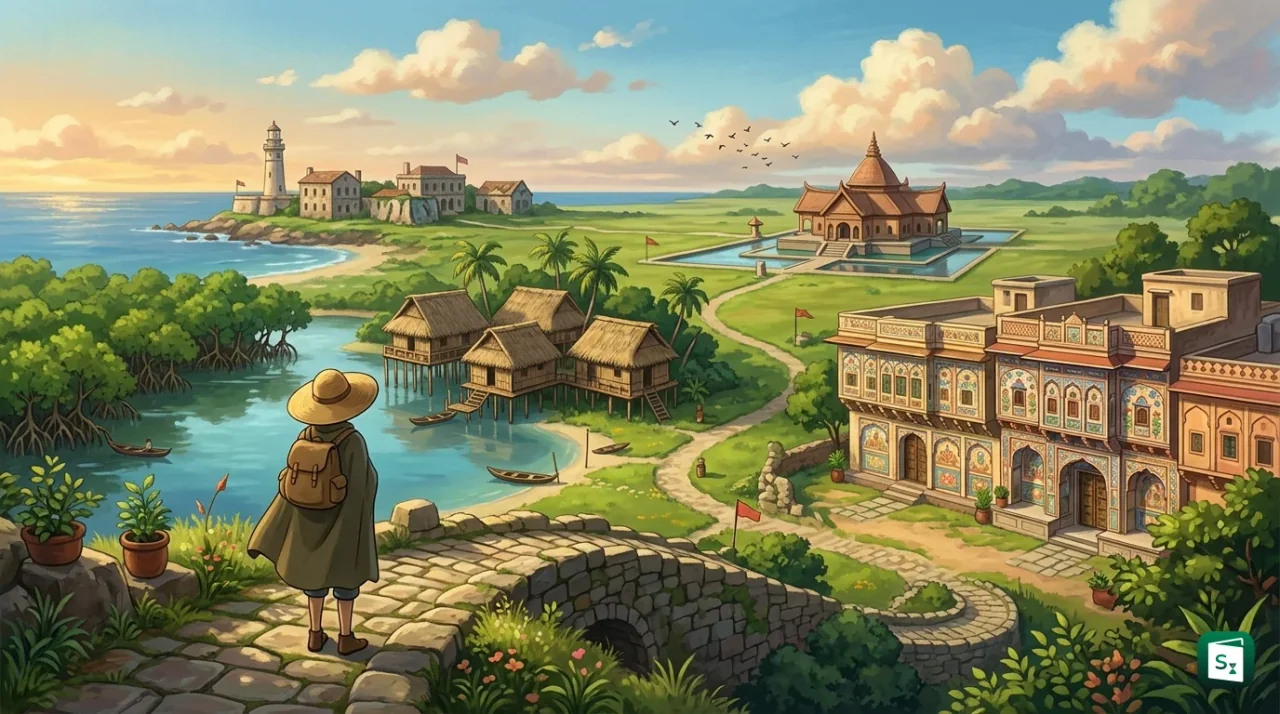
The Permanent Delegation of India to UNESCO has added four new cultural sites to India’s Tentative List under the World Heritage Convention, taking the national tally to 73. The four additions are the Rangpur Sivasagar Historic Ensemble in Assam, the Colonial Penal Settlement in the Andaman Islands, Nicobarese Cultural Continuity in the Central Nicobar Islands, and the Painted Haveli Towns of Shekhawati in Rajasthan. This first mandatory step moves all four closer to a future nomination for the UNESCO World Heritage List.
What Is a UNESCO World Heritage Site?
A UNESCO World Heritage Site is a place judged to have Outstanding Universal Value for all of humanity and protected under an international agreement called the World Heritage Convention. The site can be cultural (like monuments and historic towns), natural (like national parks), or mixed (both cultural and natural).
UNESCO stands for the United Nations Educational, Scientific and Cultural Organization. The organization was set up in 1945 and is headquartered in Paris, France. India has been a member since 1946 and works with UNESCO through the Permanent Delegation of India to UNESCO in Paris and the Archaeological Survey of India (ASI) at home.
The World Heritage Convention was adopted by UNESCO in Paris on 16 November 1972. It is the legal backbone for identifying, protecting and passing on heritage of global importance to future generations. The World Heritage Centre in Paris manages the day to day work, while the World Heritage Committee, made up of elected member countries, takes the final decision on which sites get inscribed.
To be inscribed, a site must meet at least one of ten selection criteria. Criteria (i) to (vi) are for cultural heritage and criteria (vii) to (x) are for natural heritage. Cultural criteria cover ideas like creative genius, interchange of human values, testimony to a living tradition, outstanding building or landscape, traditional settlement, and association with important events or beliefs. The four new Indian entries have all been proposed under cultural criteria only.
What Is the UNESCO Tentative List?
The UNESCO Tentative List is an official inventory of places that a country plans to consider for future nomination to the World Heritage List. A site must already be on this list before the World Heritage Centre will accept a full nomination file for it.
The Tentative List is prepared by each country, called a State Party to the Convention. India’s list is prepared with the help of the Archaeological Survey of India, which was established in 1861 and functions under the Ministry of Culture. The list is not fixed. Countries are encouraged to review it at least every ten years, and a property is removed from the list once it is inscribed on the World Heritage List.
Inclusion on the Tentative List does not mean global recognition yet. It only signals intent and starts a long process of research, protection, management planning and evaluation by expert bodies such as the International Council on Monuments and Sites (ICOMOS) for cultural sites and the International Union for Conservation of Nature (IUCN) for natural sites. Only after that evaluation does the World Heritage Committee vote on inscription.
Four New Indian Additions That Take the Total to 73
India’s four new entries were announced by the Permanent Delegation of India to UNESCO in early September 2026. All four are in the cultural category. With their addition, India’s Tentative List has grown from 69 to 73, after seven natural sites were added in 2025.
| New Site | Location | Proposed Criteria |
|---|---|---|
| Rangpur Sivasagar Historic Ensemble | Sivasagar district, Assam | (iii), (iv) |
| Colonial Penal Settlement of Andaman Islands | South Andaman district, Andaman and Nicobar Islands | (ii), (iv), (vi) |
| Nicobarese Cultural Continuity in the Central Group of Nicobar Islands | Nancowrie subdivision, Nicobar district, Andaman and Nicobar Islands | (iii), (v), (vi) |
| Painted Haveli Towns of Shekhawati | Jhunjhunu, Sikar and Churu districts, Rajasthan | (iii), (iv), (v) |
Rangpur Sivasagar Historic Ensemble in Assam
The Rangpur Sivasagar Historic Ensemble is the political and ceremonial heart of the Ahom kingdom, which ruled the Brahmaputra Valley for nearly six centuries. The Ahom polity was founded by Chaolung Sukapha in 1228 and lasted until 1826. Rangpur, present day Sivasagar town, served as the Ahom capital from 1699 to 1788. India formally submitted this ensemble on 19 June 2026.
The ensemble is not a single monument but a complete historic landscape of palaces, temples, tanks, forts, roads and bridges. Its best known structures are the Rang Ghar, described as one of Asia’s oldest surviving amphitheatres, and the multi storeyed Talatal Ghar palace. The religious core is formed by the Sivadol, Devidol and Joydol temples on the banks of the Sivasagar tank, along with the much larger Joysagar and Gaurisagar tanks. Other parts include Ghanashyam House, the fortified enclosure of Pohugarh and the Namdang stone bridge.
The submission highlights Ahom skill in water based urban planning. The Ahoms built massive tanks with embankments, moats and drains that stored monsoon water, supported farming and rituals, and displayed royal power. The site is proposed under criterion (iii) for its testimony to the living Tai Ahom tradition and criterion (iv) for its water based palace fort architecture of the 17th and 18th centuries. The temples remain active places of worship, so the landscape links past statecraft with present religious life. The entry builds on the inscription of the Charaideo Moidams in 2024 as Assam’s first cultural World Heritage Site. Together, Charaideo marks where the Ahom royalty rest and Rangpur Sivasagar marks where they ruled.
Colonial Penal Settlement of Andaman Islands
The Colonial Penal Settlement of Andaman Islands is a serial property with four linked components. The four parts are Chatham Island, Netaji Subhas Chandra Bose Island (earlier Ross Island), Viper Island and the Cellular Jail at Port Blair, now Sri Vijaya Puram. India submitted this expanded entry on 22 May 2026 with reference number 7023. It replaces and widens the earlier entry of Cellular Jail alone, which had been on the Tentative List since 15 April 2014.
The story begins on 10 March 1858, when about 200 convicts arrived at Chatham Island under Dr. James Pattison Walker. Many had taken part in the uprising of 1857, often called India’s First War of Independence. Prisoners cleared forests and built the first settlement. Chatham then developed as the industrial base, with a historic sawmill and timber work using Andaman Padauk wood for construction across the islands. Ross Island became the administrative headquarters with offices, residences, churches and barracks. Viper Island represents the early jail phase, with a major jail built between 1864 and 1867 that had solitary cells, gallows and work sheds.
The final and most famous part is the Cellular Jail, built between 1896 and 1906 on the advice of C. J. Lyall and A. S. Lethbridge. It followed the panopticon model, a prison design with a central watchtower and radial wings so that a few guards could watch many prisoners without being seen. The jail had seven wings and 693 solitary cells meant to cut all contact between freedom fighters and stop the spread of ideas. Only three wings survive today. The jail held political prisoners such as Vinayak Damodar Savarkar, Batukeshwar Dutt and Barindra Kumar Ghosh, saw hunger strikes in 1933 and 1937, was emptied of political prisoners by January 1938, occupied by Japan from 1942 to 1945, and declared a National Memorial in 1979. The new serial entry is proposed under criteria (ii), (iv) and (vi) for its role in colonial punishment systems, its architecture, and its direct link with India’s freedom struggle.
Nicobarese Cultural Continuity in the Central Group of Nicobar Islands
Nicobarese Cultural Continuity covers the living island culture of the Central or Nancowrie group in Nicobar district. The core areas are the small islands of Chowra, Trinket and Bompoka, while the buffer includes parts of Kamorta, Nancowrie, Katchal and Teressa. The sheltered Kamorta harbour, usable in all seasons, has linked these islands for centuries along the sea route from India and Sri Lanka to Southeast Asia and China. India submitted the property on 22 May 2026 with reference number 7022.
The Nicobarese people speak languages of the Austroasiatic family and are believed to share roots with Malay and Mon communities of Southeast Asia. Their social base is the tuhet, a large joint family that manages houses, coconut groves and rituals together. Material life is finely tuned to a fragile island setting. Round stilt huts called el panam protect against floods and heat, single log canoes called hodi connect villages for fishing and trade, and hand made Chowra pottery, built without a wheel, is bartered across islands for feasts.
Spiritual and festive life remains strong. The annual Pig Festival or Panuohonot, with pig sacrifice, canoe races, wrestling, songs and dances, renews kinship ties. The Ossuary Feast honours ancestors by cleansing and reburying skulls. The Takoi taboo system guides conduct after death, including care of the dead person’s house and coconut grove. Wooden ancestor figures called kareau and protective boards called hentakoi express belief in spirits. The 2004 Indian Ocean tsunami split Trinket island, displaced villages and destroyed shore settlements, but communities have rebuilt using traditional principles. The property is proposed under criteria (iii), (v) and (vi) for its testimony to a living tradition, its sustainable island settlement, and its link with living beliefs. The area is also protected as a Tribal Reserve under the rules for protection of aboriginal tribes in the islands.
Painted Haveli Towns of Shekhawati in Rajasthan
The Painted Haveli Towns of Shekhawati is a serial nomination of historic ensembles in fourteen towns across the semi desert districts of Jhunjhunu, Churu and Sikar. The fourteen towns include Alsisar, Bissau, Chirawa, Churu, Dundlod, Fatehpur, Jhunjhunu, Khetri, Lakshmangarh, Mahansar, Mandawa, Nawalgarh, Ramgarh and Sikar. India submitted the property on 1 June 2026 with reference number 7028. Shekhawati is often called the world’s largest open air art gallery.
Shekhawati takes its name from Rao Shekha, a Kachhawaha Rajput chief who built influence in the mid 15th century. His descendants, the Shekhawats, created fortified estates called thikanas by the 1730s, with forts or garhs, walls, gateways or darwazas, axial bazaars and planned residential lanes or galis. Located on old caravan routes, the towns drew Marwari merchants who later moved to colonial cities such as Calcutta and Bombay but sent wealth back home between the mid 19th century and the 1930s. That wealth built courtyard havelis, temples, cenotaphs or chhatris, guesthouses or dharamshalas, stepwells or baoris and tanks or joharas.
The defining feature is the vast fresco cover. Walls were painted in the local arayish technique, similar to fresco work, using mineral, vegetable and later imported colours. The paintings cover both outer facades and inner rooms and record gods and epics, folk tales, daily life, rulers, trains, gramophones, aeroplanes and colonial officers. They work as a visual archive of how a merchant society saw religion, modernity and global trade. The towns are proposed under criteria (iii), (iv) and (v) for their testimony to a mercantile tradition, their distinct fort town and haveli type, and their adaptation of town, water and land use to an arid environment.
How a Site Moves From Tentative List to World Heritage List
A place on the Tentative List must wait at least one year before a full nomination file can be filed. The file must prove Outstanding Universal Value, show that the site meets at least one of the ten criteria, and present a clear plan for protection, buffer zones, tourism control and local participation.
After submission, expert bodies carry out desk reviews and field visits. ICOMOS advises on cultural properties and IUCN advises on natural properties. Their reports go to the World Heritage Committee, which meets once a year. The Committee can inscribe the site, ask for more information, defer the case, or reject it. Even after inscription, the site faces regular monitoring and can be placed on the List of World Heritage in Danger if it is poorly managed. This is why the move from 73 tentative places to a final listing is slow and highly competitive, with countries allowed to push only a limited number of nominations each year.
How Many UNESCO World Heritage Sites Does India Have?
India has 45 World Heritage Sites inscribed on the World Heritage List. The count includes 37 cultural sites, 7 natural sites and 1 mixed site. The mixed site is Khangchendzonga National Park in Sikkim, listed in 2016 for both nature and sacred mountain traditions.
| Category | Number | Examples |
|---|---|---|
| Cultural | 37 | Taj Mahal (1983), Ajanta Caves (1983), Charaideo Moidams (2024), Maratha Military Landscapes (2025), Ancient Buddhist Site of Sarnath (2026) |
| Natural | 7 | Kaziranga National Park (1985), Keoladeo National Park (1985), Western Ghats (2012) |
| Mixed | 1 | Khangchendzonga National Park (2016) |
| Total inscribed | 45 | Sixth largest national total in the world |
| Tentative List | 73 | Includes the 4 new cultural entries of 2026 |
India’s first inscriptions came in 1983 with the Agra Fort, Taj Mahal, Ajanta Caves and Ellora Caves. Recent additions show steady momentum. The Moidams of Charaideo were inscribed in 2024, the Maratha Military Landscapes of India across Maharashtra and Tamil Nadu were inscribed in 2025 as the 44th site, and the Ancient Buddhist Site of Sarnath in Uttar Pradesh was added in 2026 as the 45th site. Globally, more than 1,200 properties across 168 countries are on the World Heritage List, with Italy and China holding the largest totals. Out of 196 States Parties to the Convention, 190 maintain a Tentative List.
Why These Four Additions Matter
The four choices fill clear gaps in India’s heritage story. Rangpur Sivasagar completes the Ahom narrative by pairing a living capital with the burial landscape of Charaideo. The Colonial Penal Settlement brings together scattered island prisons into one story of punishment, resistance and freedom. The Nicobarese entry shifts focus from monuments to a living indigenous cultural landscape shaped by sea, forest and custom. The Shekhawati entry recognises merchant towns and fresco art, a type of urban heritage that is under represented on the global list.
The additions also spread benefits across regions. Assam gains a second Ahom level push after 2024, Rajasthan strengthens its desert heritage beyond forts like Jaisalmer and Jaipur city, and the Andaman and Nicobar Islands gain two entries that link colonial history with tribal continuity. Better documentation, buffer control and visitor planning, which the nomination process demands, can help protect fragile tanks in Sivasagar, crumbling havelis in Shekhawati, and reef, forest and village land in the Nicobars. The road ahead will need careful conservation, community consent (especially in tribal areas), and steady work on management plans before any of the four can become India’s 46th World Heritage Site.
Key Takeaways
- India’s Tentative List total rose to 73 after 4 new cultural sites were added in September 2026.
- The Rangpur Sivasagar Historic Ensemble in Assam was submitted on 19 June 2026 under criteria (iii) and (iv).
- The Colonial Penal Settlement is a serial property of Chatham, Netaji Subhas Chandra Bose, Viper and Cellular Jail submitted on 22 May 2026.
- Nicobarese Cultural Continuity covers Chowra, Trinket and Bompoka as core areas in the Central Nicobar group.
- The Painted Haveli Towns of Shekhawati cover 14 towns in Jhunjhunu, Churu and Sikar districts of Rajasthan.
- India has 45 inscribed World Heritage Sites (37 cultural, 7 natural and 1 mixed), with Sarnath (2026) as the latest addition.