Belgium has completed the foundations of Princess Elisabeth Island in the North Sea, the world’s first artificial energy island. The 6-hectare island sits 45 km off the Belgian coast and will act as an offshore electricity hub for 3.5 GW of new wind power. In August 2026 workers placed the 23rd and final caisson, and in September 2026 the project secured a €1 billion green loan for its next phase.
What Is an Artificial Energy Island?
An artificial energy island is a man-made island built in the sea to collect and send electricity. Princess Elisabeth Island is the world’s first such island. It will gather power from offshore wind farms and send it to land through undersea cables, while also linking power grids of different countries.
An artificial island is land created by humans where no island existed before. An energy island is a special type of artificial island that works as an offshore electricity hub. Instead of houses or offices, it holds electrical equipment such as transformers, converters and switchyards.
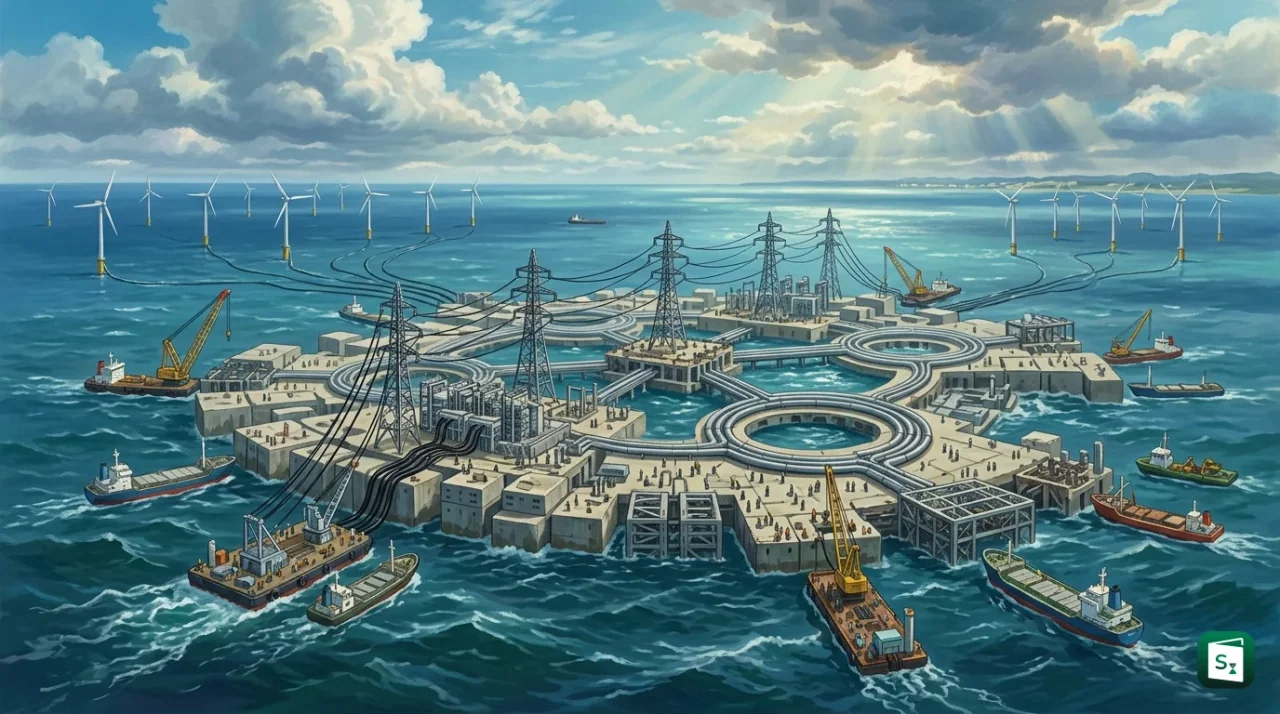
Princess Elisabeth Island is called an electricity roundabout because many power cables will meet there from different directions. Power from wind farms will come into the island, and power will go out to the Belgian coast. In future, power can also flow between Belgium and other countries through the same hub. The island will host both high-voltage alternating current (HVAC) and high-voltage direct current (HVDC) systems. HVAC is used for shorter distances, while HVDC loses less power over long undersea distances. Princess Elisabeth Island is the first artificial island in the world to host both systems together.
Where Is Princess Elisabeth Island Located?
Princess Elisabeth Island stands in the Belgian part of the North Sea, 45 km off the Belgian coast. The island sits in the middle of the Princess Elisabeth Zone, which is Belgium’s second offshore wind zone. The first Belgian wind zone, built between 2009 and 2020, already holds nine wind farms with 2.26 GW of capacity and 399 turbines.
The new island covers 6 hectares, which is equal to about 12 football fields. The area for electrical equipment will measure about 12 hectares above the waterline once all structures are complete. The island will have a small harbour and a helipad so maintenance crews can reach it by boat or helicopter.
The island will bundle power from the new wind zone through about 300 km of alternating current cables and about 60 km of direct current cables. From the island, six 220 kV three-phase alternating current cables will carry power to an onshore substation on the Belgian coast. The project is also known as the Modular Offshore Grid 2 (MOG2) project, a follow up to Belgium’s first offshore hub, the Modular Offshore Grid, which sits 40 km off the coast and links four wind farms.
How Artificial Islands Are Made?
Artificial islands are made by placing a strong outer wall on the seabed and filling the inside with sand. Princess Elisabeth Island uses 23 giant concrete boxes called caissons to form this wall. Workers then pump sand inside the ring to create solid land for electrical buildings.
Each caisson is a hollow concrete block that works as a foundation wall. The 23 caissons of Princess Elisabeth Island together form the protective outer ring of the island. Each unit is about 58 metres long and 28 metres wide, with height between 23 and 32 metres depending on the storm wall, and weighs about 22,000 tonnes.
The caissons were built in Vlissingen in the Netherlands, where about 300 workers built each unit in nearly three months. The rock installation vessel Simon Stevin first placed rocks on the seabed to give the caissons a firm base. Tugboats then towed each caisson for about 98 km to the site, a trip that took nearly 24 hours including careful lowering with anchors and tidal checks.
The sea operation could go ahead only when waves stayed below 1.5 metres and wind stayed below 5 Beaufort. The first caissons were placed in April 2025, and the 23rd and final caisson was placed in August 2026. The next step is called rainbowing, in which ships spray about 2.3 million cubic metres of sand inside the caisson ring to build the island surface.
Elia Group and the MOG2 Project
Elia Transmission Belgium is building Princess Elisabeth Island. Elia Transmission Belgium is the operator of Belgium’s high-voltage transmission grid, which covers more than 8,900 km of lines and cables. Elia Transmission Belgium is part of Elia Group, which is headquartered in Brussels and operates in Belgium and north-east Germany through Elia and 50Hertz. Elia Group supplies power to 30 million end users and is one of the five largest transmission operators in Europe.
The island project is called MOG2, short for Modular Offshore Grid 2. MOG2 follows Belgium’s first offshore hub, the Modular Offshore Grid, which has linked four wind farms since 2019. MOG2 will link the three new wind plots of the Princess Elisabeth Zone, which together will hold 3.15 GW to 3.5 GW of capacity. The first plot alone will hold about 700 MW.
On the island, Elia will install a 220 kV substation, 66 kV switchgear cabins and 220 kV to 66 kV transformers. Four high-voltage alternating current substations are being built under a separate contract by the HSI joint venture. This equipment will step voltage up or down and control power flow so large volumes of wind power can travel safely to homes and factories on land.
Jan De Nul and the 23 Caissons
The marine construction work is being done by TM Edison, a Belgian consortium of Jan De Nul and DEME. Jan De Nul Group is a Belgium-based dredging and offshore construction company known for land reclamation, dredging and coastal protection work. DEME is also a Belgium-based offshore and dredging group. The two companies won the construction tender in February 2023.
The foundation work started in early 2024 and ended in August 2026. Building the caissons used a five-stage line in Vlissingen, with slipforming used to raise the concrete walls quickly. Slipforming is a method in which concrete is poured into a moving mould so walls rise without joints. Each caisson moved between five workstations, and five units could be in production at the same time.
Finishing the foundations on time was important for money as well as engineering. Elia completed the work within the set window to claim a €99 million subsidy from the European Union for this phase. The success is seen as proof of Belgian skill in complex offshore building, since the site lies in one of the world’s busiest shipping lanes and faces harsh North Sea weather.
Cost, Funding and Revised Plan
Princess Elisabeth Island is funded in two phases with large support from the European Investment Bank (EIB), which is headquartered in Luxembourg and is the lending arm of the European Union. For Phase 1, which covers the island structure itself, the EIB gave a €650 million green credit facility in 2024. The total cost of Phase 1 is about €1.1 billion, including the island build and links for the first two wind farms.
For Phase 2, which covers electrical equipment such as the substation, transformers and cables to shore, the EIB signed a €1 billion green credit facility in July 2026. Elia has said this is the largest loan the EIB has ever given to a single energy project in Belgium, the Netherlands and Luxembourg. The total cost of Phase 2 is estimated at about €2.3 billion. A first withdrawal from this loan was made around the end of July 2026.
The overall cost of the island has been widely debated in Belgium. The first estimate was about €2.2 billion, but rising prices for steel, cables and high-voltage equipment pushed estimates to €7 billion to €9 billion when the planned link to the United Kingdom is included. Phase 1 alone is now reported at €3.6 billion. In 2025 the government rejected Elia’s costly direct current plan for Phase 2 and asked for a lighter design.
The revised plan presented in 2026 cuts costs by about €2 billion by slightly reducing capacity and the number of cables. The planned Nautilus interconnector with the United Kingdom is kept but reduced from 1.4 GW to 1.2 GW of capacity. Belgium and the United Kingdom are still discussing how to share the cost of Nautilus, and Belgium’s energy minister must give final approval to the new design.
Belgium vs Denmark: Two Different Energy Island Models
Denmark is building the only other large energy island project in Europe, so Belgium is often compared with Denmark. Denmark’s main project is Bornholm Energy Island in the Baltic Sea, which will collect 3 GW of wind power and send it to Denmark and Germany. Unlike Belgium, Denmark plans to use the natural island of Bornholm with new onshore stations, not a fully artificial island in the open sea.
Denmark also planned a second artificial island in the North Sea, but that tender was delayed due to high costs and design concerns. Belgium’s artificial island in the North Sea is therefore the only fully artificial energy island now under construction. Both countries support hybrid links, which are cables that connect two countries and also connect to offshore wind farms at the same time.
| Feature | Belgium’s Princess Elisabeth Island | Denmark’s Bornholm Energy Island |
|---|---|---|
| Location | North Sea, 45 km off Belgian coast | Baltic Sea, 15 km off Bornholm coast |
| Type | Fully artificial island | Natural island with new energy stations |
| Wind capacity | 3.15 GW to 3.5 GW | 3 GW |
| Main links | Belgium coast, future link to United Kingdom | Denmark and Germany |
| Status in 2026 | Foundations complete, completion by 2031 | Agreement with Germany in January 2026, target before 2030 |
Belgium and Denmark had also planned a joint link called TritonLink between their two island systems. That cable is on hold while both sides review costs. The comparison shows a common lesson. Offshore hubs can cut the number of separate cables and save sea space, but high-voltage equipment costs and supply delays can quickly raise the bill.
Significance for Europe’s Offshore Grid
Princess Elisabeth Island will more than double Belgium’s offshore wind capacity. Belgium now has 2.26 GW offshore, and the new zone will add up to 3.5 GW, taking total offshore capacity to between 5.4 GW and 5.8 GW. This extra clean power will help Belgium reduce use of fossil fuels, improve energy independence and keep industry competitive.
The island is also a first building block for a meshed offshore grid in Europe. A meshed grid means many hubs and countries are joined in a web at sea, not only by single point to point cables. Through future hybrid interconnectors such as Nautilus to the United Kingdom and TritonLink to Denmark, Belgium could import wind power when its own wind is low and export surplus when its wind is strong. The European Union aims to raise offshore wind capacity from about 16 GW today to 300 GW by 2050, and hubs like this island are central to that plan.
The project uses a nature-inclusive design to support sea life. Scientists helped design ledges, rock layers and reef structures around the caissons. In July 2026 young oysters were placed on rocks around the island as part of the Reefcovery project. The rocks protect the island from erosion and are expected to grow into a living oyster reef, which gives shelter to fish, crabs and other marine species.
The Way Forward
The Princess Elisabeth Island project will move in clear stages from now to 2031. Sand filling inside the caisson ring will continue through the coming months. Cable links to the coast are planned for 2027 and 2028, installation of electrical equipment will start in 2029, and full completion is set for 2031. The first wind farms of the Princess Elisabeth Zone are expected to connect from 2031.
Three tasks will decide the next phase. First, the government must approve the lighter and cheaper Phase 2 design. Second, Belgium must restart the delayed tender for the first 700 MW wind plot, now expected in 2026. Third, Belgium must finish onshore grid works such as the Ventilus line so offshore power can actually reach users inland.
If these steps stay on track, the island will bring its first power ashore in 2031 and open the door to a future power link with the United Kingdom. If costs rise again or tenders slip, the third wind plot and the cross-border links could face further delay.
Key Takeaways
- Princess Elisabeth Island is the world’s first artificial energy island, located 45 km off the Belgian coast in the North Sea.
- The 6-hectare island will connect 3.5 GW of wind power from the Princess Elisabeth Zone through the MOG2 hub.
- The foundations use 23 concrete caissons, each weighing about 22,000 tonnes, built by TM Edison (Jan De Nul and DEME).
- The European Investment Bank gave €650 million in 2024 for Phase 1 and €1 billion in July 2026 for Phase 2.
- Cable links to shore are planned for 2027 to 2028, electrical installation for 2029, and first power ashore in 2031.