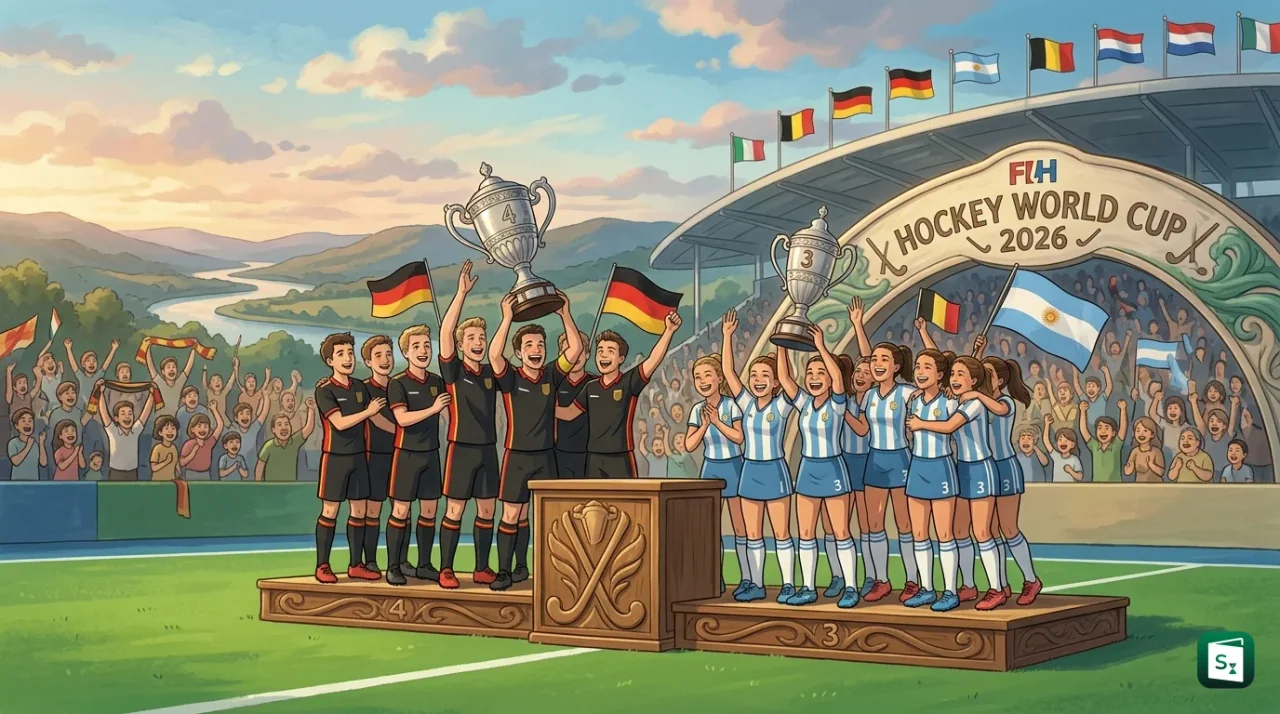
Germany defended their world crown with a 1-0 win over Spain in the men’s final on 30 August 2026 at the Belfius Hockey Arena in Wavre, while Argentina dethroned defending champions Netherlands 3-1 on penalties after a 1-1 draw in the women’s final on 29 August at the Wagener Stadium in Amstelveen. The FIH Hockey World Cup 2026, co-hosted by Belgium and the Netherlands from 15 to 30 August, was the first edition to stage the men’s and women’s tournaments together at the same time with 16 teams each. With this victory, Germany lifted their fourth men’s title to equal Pakistan’s record and Argentina claimed their third women’s title, their first since 2010.
What Is the FIH Hockey World Cup?
The FIH Hockey World Cup is the flagship international tournament for field hockey, organised by the International Hockey Federation (FIH). FIH stands for Fédération Internationale de Hockey, the world governing body for field hockey, indoor hockey, Hockey5s and Para hockey. It was founded on 7 January 1924 in Paris by Paul Léautey, who became its first president, after hockey was omitted from the 1924 Olympic programme. The federation merged with the International Federation of Women’s Hockey Associations (IFWHA) in 1982, bringing men’s and women’s hockey under one umbrella. It is headquartered in Lausanne, Switzerland, is recognised by the International Olympic Committee (IOC) and has 140 member national associations.
Conceptualised to give hockey a standalone world championship beyond the Olympic Games, the World Cup is the sport’s biggest title alongside Olympic gold. The men’s Hockey World Cup was first held in 1971 in Barcelona, Spain, when Pakistan beat Spain 1-0 to become inaugural champions. The women’s Hockey World Cup began in 1974 in Mandelieu, France, where the Netherlands beat Argentina 1-0 to win the first edition. Initially played at intervals of two to three years, both tournaments have been held every four years since 1978 for men and 1986 for women, with the 2023 men’s edition delayed by Covid-19 and the calendar reset with the 2026 joint edition.
The tournament is played on synthetic turf. The men’s trophy, constructed by the Pakistan Army for the inaugural edition, continues to be used, while the women’s trophy, often called the Salad Bowl, is a silver cup made in Scotland and first presented in 1975, revamped in 2018. The World Cup is distinct from the Hockey Champions Trophy, the FIH Hockey Pro League and the Hockey5s World Cup, and from the Ice Hockey World Championship governed by the International Ice Hockey Federation.
The FIH Hockey Rankings for men and women decide seedings and qualification pathways, and the World Cup also influences Olympic qualification conversations for the LA28 Olympic Games in Los Angeles.
FIH Hockey World Cup 2026 at a Glance: Hosts, Dates and Venues
The 2026 edition was co-hosted by Belgium and the Netherlands from 15 to 30 August 2026. It was the 16th edition of the men’s tournament and the 16th edition of the women’s tournament. For the first time, the men’s and women’s World Cups were held jointly and simultaneously, with matches spread over a single fortnight. The joint hosting follows earlier co-hosted women’s events, but 2026 was the first time both genders were staged together.
Two venues hosted all 72 matches, 36 for each gender:
| Venue | City and Country | Capacity for 2026 | Historical Note |
|---|---|---|---|
| Belfius Hockey Arena (Stade Justin Peeters) | Wavre, Belgium | Expanded to 10,000 | Purpose built arena, expanded from 4,000 for the World Cup, hosted the men’s final and men’s bronze match on 30 August |
| Wagener Stadium | Amstelveen, Netherlands | Expanded to 10,000 | Built in 1938, named after former Hockey Club Amsterdam chairman Joop Wagener, hosted the 1973 men’s World Cup and the women’s final and bronze match on 29 August |
The mascot and theme for 2026 was Together for Glory. Belgium and the Netherlands qualified automatically as hosts. The other teams qualified through the FIH Pro League 2023-24 and 2024-25, the Pan American Cup 2025, the EuroHockey Championship 2025, the Asia Cup 2025 and the dedicated World Cup Qualifiers held between December 2023 and March 2026 and in mid-2025. In total, 32 teams participated, 16 men’s and 16 women’s, drawn from five continental confederations.
The women’s final was played on 29 August 2026 in Amstelveen and the men’s final on 30 August 2026 in Wavre, with bronze medal matches on the same days. Current FIH President is Tayyab Ikram and CEO is Thierry Weil.
Germany Retains Men’s Title and Argentina Reclaims Women’s Crown
Men’s Final: Germany 1-0 Spain in Wavre
Defending champions Germany beat Spain 1-0 in the men’s final on 30 August 2026 to retain the title and secure a fourth men’s World Cup crown. Forward Michel Struthoff scored the only goal late in the third quarter, converting Germany’s sole circle entry of that quarter. Spain, playing their third World Cup final and first since 1998, controlled possession and earned more penalty corners but could not break down a disciplined German defence led by captain Tom Grambusch, a silver medallist at Paris 2024.
Trailing by one goal with just under four minutes left, Spain withdrew their goalkeeper for an extra outfield player to press for an equaliser, but Germany held firm until the final hooter at the Belfius Hockey Arena. Earlier the same day, Argentina beat the Netherlands 2-1 to win the men’s bronze medal. With this win, Germany became the first team to win back-to-back men’s titles since their own successes in 2002 and 2006, and they equalled Pakistan’s record of four titles. Germany’s earlier titles came in 2002 against Australia (2-1), 2006 against Australia (4-3) and 2023 against Belgium (5-4 on penalties after 3-3) in Bhubaneswar and Rourkela, India.
Women’s Final: Argentina Beats Netherlands in Shootout in Amstelveen
In the women’s final on 29 August 2026, Argentina defeated defending champions and hosts Netherlands 3-1 in the shootout after a 1-1 draw in regulation at the Wagener Stadium in front of about 10,000 spectators. The win gave Las Leonas their third women’s World Cup title, after 2002 and 2010, and ended a 16-year wait since their last triumph in Rosario in 2010. It also avenged defeats to the Netherlands in the 2022 World Cup final (3-1) in Terrassa and Amstelveen and the Tokyo Olympic gold medal match.
Netherlands took the lead just before half time when Yibbi Jansen, the world’s leading drag-flicker and top scorer of the tournament with eight goals, converted a penalty corner with 51 seconds left in the second quarter. Argentina pushed hard, earning eight penalty corners, and finally equalised early in the fourth quarter when captain Victoria Granatto scored off a rebound from Agustina Gorzelany’s flick in the 54th minute, making it 1-1.
In the shootout, goalkeeper Cristina Cosentino, an Olympic bronze medallist, emerged as the hero. She saved efforts from Pien Sanders and Felice Albers, while Victoria Granatto, Brisa Bruggesser and Sofía Cairo scored for Argentina. Marijn Veen scored the only goal for the Netherlands and a goal by Zoe Díaz was overturned on referral for a back-stick. Freeke Moes also missed for the Dutch. Earlier that day, Belgium beat Australia 1-0 to win the women’s bronze medal, their first World Cup medal on home soil.
For the Netherlands, the defeat ended a bid for a fourth consecutive title and a 10th overall title, and marked the final international appearance of two-time Olympic champion Xan de Waard, who retired with 252 caps after the tournament.
New Competition Format in 2026: How the Tournament Works
The Hockey World Cup 2026 format introduced a major change. There were no quarter-finals. Instead, the tournament was played in three stages for each gender, with 16 teams divided into four pools of four at the start.
Phase 1: Pool Stage (15 to 20 August)
All 32 teams began in Pools A, B, C and D with four teams each. Each team played three matches, one against every other team in its pool. The earlier pools for the men, as an example, were Pool A: Argentina, Japan, Netherlands, New Zealand, Pool B: Belgium, France, Germany, Malaysia, Pool C: Australia, Spain, Ireland, South Africa, and Pool D: England, India, Pakistan, Wales. The top two teams from each pool advanced to the Second Stage, while the bottom two moved to the Classification Stage.
Phase 2: Second Stage or Crossover Pools (21 to 24 August)
The top two teams from Pools A and D formed new Pool E, and the top two from Pools B and C formed new Pool F. In this stage, each team played two matches, only against the two teams that came from the other original pool. The result against the fellow qualifier from the same original pool was carried forward and counted in the new pool standings. That carry-forward point proved decisive in tight groups.
The top two teams from Pool E and Pool F advanced directly to the semi-finals, while the third and fourth placed teams played classification matches for 5th to 8th place. For women, Pool E matches were played in the Netherlands and Pool F in Belgium. The same crossover principle meant that every result from the first week still mattered in the second week, placing a heavy premium on winning the initial pool games.
Phase 3: Classification Stage and Knockouts
Teams finishing third and fourth in the original pools formed new groups, Pools G and H, and competed for 9th to 16th place. After the crossover pools, the tournament moved to semi-finals on 27 and 28 August, with one men’s and one women’s semi-final at each venue, followed by bronze medal matches and finals on 29 August for women and 30 August for men. In total, the format produced a clear pathway: Pool Stage, Crossover Pools, Semi-finals and Finals, with carried-forward points replacing the traditional knockout quarter-finals used in 2018 and 2023.
History and Roll of Honour: Most Successful Teams and India’s Record
The Hockey World Cup began to give the sport a global championship independent of the Olympics. The men’s roll of honour is led jointly by Pakistan and Germany with four titles each. Pakistan won in 1971, 1978, 1982 and 1994 and has not won since 1994. Germany won in 2002, 2006, 2023 and 2026. The Netherlands and Australia have three titles each, Belgium and India have one each.
| Year and Hosts | Men’s Champion | Runners-up | Score |
|---|---|---|---|
| 1971 Barcelona, Spain | Pakistan | Spain | 1-0 |
| 1973 Amstelveen, Netherlands | Netherlands | India | 4-2 on penalties after 2-2 |
| 1975 Kuala Lumpur, Malaysia | India | Pakistan | 2-1 |
| 1978 Buenos Aires, Argentina | Pakistan | Netherlands | 3-2 |
| 1982 Bombay, India | Pakistan | West Germany | 3-1 |
| 1986 London, England | Australia | England | 2-1 |
| 1990 Lahore, Pakistan | Netherlands | Pakistan | 3-1 |
| 1994 Sydney, Australia | Pakistan | Netherlands | 4-3 on penalties after 1-1 |
| 1998 Utrecht, Netherlands | Netherlands | Spain | 3-2 |
| 2002 Kuala Lumpur, Malaysia | Germany | Australia | 2-1 |
| 2006 Mönchengladbach, Germany | Germany | Australia | 4-3 |
| 2010 New Delhi, India | Australia | Germany | 2-1 |
| 2014 The Hague, Netherlands | Australia | Netherlands | 6-1 |
| 2018 Bhubaneswar, India | Belgium | Netherlands | 3-2 on penalties after 0-0 |
| 2023 Bhubaneswar and Rourkela, India | Germany | Belgium | 5-4 on penalties after 3-3 |
| 2026 Wavre and Amstelveen, Belgium and Netherlands | Germany | Spain | 1-0 |
The women’s Hockey World Cup is dominated by the Netherlands with nine titles in 1974, 1978, 1983, 1986, 1990, 2006, 2014, 2018 and 2022. Argentina now has three titles (2002, 2010, 2026), Australia has two (1994, 1998) and West Germany / Germany also has two (1976, 1981). India’s best women’s finish was fourth in 1974 at the inaugural edition, which remained their only semi-final until recently.
How Did India Fare in 2026?
Indian men finished 8th, losing the 7th place playoff to Belgium 4-3 on penalties after 3-3 in Wavre on 28 August. Captain Harmanpreet Singh scored eight goals to finish as joint top scorer with Argentina’s Tomás Domene. India beat Wales and Pakistan in the first round but lost to higher ranked opponents including England, Netherlands, Argentina and Belgium. Defender Amit Rohidas earned his 250th cap and Rajinder Singh his 50th during the tournament.
Indian women produced a breakthrough, finishing 5th after beating Germany 3-1 in the 5th place match at Amstelveen on 27 August, with goals from Ishika, Navneet Kaur (2) and a consolation from Germany’s Lynn Krings. This was India’s best women’s World Cup result in 52 years, since fourth place in 1974, and lifted the women’s team to 8th in the FIH World Rankings with 2,938 points. The team had drawn 2-2 with China, beaten South Africa 6-1 and drawn 0-0 with England in Pool D, then competed in the crossover pools against Netherlands, Australia and China.
Points Table, Rankings and Where to Watch in India
What Is the Points Table System?
Like most FIH events, the Hockey World Cup points table awards 3 points for a win, 1 point for a draw and 0 for a loss. Teams are ranked first by points, then by goal difference, goals scored and head-to-head if tied. In 2026, the initial pool tables from 15 to 20 August determined who entered Pools E and F for the title chase and Pools G and H for 9th to 16th place. Because carried-forward results counted in the crossover pools, tracking the FIH Hockey World Cup points table became especially important for fans following today’s hockey world cup match and qualification scenarios.
The final men’s standings in Wavre and Amstelveen placed Germany first, Spain second, Argentina third, Netherlands fourth, followed by Australia, England, Belgium and India in eighth. The women’s standings placed Argentina first, Netherlands second, Belgium third, Australia fourth, followed by India in fifth, then Germany, Spain, China, England and United States.
FIH Hockey Rankings
After the World Cup, Germany moved to the top of the men’s FIH Rankings, while India’s men stayed 8th. On the women’s side, Netherlands remained the top ranked side despite the final loss, and India climbed to 8th, overtaking Australia who slipped to 9th with 2,812 points. The FIH rankings are updated based on results from World Cups, Pro League and continental championships and will shape seedings for the road to LA28.
Hockey World Cup 2026 Live Streaming and Broadcast in India
Fans searching for hockey world cup 2026 live, hockey world cup on which channel and on which OTT could watch the tournament in India through the FIH’s official Where to Watch platform and its broadcast partners. In India, matches were streamed live on the JioCinema and Disney+ Hotstar OTT platforms and telecast on the Star Sports network, with live scores, pools, fixtures and the points table updated on fih.hockey and Olympics.com. Tickets for the Belgium leg were sold through the official Hockey World Cup 2026 Belgium platform (agenda.hockeyworldcup2026.be) for Wavre, and for the Netherlands leg through agenda.hockeyworldcup2026.nl for Amstelveen.
Key Takeaways
- Germany beat Spain 1-0 on 30 August 2026 at Belfius Hockey Arena, Wavre to win the Men’s FIH Hockey World Cup 2026 and claim a fourth title, equalling Pakistan’s record of four titles.
- Argentina beat defending champions Netherlands 3-1 on penalties after 1-1 on 29 August 2026 at Wagener Stadium, Amstelveen to win the Women’s FIH Hockey World Cup 2026 for a third title after 2002 and 2010.
- The 2026 edition was co-hosted by Belgium and the Netherlands from 15 to 30 August 2026 and was the first time the men’s and women’s tournaments were held jointly, with 16 teams each in four pools.
- The 2026 format had no quarter-finals, with a Pool Stage, Crossover Pools E, F, G, H with carried-forward results, semi-finals and finals, and points awarded as 3 for a win and 1 for a draw.
- The FIH, the International Hockey Federation founded on 7 January 1924 in Paris and headquartered in Lausanne, Switzerland, organises the World Cup and is led by President Tayyab Ikram.
- India’s women finished 5th, their best result since 1974 fourth place, and rose to 8th in FIH Rankings with 2,938 points, while India’s men finished 8th and captain Harmanpreet Singh was joint top scorer with 8 goals.