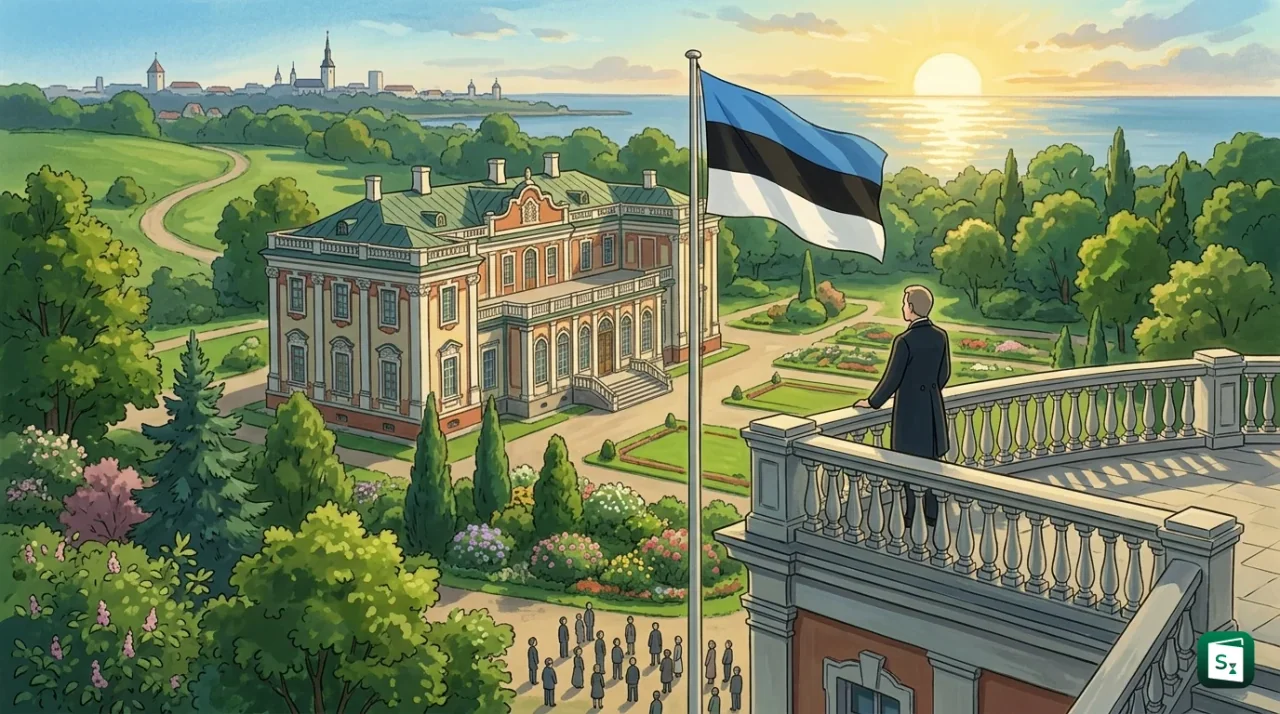
Estonia’s parliament, the Riigikogu, elected Chancellor of Justice Ülle Madise as the next President of Estonia on 2 September 2026 with 71 votes, crossing the required two thirds majority of 68. She will take the oath of office on 12 October 2026 and succeed outgoing President Alar Karis, who decided not to seek a second term. Madise will become the country’s seventh president and only its second woman head of state.
Who Is Ülle Madise? Estonia’s New Head of State
Ülle Madise, born Ülle Anton on 11 December 1974 in Tartu, is 51 years old and is one of Estonia’s most respected constitutional lawyers. She will assume office as President-elect on 12 October 2026 and serve a five-year term as head of state. Prime Minister Kristen Michal will head the government alongside her.
Madise has served as Chancellor of Justice (Õiguskantsler) since 31 March 2015, and is now in her second seven-year term that began on 4 April 2022. The Chancellor of Justice is an independent constitutional institution in Estonia, it is not part of the legislative, executive or judicial branch and acts as the guardian of constitutional principles, protector of individual rights, and ombudsman for public grievances. The Riigikogu appoints the Chancellor on the proposal of the President, and the role carries strong moral authority without political affiliation.
Her academic and professional background is deeply rooted in law and public administration. She graduated cum laude with a BA and magister iuris from the University of Tartu Faculty of Law between 1993 and 2001, and earned a PhD in Public Administration in 2007 from Tallinn University of Technology with a dissertation on elections and political parties in Estonia. She has worked as Head of the Public Law Department at the Ministry of Justice (1998 to 2002), Adviser to the Constitutional Committee of the Riigikogu (2002 to 2005), member of the National Electoral Committee (2006 to 2010), Legal Adviser to President Toomas Hendrik Ilves (2009 to 2015), and Professor of Constitutional Law at the University of Tartu (2011 to 2016) and visiting professor thereafter.
Madise is known for her independent positions, including interventions on surveillance, digital identity cards, and the car tax law, and for her clear public communication on constitutional matters. Her father Tõnu Anton was a former Supreme Court judge and signatory of Estonia’s restoration of independence. She is married to Lauri Madise, a judge at the Court of Justice of the European Union in Luxembourg. As early as 2016, when parliament and the Electoral College failed to agree on a president, her name was already discussed as a potential future head of state.
When asked what kind of president she would be, she described herself as dedicated, hardworking and down to earth, adding that she values lightness, humour and creativity and does not intend to become overly serious in office. Her stated vision is for Estonia to remain a safe, peaceful and attractive place to live, with strong allies ready to defend it and deter external threats.
How the President Was Elected: Result on 2 September 2026
The election was held in the Riigikogu, Estonia’s 101-seat unicameral parliament, at Toompea Castle in Tallinn, on 2 September 2026. It was an extraordinary session convened specifically for the presidential election.
Ülle Madise was the only candidate on the ballot. She was registered by the National Electoral Committee on 25 August 2026 after being nominated by 75 members of the Riigikogu. By law, at least one fifth of members, which is 21 members, is needed to nominate a candidate, so her support far exceeded the minimum.
In a secret ballot, she received 71 votes, which was three votes more than the required two thirds majority of 68. Out of 101 members, 78 ballots were cast, with 7 blank or invalid votes. The remaining members abstained or were absent. Because she crossed the threshold in the first round, no second or third round was needed and no Electoral College had to be convened.
The National Electoral Committee formally declared her elected under the President of the Republic Election Act, and she will be sworn in on 12 October 2026, the day after President Karis’s term ends on 11 October 2021 to 11 October 2026. Alar Karis congratulated her publicly, saying that serving as head of state is a great honour and an even greater responsibility, and wishing her strength, wisdom and resolve as he prepares to hand over office.
How Estonia Elects Its President: A Parliamentary System Explained
Estonia is a parliamentary republic, not a semi-presidential or presidential system, and the President is largely a ceremonial head of state with no direct executive power. Executive authority rests with the Government of the Republic, headed by the Prime Minister. A common doubt, whether Estonia has both a President and a Prime Minister, is answered by this division. The President represents the country, while the Prime Minister runs the government.
The election is indirect, the people do not vote directly for President. The process is laid down in Section 79 of the Constitution of Estonia (1992) and the President of the Republic Election Act.
Three Rounds in the Riigikogu and the Electoral College
| Stage | Body | Threshold to Win | Key Rule |
|---|---|---|---|
| First Round | Riigikogu (101 members) | 68 votes (two thirds) | Nomination by at least 21 members of the Riigikogu, secret ballot |
| Second Round | Riigikogu (next day) | 68 votes | Fresh nominations allowed |
| Third Round | Riigikogu (same day) | 68 votes | Contest between two candidates who got the most votes in second round |
| Electoral College | 208 members (101 Riigikogu members + 107 local government representatives) | Majority of voting members | Convened by Speaker of Riigikogu within one month if parliament fails in three rounds, two rounds held if needed |
To be eligible, a candidate must be an Estonian citizen by birth and at least 40 years old. The term is five years, renewable only once consecutively. If no one wins even in the Electoral College, the process restarts in the Riigikogu within 14 days.
This system explains why Madise’s first-round victory was notable, it avoided the prolonged deadlocks seen in the past, for example in 2016 when parliament and the Electoral College both failed to elect a president and the election returned to parliament where Kersti Kaljulaid was eventually elected.
What Does the President of Estonia Actually Do? Powers of a Ceremonial Head of State
The office of President of the Republic of Estonia was created under the Constitution of 1938 and restored in its current form with the Constitution of 1992 after Estonia regained independence from the Soviet Union in 1991. The President must suspend membership in any political party while in office and cannot hold any other elected or appointed post.
Head of State vs Head of Government
| Role | Position | Main Functions |
|---|---|---|
| President | Head of State | Represents Estonia internationally, appoints and recalls diplomats, proclaims laws passed by Riigikogu, can refuse to proclaim a law and return it for review, nominates the Prime Minister candidate, appoints the Government on proposal of Prime Minister, declares regular and extraordinary elections of Riigikogu in specific constitutional situations, supreme commander of national defence, confers awards and grants clemency |
| Prime Minister | Head of Government | Leads and directs the Government, implements domestic and foreign policy, represents the Government, chairs cabinet meetings |
In practice, the President acts as the highest notary and balancer. The President declares elections, convenes the first sitting of a new Riigikogu, can convene extraordinary sessions, and must declare extraordinary elections if the Riigikogu fails to pass the annual state budget within two months, fails to get approval in a referendum it initiated, or fails twice to approve a Prime Minister candidate nominated by the President. The President also nominates the Prime Minister candidate after consultations with parliamentary factions, normally the leader of the coalition or largest party, who must then get approval from the Riigikogu.
The President’s official residence is the Presidential Palace in the Kadriorg district of Tallinn, and independence and impartiality are central to the role. The current monthly salary for the President is about €10,240.
Who Was Alar Karis? The Outgoing President
Alar Karis, born 26 March 1958 in Tartu, served as the sixth President of Estonia from 11 October 2021 to October 2026. An independent with no party affiliation, he came from a scientific and academic background rather than party politics. He graduated from the Estonian University of Life Sciences in 1981, earned a research degree in parasitology and later worked in molecular genetics and developmental biology, served as Rector of the Estonian University of Life Sciences (2003 to 2007), Rector of the University of Tartu (2007 to 2012), Auditor General of Estonia (2013 to 2018), and Director of the Estonian National Museum (2018 to 2021).
Karis was elected on 31 August 2021 in the second round of the Riigikogu with 72 votes, after being nominated by the Reform Party and Centre Party and approached by Speaker Jüri Ratas. As President, he acted as a balancer and at times returned laws for reconsideration, for example declining to proclaim the Vehicle Tax Act in July 2024 on constitutional equality grounds until it was amended.
He was eligible for a second consecutive five-year term but announced on 23 June 2026 at the Victory Day parade in Rapla that he would not stand again. He said the decision was personal and based on a promise made to his family when he took office to serve only one term, a view he had earlier expressed in favour of a single seven-year term to avoid mid-term speculation about re-election. His term saw high public trust and close cooperation with Prime Ministers Kaja Kallas and later Kristen Michal, who took office on 23 July 2024.
Where Is Estonia? A Profile of the Baltic State
Estonia is the northernmost and smallest of the three Baltic States, the other two being Latvia and Lithuania, located in Northern Europe on the eastern shore of the Baltic Sea and the Gulf of Finland, bordering Latvia to the south and Russia to the east. It is often confused with the Balkans, but the Baltic States are in the northeast of Europe while the Balkans are in southeastern Europe.
The capital and largest city is Tallinn, with about 454,000 residents. The country covers about 45,339 sq km, with a total population of about 1.34 to 1.37 million as of 2024 to 2025, making it one of the smallest members of the European Union. The official language is Estonian, a Finno-Ugric language closely related to Finnish and unrelated to Russian or other Slavic languages, though Russian is also widely spoken. The national currency is the euro (EUR), adopted on 1 January 2011, and the time zone is Eastern European Time (EET), GMT+2, which is 3 hours and 30 minutes behind Indian Standard Time (IST).
Estonia was independent from 1918 to 1940, was forcibly incorporated into the Soviet Union in 1940, and regained independence on 20 August 1991 as the USSR collapsed, with the last Russian troops leaving in 1994. Since then it has pursued close integration with the West. It joined both NATO on 29 March 2004 and the European Union on 1 May 2004, became a full member of the OECD on 9 December 2010, and is a member of the Schengen Area, which allows visa-free travel across most of Europe. Indians need a Schengen visa to visit Estonia, there is no visa-free access, and Estonia maintains an Embassy in New Delhi while India has limited direct representation.
Estonia is known as a highly digital society, creator of the e-Residency programme that allows foreigners to establish an EU-based digital identity and business online, host of the NATO Cooperative Cyber Defence Centre of Excellence in Tallinn, and one of Europe’s most developed countries despite its small size.
| Fact | Detail |
|---|---|
| Capital | Tallinn |
| Area | 45,339 sq km |
| Population | About 1.34 million (2025 estimate) |
| Official Language | Estonian (Finno-Ugric family) |
| Currency | Euro (EUR), since 2011 |
| Government Type | Parliamentary republic |
| Legislature | Riigikogu (101 members) |
| Independence Restored | 20 August 1991 |
| EU Member Since | 1 May 2004 |
| NATO Member Since | 29 March 2004 |
Why This Election Matters: Stability on NATO’s Eastern Flank
Estonia sits on the eastern edge of NATO and the EU, sharing a border with Russia and facing direct security pressures since Russia’s full-scale invasion of Ukraine in 2022. For a country of only 1.3 million people, the presidency carries symbolic weight as a unifying voice on defence and foreign policy, even though executive power lies with the Government.
Estonia has been one of NATO’s heaviest defence spenders relative to GDP, hosts a UK-led multinational NATO battlegroup since 2017 as part of Enhanced Forward Presence, relies on NATO’s Baltic Air Policing mission since it has no fighter aircraft of its own, and hosts allied aircraft at Ämari Air Base. The President, as supreme commander of national defence, plays a formal role in declaring a state of war or emergency on proposal of the Government and in representing Estonia in international relations in coordination with the Government.
The smooth first-round election of a widely respected constitutional expert avoids a prolonged political vacuum and signals institutional stability at a time when European security, digital governance, and rule of law debates dominate the region. With a President who has spent more than a decade as the independent guardian of the Constitution, Estonia reinforces the credibility of its legal and democratic institutions both at home and among its EU and NATO allies.
Key Takeaways
- Ülle Madise, Chancellor of Justice since 2015, was elected President of Estonia on 2 September 2026 with 71 votes in the 101-seat Riigikogu, exceeding the 68-vote two thirds threshold.
- She will take oath as the 7th President of Estonia on 12 October 2026, succeeding Alar Karis (6th President, 2021 to 2026), and becomes the second woman president after Kersti Kaljulaid (2016 to 2021).
- The President is elected for a five-year term renewable only once consecutively under Section 79 of the Constitution of Estonia (1992), by secret ballot in the Riigikogu or, if needed, by a 208-member Electoral College.
- The President is the head of state with largely ceremonial powers, executive authority rests with the Government headed by Prime Minister Kristen Michal, who took office on 23 July 2024.
- Estonia’s capital is Tallinn, currency is the euro since 1 January 2011, and it joined both NATO and the EU in 2004 after restoring independence on 20 August 1991.