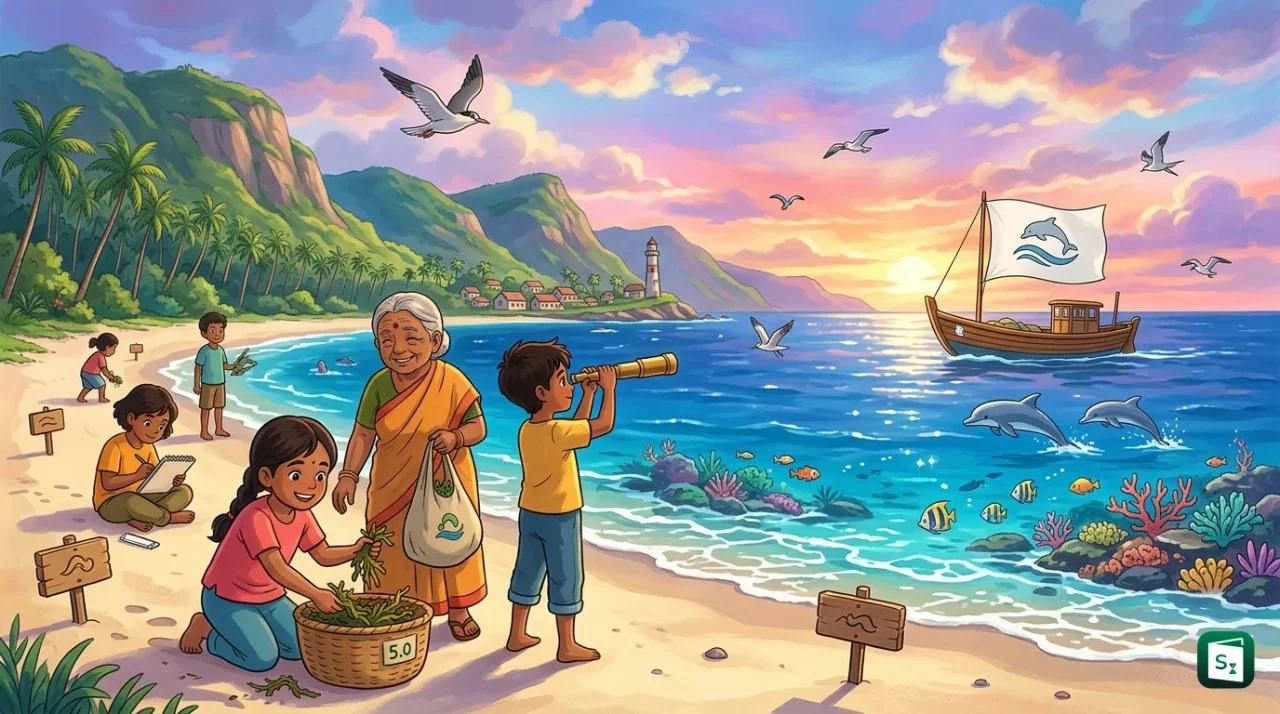
Union Minister of State (Independent Charge) for Earth Sciences Dr Jitendra Singh has launched the fifth edition of Swachh Sagar Surakshit Sagar 2026 (SSSS v5.0) in New Delhi. The week-long ocean conservation campaign will run from 12 to 19 September 2026 and will culminate on International Coastal Cleanup Day on 17 September with large scale beach cleanup drives across more than 100 coastal locations. This year’s edition adds two major firsts, an AI-enabled SAGAR PRAHARI mobile application and the inaugural National Ocean Olympiad, to turn coastal cleanup into a nationwide people’s movement.
What Is the Swachh Sagar Surakshit Sagar Campaign?
Swachh Sagar Surakshit Sagar (SSSS), which means Clean Coast Safe Sea, is a nationwide coastal cleanup and ocean conservation campaign led by the Ministry of Earth Sciences (MoES). A coastal cleanup is an organised drive where volunteers collect, segregate and remove litter from beaches and coastlines, while a beach cleanup focuses specifically on cleaning sandy shore areas where marine litter accumulates. The campaign translates these cleanups into a larger goal of ocean conservation, which means protecting marine ecosystems and promoting the sustainable use of ocean resources.
The initiative is coordinated by the National Centre for Coastal Research (NCCR), Chennai, an attached office of MoES, with support from the National Institute of Ocean Technology (NIOT), Chennai, and other MoES institutions. It follows a whole of government approach, bringing together the Ministry of Environment, Forest and Climate Change, Indian Coast Guard, National Disaster Management Authority, National Service Scheme (NSS) and other central ministries, along with state governments, educational institutions, coastal communities, volunteers and non-governmental organisations.
The campaign has three underlying behaviour change goals that have remained constant since its start. These are to consume responsibly, to segregate waste at home and to dispose of waste responsibly. At the beach level, this means reducing single use plastic, separating plastic waste at source and ensuring it does not reach rivers and seas. The messaging is aligned with India’s ban on identified single use plastic items from 1 July 2022 and with the broader Swachh Bharat vision.
From 2022 to SSSS 5.0: How the Campaign Has Evolved
The SSSS initiative was originally established in 2022 as a 75-day citizen led campaign from 5 July to 17 September 2022. It was launched to coincide with Azadi Ka Amrit Mahotsav, marking 75 years of India’s independence. The design was symbolic, covering 75 beaches along India’s coastline with 75 volunteers for every kilometre, and targeting the removal of 1,500 tonnes of garbage, mainly single use plastic, from the coasts. The campaign culminated on International Coastal Cleanup Day, which is observed globally on the third Saturday of September every year and fell on 17 September in 2022.
That first edition was described as the first of its kind and the longest running coastal cleanup campaign in the world in terms of duration and participation. A mobile app called Eco Mitram was introduced then to spread awareness and allow voluntary registration for the cleanup on 17 September. More than 52,000 volunteers from 24 states had registered within the first 20 days, and more than 200 tonnes of garbage were removed in that early phase.
Since then, the campaign has been conducted annually during the week of International Coastal Cleanup Day with participation from government institutions, volunteers, non-governmental organisations, students and community groups. Each year has expanded coverage and public engagement, moving from a 75-day format to a focused week-long national movement centred on the third Saturday of September. By 2025, the drive ran from 15 to 20 September 2025 across coastal locations. The 2026 edition is the fifth edition, now branded as SSSS v5.0, and it has been positioned explicitly as a Jan Bhagidari or people’s participation movement inspired by the Deep Ocean Mission.
Swachh Sagar Surakshit Sagar 5.0: Dates, Theme and Major Highlights in 2026
When is the campaign and what is International Coastal Cleanup Day? The SSSS 5.0 campaign is scheduled from 12 to 19 September 2026, a week-long celebration of oceans with activities across the country. It will culminate on International Coastal Cleanup Day on 17 September 2026. Globally, International Coastal Cleanup Day is observed on the third Saturday of September every year. It was first organised in 1986 in Texas, USA by the Ocean Conservancy and has since grown into the world’s largest volunteer effort for marine environment, now held in more than 100 countries with millions of volunteers collecting and documenting trash.
The 2026 Indian campaign aligns with this global observance and is focused on ocean conservation, marine pollution awareness and sustainable use of ocean resources. The 2026 edition is presented as a week-long nationwide coastal cleanup. Its core objective is to increase public understanding of how litter, especially plastic, damages coasts and seas, and to encourage action that keeps beaches clean beyond the cleanup day itself.
Key highlights announced for SSSS 5.0 in New Delhi by Dr Jitendra Singh include:
| Feature | Detail for 2026 |
|---|---|
| Duration | 12 to 19 September 2026, week-long |
| Culmination Day | 17 September 2026, International Coastal Cleanup Day |
| Scale | Beach cleanup drives across more than 100 locations along India’s coastline |
| Public Activities | Human chain, cycling rallies, marathons, youth activities, ozone day programmes and citizen engagement events |
| Launch Venue | New Delhi, by Dr Jitendra Singh, Minister of State (Independent Charge) for Earth Sciences |
| Inspiration | Swachh Bharat vision and Deep Ocean Mission of Prime Minister Narendra Modi |
How Long Is India’s Coastline Covered Under the Swachh Sagar Campaign?
India’s coastline stretches about 11,098.81 km including island territories, reassessed from 7,516.6 km by the National Hydrographic Office with the Survey of India and notified on 29 April 2025. This vast 13-state coastline, home to livelihoods of around 200 million people, is the focus of synchronised Swachh Sagar cleanup drives.
With millions depending on the sea for livelihood, such synchronised action is crucial. The campaign calls on citizens, students, youth, coastal communities and organisations to join sea beach clean-up drives, ocean pledges, youth activities and rallies during the week.
Digital Platforms Powering Swachh Sagar Surakshit Sagar 5.0
SSSS 5.0 is supported by three official digital platforms that make participation and tracking easier for citizens.
Official Website and Ocean Conservation Pledge Platform
The dedicated SSSS v5.0 website at https://niot.res.in/SSSS/ provides details on beach locations, activity brochure, schedule and registration. Citizens can find where cleanups are happening and how to join as volunteers through this portal. This is the Swachh Sagar Portal being searched for online, and it is distinct from the Swachh Sagar port portal used for other maritime services.
A separate ocean conservation pledge platform at https://niot.res.in/SSSS/pledge.php allows individuals, families, schools, colleges and organisations to take the Ocean Pledge, a commitment to keep shores clean and protect oceans. Dr Jitendra Singh has urged citizens to take the pledge with family and friends and to encourage their institutions and communities to do the same, to make the campaign a Jan Bhagidari movement. An introductory video and an activity schedule video were also unveiled at the launch.
Which Mobile App Was Launched for the Swachh Sagar Coastal Cleanup Campaign?
SAGAR PRAHARI is the official mobile app of the Swachh Sagar Surakshit Sagar coastal cleanup campaign. Developed by the National Centre for Coastal Research for the Ministry of Earth Sciences, this free AI-enabled app helps volunteers register, photograph, categorise and report marine litter for data-driven action.
The app allows volunteers to register, record collected marine litter, photograph and categorise waste, and submit cleanup information in a standard format. This creates a record similar to the global Clean Swell data cards used during International Coastal Cleanup drives, helping policymakers track litter types and sources. The app is available on Google Play Store at the link shared by the Ministry and is linked from the official SSSS website.
This SAGAR PRAHARI should not be confused with Sagar Prahari Bal (SPB), which is a coastal protection unit of the Indian Navy formed in March 2009 after the Mumbai attacks, with about 2,000 personnel and 80 fast interceptor boats for patrolling coastal waters. The name is similar, but the app is a civilian citizen science tool for beach monitoring.
What Is Ocean Olympiad India 2026?
Ocean Olympiad India 2026, also called the National Ocean Olympiad, is the first-ever national annual competition to promote ocean literacy among young learners. Initiated by the National Institute of Ocean Technology (NIOT) under the Ministry of Earth Sciences, it was inaugurated as part of Swachh Sagar Surakshit Sagar 5.0.
Who can participate and how does it work? The Olympiad is open to students of Grade 11 and undergraduate students, excluding those in their final year. It encourages participants to explore ocean science, ocean engineering and allied technologies linked to India’s Blue Economy, which refers to sustainable use of ocean resources for economic growth and livelihoods.
The competition follows a multi-stage process. It begins with online registration and a screening examination, followed by further selection rounds including a qualifier stage and a grand finale. Citizens can register and test their knowledge via https://www.oceanolympiad.com/. Academic quiz design and the digital platform are supported by X Quiz It as Knowledge Partner.
Incentives are strong. The Top 5 National Winners will be awarded a fully sponsored educational tour of all prestigious Ministry of Earth Sciences research institutes across the country, funded entirely by NIOT. The Olympiad was announced along with two other youth initiatives by NIOT in August 2026, the National Technothon on Innovative Deep-Sea Mining Technology and the World Ocean Hackathon, showing a wider push to connect students to the Deep Ocean Mission and SAMUDRAYAAN, India’s manned submersible programme with MATSYA 6000 designed to carry three persons to 6,000 metre water depth.
Why Ocean Conservation Matters: Marine Pollution and Sustainable Use of Ocean Resources
The campaign aims to increase awareness about marine pollution and the sustainable use of ocean resources. Both issues are central to India’s coastal future.
What Is Marine Pollution and What Are Its Causes?
What is marine pollution? As defined under the United Nations Convention on the Law of the Sea (UNCLOS), 1982, marine pollution is the introduction by humans, directly or indirectly, of substances or energy into the marine environment that results in harmful effects to living resources and marine life.
About 80 per cent of marine pollution comes from land-based activities and the rest from sea-based sources. Major causes and sources include:
| Source Type | Examples |
|---|---|
| Land-based | Untreated sewage and industrial wastewater, agricultural runoff with nitrogen and phosphorus, plastic waste and microplastics carried by rivers and wind |
| Sea-based | Oil spills from shipping and offshore drilling, discharge of ballast water carrying invasive species, abandoned fishing gear or ghost nets, dumping of garbage at sea |
In India, the Ganga-Brahmaputra river system is ranked among the largest contributors of plastic to the Indian Ocean, and studies by NCCR from 2018 to 2021 found that single use plastics contribute to more than 50 per cent of marine litter on Indian coasts. The Beach Litter Survey also showed that maximum litter accumulates on the backshore rather than the intertidal zone, and urban beaches have higher accumulation than rural beaches. Microplastics, which are plastic pieces smaller than 5 mm, have been found to increase along the east coast during the monsoon, with higher concentrations near river mouths.
What are ocean resources and why use them sustainably? Ocean resources include living resources like fish and marine biodiversity, and non-living resources like minerals, energy and water. Conservation of ocean resources means using them in a way that meets present needs without harming the ability of future generations to benefit, including protecting resources beyond 200 nautical miles, which is the limit of a country’s Exclusive Economic Zone (EEZ) under UNCLOS.
Effects of Marine Pollution and How to Control It
Why is marine pollution a problem? Effects are severe for nature, economy and health. Plastic and oil harm marine species through ingestion and entanglement, with estimates that around 100,000 marine mammals die each year due to plastic. Eutrophication, caused by excess nutrients, leads to harmful algal growth and creates dead zones where marine life cannot survive. Coral reefs, mangroves and seagrasses, which act as natural buffers against storms and erosion, are degraded by chemical and sediment pollution, raising the vulnerability of coastal communities to cyclones and sea level rise. For human health, contaminated seafood can carry methylmercury and persistent chemicals, while microplastics are now detected in water, salt and fish of commercial importance.
How to prevent and control marine pollution? Control requires action on land and at sea. On land, India has enforced the Plastic Waste Management Rules, 2016 and its amendments, including the ban on identified single use plastic items from 1 July 2022, and Extended Producer Responsibility (EPR) guidelines notified on 16 February 2022 that make producers responsible for the plastic they place on the market. At sea, the International Convention for the Prevention of Pollution from Ships (MARPOL 73/78), especially Annex V on Garbage, prohibits disposal of plastics at sea, and the Directorate General of Shipping Order 05 of 2019 bans single use plastic on Indian ships from 1 January 2020. Other steps include segregation and collection of waste at source, improved solid waste management, monitoring of coastal water quality using buoys deployed at 10 sites by NCCR, and citizen science through cleanups and apps like SAGAR PRAHARI that help track litter types.
How the Campaign Is Implemented Across India
The campaign is led by the Ministry of Earth Sciences (MoES), which was established on 29 January 2006 through the reorganisation of the Department of Ocean Development, first created in July 1981. MoES is headquartered at Prithvi Bhavan, Lodhi Road, New Delhi, and is headed by Dr Jitendra Singh as Minister of State (Independent Charge). Its mandate covers weather, climate, ocean and coastal states, seismology and natural hazards, along with sustainable exploration of marine resources and polar research.
Within MoES, implementation is anchored by the National Centre for Coastal Research (NCCR), Chennai, which manages coastal water quality, marine biodiversity, litter and hazards. NCCR works with NIOT, Indian National Centre for Ocean Information Services (INCOIS), Hyderabad, National Centre for Polar and Ocean Research (NCPOR), Goa, and other MoES institutes. The Indian Meteorological Department (IMD) and Indian Institute of Tropical Meteorology (IITM), Pune, also function under MoES.
At the ground level, a lead coordinating institution is assigned for each of the more than 100 beach locations. That institution works with the State Pollution Control Boards, district administrations, local municipalities, Indian Coast Guard units, NSS volunteers, schools, colleges and NGOs to organise cleanups, safety, waste segregation and data recording. Collected data on marine litter is shared with Central Pollution Control Board (CPCB) and state boards, and feeds into longer term tools like Marine Spatial Planning and the National Action Plan on Sea-based Marine Plastic Litter, prepared in line with UNCLOS and MARPOL commitments. Volunteers who miss a local beach can still join through the Ocean Pledge and the SAGAR PRAHARI app, which keep the campaign active beyond the physical cleanup week.
Campaign Outcome in September 2026
The fifth edition concluded with cleanup drives at 231 locations across 13 coastal States and Union Territories from 12 to 19 September 2026. About 15 lakh people took the Ocean Conservation Pledge during the week. Dr Jitendra Singh reviewed the outcome on 21 September 2026 and praised the mass participation of citizens, students, coastal communities, scientific institutions and volunteers.
The Way Forward
The fifth edition shows a clear shift from a one-time cleanup to a year-round people’s movement with digital tracking and youth learning at its core. The large volunteer base created by SSSS, combined with the new AI-enabled monitoring through SAGAR PRAHARI, can build a long term dataset on marine debris types and sources, similar to the global International Coastal Cleanup database that has recorded more than 400 million pounds of trash by nearly 19 million volunteers since 1986. Such data helps identify whether policy actions like the single use plastic ban and EPR are reducing specific items on beaches.
For lasting impact, the focus will need to move from collecting waste on the shore to stopping waste at source. That means better segregation at home, improved collection and recycling infrastructure, and enforcement of waste management rules in coastal cities. Success stories like the Versova Beach Cleanup in Mumbai, which began as a citizen effort and restored a heavily polluted beach, and similar drives at Chennai during earlier International Coastal Cleanup Days, show that sustained community ownership works.
The linkage with ocean literacy through the Ocean Olympiad also prepares a next generation of researchers, engineers and policy thinkers for India’s Blue Economy and Deep Ocean Mission. With India’s coasts facing pressure from urbanisation, tourism and fishing, continued annual drives around the third Saturday of September, backed by scientific monitoring, international cooperation under Sustainable Development Goal 14.1 to prevent and reduce marine pollution, and behavioural change on single use plastic, will be key to keeping the Swachh Sagar, Surakshit Sagar promise of clean coasts and safe seas.
Key Takeaways
- Swachh Sagar Surakshit Sagar 5.0 (SSSS v5.0) was launched in New Delhi by Dr Jitendra Singh, Minister of State (Independent Charge) for Earth Sciences, as a week-long campaign from 12 to 19 September 2026.
- The campaign culminates on International Coastal Cleanup Day on 17 September, which is observed globally on the third Saturday of September and was first started in 1986 by the Ocean Conservancy in Texas.
- The SSSS initiative was originally established in 2022 as a 75-day, 75-beach drive for Azadi Ka Amrit Mahotsav with a target to remove 1,500 tonnes of garbage.
- The campaign is led by the Ministry of Earth Sciences (established 29 January 2006) and coordinated by the National Centre for Coastal Research (NCCR), Chennai, with support from the National Institute of Ocean Technology (NIOT), Chennai (established November 1993).
- Digital tools for 2026 include the official website https://niot.res.in/SSSS/, the pledge platform https://niot.res.in/SSSS/pledge.php and the AI-enabled SAGAR PRAHARI mobile app for registering and recording marine litter.
- The first-ever National Ocean Olympiad (Ocean Olympiad India 2026) at https://www.oceanolympiad.com/ is open to Grade 11 and undergraduate students excluding final year through online screening, qualifier and grand finale, with Top 5 winners receiving a sponsored tour of MoES institutes.