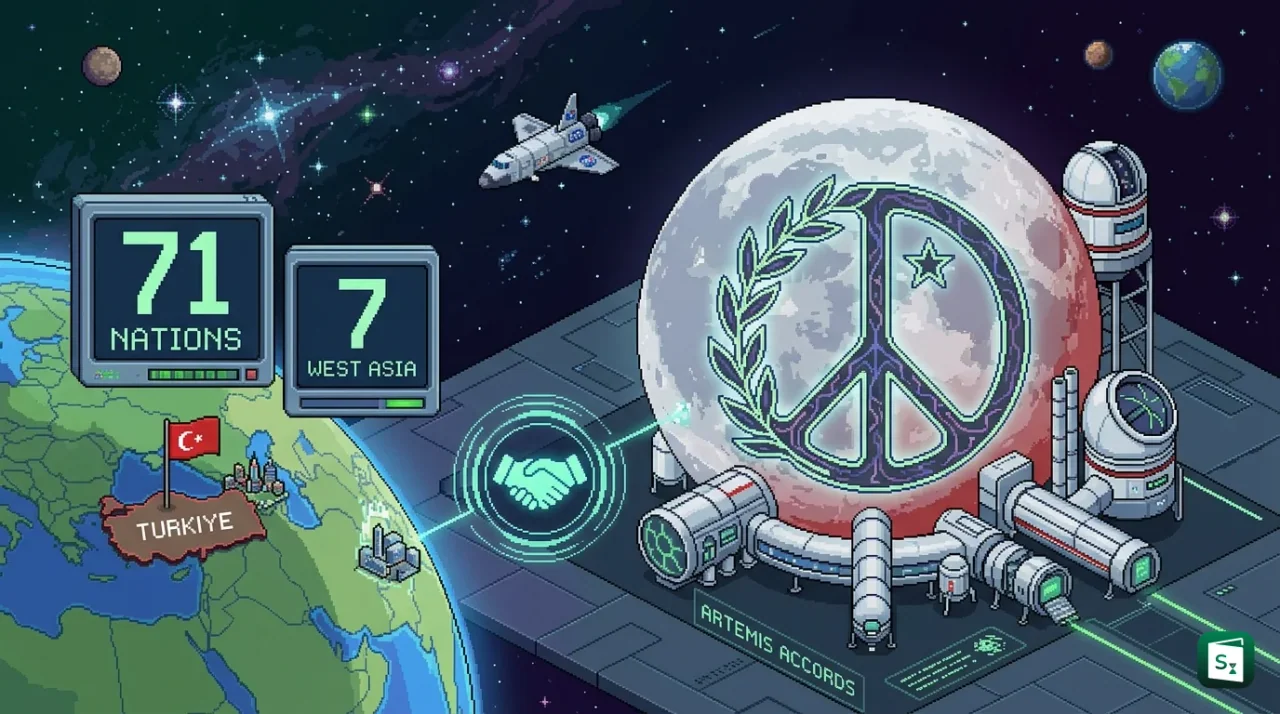
Türkiye signed the Artemis Accords on 31 August 2026 at NASA Headquarters in Washington, becoming the 71st signatory globally and the 7th nation from West Asia to join the framework. The ceremony was hosted by NASA Administrator Jared Isaacman with Turkish Minister of Industry and Technology Mehmet Fatih Kacır signing on behalf of the country, alongside Turkish Space Agency President Yusuf Kıraç and US Deputy Assistant Secretary of State Connor Tomlinson. As the Artemis program prepares for its crewed Artemis II launch, Türkiye’s entry signals growing global momentum to set common rules for peaceful exploration of the Moon, Mars and beyond.
What Are the Artemis Accords?
The Artemis Accords are a non-binding set of principles for the civil exploration and use of the Moon, Mars, comets and asteroids, including their surfaces, subsurfaces, orbits and transit routes. Their formal title is Principles for Cooperation in the Civil Exploration and Use of the Moon, Mars, Comets and Asteroids for Peaceful Purposes. They were jointly established by the National Aeronautics and Space Administration (NASA), headquartered in Washington, D.C. and founded in 1958, and the United States Department of State on 13 October 2020.
The Accords are named after the Artemis program, the American led effort to return humans to the Moon and prepare for crewed missions to Mars. While signing the Accords is a prerequisite for deeper civil cooperation under Artemis, signing alone does not automatically mean a country contributes hardware to Artemis missions. The Accords are open to any nation, even those without an active space programme, that accepts their principles.
The eight founding signatories in 2020 were Australia, Canada, Italy, Japan, Luxembourg, the United Arab Emirates, the United Kingdom and the United States. From that core group, the coalition has expanded to 71 nations as of 31 August 2026, making it the largest voluntary framework for deep space conduct outside the United Nations system.
Grounded in the Outer Space Treaty of 1967
The Accords do not replace existing space law. They build directly on the Treaty on Principles Governing the Activities of States in the Exploration and Use of Outer Space, including the Moon and Other Celestial Bodies, known as the Outer Space Treaty of 1967. That treaty, negotiated under the United Nations, entered into force in 1967 and is considered the foundation of international space law. It bars national appropriation of celestial bodies, requires space activity to be for peaceful purposes, and obliges states to avoid harmful contamination.
The Accords also reinforce other instruments, including the Agreement on the Rescue of Astronauts, the Return of Astronauts and the Return of Objects Launched into Outer Space (Rescue Agreement, 1968), the Convention on Registration of Objects Launched into Outer Space (Registration Convention, 1975), and the United Nations Guidelines for the Long-term Sustainability of Outer Space Activities adopted by the Committee on the Peaceful Uses of Outer Space (COPUOS) in 2019. The text also commits the Government of the United States to maintain the original document and transmit a copy to the Secretary-General of the United Nations for circulation, though it is not eligible for registration under Article 102 of the United Nations Charter.
Why Was Türkiye’s Signing Significant? The 71st Signatory and 7th from West Asia
Türkiye’s accession was significant for two numerical milestones. It became the 71st signatory globally and the 7th nation from West Asia to join the framework. The announcement was confirmed by both NASA and the United States Department of State in releases dated 1 September 2026, a day after the signing.
The six earlier signatories from West Asia are Bahrain, Israel, Jordan, Oman, Saudi Arabia and the United Arab Emirates (UAE). The UAE was one of the eight founders in 2020, while Saudi Arabia joined in 2022, and Bahrain, Israel and others joined in subsequent years. Jordan signed on 23 April 2026 as the 63rd signatory, and Oman followed on 26 January 2026 as the 61st signatory, with Mauritius becoming the 70th on 17 July 2026 just weeks before Türkiye.
The growth trajectory has been rapid:
| Period | Signatories |
|---|---|
| 13 October 2020 | 8 founding nations |
| June 2023 | 27 nations, including India |
| January 2026 | 61 nations, with Oman as 61st |
| July 2026 | 70 nations, with Mauritius as 70th |
| 31 August 2026 | 71 nations, with Türkiye as 71st |
This expansion from eight to 71 in less than six years shows widening acceptance of common operational norms as lunar activity accelerates and more countries plan missions beyond low Earth orbit.
When and How Did Türkiye Join? The Signing Ceremony in Washington
Türkiye signed the Accords on Monday, 31 August 2026 at the Mary W. Jackson NASA Headquarters building in Washington. The ceremony was hosted by NASA Administrator Jared Isaacman, who was appointed as NASA head and has overseen Artemis coordination under the current United States administration.
On behalf of Türkiye, the document was signed by Mehmet Fatih Kacır, Minister of Industry and Technology. He was joined by Yusuf Kıraç, President of the Turkish Space Agency (TUA), and for the United States by Connor Tomlinson, Deputy Assistant Secretary of State for Space and Environment.
In remarks at the event, Kacır said Türkiye enters this era of space travel with strong ambitions and capabilities and aims to establish a sustainable presence in space while supporting the peaceful use of space for the benefit of all humanity. Isaacman welcomed Türkiye as the 71st signatory and noted that the Accords would help support efforts to accelerate a return to the Moon and build an enduring presence on another world. He also invited signatories to contribute hardware, scientific payloads, technology demonstrations and other capabilities to future Artemis missions.
The signing comes just weeks before Türkiye hosts the 77th International Astronautical Congress (IAC 2026) in Antalya from 5 to 9 October 2026 under the theme “The World Needs More Space”, where dozens of Accords signatories are expected to discuss lunar exploration and interoperability guidelines.
What Do the Artemis Accords Require? Core Principles Explained
The Accords contain 13 sections but are commonly explained through ten core principles. They apply to civil space activities conducted by civil space agencies of each signatory on the Moon, Mars, comets, asteroids, in lunar or Martian orbit, at Earth Moon Lagrange points, and in transit between these destinations.
| Principle | What It Means in Simple Terms |
|---|---|
| 1. Peaceful Purposes | All cooperative activity must be exclusively for peaceful purposes and in accordance with international law, consistent with the Outer Space Treaty. |
| 2. Transparency | Signatories must openly share their national space policies and exploration plans and broadly disseminate scientific information on a good faith basis, consistent with Article XI of the Outer Space Treaty. |
| 3. Interoperability | Nations should develop common standards and systems for fuel storage, landing structures, communications and power, and use existing standards where possible to make missions safe and compatible. |
| 4. Emergency Assistance | Signatories commit to take all reasonable efforts to help personnel in distress in outer space and honour obligations under the Rescue Agreement. |
| 5. Registration of Space Objects | Nations must register their space objects under the Registration Convention to reduce risk of harmful interference. |
| 6. Release of Scientific Data | Scientific data from Accords activities should be shared publicly and promptly with the global community so all can benefit. |
| 7. Protecting Heritage | Historically significant landing sites, artifacts and spacecraft, such as Apollo sites, should be preserved and multilateral rules to protect heritage should be developed. |
| 8. Space Resources | Extraction and use of resources on the Moon, Mars and asteroids is affirmed as critical for sustainable exploration and must comply with the Outer Space Treaty, with information shared with the public and scientific community. |
| 9. Deconfliction and Safety Zones | Signatories must respect due regard and avoid harmful interference under Article IX of the Outer Space Treaty. A nation may notify a temporary safety zone around its operation to avoid interference, which ends when the operation ceases. |
| 10. Orbital Debris and Disposal | Nations must plan for safe, timely and efficient disposal of spacecraft after missions and limit creation of new long lived debris, following UN long term sustainability guidelines. |
Together these principles translate broad treaty language into practical operating rules for an era when many governments and private companies will work near the same lunar regions.
Are the Artemis Accords Legally Binding?
A frequent question is whether the Artemis Accords are a treaty. The answer is no. The Accords are a political commitment, not a treaty. They are implemented through bilateral agreements between the United States and each partner, with one common text. They do not create a new court or enforcement mechanism and they do not require legislative ratification like a treaty.
This non-binding character was deliberate. It allows countries to join quickly and align on practical standards without lengthy domestic approval processes. At the same time, the Accords explicitly commit signatories to uphold binding obligations that already exist under the Outer Space Treaty, the Rescue Agreement and the Registration Convention.
Critics argue that this approach allows the United States to shape norms without a universal negotiation at the United Nations. Proponents counter that waiting for consensus at the UN has become impractical as missions multiply, and that the Accords provide an interim, voluntary path to safe operations while broader consensus evolves within COPUOS.
How Do the Artemis Accords Compare with Other Space Governance Frameworks?
Several high intent queries ask how the Artemis Accords relate to older treaties and to the rival lunar framework led by China and Russia.
| Feature | Outer Space Treaty, 1967 | Moon Agreement, 1979 | Artemis Accords, 2020 | International Lunar Research Station (ILRS) |
|---|---|---|---|---|
| Full Name | Treaty on Principles Governing the Activities of States in Exploration and Use of Outer Space | Agreement Governing the Activities of States on the Moon and Other Celestial Bodies | Principles for Cooperation in Civil Exploration and Use of the Moon, Mars, Comets and Asteroids | China and Russia led joint station, announced June 2021 |
| Legal Status | Binding multilateral treaty under the UN, 114 parties | Binding but poorly ratified, only 18 parties, no major space power has ratified it | Political commitment, non-binding bilateral framework | Intergovernmental partnership agreements, led by China National Space Administration (CNSA) and Roscosmos |
| Core Idea | Space is province of all mankind, no national appropriation, peaceful use | Declares Moon and resources as Common Heritage of Mankind, requires international regime for resource sharing | Affirms Outer Space Treaty, adds practical rules for transparency, interoperability, safety zones and resource use | Build crewed research station at lunar south pole in 2030s, open to international partners |
| Resource Use | Silent on detailed mining rules | Requires equitable sharing framework before exploitation | Allows extraction and use consistent with treaty, with notification to UN and public | Promises hardware and data sharing with heavy financial backing from China |
| Members | Global, includes US, Russia, China, India | Limited | 71 as of August 2026 | 13 sovereign nations as of 2026, including Pakistan which joined in October 2023 |
| Why Others Stay Out | Foundation, widely accepted | Major powers rejected due to Common Heritage constraints | Russia criticised it as US led outside UN; China excluded in practice by Wolf Amendment of 2011 which bars NASA bilateral cooperation with Chinese entities | Western nations view governance and technology controls as less transparent |
In short, the Artemis Accords vs Outer Space Treaty comparison is about detail versus principle, the Artemis Accords vs Moon Agreement is about permissive use versus Common Heritage, and the Artemis Accords vs International Lunar Research Station reflects a broader geopolitical split between two competing visions for lunar order.
Inside Türkiye’s Space Ambitions: TUA, National Space Program and the AYAP Lunar Mission
Türkiye’s decision to sign is closely linked to its fast growing civil space programme, managed by the Turkish Space Agency (TUA), known in Turkish as Türkiye Uzay Ajansı. TUA was established by presidential decree on 13 December 2018 and operates under the Ministry of Industry and Technology, with headquarters in Ankara. Its current president is Yusuf Kıraç.
The overarching roadmap is the National Space Program, announced in 2021 as a ten year plan with ten objectives, including independent satellite capability, astronaut missions and lunar exploration. A major milestone came in January 2024 when Alper Gezeravcı, a Turkish Air Force colonel, became the first Turkish astronaut. He spent about 18 days on the International Space Station during Axiom Space Ax-3 and conducted 13 scientific experiments. Later, Tuva Cihangir Atasever conducted a suborbital research flight on Virgin Galactic VSS Unity. In 2025, Türkiye also commissioned Türksat 6A, its first domestically built communications satellite.
The flagship deep space effort is the Lunar Research Program (AYAP). Its first mission, AYAP-1, is being developed by the Scientific and Technological Research Council of Türkiye Space Technologies Research Institute (TÜBİTAK UZAY). AYAP-1 is designed as a lunar orbiter and controlled hard landing (impactor), not a soft landing. It will operate in a circular 100 km orbit above the Moon for roughly three months of data collection before a controlled impact. It will test Türkiye’s first domestically developed hybrid propulsion system for lunar orbit insertion and use an S-Band Tracking, Telemetry and Command transponder supplied by Thales Alenia Space under a 2023 contract for communications. Its science payload includes the Lunar Neutrals Telescope contributed by the Swedish Institute of Space Physics (IRF) to study solar wind interaction with the lunar surface, along with instruments to study lunar water, magnetic activity and radiation. Launch is planned for 2027 on a Falcon 9 Block 5 from Cape Canaveral Space Force Station, SLC-40.
A follow on mission, AYAP-2, planned for the early 2030s, aims for a soft landing and rover. In parallel, Türkiye completed feasibility and design studies in December 2025 for an equatorial spaceport in Somalia. Somalia allocated land under a bilateral cooperation agreement. An equatorial site near the equator offers efficiency advantages for launches to low Earth orbit and geosynchronous orbit because the Earth’s rotation provides an extra velocity boost.
Joining the Artemis Accords helps integrate these projects into interoperable standards and gives Türkiye access to technical consultations, safety coordination and scientific data exchange with 70 other signatories.
India and the Artemis Accords: Where Does New Delhi Stand?
India signed the Artemis Accords on 21 June 2023 at a ceremony at the Willard Intercontinental Hotel in Washington during the Prime Minister’s state visit to the United States. India became the 27th signatory at that time. The Ministry of External Affairs and NASA confirmed the step, noting that India’s participation reflects commitment to sustainable and transparent civil exploration. India is a signatory but is not automatically a participant in the NASA led Artemis program, which remains a separate mission driven partnership.
India’s decision aligned all members of the Quadrilateral Security Dialogue (Quad) within the Accords and built on Indian Space Research Organisation (ISRO), established in 1969 and headquartered in Bengaluru, and NASA cooperation that also includes the NISAR earth observation mission and discussions on lunar cooperation such as the Lunar Polar Exploration Mission (LUPEX) with Japan. As of 2026, India’s presence adds weight to the framework among Global South space powers, while its traditional partners Russia and China remain outside and continue the International Lunar Research Station path. Pakistan’s choice to join ILRS in October 2023 further illustrates the diverging tracks in the region.
For Türkiye, the timing also parallels deepening NASA and ISRO engagement, including a NASA invitation in August 2026 for ISRO to explore contributions to future Moon base related cooperation under the Accords’ umbrella, showing how the framework now facilitates bilateral project discussions beyond symbolic endorsement.
Why the Accords Matter for Global Lunar Governance and Future Exploration
The Artemis Accords matter because the number of actors heading to the Moon is rising sharply. Government missions, commercial landers and planned resource prospecting around the lunar south pole increase the risk of interference, collisions and disputes over sites and data. Common principles on transparency, registration, data sharing, heritage protection and deconfliction aim to prevent confusion and keep operations predictable before crowding occurs.
The Artemis II mission, a crewed flight around the Moon planned as the next major Artemis launch, has become a focal point for public interest, with search interest for Artemis launch and Artemis II showing breakout levels. The Accords seek to ensure that such high profile crewed missions operate within agreed norms for emergency assistance and interoperability.
The broader challenge remains scale and enforcement. With 71 signatories, the Accords now include the majority of COPUOS member states, which supporters cite as evidence of emerging global consensus. Yet they must still coexist with the Sino Russian ILRS track, which offers an alternative for countries seeking different technology partnerships. How the two frameworks interact on issues such as safety zones, resource extraction and space debris mitigation will shape the rules of the road for the next decade of exploration of the Moon, Mars and beyond.
Türkiye’s entry, followed by its hosting of the astronautical congress in Antalya, positions the country as a bridge between Europe, West Asia and emerging space nations, and embeds its lunar debut within a widely adopted rulebook rather than as an isolated national effort.
Key Takeaways
- Türkiye signed the Artemis Accords on 31 August 2026 in Washington, becoming the 71st signatory globally and the 7th from West Asia.
- The Accords were established on 13 October 2020 by NASA and the US Department of State with eight founders, including Australia, Canada, Italy, Japan, Luxembourg, UAE, UK and USA.
- The Accords are a non-binding political commitment grounded in the Outer Space Treaty of 1967 and related conventions, not a treaty.
- Core principles cover peaceful purposes, transparency, interoperability, emergency assistance, registration, scientific data release, heritage protection, space resources, safety zones for deconfliction, and orbital debris mitigation.
- India joined the Accords on 21 June 2023 as the 27th signatory, while China and Russia remain outside and lead the rival International Lunar Research Station (ILRS) announced in 2021.
- Türkiye’s space programme is led by the Turkish Space Agency (TUA) established on 13 December 2018 in Ankara, with the AYAP-1 lunar orbiter and hard lander planned for 2027.