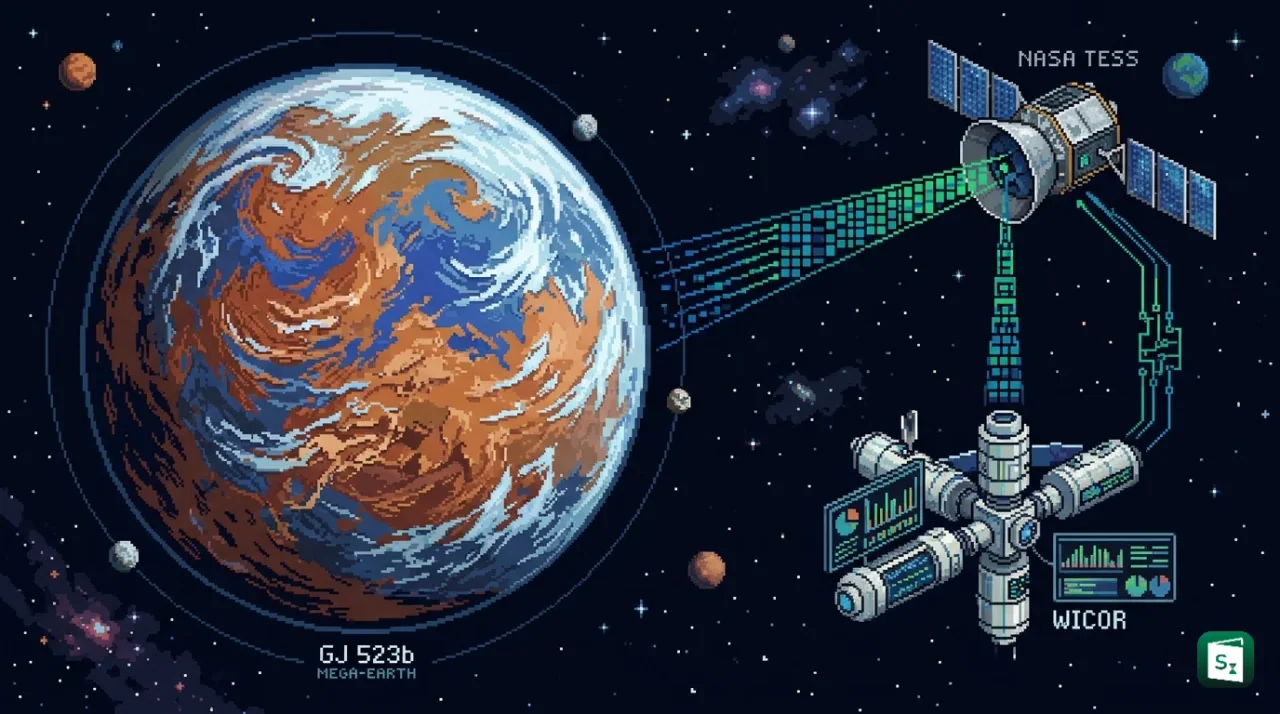
Astronomers have discovered a giant rocky exoplanet named GJ 523b, informally called a mega-Earth, that is about 170 million years old and weighs around 23 times as much as Earth. The planet is more than 2.5 times wider than Earth, with a radius about 2.55 times larger, and was first flagged by NASA’s Transiting Exoplanet Survey Satellite (TESS) before being confirmed by Max Kroft at the Wisconsin Center for Origins Research (WiCOR). Its extreme density and youth are challenging long held ideas about how massive planets form and why some become gas giants while others stay rocky.
What Is GJ 523b and Why Is It Called a Mega-Earth?
An exoplanet is a planet that orbits a star outside our solar system. Astronomers classify exoplanets by size, mass and composition. A super-Earth is generally a rocky planet with a mass up to about 10 times that of Earth, while a mega-Earth is a rarer and more extreme category for rocky planets that are far heavier, typically more than 10 Earth masses, yet remain solid rather than developing thick hydrogen and helium envelopes like gas giants.
The term mega-Earth was first used in 2014 after the discovery of Kepler-10c, which was then thought to have a mass of about 17 times Earth and a radius of about 2.3 times Earth, implying a very high density of around 7 grams per cubic centimetre. For years the term remained informal. A 2026 study finally proposed a quantitative definition, describing mega-Earths as planets with a radius between 2.1 and 5.0 times Earth’s radius and a density greater than 5.5 grams per cubic centimetre, which is higher than Earth’s own density of about 5.51 grams per cubic centimetre. As of March 2026, about 13 planets met this strict definition.
GJ 523b fits squarely in this group. The designation GJ comes from the Gliese Catalogue of Nearby Stars, originally compiled by German astronomer Wilhelm Gliese in 1957 and later expanded as the Gliese-Jahreiss catalogue, which lists stars within about 25 parsecs of the Sun. The letter b indicates it is the first planet discovered around the star GJ 523. With a mass of about 23 to 23.5 times Earth and a radius 2.5 to 2.55 times Earth, it sits in the middle of the mega-Earth radius-density diagram, yet its mass makes it one of the most massive rocky worlds yet measured.
How Was GJ 523b Discovered and Confirmed?
The discovery followed the standard two step process used for most exoplanets, an initial detection from space and a detailed confirmation from the ground. The research was led by Max Kroft, a graduate student in astronomy at the University of Wisconsin-Madison working in the lab of Assistant Professor Thomas Beatty, and carried out through the Wisconsin Center for Origins Research (WiCOR). WiCOR was launched in 2024 as a cross-disciplinary centre joining seven departments including astronomy, biology, chemistry, geoscience, atmospheric and oceanic sciences, physics and bacteriology to study the origins of life. The team’s paper characterising GJ 523b has been submitted to The Astronomical Journal, a peer reviewed journal published since 1849 by the American Astronomical Society, and is available as a preprint on arXiv.
The Role of TESS and the Transit Method
NASA’s Transiting Exoplanet Survey Satellite (TESS) first flagged GJ 523b as a candidate. TESS was launched on 18 April 2018 aboard a SpaceX Falcon 9 from Cape Canaveral and placed in a highly elliptical 13.7 day orbit around Earth. It is operated by NASA with the Massachusetts Institute of Technology (MIT). The spacecraft carries four wide-field optical CCD cameras that together monitor more than 200,000 of the nearest and brightest stars across nearly the entire sky.
TESS uses the transit method. When a planet passes in front of its host star as seen from Earth, it blocks a tiny fraction of starlight and causes a periodic dip in brightness. The depth of the dip reveals the planet’s size, while how often it repeats reveals the orbital period. In its two year primary mission TESS was expected to find about 1,250 transiting planets, and by 3 May 2026 it had identified 7,931 candidate exoplanets, of which 885 had been confirmed. GJ 523b was picked out because it produced a relatively large and regular dip, suggesting a planet larger and warmer than Earth with an orbital period of about 17.75 days.
Ground-Based Confirmation with the WIYN Telescope
A transit detection alone does not confirm a planet or measure its mass. The team followed up with the WIYN 3.5-meter Telescope at Kitt Peak National Observatory near Tucson, Arizona, located on Iolkam Du’ag (Kitt Peak) within the Tohono O’odham Nation. The telescope is operated by NSF NOIRLab. Observations used the NEID spectrograph, which stands for NN-EXPLORE Exoplanet Investigations with Doppler Spectroscopy. NEID is funded by the NASA and National Science Foundation NN-EXPLORE programme, built by Pennsylvania State University, and installed on WIYN. It measures the radial velocity or Doppler shift of starlight with precision as fine as about one kilometre per hour.
As a planet orbits, its gravity tugs on the host star, making the star wobble slightly. NEID detects this by measuring tiny shifts in the star’s spectrum toward blue and red. Combining the transit size from TESS with the mass inferred from the star’s wobble allowed the team to calculate density and confirm that GJ 523b is a real, massive rocky planet rather than a false signal. Data from the James Webb Space Telescope (JWST), launched in December 2021, also helped characterise its composition and lack of a thick atmosphere.
Physical Characteristics of GJ 523b
GJ 523b is notable not just for its size but for how much mass is packed into that size. It is described as predominantly rocky with a massive core and relatively little gas, despite being far larger than Earth or Mercury, where high density is more common in smaller bodies.
| Feature | Detail |
|---|---|
| Formal name | GJ 523b |
| Informal name | Mega-Earth |
| Age of system | About 170 million years (Earth is about 4.5 billion years old) |
| Mass | About 23 to 23.5 times Earth’s mass |
| Radius | About 2.5 to 2.55 times Earth’s radius, about 60 percent the size of Neptune |
| Density | About 126.82 grams per cubic inch, which is about 7.7 to 7.8 grams per cubic centimetre (Earth is 5.51, Jupiter is 1.33) |
| Orbital period | 17.75 days around its host star |
| Host star | GJ 523, a nearby star catalogued in the Gliese catalogue |
| Composition | Mostly dense rock and metal with a massive core, little hydrogen-helium envelope |
The combination is striking. A planet with a radius 2.55 times Earth’s should normally have a much lower density if it held a thick atmosphere. For comparison, the puffy gas-rich planet WASP-193b is about 50 percent larger than Jupiter but has a density of only about 0.059 grams per cubic centimetre, similar to cotton candy. GJ 523b is the opposite, an ultra dense world where gravity has compressed rock and metal to a density higher than Earth’s, even though it is more than twice as wide.
Why GJ 523b Challenges Planet Formation Theory
Most current models of planet formation follow the core accretion idea. Planets start as a solid core of rock and metal that grows by gathering material in a protoplanetary disc of gas and dust around a young star. Once the core reaches a critical mass, usually estimated between about 10 and 20 Earth masses, its gravity becomes strong enough that it can no longer stay in balance with its gas envelope. The envelope contracts and the planet enters a phase of runaway gas accretion, rapidly pulling in huge amounts of hydrogen and helium to become a gas giant like Jupiter or Saturn, or an ice giant like Uranus and Neptune.
GJ 523b has crossed that threshold. At 23 times Earth’s mass, it should have easily triggered runaway accretion and grown a thick gaseous envelope. Instead it remained overwhelmingly rocky with little atmosphere. As lead author Max Kroft noted, dense rocky planets are usually small and similar to Earth or Mercury, so a planet two and a half times wider than Earth retaining such a dense, rocky makeup was not expected. Its youth makes the puzzle sharper. At only 170 million years, the system is very young on astronomical timescales, yet the planet is already fully formed and dense, suggesting it either never gathered much gas or lost it very early.
Two Leading Explanations: Atmospheric Stripping and Giant Impact
Researchers have proposed two main ideas to explain the anomaly, both of which will be familiar from studies of other unusual exoplanets.
First is atmospheric stripping. GJ 523b may have originally formed with a thick gas envelope but later lost it. Intense radiation and stellar winds from a young, active host star, or a nearby energetic event, could have blasted the light gases away, leaving only the dense core behind. This process is called photoevaporation or erosion.
Second is a giant impact. The planet could be the result of a catastrophic collision between two large rocky protoplanets. When two massive solid bodies merge, their dense cores combine while the heat and energy of the impact blows off the lighter gaseous layers. Similar giant impact models are used to explain the formation of Earth’s Moon and the unusual density of Mercury.
Neither explanation is proven yet. Determining which is more likely will require measuring the planet’s atmosphere more precisely and finding whether similar planets share common features.
Broader Significance for Exoplanet Science
The discovery matters beyond a single record breaking planet. As Thomas Beatty of WiCOR has pointed out, astronomers have used the phrase mega-Earth for over a decade but lacked a planet that could firmly define the class. GJ 523b now provides that anchor. Beatty also notes that defining a mega-Earth cannot be done by astronomers alone. It requires geologists who understand how rock and iron behave at pressures far beyond any lab on Earth, and atmospheric scientists who can tell how much of the measured density is truly rock.
For WiCOR, which was set up to hunt for Hycean worlds, a theorised type of planet with a deep ocean and hydrogen rich atmosphere that might support life, GJ 523b is a different but valuable find. It is not a Hycean planet, but it shows the centre’s ability to combine transit data, high precision radial velocity and space based spectroscopy to characterise distant worlds.
The broader question is whether GJ 523b is a one off outlier or the first example of a hidden population. With more than 5,700 confirmed exoplanets as of 2024 and thousands of TESS candidates still to be checked, researchers hope to build a larger sample. As Kroft has said, it is hard to draw general lessons from a sample of one. Finding even 20 to 30 similar over-dense planets could reveal trends, such as whether the heaviest rocky planets tend to have shorter orbits or lack companion planets. Upcoming missions will help. NASA’s Nancy Grace Roman Space Telescope, scheduled for launch at the end of August 2026, is expected to discover tens of thousands of new candidates using microlensing and wide field imaging. Alongside JWST, the European PLATO mission in 2026 and ARIEL in 2031, and ground based giants like the Extremely Large Telescope, these observatories will allow more precise measurements of mass, radius and atmospheric composition for dense rocky worlds.
Key Takeaways
- GJ 523b is a 170 million-year-old mega-Earth with a mass of about 23 times Earth and a radius 2.5 to 2.55 times Earth.
- The planet was first flagged by NASA’s TESS, launched in April 2018, and confirmed by Max Kroft at the Wisconsin Center for Origins Research (WiCOR) at the University of Wisconsin-Madison.
- Confirmation used the WIYN 3.5-meter Telescope at Kitt Peak National Observatory with the NEID spectrograph to measure mass via the radial velocity method.
- Its density is about 126.82 grams per cubic inch or about 7.8 grams per cubic centimetre, higher than Earth’s 5.51, and it orbits its star every 17.75 days.
- At 23 Earth masses it has passed the critical core mass of 10 to 20 Earth masses where theory predicts runaway gas accretion into a gas giant, yet it stayed rocky.
- Two leading ideas for this are atmospheric stripping by stellar activity and formation through a giant impact merger of two rocky protoplanets.
- The paper on GJ 523b has been submitted to The Astronomical Journal and the system’s youth and density make it a benchmark for defining the mega-Earth class (2.1 to 5 Earth radii, density greater than 5.5 grams per cubic centimetre).