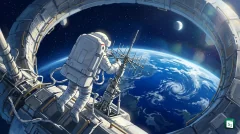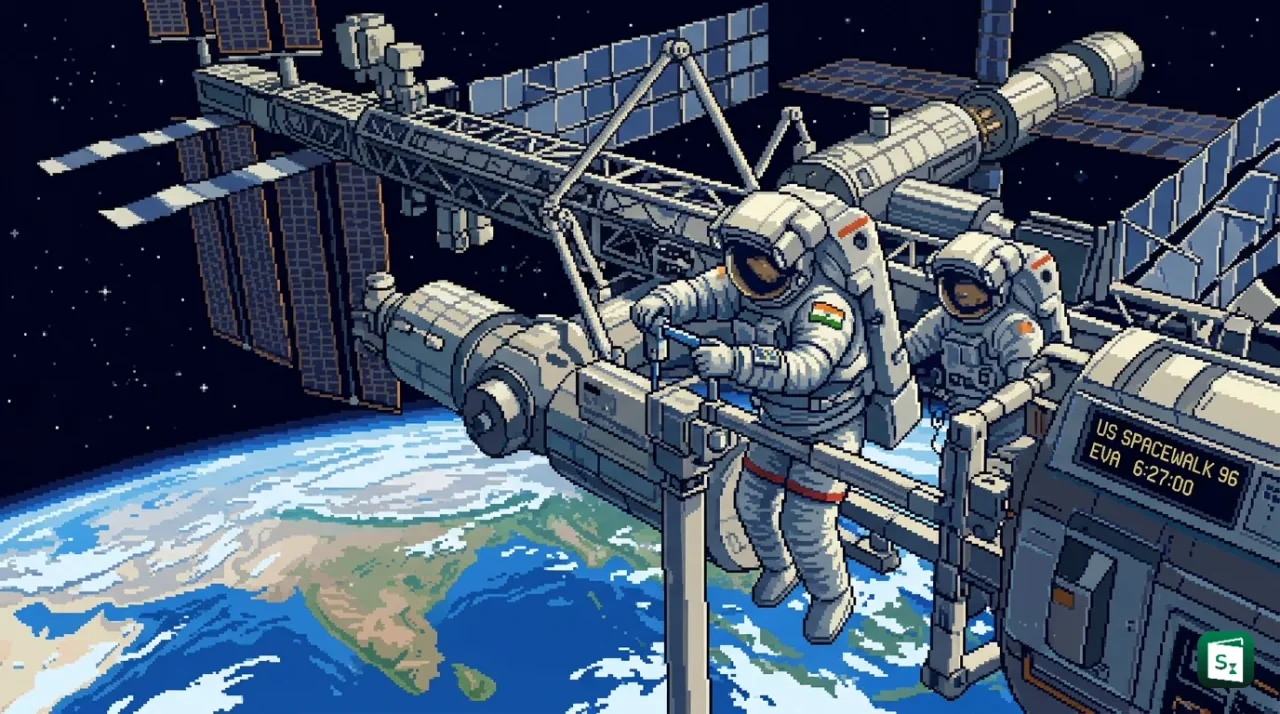
Indian-origin NASA astronaut Anil Menon completed his first spacewalk on 6 August 2026, spending 6 hours and 27 minutes outside the International Space Station (ISS). The walk, designated US Spacewalk 96, was carried out alongside veteran astronaut Jessica Meir to prepare the station’s power system for new solar arrays. With this feat, Menon became the third Indian-origin astronaut, after Sunita Williams and Raja Chari, to perform a spacewalk.
Who Is Anil Menon?
Anil Madhavan Samoilenko Menon, born on 15 October 1976, is an emergency medicine physician, a colonel in the US Space Force, and a NASA astronaut. He was raised in Minneapolis, United States, by an Indian father from Kerala and a Ukrainian mother. His father, K. P. Shankaran Menon, hails from Ottapalam in Kerala’s Palakkad district, making Menon the first astronaut of Malayali origin to reach the ISS.
Menon’s career before spaceflight is remarkable. He graduated from Harvard University with a degree in neurobiology, earned a master’s degree in mechanical engineering, and completed his medical degree at Stanford University. He served as a NASA flight surgeon, supporting multiple ISS expeditions, before joining SpaceX in 2018 as its first flight surgeon, where he helped launch the first humans aboard the Crew Dragon during the Demo-2 mission.
He was selected into NASA’s 2021 Astronaut Candidate Class and graduated in 2024. On 14 July 2026, Menon launched to the ISS aboard the Russian Soyuz MS-29 spacecraft from the Baikonur Cosmodrome, flying with cosmonauts Pyotr Dubrov and Anna Kikina as a flight engineer for Expeditions 74 and 75. His spacewalk on 6 August came only 23 days into his first spaceflight.
What Exactly Happened During the Spacewalk?
US Spacewalk 96 began at 8:33 am EDT (about 6 pm IST) on 6 August 2026 and ended at 3 pm EDT, covering 6 hours and 27 minutes. It was the 281st spacewalk in support of ISS assembly, maintenance, and upgrades, and the first of three US spacewalks planned for August 2026.
Meir, serving as spacewalk crew member 1, wore a spacesuit marked with red stripes, while Menon, crew member 2, wore an unmarked suit. The two exited the station through the Quest airlock, the dedicated gateway for spacewalks.
The pair’s main task was to install a modification kit on the 3B power channel located on the S6 truss on the station’s starboard side. They assembled a mounting bracket, routed cabling to carry electricity from a future solar array, and covered the structure with multilayer insulation to protect it from micrometeoroid impacts. NASA confirmed that all primary objectives were completed successfully.
Why Was the Work Important?
The International Space Station has relied on its solar panels for electricity since it became continuously occupied in November 2000. Its eight original solar arrays were designed for a 15-year service life, and their power output has degraded over time.
To compensate, NASA has been installing new ISS Roll-Out Solar Arrays (iROSA). These lightweight, flexible arrays, made by the company Redwire, roll out like a carpet along the older panels and can generate more power at less mass. The spacewalk prepared the 3B power channel to receive the seventh iROSA, which is expected to arrive later in 2026.
This work matters for two reasons. The upgraded panels will raise the station’s electricity supply by an estimated 20 to 30 per cent. Just as importantly, the extra power will support the critical systems needed for the safe and controlled deorbit of the ISS, which is planned for around 2030. NASA has contracted SpaceX to build a dedicated deorbit vehicle to steer the station into a remote part of the South Pacific Ocean at the end of its life.
What Is a Spacewalk and Why Are They Needed?
A spacewalk, officially called an extravehicular activity (EVA), is any time an astronaut leaves a spacecraft while in orbit. Since space has no atmosphere, the astronaut depends entirely on the spacesuit for oxygen, temperature control, and protection from radiation and micrometeoroids.
Spacewalks are among the most demanding tasks in human spaceflight. The first spacewalk was performed by Soviet cosmonaut Alexei Leonov on 18 March 1965 for about 12 minutes, and the first American spacewalk by Ed White on 3 June 1965 during the Gemini 4 mission. Spacewalks usually last between five and eight hours, and every movement and tool operation is rehearsed in advance. Astronauts wear a backpack device called SAFER, which uses small jet thrusters, so they can fly back to the spacecraft if they become untethered.
Spacewalks allow astronauts to install, repair, and upgrade equipment on the station’s exterior, work that cannot be done from inside. The ISS could not have been assembled without them.
The Growing Legacy of Indian-Origin Astronauts
Menon’s spacewalk continues a proud tradition of Indian-origin astronauts at NASA.
| Astronaut | Roots | Spacewalk Record |
|---|---|---|
| Kalpana Chawla | Born in Karnal, Haryana | First Indian-origin woman in space (1997); died in the Columbia disaster of 2003; did not spacewalk |
| Sunita Williams | Father from Gujarat | 9 spacewalks; holds the female record for total spacewalk time at 62 hours and 6 minutes |
| Raja Chari | Father from Telangana | 2 spacewalks during the SpaceX Crew-3 mission in 2022 |
| Anil Menon | Father from Kerala’s Palakkad | 1 spacewalk (US Spacewalk 96, 2026) |
Sunita Williams was the first Indian-origin astronaut to perform a spacewalk, doing so during her expeditions to the ISS starting in 2006. Raja Chari followed in March 2022, carrying out spacewalks to prepare for solar array installations. Menon has now added his name to this group, and he is scheduled to take part in additional spacewalks during his current mission.
Menon’s achievement also arrives as India builds its own human spaceflight capability. Under the Gaganyaan programme, the Indian Space Research Organisation (ISRO) is developing a crewed orbital spacecraft, with the first uncrewed test flight carrying the humanoid robot Vyommitra targeted for late 2026. India also plans to establish its own space station, the Bharatiya Antariksh Station, by 2035.
Key Takeaways
- Anil Menon completed his first spacewalk, US Spacewalk 96, on 6 August 2026, lasting 6 hours and 27 minutes outside the ISS.
- The spacewalk was the 281st in support of ISS assembly, maintenance, and upgrades, and was performed alongside veteran astronaut Jessica Meir, for whom it was the sixth.
- Menon became the third Indian-origin astronaut, after Sunita Williams and Raja Chari, to perform a spacewalk, and the first person of Malayali origin to reach the ISS.
- The main task was installing a modification kit on the 3B power channel to prepare for the installation of a new ISS Roll-Out Solar Array (iROSA).
- Anil Menon, born in 1976, is an emergency medicine physician, a US Space Force colonel, and was SpaceX’s first flight surgeon before being selected as a NASA astronaut in 2021.
- The first spacewalk in history was made by Soviet cosmonaut Alexei Leonov on 18 March 1965; the first American spacewalk was by Ed White on 3 June 1965.