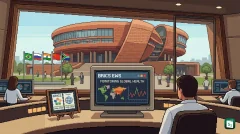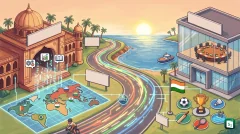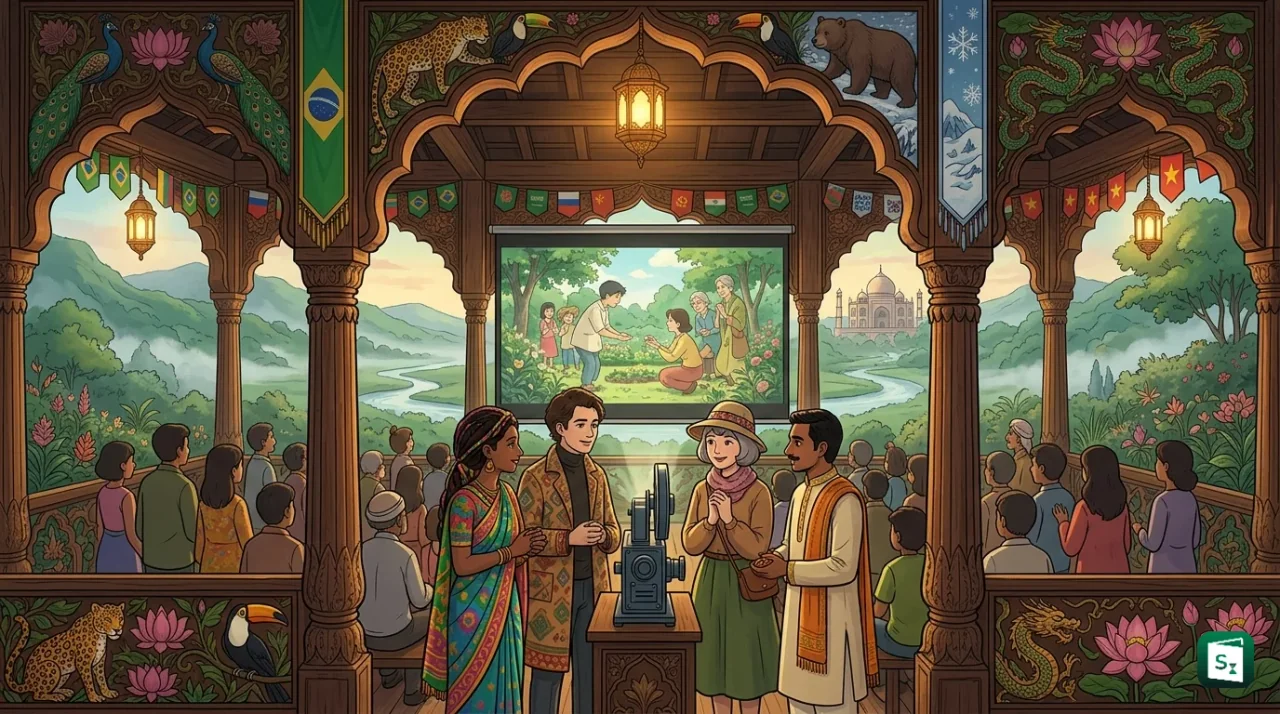
India will host the first-ever Global South Film Festival in 2027, an event designed to deepen international cooperation across the entertainment sector. Brazil, Russia and Vietnam will serve as the key partner countries for the festival. The announcement was made during a press conference on the sidelines of the BRICS World Audio Visual & Entertainment Summit (WAVES) Bazaar in Mumbai, marking a new chapter in India’s creative diplomacy.
The Announcement: India to Host the First Global South Film Festival
The festival was proposed by industry representatives from several BRICS member and partner countries, including South Africa, Russia, Thailand and Kazakhstan, during the two-day BRICS WAVES Bazaar 2026, which ran from 6 to 7 August 2026 in Mumbai. It is intended to strengthen cultural and cinematic collaboration among the world’s emerging creative economies.
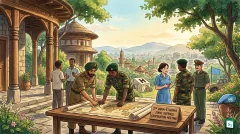
Alongside this announcement, the National Film Development Corporation (NFDC) and the National Film Archive of India (NFAI) signed agreements, exchanged Letters of Intent and held discussions with partner institutions from Brazil, Russia and Vietnam. The participating organisations agreed to explore joint film production and other forms of creative cooperation. Brazil, Russia and Vietnam will be the anchor partners for the first edition of the festival in 2027.
The festival is expected to give filmmakers from developing nations a shared platform to showcase their work, build cross-border partnerships and open up new markets. For India, it also signals an ambition to become the meeting point for the cinema of the Global South, much as it has positioned itself as a hub for the wider creative economy.
What Is the Global South?
The Global South is a broad term used for the developing and emerging economies of Asia, Africa, Latin America and Oceania. The concept grew out of the historical divide between the industrialised nations of the Global North and the rest of the world, a divide popularised by the Brandt Line, a line drawn across the world map in the 1980s based on per-capita income. It is a geographic, geopolitical, historical and developmental concept at the same time.
These countries share a common history of colonisation, economic marginalisation and under-representation in global decision-making bodies. Today the Global South is home to the majority of the world’s population and an increasing share of global economic growth, which is why its voice in forums such as the United Nations, the G20 and BRICS has grown louder.
India as the Voice of the Global South
India has actively championed the interests of the Global South in recent years. During its G20 Presidency in 2023, India held the Voice of the Global South Summit, a platform for developing countries to raise their priorities, and played a leading role in the admission of the African Union as a full G20 member. India’s BRICS Presidency in 2026 carries this approach forward under the theme “Building for Resilience, Innovation, Cooperation and Sustainability”. The Global South Film Festival fits squarely into this vision of using shared culture and creativity to unite developing nations.
The Platform: BRICS WAVES Bazaar 2026
The BRICS WAVES Bazaar is a marketplace for the global creative economy, hosted by the Ministry of Information and Broadcasting through the National Film Development Corporation (NFDC). The 2026 edition, held in Mumbai on 6 and 7 August, brought together more than 900 delegates from 20 BRICS member and partner countries. Over 275 curated business-to-business meetings were held, covering film, television, animation, visual effects, gaming, comics, digital media and music.
The Bazaar was organised under India’s BRICS Presidency, which began on 1 January 2026. It is part of the larger WAVES (World Audio Visual & Entertainment Summit) initiative, India’s flagship platform for positioning itself as a global hub for content creation, media and entertainment.
Key Partnerships Announced
Several significant collaborations were announced alongside the Global South Film Festival. The NFDC exchanged a Letter of Intent (LoI) with Brazil’s RioFilme to strengthen audiovisual cooperation and facilitate Brazilian participation in WAVES 2027. On the archival front, NFDC and NFAI deepened their collaboration with Russia’s Gosfilmofond, with both institutions being members of the International Federation of Film Archives (FIAF).
The Media & Entertainment Association of India (MEAI) signed a Record of Meeting with Vietnam’s Cinema Department under the Ministry of Culture, Sports and Tourism, working towards a formal bilateral film agreement. The BRICS Independent Producers Alliance (BIPA) was launched as a permanent platform to connect producers across BRICS nations through collaboration, investment, education and innovation. Co-production projects were also unveiled, including the India-Portugal feature film Portuguese Man ‘O War and the India-Russia film KOROVA.
The Bigger Picture: WAVES and India’s Creative Economy
The Global South Film Festival is not an isolated event. It is part of a sustained push by India to build what the Prime Minister has called the Orange Economy, the part of the economy driven by creativity, culture and intellectual property. The first WAVES summit, held in Mumbai from 1 to 4 May 2025 at the Jio World Convention Centre, was inaugurated by the Prime Minister and drew participants from over 100 countries. It hosted more than 140 sessions, and its Create in India Challenge attracted nearly one lakh registrations from over 60 countries.
The second edition of WAVES is scheduled for 2027 in Mumbai, and preparations are already underway. India’s media and entertainment sector grew to about ₹2.78 lakh crore in 2025, and the government has signalled that it will now run as a biennial event, giving India a recurring global stage for its creative industries.
The Orange Economy
The Orange Economy, also known as the creative economy, covers film, television, music, gaming, animation, design, publishing and digital content. These sectors are increasingly seen as an engine of jobs and exports, not just entertainment. India has also announced plans for an AVGC (Animation, Visual Effects, Gaming and Comics) policy and an AVGC Mission, along with support for the Indian Institute of Creative Technologies (IICT) to set up content creator labs in schools and colleges.
IFFI and the BRICS Film Festival
India already hosts the International Film Festival of India (IFFI), founded in 1952 and recognised by the FIAPF (the international federation of film producer associations). Held annually in Goa since 2004, it is Asia’s oldest film festival. A BRICS Film Festival is also planned alongside IFFI in November 2026, running in parallel with the Bazaar. The Global South Film Festival, IFFI and the BRICS Film Festival together give India a calendar of major cinematic events connecting the developing world.
Why This Matters: Soft Power and the Creative Sector
Soft power is a country’s ability to influence others through its culture, values and ideas rather than through force or economic pressure. Cinema is one of the most effective vehicles of soft power. Indian films are already released in more than 100 countries, and regional cinema from Tamil, Telugu, Malayalam and other languages is winning audiences and awards around the world. The Global South Film Festival builds on this reach by positioning India as the cultural meeting point of the developing world.
For developing countries, the festival offers a rare chance to compete on their own terms. Instead of relying on Hollywood or European festival circuits, filmmakers from Asia, Africa and Latin America will have a platform where their stories are the main event. This matters because most global film festivals are based in the Global North, and cinema from the developing world often struggles for screen space and financing.
Economically, the festival supports India’s broader goal of turning creativity into an export industry. Co-production treaties allow two countries to pool creative, technical and financial resources, and a project made under such a treaty qualifies as a national production in both partner countries. With co-production agreements already signed with more than a dozen nations, India is building the legal framework that lets Indian studios and global partners work together. A festival dedicated to the Global South is the natural next step in converting India’s cultural reach into trade, jobs and lasting diplomatic goodwill.
Key Takeaways
- India will host the inaugural Global South Film Festival in 2027, with Brazil, Russia and Vietnam as key partner countries.
- The announcement was made on the sidelines of the BRICS WAVES Bazaar 2026, held in Mumbai on 6 and 7 August 2026, which brought together more than 900 delegates from 20 countries.
- The National Film Development Corporation (NFDC), established in 1975 under the Ministry of Information and Broadcasting, organised the Bazaar.
- The National Film Archive of India (NFAI), established in 1964 and headquartered in Pune, is deepening archival cooperation with Russia’s Gosfilmofond.
- The Global South refers to the developing and emerging economies of Asia, Africa, Latin America and Oceania, and India has championed its cause through the Voice of the Global South Summit and the G20 Presidency in 2023.
- India’s media and entertainment sector grew to about ₹2.78 lakh crore in 2025, and India hosts the International Film Festival of India (IFFI), founded in 1952, annually in Goa since 2004.