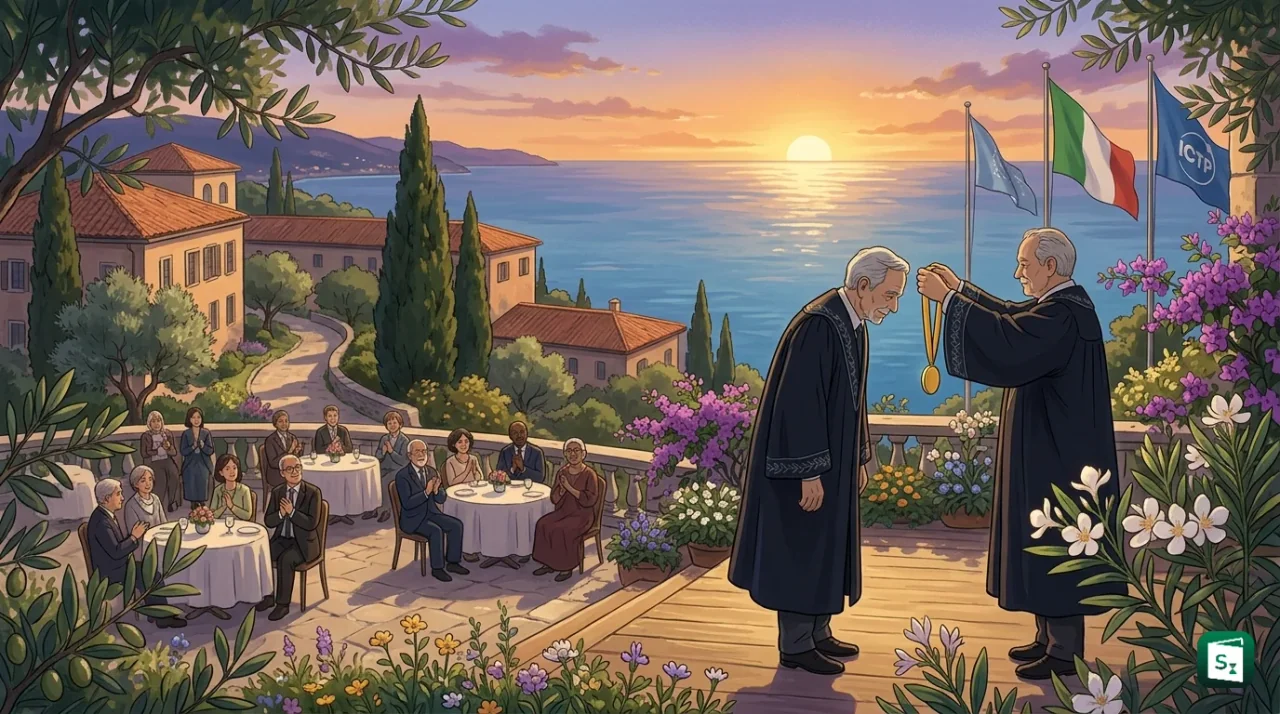
Indian theoretical physicist Deepak Dhar has been awarded the 2026 Dirac Medal by the International Centre for Theoretical Physics (ICTP) in Trieste, Italy, for his pioneering contributions to statistical mechanics. He shares the honour with Bernard Derrida, Marc Mézard and Haim Sompolinsky. With this award, Dhar becomes the second scientist working in India to receive the medal, after string theorist Ashoke Sen.
What Is the Dirac Medal?
The ICTP Dirac Medal is one of the most prestigious honours in theoretical physics. It is awarded every year by the International Centre for Theoretical Physics (ICTP), a research institute in Trieste, Italy, which was founded in 1964 by the Pakistani Nobel laureate Abdus Salam. The centre operates under a tripartite agreement between the Italian government, UNESCO and the International Atomic Energy Agency, and its mission is to support scientific research and training across the world, especially in developing countries.
The medal is named after the British physicist Paul Adrien Maurice Dirac, one of the greatest theoretical physicists of the 20th century. Dirac won the Nobel Prize in Physics in 1933 for his equation describing the behaviour of electrons, which also predicted the existence of antimatter. The medal was first awarded in 1985, the year after Dirac’s death, and is announced each year on 8 August, Dirac’s birthday.
A committee of distinguished physicists selects the winners from nominated candidates. The medal is not given to Nobel laureates, Fields medallists or Wolf Prize winners, although many Dirac medallists have later gone on to win those prizes. The award comes with a prize of $5,000.
The 2026 Dirac Medal Winners
The 2026 medal was awarded to four physicists for their pioneering contributions to statistical mechanics and for extending its concepts into areas such as non-equilibrium statistical mechanics, optimization problems, theoretical neuroscience and artificial intelligence. The winners are:
| Scientist | Affiliation | Area of Contribution |
|---|---|---|
| Bernard Derrida | Collège de France, France | Random Energy Model, disordered systems, non-equilibrium physics |
| Deepak Dhar | ICTS-TIFR, Bengaluru, India | Abelian sandpile model, self-organized criticality |
| Marc Mézard | Bocconi University, Italy | Cavity method, spin glass theory, machine learning |
| Haim Sompolinsky | Hebrew University of Jerusalem, Israel | Theoretical neuroscience, neural networks, Hopfield model |
The Work That Won the Award
The citation describes Dhar’s contribution as showing how simple interactions can lead to complex and sometimes unpredictable behaviour in large systems. Through his work on the sandpile model, he described a familiar phenomenon: as grains are added to a pile, most cause no change or only small avalanches, but occasionally a single grain can trigger a much larger collapse. This idea has been used to model systems as different as earthquakes, traffic jams and fluctuations in financial markets.
The other three winners contributed in related areas. Bernard Derrida developed mathematical models explaining how collective behaviour emerges in complex disordered systems. Marc Mézard helped explain how disordered systems with many competing possibilities behave, and developed methods now used in artificial intelligence. Haim Sompolinsky used statistical mechanics to understand the behaviour of neural circuits, memory and the brain, and is regarded as one of the founders of theoretical neuroscience.
Deepak Dhar: A Career Built in India
Early Life and Education
Deepak Dhar was born on 30 October 1951 in Pratapgarh, Uttar Pradesh. He grew up in small towns across the state, and developed an early interest in science, encouraged partly by the science magazines his father brought home. He completed his BSc at the University of Allahabad in 1970 and his master’s degree in physics at IIT Kanpur in 1972.
Dhar then moved to the United States for doctoral studies at the California Institute of Technology (Caltech), where he earned his PhD in 1978. During his time there, he held a fellowship named after the Nobel laureate physicist Richard Feynman and worked as a teaching assistant to Feynman himself. Despite the opportunity to build a career abroad, Dhar chose to return to India the same year.
A Career at TIFR and Beyond
In 1978, Dhar joined the Tata Institute of Fundamental Research (TIFR) in Mumbai as a research fellow, and spent most of the next four decades there, rising to the position of full professor. After his retirement from regular service, he served as a distinguished visiting faculty member at the Indian Institute of Science Education and Research (IISER) Pune from 2016 to 2024. Since 2024, he has been an INSA Distinguished Professor at the International Centre for Theoretical Sciences (ICTS), a centre of TIFR located in Bengaluru.
Why the Sandpile Model Matters
Dhar’s most celebrated work is the exact solution of the Abelian sandpile model, a mathematical model first proposed in 1987 by physicists Per Bak, Chao Tang and Kurt Wiesenfeld. The model was designed to explain self-organized criticality, a phenomenon in which systems naturally arrange themselves into a critical state where they are poised between order and chaos.
Imagine grains of sand being dropped one by one onto a pile. For a long time, nothing dramatic happens, and the pile simply grows. But at some point, a single grain can trigger a collapse that sweeps across the whole pile. The striking finding is that such systems do not need an external force to reach this fragile state. They organize themselves into it, which is why the phenomenon is called self-organized criticality.
Dhar showed in 1990 that the toppling operators in the model commute, which means the final stable configuration of the pile does not depend on the order in which grains topple. This single observation made the model mathematically solvable and gave it the name Abelian, in reference to the mathematical concept of commutative operations. The model has since been applied to earthquakes, landslides, forest fires, traffic jams and stock market crashes, wherever small changes can occasionally produce huge effects.
A Rare Double: Dirac and Boltzmann Medals
The Dirac Medal is not the first major international recognition for Dhar. In 2022, he became the first Indian to receive the Boltzmann Medal, widely regarded as the highest honour in statistical physics. That medal is awarded once every three years by the Commission on Statistical Physics of the International Union of Pure and Applied Physics (IUPAP), and Dhar shared it with American physicist John J. Hopfield.
In 2023, the Government of India awarded him the Padma Bhushan, the country’s third-highest civilian honour. Earlier honours include the Shanti Swarup Bhatnagar Prize in 1991, one of India’s highest science awards, and the TWAS Prize of The World Academy of Sciences in 2002. Dhar is also a Fellow of all three major science academies in India.
Significance for Indian Science
Dhar’s award is significant for Indian science for several reasons. He is only the second scientist working in India to receive the Dirac Medal, after the string theorist Ashoke Sen, who won it in 2014 together with Andrew Strominger and Gabriele Veneziano for their contributions to string theory. Sen is also based at ICTS-TIFR in Bengaluru, which makes the institution the home of both Indian Dirac medallists.
The Dirac Medal has been awarded to many physicists who later went on to receive the Nobel Prize. Past recipients include Edward Witten, the first winner in 1985, David Gross, Frank Wilczek, Giorgio Parisi and Subir Sachdev, among others. Dhar’s selection therefore places him in an elite list that also serves as a reminder of the strength of fundamental science done in India, particularly in theoretical physics.
Dhar’s journey, from a small town in Uttar Pradesh to Caltech and back to a lifetime of research at TIFR, also highlights the value of scientists choosing to build their careers in India. His work on the sandpile model shows how deep curiosity about simple, everyday phenomena can lead to results that reshape an entire field of physics.
Key Takeaways
- Theoretical physicist Deepak Dhar was awarded the 2026 Dirac Medal by the International Centre for Theoretical Physics (ICTP) for his contributions to statistical mechanics.
- Dhar shared the medal with Bernard Derrida, Marc Mézard and Haim Sompolinsky, all honoured for extending statistical mechanics into areas like neuroscience and artificial intelligence.
- The ICTP, founded in 1964 in Trieste, Italy by Nobel laureate Abdus Salam, has awarded the Dirac Medal annually on 8 August, the birthday of physicist Paul Dirac, since 1985.
- Dhar is only the second scientist working in India to win the medal, after string theorist Ashoke Sen in 2014.
- In 2022, Dhar became the first Indian to receive the Boltzmann Medal, the highest honour in statistical physics, awarded every three years by IUPAP.
- Dhar’s landmark contribution is the exact solution of the Abelian sandpile model, which explains self-organized criticality and has applications to earthquakes, traffic jams and financial markets.