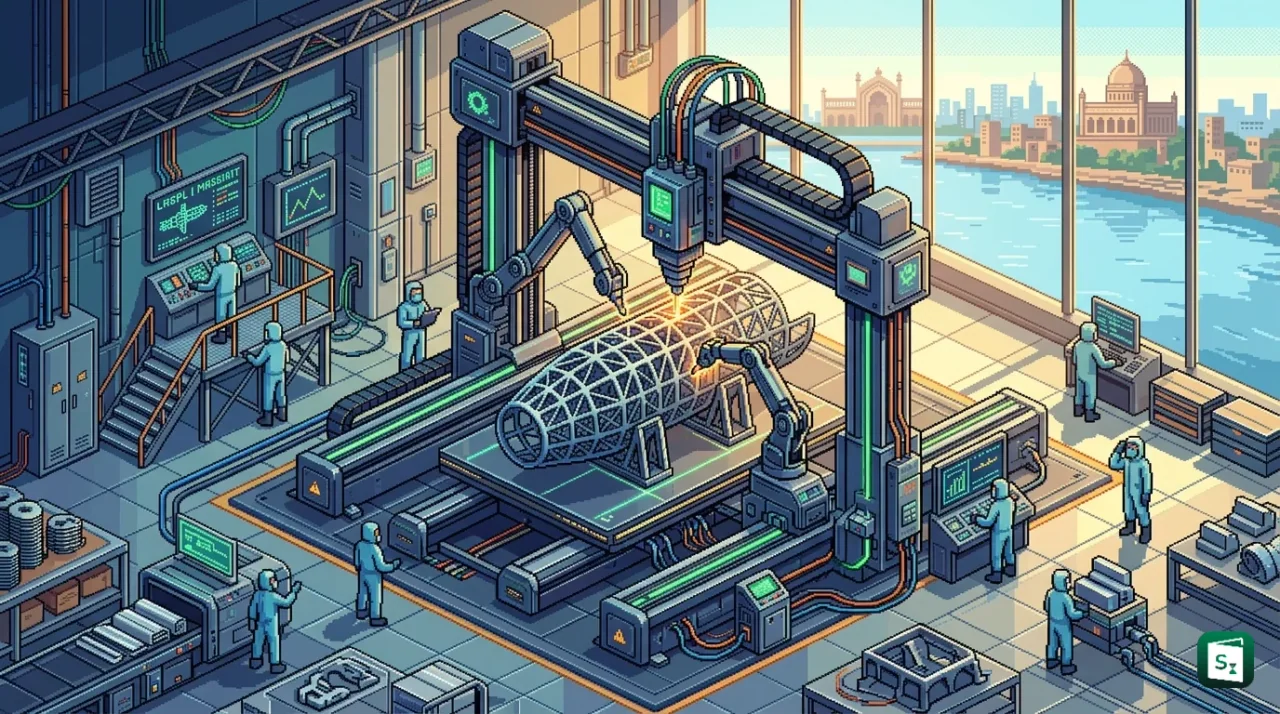
Kanpur-based Lohia Aerospace Systems Pvt Ltd (LASPL) has signed a memorandum of understanding (MoU) with Israel’s Massivit to establish the first commercial large-format additive manufacturing facility in India. The facility will come up at LASPL’s plant in Kanpur, Uttar Pradesh (UP), with an estimated investment of $8-10 million over the next one to two years. Once operational, it will produce composite tooling and critical aerospace components in days instead of weeks, marking a significant step towards reducing India’s dependence on imported aerospace tooling.
What the MoU Includes
The MoU sets up a Joint Manufacturing Alliance (JMA) between the two companies. Under this arrangement, Massivit’s RapidWings large-format 3D printing platform will be installed at LASPL’s Kanpur plant. This will be the first commercial installation of large-format additive manufacturing technology for composites anywhere in India.
LASPL will manufacture, finish and certify the tooling through its facilities, which hold ISO 9001, AS9100D and NADCAP certifications. It will also hold exclusive rights to deploy the RapidWings platform for India’s aerospace and defence sector, covering both unmanned aerial vehicles (UAVs) and manned aircraft programmes.
The key project details are summarised below:
| Parameter | Details |
|---|---|
| Estimated investment | $8-10 million over one to two years |
| Facility location | LASPL plant, Kanpur, Uttar Pradesh |
| New production space | 250,000 sq ft expansion alongside an existing 80,000 sq ft plant |
| Printers planned | 8-10 large-format systems |
| Output per printer | One to two complete tool sets per day |
| Jobs expected | 60-100 skilled positions |
| Tooling lead time cut | Up to 90% (from weeks to days) |
| Tooling cost reduction | Up to 50% |
| Price per tool | Roughly $10,000-20,000 |
The investment will scale up according to market demand. Since large-format additive tooling is not yet manufactured in India and whatever little is used today is imported, the alliance aims to progressively replace imported tooling with domestically produced tooling, with full import substitution as the eventual goal.
Composite Tooling and Additive Manufacturing Explained
What Are Composites and Composite Tooling?
Composites are lightweight but strong materials made by combining two different components, typically a fibre (carbon, glass or aramid) with a resin matrix. They are used extensively in aerospace because they offer high strength at low weight, which cuts fuel use and improves performance. In India’s indigenous Light Combat Aircraft (LCA) Tejas, for instance, carbon composites account for nearly 45% of the airframe.
Aircraft makers do not shape composite parts directly. Instead, they first build tools (moulds, masters, jigs, fixtures and mandrels) and then cure the composite material on or inside these tools. Every part inherits its shape from the tool, so the tool must be dimensionally accurate, heat-resistant and durable enough to last hundreds of production cycles.
Making such tools has long been a bottleneck. Conventional processes use metal or machinable tooling boards and can take three to six months, largely through manual methods. Since India’s composite industry relies heavily on manual tooling, and most advanced tooling is imported, delivery times and costs stay high.
Analogy · The Baking Tin Idea Expand analogy
Think of a tool as the baking tin for a cake. Just as a cake takes the shape of the tin it is baked in, a composite part takes the shape of the mould it is cured on. Today, making these tins is slow, costly work done mostly by hand. Large-format 3D printing builds the tin automatically in a few days, using the same idea as a digital printer.
How Does Large-Format Additive Manufacturing Work?
Additive manufacturing, popularly known as 3D printing, builds an object layer by layer from a digital design, instead of cutting it out of a solid block. Large-format additive manufacturing (LFAM) simply means machines big enough to print large industrial parts such as moulds and full-scale tools.
Massivit’s technology, called Cast-In-Motion (CIM), is central to this project. The printer deposits the outer shell of a mould and simultaneously fills it with an epoxy-based casting material that cures into a solid, isotropic mould (a mould with uniform properties in all directions). The traditional composite mould-making workflow, which can involve about 19 steps, is compressed to around four steps. The resulting tools withstand hundreds of cycles and are suitable for autoclave curing, the high-pressure, high-temperature process used to harden aerospace composites.
The RapidWings platform used in this deal bundles CIM into a turnkey manufacturing service for aerospace and defence. Massivit launched RapidWings in June 2026 as a global network of on-demand, locally run production facilities built through partnerships like the one with Lohia. The company says selected programmes can move from a digital design to a finished composite part in as little as five days.
The Two Companies Behind the Deal
Lohia Aerospace Systems is the aerospace and defence arm of the Kanpur-based Lohia Group. Incorporated in March 2019, it is described as India’s first multinational composites manufacturing company, with production facilities in Kanpur and in Israel. The group, headed by Anurag Lohia as Chairman and Managing Director, employs about 5,000 people and has a manufacturing footprint in nine countries across four continents. Its flagship business builds complete machinery lines for the woven sack industry, alongside automotive and technical textile operations.
LASPL entered the sector in February 2019 by acquiring Light & Strong Ltd, an Israeli maker of carbon fibre and glass fibre composite components based in Gedera. Light & Strong, founded in 2007, counts Israel’s Ministry of Defence, Israel Aerospace Industries (IAI), Elbit Systems and Rafael among its customers. The acquisition gave LASPL composite manufacturing expertise and a global customer base in aerospace and defence.
Massivit 3D Printing Technologies Ltd is an Israeli industrial technology company founded in 2013 and headquartered in Lod, Israel. It is listed on the Tel Aviv Stock Exchange and holds more than 50 patents, with systems installed across around 40 countries. The company makes large-format 3D printers using two core technologies, Gel Dispensing Printing (GDP) for high-speed printing of large parts, and Cast-In-Motion (CIM) for composite moulds and tooling. Its first printer, the Massivit 1800, was launched in 2016, followed by the Massivit 5000 in 2021 and the composite-focused Massivit 10000 in 2022.
| Aspect | Lohia Aerospace Systems | Massivit |
|---|---|---|
| Established | 2019 (Lohia Group, decades older) | 2013 |
| Headquarters | Kanpur, Uttar Pradesh, India | Lod, Israel |
| Core focus | Aerospace and defence composites manufacturing | Large-format 3D printers and manufacturing platforms |
| Key capability | Composite parts and assemblies for UAVs, aircraft and defence | Cast-In-Motion (CIM) composite tooling technology |
| Certifications | ISO 9001, AS9100D, NADCAP | ISO 9001; listed on Tel Aviv Stock Exchange |
The two firms complement each other. Lohia brings manufacturing scale, finishing and quality control, while Massivit brings a patented digital tooling technology that Indian industry has not used at commercial scale before.
Why Kanpur Is the Chosen Location
Kanpur, once known as the “Manchester of the East” for its textile industry, has reinvented itself as a centre for defence and aerospace manufacturing. LASPL’s main composite plant already sits in the city, and the new facility will be housed at this existing site.
The city is one of the six nodes of the Uttar Pradesh Defence Industrial Corridor (UPDIC), one of two dedicated defence industrial corridors in India (the other is in Tamil Nadu). The corridor was announced in August 2018 and is executed by the Uttar Pradesh Expressways Industrial Development Authority (UPEIDA). Its six nodes are Lucknow, Kanpur, Jhansi, Agra, Aligarh and Chitrakoot, spread across the state and connected by the Golden Quadrilateral and several expressways.
Investment proposals in the corridor have crossed ₹35,000 crore, with Kanpur attracting the largest share. The node-wise investment picture is given below:
| Node | Investment proposals (approx.) |
|---|---|
| Kanpur | ₹13,000 crore |
| Jhansi | ₹11,700 crore |
| Lucknow | ₹4,850 crore |
| Aligarh | ₹4,500 crore |
| Chitrakoot | ₹900 crore |
| Agra | ₹600 crore |
Kanpur is being developed as a hub for small arms, ammunition and defence textiles, with IIT Kanpur contributing a Centre of Excellence and testing facilities. Major anchor projects in the city include an ammunition manufacturing complex by Adani Defence Systems and a light business jet facility by Genser Aerospace. LASPL itself has proposed an aerospace composite facility of around ₹370 crore under the corridor. The presence of established players such as ordnance factories, HAL and BEL in the state, along with good road and rail connectivity, adds to Kanpur’s attractiveness for defence manufacturing.
Building Self-Reliance in Aerospace Manufacturing
The deal must be seen against India’s long-standing dependence on imported inputs for its aerospace and defence industry. Industry studies have estimated that India imports roughly $2 billion worth of critical materials every year, and Hindustan Aeronautics Limited (HAL) alone imported about $500 million of raw materials in a single recent financial year. Production tools and moulds used by composite manufacturers are among these imports.
Yet the broader sector is expanding quickly. India’s defence production touched a record ₹1.27 lakh crore in 2023-24, while defence exports crossed ₹21,000 crore in the same year. To keep this momentum, the government has used instruments such as the Positive Indigenisation Lists (PIL), which progressively ban imports of listed defence items, and the Srijan portal, launched in 2020, which invites private industry, MSMEs and start-ups to develop thousands of items that defence public sector undertakings previously imported.
The additive manufacturing sector has its own national policy. The National Strategy for Additive Manufacturing (NSAM), released in 2022 by the Ministry of Electronics and Information Technology (MeitY), aims to raise India’s share of the global additive manufacturing market to 5% and build a market of around $1 billion. The National Centre for Additive Manufacturing (NCAM) was set up in Hyderabad to drive adoption. A successor policy, NSAM 2.0, is being drafted with a more ambitious target of around $5 billion by 2030.
Demand for aerospace-grade composites is also rising. India’s aircraft parts manufacturing market is projected to reach roughly $21.5 billion by 2030, and global aerospace majors such as Boeing and Airbus are steadily increasing their sourcing from India. Against this backdrop, a domestic facility that can produce composite tooling quickly and reliably supports both indigenisation and export ambitions. Each tool it produces replaces an imported one, and the technology can serve composite manufacturers well beyond aerospace, including in automotive, marine and other industries.
India-Israel Ties and the Defence Dimension
The MoU is also an example of the deepening economic and technological partnership between India and Israel. The two countries established full diplomatic relations in 1992 and elevated their ties to a Special Strategic Partnership in July 2018 during the Prime Minister’s visit to Israel.
The defence relationship has grown steadily over three decades. Israel supplied laser-guided bombs to India during the Kargil conflict in 1999, and the partnership has since expanded into air defence, missiles, unmanned systems, radars and small arms. In 2021, India accounted for around 37% of Israel’s arms exports. In November 2025, the two countries signed a new MoU on defence cooperation at the 17th meeting of the India-Israel Joint Working Group, covering co-development, co-production, artificial intelligence, cyber security and joint research.
Several Israeli firms now manufacture in India through joint ventures rather than selling finished products alone:
| Indian partner | Israeli partner | Collaboration |
|---|---|---|
| Bharat Electronics (BEL) | Israel Aerospace Industries (IAI) | Support and life-cycle management of MRSAM air defence systems |
| DCX Systems | IAI’s ELTA Systems | Radar manufacturing venture (ELTX) in Tamil Nadu |
| Adani Defence & Aerospace | Israel Weapon Industries (IWI) | Small arms production, including the Negev light machine gun |
| Adani Defence & Aerospace | Elbit Systems | Production of the Hermes 900 UAV in Hyderabad |
| Lohia Aerospace Systems | Massivit | Large-format additive manufacturing for composite tooling |
The Lohia-Massivit alliance continues this pattern of pairing Israeli innovation with Indian manufacturing capacity. It brings an advanced digital manufacturing capability to Indian soil, supports the Make in India and Atmanirbhar Bharat goals, and positions India to serve its own aerospace and defence industry while opening the door to exports in future.
Key Takeaways
- Lohia Aerospace Systems Pvt Ltd (LASPL) signed an MoU with Israel’s Massivit to set up India’s first commercial large-format additive manufacturing facility at its plant in Kanpur, Uttar Pradesh.
- The project involves an investment of $8-10 million over the next one to two years and will produce composite tooling and critical aerospace components.
- Massivit’s RapidWings platform is based on Cast-In-Motion (CIM) technology, which can cut tooling production cycles by up to 90% and tooling costs by up to 50%.
- LASPL, incorporated in 2019, is the aerospace and defence arm of the Kanpur-based Lohia Group and holds ISO 9001, AS9100D and NADCAP certifications.
- Massivit 3D Printing Technologies, founded in 2013 and headquartered in Lod, Israel, is listed on the Tel Aviv Stock Exchange.
- Kanpur is one of the six nodes of the Uttar Pradesh Defence Industrial Corridor (UPDIC), which has attracted defence and aerospace investment proposals worth over ₹35,000 crore.