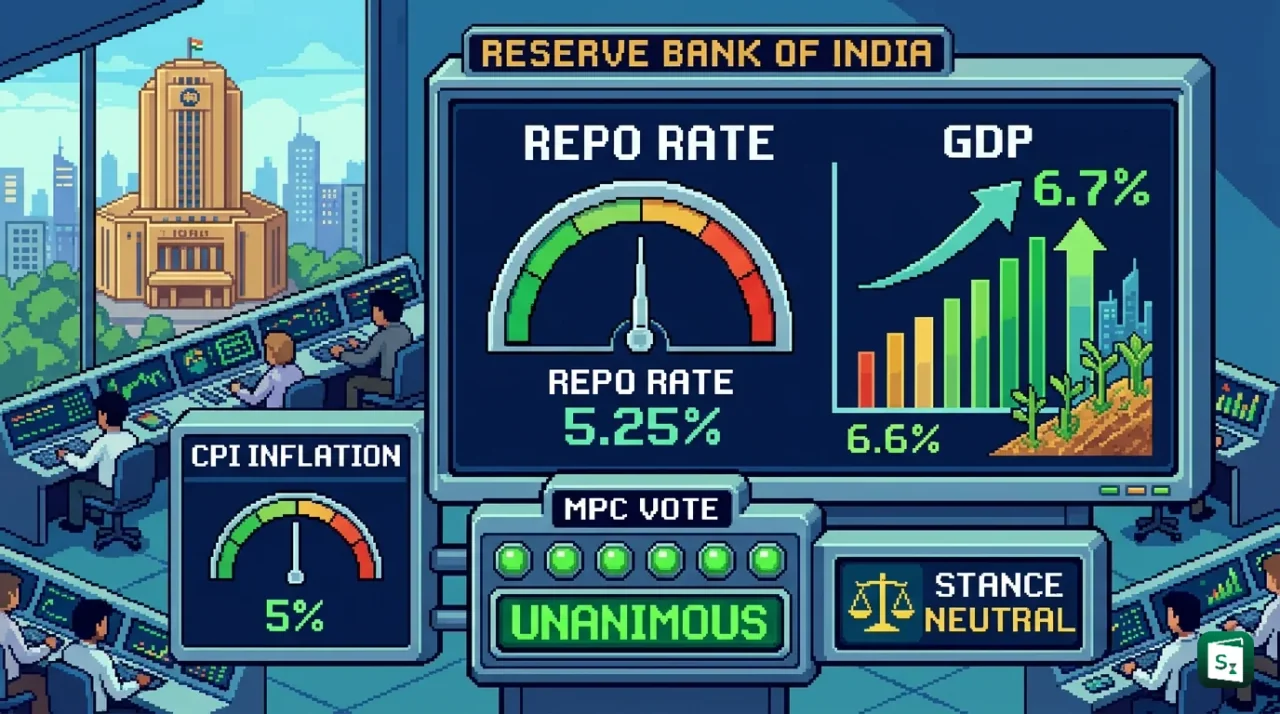
The Monetary Policy Committee (MPC) of the Reserve Bank of India (RBI), chaired by Governor Sanjay Malhotra, held its third bi-monthly review of the financial year 2026-27 on August 3-5, 2026, and decided to keep the policy repo rate unchanged at 5.25%. This was the 62nd meeting of the committee, which also voted unanimously to retain a “Neutral” stance on policy. Alongside the rate decision, the RBI revised its GDP growth forecast for FY27 upward to 6.7% from the earlier 6.6% and projected CPI inflation for the year at 5%.
What Is the Monetary Policy Committee?
The Monetary Policy Committee (MPC) is the statutory body of the RBI that decides the policy repo rate to keep inflation within the target set by the government. It was constituted under Section 45ZB of the Reserve Bank of India Act, 1934, after the act was amended by the Finance Act, 2016. Before the MPC came into being, the RBI Governor alone decided interest rates, taking advice from a non-statutory Technical Advisory Committee.
The MPC has six members. Three of them are from the RBI: the Governor, who chairs the committee, the Deputy Governor in charge of monetary policy, and one RBI officer nominated by the Central Board of the RBI. The other three are external members appointed by the Government of India for a term of four years. The Governor holds a casting vote in case of a tie, and the quorum for a meeting is four members. Once the MPC decides the policy rate, the decision is binding on the RBI.
The committee operates under a flexible inflation targeting framework, under which the government sets a medium-term inflation target in consultation with the RBI once every five years. The current target is 4% CPI inflation, with a tolerance band of 2% to 6%, which was retained by the government in March 2026 for the period up to March 2031. The RBI’s primary objective is to keep price stability in focus while supporting growth.
The Key Policy Decisions
The MPC voted unanimously to keep the policy repo rate under the Liquidity Adjustment Facility (LAF) unchanged at 5.25%. It also decided to continue with the “Neutral” stance, which means the central bank keeps its options open and can move rates in either direction depending on how inflation and growth evolve.
The related policy rates were left untouched as well. The Standing Deposit Facility (SDF) rate stays at 5%, while the Marginal Standing Facility (MSF) rate and the Bank Rate remain at 5.5%. Because the SDF rate sits 25 basis points below the repo rate and the MSF rate sits 25 basis points above it, the policy corridor remains symmetric at 50 basis points. A basis point is one-hundredth of a percentage point.
Why the Rate Was Held
The central bank chose to wait because it wants “greater clarity” on the inflation outlook before acting on rates. Headline inflation has moved above the 4% target, but the increase has been driven mainly by food and fuel prices, with little sign of pressures spreading to other items. Core inflation, which strips out volatile food and energy prices, has remained contained. Renewed tensions in West Asia, volatile crude oil prices, an uneven southwest monsoon amid El Niño conditions, and global trade uncertainty were all cited as risks that warrant caution.
Understanding the Policy Rates
The repo rate is the interest rate at which the RBI lends short-term money to commercial banks against government securities as collateral. It is the key policy rate that signals the direction of interest rates in the economy. When the RBI raises the repo rate, banks pass on the higher cost to borrowers, which makes loans dearer and slows spending. When it cuts the rate, borrowing becomes cheaper and economic activity gets a push.
The Liquidity Adjustment Facility (LAF) is the framework through which the RBI manages day-to-day liquidity in the banking system and keeps short-term market rates aligned with the policy rate. It was introduced on the recommendation of the Narasimham Committee on Banking Sector Reforms (1998). The LAF works through a corridor of rates:
| Rate | Level | Role in the Corridor |
|---|---|---|
| Standing Deposit Facility (SDF) | 5.00% | Floor, the rate at which banks can park surplus cash with the RBI without collateral |
| Policy Repo Rate | 5.25% | Midpoint, the anchor of the corridor |
| Marginal Standing Facility (MSF) | 5.50% | Ceiling, the penal rate at which banks can borrow overnight against eligible securities |
| Bank Rate | 5.50% | Standard rate for long-term lending to banks, aligned with the MSF rate |
Banks will not lend in the money market below the SDF rate, because they can earn a safe return by simply depositing funds with the RBI. They will also not borrow in the market above the MSF rate, because the RBI itself offers funds at that rate. This keeps overnight market rates anchored within the corridor. The SDF was introduced in April 2022, replacing the fixed-rate reverse repo as the floor of the corridor.
Growth and Inflation Forecasts for FY27
GDP Growth Revised Upward to 6.7%
The RBI raised its real GDP growth forecast for 2026-27 to 6.7%, 10 basis points higher than the 6.6% projected in the June policy. The upgrade rests on the resilience of the domestic economy, backed by robust private consumption, continued investment activity, and strong services exports. High-frequency indicators pointed to steady domestic demand in the first quarter of the year, while a rebound in merchandise exports added to the strength.
The quarter-wise growth projections for FY27 are Q1 at 7.0%, Q2 at 6.4%, Q3 at 6.5%, and Q4 at 6.8%. For the first quarter of the next financial year, 2027-28, the RBI has projected growth at 7.3%.
CPI Inflation Projected at 5%
The RBI projected CPI inflation for 2026-27 at 5%, slightly lower than the 5.1% estimated earlier. Headline retail inflation had inched up to 4.4% in June 2026 after staying below the target for 16 consecutive months, and the rise was attributed mainly to food and fuel prices. Core inflation, which excludes these volatile items, remained unchanged at 3.9% during May-June and is projected at 4.3% for the full year.
The quarter-wise inflation projections for FY27 are Q2 at 4.7%, Q3 at 5.9%, and Q4 at 5.5%, with inflation for Q1 of 2027-28 seen at 5.3%. The MPC expects inflation to peak in the October-December quarter before easing. It also cautioned that the rise so far has not become broad-based, which gives the central bank room to wait before changing rates.
Where Does the Repo Rate Stand in the Current Cycle?
The current pause is part of a longer rate story. After holding the repo rate at 6.50% through much of 2023 and 2024, the RBI began an easing cycle in February 2025. Rates were cut by 25 basis points each in February and April 2025, followed by a larger 50 basis point cut in June 2025 that brought the rate down to 5.50%. Another 25 basis point reduction in December 2025 took the repo rate to its current level of 5.25%.
| Month | Action | Repo Rate |
|---|---|---|
| June 2025 | Cut by 50 bps | 5.50% |
| December 2025 | Cut by 25 bps | 5.25% |
| February 2026 | Held | 5.25% |
| April 2026 | Held | 5.25% |
| June 2026 | Held | 5.25% |
| August 2026 | Held | 5.25% |
The August 2026 decision marks the fourth consecutive pause after the December 2025 cut, taking cumulative easing since February 2025 to 125 basis points. The next MPC meeting is scheduled for October 5-7, 2026, and the minutes of the August meeting are to be published on August 19, 2026.
What the Decision Means
For borrowers, the decision brings no change in the near term. Since the repo rate is unchanged, banks have no fresh reason to revise the lending rates on home loans, vehicle loans, and other loans linked to it. The stability of rates also gives homebuyers and businesses predictable borrowing costs. However, because the neutral stance keeps the door open for future action, borrowers may still see cuts later if inflation cools as expected.
For savers, fixed deposit rates are likely to stay steady for now. Banks tend to adjust deposit rates only after policy rates move, and a prolonged pause means returns on bank deposits are unlikely to change immediately.
For the broader economy, the unchanged rate and the higher growth projection together signal confidence in domestic demand. The RBI also noted that the financial parameters of scheduled commercial banks, such as capital adequacy, asset quality, and profitability, remain healthy, while gross FDI inflows stood at $30.7 billion in Q1 of FY27, up from $26.7 billion a year earlier. The central bank is also working on other measures, including draft guidelines to resume licensing of urban cooperative banks and a push to harmonise lending rate frameworks across regulated entities.
The RBI has described its stance as “neither dovish nor hawkish.” The decision reflects a wait-and-watch approach: hold rates now, assess how growth and inflation evolve, and act when there is clearer evidence that inflation is moving durably toward the 4% target.
Key Takeaways
- The Monetary Policy Committee kept the policy repo rate unchanged at 5.25% in its third bi-monthly meeting of FY27, held on August 3-5, 2026, while retaining a “Neutral” stance.
- The Standing Deposit Facility (SDF) rate remains at 5%, while the Marginal Standing Facility (MSF) rate and the Bank Rate stay at 5.5%, keeping the LAF corridor symmetric at 50 basis points.
- The MPC, a six-member body constituted under Section 45ZB of the RBI Act, 1934, is chaired by the RBI Governor Sanjay Malhotra, with three members from the RBI and three external members appointed by the government for four years.
- The RBI revised its real GDP growth forecast for FY27 upward to 6.7%, from 6.6% earlier, and projected CPI inflation at 5%, slightly down from the earlier 5.1%.
- The repo rate has been held at 5.25% for four consecutive reviews since the 25 basis point cut in December 2025, completing 125 basis points of cumulative easing since February 2025.
- The Liquidity Adjustment Facility (LAF), introduced on the recommendation of the Narasimham Committee (1998), is the framework through which the RBI manages short-term liquidity and steers the policy rate corridor.