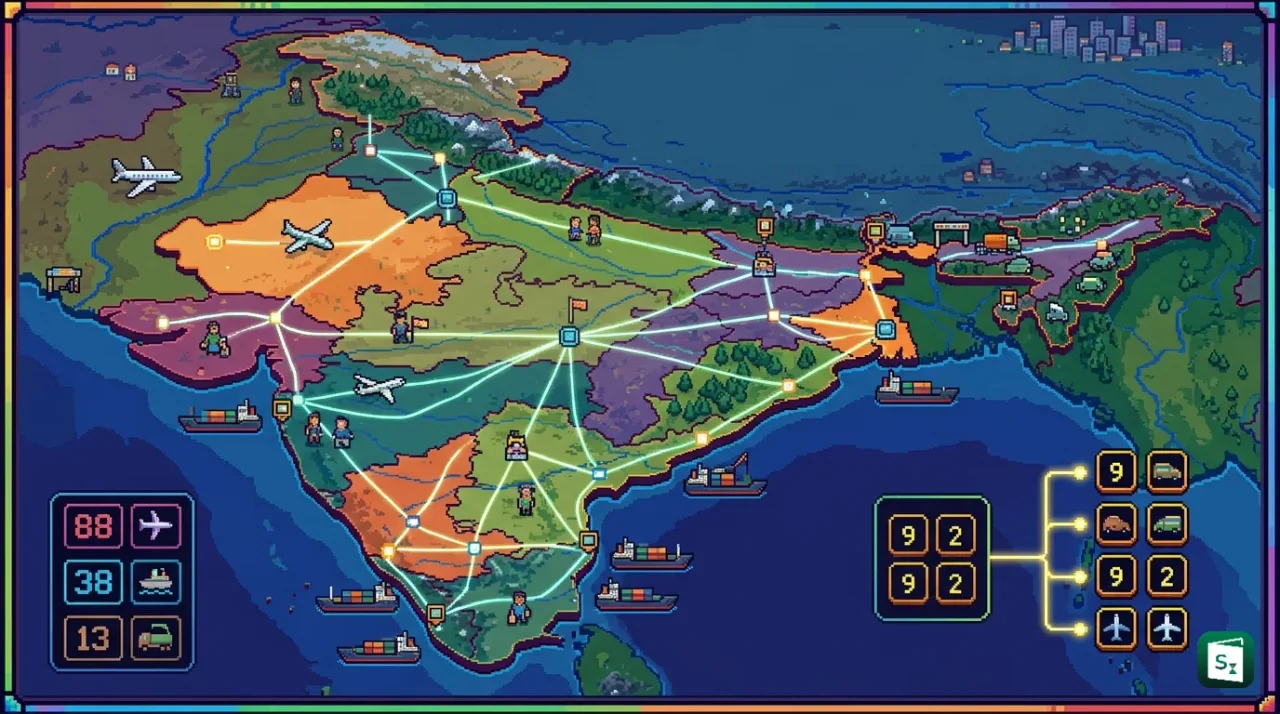
The Ministry of Home Affairs has notified 11 additional international ports, including nine land ports and two airports, through which foreign nationals holding an e-Visa can now enter India. With this expansion, the total number of designated e-Visa entry points in the country has increased to 88, comprising 37 airports, 38 seaports, and 13 land ports. The move is part of a broader push to liberalise India’s visa regime, which now processes about 95% of e-Visa applications in less than 72 hours.
What Is an e-Visa and How Does It Work?
An e-Visa is an electronic travel authorisation that allows eligible foreign nationals to apply for an Indian visa entirely online, without visiting an embassy or consulate. India introduced the facility in November 2014 for nationals of 43 countries, mainly to simplify the tourist visa process. The scheme has grown steadily since then and is now available to citizens of 172 countries under 17 categories, including tourist, business, medical, student, mountaineering, transit, conference, and group visitor (cruise) visas.
The entire process runs on the official portal indianvisaonline.gov.in, which is operated by the Bureau of Immigration (BoI) under the Ministry of Home Affairs. An applicant fills the form online, uploads a photo and passport page, and pays the processing fee. Once the application is approved, an Electronic Travel Authorisation (ETA) is granted. The traveller prints the ETA and carries it to the port of entry, where an immigration officer stamps the e-Visa on the passport and captures biometric details. The passport must be valid for at least six months from the date of arrival.
Not every international airport or border crossing accepts an e-Visa. A traveller can enter India only through ports that the government has formally designated for e-Visa entry. This is why expansions of the designated port list matter directly for travellers and for India’s tourism and connectivity goals.
The 11 Newly Notified Ports
The latest notification, issued under the Immigration and Foreigners Act, 2025, adds nine land ports and two airports to the e-Visa network. The two new airports are Bhopal in Madhya Pradesh and Tirupati in Andhra Pradesh.
The nine land ports are spread across four of India’s international land borders.
| Land Port | State | Border |
|---|---|---|
| Attari (Road) | Punjab | India-Pakistan |
| Agartala | Tripura | India-Bangladesh |
| Gede | West Bengal | India-Bangladesh |
| Ghojadanga | West Bengal | India-Bangladesh |
| Haridaspur | West Bengal | India-Bangladesh |
| Dawki | Meghalaya | India-Bangladesh |
| Jaigaon | West Bengal | India-Bhutan |
| Darranga | Assam | India-Bhutan |
| Moreh | Manipur | India-Myanmar |
Five of these crossings serve the India-Bangladesh frontier, two sit on the India-Bhutan border, one connects India with Myanmar, and Attari is India’s only road crossing with Pakistan. Before this notification, e-Visa land entry was limited to four posts, mainly Raxaul, Rupaidiha, and Jogbani on the India-Nepal border and Darranga on the India-Bhutan border. The expansion is the largest single-batch addition of land ports since the e-Visa facility was launched in 2014.
Why the New Ports Matter
The addition of Attari is symbolically and practically significant. Located about 28 km from Amritsar on the Grand Trunk Road, Attari-Wagah is the only authorised land route for trade and passenger movement between India and Pakistan. It is also India’s first land port, developed over 120 acres by the Land Ports Authority of India (LPAI), which was set up in 2012 under the Land Ports Authority of India Act, 2010. The e-Visa facility itself is not available to Pakistani passport holders, but third-country nationals can now use this historic crossing on a digital visa.
The eastern land crossings strengthen people-to-people connectivity with Bangladesh, Bhutan, and Myanmar. Dawki in Meghalaya, Ghojadanga and Haridaspur in West Bengal, and Agartala in Tripura are among the busiest border trade points with Bangladesh. Jaigaon, opposite Bhutan’s Phuentsholing, and Moreh in Manipur, on the India-Myanmar border, are gateways for cross-border commerce and for travellers planning multi-country itineraries across South and Southeast Asia. Regular bus links, such as the Delhi-Lahore bus and the Agartala-Dhaka services, fall within e-Visa coverage for foreign travellers of any eligible nationality.
Boost for Tourism and Connectivity
The new airports open fresh gateways for travellers. Bhopal gives direct access to central India, while Tirupati, which serves the famous Tirumala Venkateswara Temple, is one of the most visited pilgrimage destinations in the world. Foreign pilgrims previously had to fly into Chennai, Bengaluru, or Hyderabad and then travel onward by road or domestic flight. Now eligible e-Visa holders can clear immigration at Tirupati itself. The airport has a 3,810-metre runway, the longest operated by the Airports Authority of India, and is equipped to handle large aircraft.
The e-Visa system has become the backbone of India’s visa regime. Around 78% of all visas issued by India are now e-Visas, and the facility supports the country’s goal of welcoming more international tourists. India recorded over 20 million international visitors in 2025 and foreign tourist arrivals have been rising steadily, driven in part by simplified digital visas. By spreading entry across more airports, seaports, and land crossings, the government also eases pressure on a handful of major airports and distributes the economic benefits of tourism to smaller cities and border regions, especially in the Northeast.
The Legal Framework Behind the Expansion
This notification was issued under the Immigration and Foreigners Act, 2025, which came into force on 1 September 2025. The Act is a major overhaul of India’s immigration law. It consolidates and replaces four older colonial-era laws: the Passport (Entry into India) Act, 1920, the Registration of Foreigners Act, 1939, the Foreigners Act, 1946, and the Immigration (Carriers’ Liability) Act, 2000.
The new Act provides a single, modern framework to regulate the entry, stay, movement, and exit of foreigners in India. It legally empowers the Bureau of Immigration to investigate immigration fraud, and it supports a central immigration database for real-time tracking of foreign nationals. Under this framework, the central government can designate ports of entry and exit by notification, which is exactly what happened with the latest list of e-Visa ports. Consolidating the rules under one law brings airports, seaports, land borders, and rail posts under a common set of provisions and helps standardise immigration facilities across all modes of entry.
What Lies Ahead
The expansion signals India’s intent to keep widening the reach of its digital visa system. In earlier batches during 2026, the government added seaports and airports to the network, and this notification extends the same ease of entry to land borders. More land posts along the Nepal and Bangladesh frontiers could follow, along with greater emphasis on upgrading the Integrated Check Posts (ICPs) managed by the Land Ports Authority of India so that immigration, customs, and security checks happen at a single modern facility.
For the traveller, the practical rule remains simple: an e-Visa is valid only at the ports the government has designated, so the intended port of entry must be selected at the time of application. The steady growth of this network, combined with processing of 95% of applications within 72 hours, positions India’s e-Visa among the most accessible electronic visa systems in the world.
Key Takeaways
- The Ministry of Home Affairs notified 11 additional international ports, including nine land ports and two airports, for entry of e-Visa holders.
- India now has 88 designated e-Visa entry ports, comprising 37 airports, 38 seaports, and 13 land ports.
- The two new airports are Bhopal (Madhya Pradesh) and Tirupati (Andhra Pradesh), the latter serving the Tirumala Venkateswara Temple.
- The newly added land ports include Attari (India-Pakistan border), Moreh (India-Myanmar), Dawki, Jaigaon, Haridaspur, Gede, Ghojadanga (India-Bangladesh), Darranga (India-Bhutan), and Agartala (India-Bangladesh).
- The e-Visa facility, launched in November 2014 for 43 countries, is now available to nationals of 172 countries under 17 categories, and around 78% of all visas issued by India are e-Visas.
- The notification was issued under the Immigration and Foreigners Act, 2025, which came into force on 1 September 2025 and replaced four older immigration laws.