Hindustan Aeronautics Limited (HAL), the National Culture Fund (NCF) and the Archaeological Survey of India (ASI) signed a Memorandum of Agreement (MoA) on 13 October 2026 at Kartavya Bhawan 2 in New Delhi for heritage sites in India. The pact covers conservation and visitor development works at Hampi in Karnataka, the Taj Mahal in Agra and Bekal Fort in Kerala. HAL has given in principle approval for ₹23.60 crore in support over the financial years 2026-27 to 2028-29 to protect these sites and promote sustainable heritage tourism.
What Does the HAL NCF ASI Agreement Cover?
The HAL NCF ASI agreement is a three way Memorandum of Agreement (MoA) for conservation, preservation and development of visitor amenities at three prominent heritage sites. The MoA was signed in the presence of Union Culture Secretary Vivek Aggarwal, with Executive Director (HR) Pradeep Kumar signing on behalf of HAL. Senior officials of HAL, NCF and ASI attended the signing at Kartavya Bhawan 2.
Under the pact, HAL provides the funds, NCF facilitates implementation and ASI gives technical guidance. The stated goals are clear. Conserve historic fabric, improve facilities for visitors and support sustainable heritage tourism that protects cultural legacy while handling growing footfall.
| Fact of the pact | Detail |
|---|---|
| Parties | Hindustan Aeronautics Limited, National Culture Fund, Archaeological Survey of India |
| Signed on | 13 October 2026 |
| Signed at | Kartavya Bhawan 2, New Delhi |
| Financial support | ₹23.60 crore, in principle approval by HAL |
| Period | FY 2026-27 to FY 2028-29 |
| Sites covered | Hampi (Karnataka), Taj Mahal (Agra, Uttar Pradesh), Bekal Fort (Kerala) |
| Technical supervision | Archaeological Survey of India |
Three Heritage Sites Chosen for Conservation
The MoA names three sites spread across south, north and coastal India. Each site has a different historical character, so the work plan differs for each one.
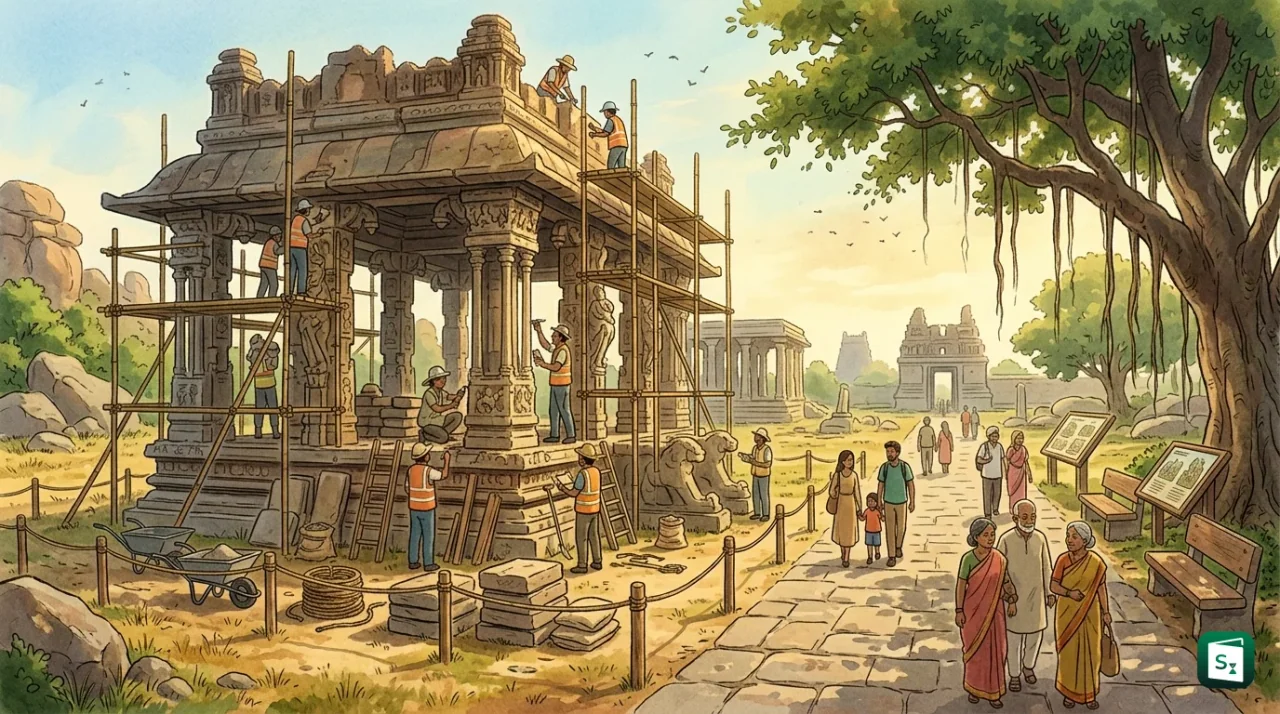
At Hampi, a UNESCO World Heritage Site since 1986, the focus is on the historic bazaar areas. The project proposes interventions in the North Bazaar over about 270 metres and the South Bazaar over about 250 metres. Hampi sits on the southern bank of the Tungabhadra river in Vijayanagara district of Karnataka. It preserves more than 1,600 remains of Vijayanagara, the capital of the Vijayanagara Empire from 1336 to 1565. The landscape includes Dravidian temples and palaces, pillared halls, gateways, water structures, markets and royal complexes. Living worship continues at the Virupaksha Temple, while the Vitthala Temple with its stone chariot remains its best known icon.
At the Taj Mahal in Agra, also a UNESCO World Heritage Site since 1983, the work will cover approved conservation and site development in consultation with ASI. The Taj Mahal is a white marble mausoleum built between 1631 and 1648 on the right bank of the Yamuna river by Mughal emperor Shah Jahan in memory of Mumtaz Mahal. The main architect is recorded as Ustad Ahmad Lahori. The complex spreads over nearly 17 hectares and includes the mosque, guest house, main gateway and outer courtyard.
At Bekal Fort in Kasaragod district of Kerala, the work will also follow approved conservation and development plans cleared with ASI. Bekal Fort is the largest fort in Kerala, spread over about 40 acres on a headland facing the Arabian Sea. Construction was started by Hiriya Venkatappa Nayaka and completed in 1650 by Shivappa Nayaka of the Keladi Nayakas. The fort later passed under Hyder Ali and Tipu Sultan and then under the British East India Company in 1799. Today the Archaeological Survey of India protects the fort, which contains an Anjaneya temple, a mosque linked to Tipu Sultan, underground passages and laterite bastions with a keyhole shaped plan.
What Is Heritage Conservation and Why Does It Matter?
Heritage conservation is the planned care of historic buildings, sites and objects through study, repair, maintenance and controlled use so that their original material and meaning survive for future generations. It includes structural repair, control of damp and vegetation, scientific cleaning, documentation and careful design of visitor facilities that do not harm historic fabric.
The need is urgent at high footfall monuments. Unmanaged tourism wears stone floors, strains water and sanitation systems and increases litter and vibration near fragile structures. At river side sites like Hampi and Agra, weather, floods and air pollution add further stress. Conservation slows this decay. Better pathways, drinking water, toilets, signage and landscaping reduce pressure on the core monument and spread visitors safely. Sustainable heritage tourism means growth in visits and local income without loss of authenticity.
Who Are the Three Partners Behind the Pact?
The Archaeological Survey of India functions under the Ministry of Culture as the central agency for archaeological research and protection of monuments of national importance. The ASI maintains more than 3,600 centrally protected monuments and regulates work under the Ancient Monuments and Archaeological Sites and Remains Act, 1958 and the Antiquities and Art Treasure Act, 1972.
Hindustan Aeronautics Limited (HAL) is a central public sector aerospace and defence company headquartered in Bengaluru, Karnataka. HAL was first set up on 23 December 1940 as Hindustan Aircraft Limited by industrialist Walchand Hirachand with support from the princely state of Mysore. The company took its present name on 1 October 1964 after amalgamation with Aeronautics India Limited. HAL works under the Ministry of Defence and became the 14th Maharatna company in October 2024. It designs, builds and overhauls aircraft, helicopters, engines and avionics, including the Tejas Light Combat Aircraft. In this MoA, HAL acts as the funding partner through corporate social responsibility support.
The National Culture Fund (NCF) is a trust set up by the Department of Culture, now the Ministry of Culture, through a gazette notification dated 28 November 1996 under the Charitable Endowments Act, 1890. NCF serves as a financing route that lets donors and sponsors join the government directly as partners to protect, restore and develop tangible and intangible heritage. The NCF Council is chaired by the Minister of Culture and the Executive Committee is chaired by the Secretary, Ministry of Culture. NCF received a one time corpus of ₹19.50 crore from the government and raises the rest as project funds and donations. Donations to NCF carry 100 percent tax benefit under Section 80G(ii) of the Income Tax Act, 1961.
The Archaeological Survey of India (ASI) was founded in 1861 by Alexander Cunningham, its first Director General. The ASI headquarters is at Dharohar Bhawan, 24 Tilak Marg, New Delhi. The country is divided into 37 circles for monument care, supported by branches for excavation, epigraphy, science, horticulture, museums and underwater archaeology. In this MoA, ASI provides technical guidance to ensure all works follow accepted conservation principles and prescribed norms.
How Will the Projects Be Implemented?
The NCF will anchor coordination between HAL as donor and ASI as technical authority. A joint project account and a project implementation committee with representatives of NCF, ASI and the donor track each work, a method NCF uses across donor funded projects. Funds flow in phases across 2026-27, 2027-28 and 2028-29, which allows survey and approvals first, then civil and conservation work, then finishing and visitor services.
ASI supervision keeps new construction away from protected fabric and ensures use of matching materials and reversible methods. For Hampi, this discipline matters because the bazaar streets sit within a living heritage landscape with active temples, shops and pilgrim movement. For the Taj Mahal and Bekal Fort, only works already approved after ASI scrutiny will move forward. This guards against overbuilding at sensitive monuments while still fixing toilets, water points, pathways, lighting and interpretation.
The MoA also links to the wider push for private participation. The revamped Adopt a Heritage 2.0 programme, launched on 4 September 2023 by the Ministry of Culture, invites partners to improve visitor experience while ASI retains conservation control. The HAL contribution follows the same logic. Corporate funds meet public expertise.
Why Corporate Support Matters for Heritage Sites in India
India has one of the largest stocks of protected heritage in the world, with thousands of centrally protected monuments and 43 UNESCO World Heritage Sites (as of October 2026). Government budgets alone cannot meet the full cost of year round upkeep, scientific conservation, staff, security and visitor services. A funding gap often shows up first in basic amenities.
Corporate social responsibility funding under Section 135 of the Companies Act, 2013 allows support for protection of national heritage, art and culture, including restoration of buildings and sites of historical importance. NCF gives companies a clean channel for such spending, with audited accounts by the Comptroller and Auditor General of India, a separate joint bank account for each project and public acknowledgement through plaques. The model keeps ownership with the state and ASI keeps control of technical standards.
The gains are practical. Cleaner approaches, shaded rest points and clear signage raise the quality of visits at places like Hampi village, Agra and Bekal beach circuit. Local guides, shops and transport earn more when visitors stay longer. Youth see heritage jobs in conservation, masonry, horticulture and interpretation. Risks remain. Funds must reach the ground on time and new facilities must respect sightlines and drainage. ASI supervision and phased release of the ₹23.60 crore are designed to manage those risks.
Key Takeaways
- HAL, NCF and ASI signed a MoA on 13 October 2026 at Kartavya Bhawan 2, New Delhi for heritage conservation works.
- The pact covers Hampi in Karnataka, Taj Mahal in Agra and Bekal Fort in Kerala with HAL support of ₹23.60 crore over FY 2026-27 to FY 2028-29.
- Works at Hampi cover the North Bazaar (about 270 metres) and South Bazaar (about 250 metres) in the UNESCO listed Vijayanagara landscape.
- The National Culture Fund was set up on 28 November 1996 under the Charitable Endowments Act, 1890 and functions under the Ministry of Culture.
- The Archaeological Survey of India was founded in 1861 by Alexander Cunningham and works under the Ministry of Culture as technical supervisor for the projects.