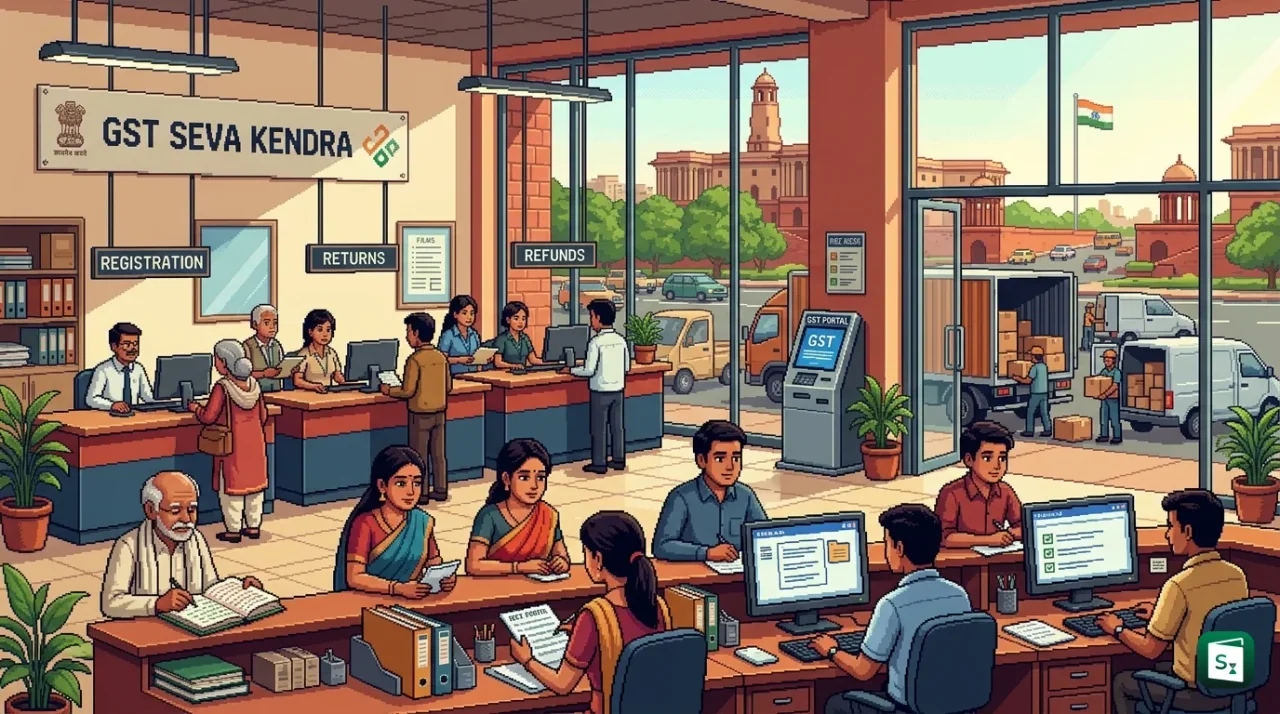
The 57th meeting of the Goods and Services Tax (GST) Council was held on 8 October 2026 in New Delhi under the chairpersonship of Union Finance Minister Nirmala Sitharaman. Unlike the 56th meeting which cut tax rates, this meeting left rates largely unchanged and focused on how GST works day to day, covering registration, returns, refunds and dispute settlement. Most of the approved changes will roll out from April 2027 and aim to make compliance faster, automatic and trust based.
What Is the GST Council?
The Goods and Services Tax Council is a joint forum of the Union and the states that decides the design of GST in India. The Council recommends which goods and services will face tax, which will stay exempt, what the tax rates and turnover thresholds will be, and how the tax will be collected and shared between governments.
The GST Council is a constitutional body under Article 279A, which was inserted by the Constitution (101st Amendment) Act, 2016. The President constituted the Council in September 2016, and the Council held its first meeting on 22 and 23 September 2016 in New Delhi. GST itself was launched on 1 July 2017, merging 17 central and state taxes and 13 cesses into one national tax on the supply of goods and services.
The Council was created because GST needed shared ownership. Central excise, service tax, state VAT, entry tax and several other levies were merged, so neither Delhi nor the states could set rules alone. Article 279A directs the Council to work for a harmonised tax structure and a single national market for goods and services.
How Is the GST Council Constituted and How Does It Take Decisions?
The GST Council consists of the Union Finance Minister as chairperson, the Union Minister of State in charge of Revenue or Finance as member, and the finance or taxation minister nominated by each state government as members. Union territories with a legislature take part in the same way as states. The GST Council Secretariat operates from New Delhi, with the Revenue Secretary acting as ex officio Secretary to the Council and the chairperson of the Central Board of Indirect Taxes and Customs (CBIC) attending as a permanent non voting invitee.
The Council makes recommendations to the Union and the states on model GST laws, principles of levy, place of supply rules, exemption thresholds, rate bands including floor rates, special rates during calamities, special provisions for northeastern and hill states, and the taxation of petroleum products and any other GST matter. The Council frames its own procedure for meetings. One half of the total members forms the quorum.
| Element | Rule Under Article 279A |
|---|---|
| Chairperson | Union Finance Minister |
| Members | Union Minister of State for Revenue, and one minister from each state |
| Quorum | One half of total members must be present |
| Decision rule | Majority of not less than three fourths of weighted votes of members present and voting |
| Weight of Centre | One third of total votes cast in the meeting |
| Weight of States together | Two thirds of total votes cast in the meeting |
The question whether Council decisions bind governments has a clear legal answer. The Supreme Court held in Union of India versus Mohit Minerals (2022) that Council recommendations have persuasive value and do not by themselves become law, because Parliament and state legislatures hold simultaneous power to legislate on GST under Article 246A. In practice, Union and state laws follow Council recommendations closely to keep one national tax, and the executive remains bound to frame subordinate rules and notifications in line with those recommendations. This balance reflects cooperative federalism, where the Centre and states reach decisions through dialogue rather than command.
57th GST Council Meeting: What Was Decided in New Delhi?
The GST Council held its 57th meeting on 8 October 2026 in New Delhi. Union Finance Minister Nirmala Sitharaman chaired the session. Chief Ministers of Delhi, Goa, Haryana, Jammu and Kashmir, Karnataka, Kerala, Maharashtra and Meghalaya attended, along with Deputy Chief Ministers of Manipur and Telangana, finance ministers of other states and Union territories, the Revenue Secretary and the senior leadership of CBIC.
The 57th meeting completed the second leg of next generation GST reform. The 56th meeting in September 2025 had focused on rate rationalisation, moving India from four main slabs of 5%, 12%, 18% and 28% to a simpler structure of 5% and 18% with a 40% rate for luxury and sin goods from 22 September 2025. The 57th meeting kept rates steady and turned to process.
The Council grouped its recommendations into three buckets. The first bucket covered process reforms for registration, returns, refunds and adjudication. The second bucket widened input tax credit, eased exports and shifted enforcement to a trust based model. The third bucket clarified the correct classification and rate for specific goods and services. The Council also released frequently asked questions to explain the changes. Most legal amendments and system upgrades will take effect from the return period of April 2027, after changes to the Central GST Act, 2017, the Integrated GST Act, 2017 and the CGST Rules, 2017.
How Will Registration and Returns Become Simpler?
Registration is the entry gate to GST. Every business above the turnover threshold must obtain a Goods and Services Tax Identification Number on the GST portal. Returns are the periodic statements in which a business reports sales and claims tax credit. The Council found that most friction sits at these two stages, not in rates.
On registration, the Council built on the automatic route already in use. Under Rule 14A of the CGST Rules, low risk applicants who do not pass on input tax credit of more than ₹2.5 lakh per month receive registration within three working days without officer contact. About 61% of new registrations already flow through this route. For the remaining cases, the Council recommended a detailed circular listing the exact documents needed, a redesigned FORM GST REG-01 with drop down boxes for document selection, and a simpler portal with tool tips and guided paths. The aim is to cut rejections caused by unclear paperwork.
The Council also made post registration changes almost instant. Amendments to trade name, directors or partners and additional places of business will be accepted automatically under revised Rule 19, except for changes to the principal place of business. Taxpayers already registered through the automatic route will get automatic approval even for principal place changes. Cancellation will follow a similar path. Applications in FORM GST REG-16 will be accepted by the system itself once pending returns are filed and dues are paid, first for low credit cases and later for all cases. Officer led cancellation under Rules 21, 21A and 22 and a new Rule 23A will shift to system checks linked to return filing and bank account reporting.
Small online sellers gain a dedicated path. New Rule 14B will let a supplier of goods through an Electronic Commerce Operator (ECO) register in a state where it holds no premises by declaring the warehouse of the operator as its principal place of business, provided monthly credit passed on stays within ₹2.5 lakh. Registration in such cases will be automatic. A weaver in Surat will thus be able to sell in Assam through a marketplace without opening a local office.
On returns, the Council approved a full correction architecture to stop mismatches between sales and purchase data. FORM GSTR-1 reports outward sales, FORM GSTR-3B pays the net liability, and FORM GSTR-2B shows the credit available from supplier filings. Small gaps between these forms trigger about 95,000 system notices a year, though recovery is tiny because most gaps reflect typing slips. The new design adds an electronic statement for reverse charge tax and credit, an Invoice Management System facility to accept, reject or hold supplier invoices, and an Electronic Credit Reversal and Reclaim Statement to track credit that is first reversed and later reclaimed. Liability in GSTR-3B will be aligned with GSTR-1 through new Rule 61(1A), and credit in GSTR-3B will be aligned with GSTR-2B through new Rule 61(1B). The package will apply from April 2027 after public consultation.
For the smallest consumer facing firms, the Council approved in principle an optional Annual Return Quarterly Payment (ARQP) scheme. Taxpayers with turnover up to ₹5 crore who sell only to unregistered buyers can pay tax every quarter and file one annual return. Late fee on monthly returns under Section 39(1) will be waived for taxpayers up to ₹5 crore turnover if the delayed return is filed before the month ends.
What Changes in Refunds and Input Tax Credit?
Input tax credit, or ITC, is the core promise of GST. A business pays tax on its purchases and subtracts that amount from the tax it collects on sales, so tax falls only on value added. When credit piles up because inputs face higher tax than outputs, the business can claim a refund. This situation is called an inverted duty structure. Slow refunds lock up working capital, especially for exporters.
The Council moved refunds to system based sanction in two phases. Excess cash lying in the electronic cash ledger will be refunded in full automatically without officer review. The time to acknowledge a claim or point out defects will fall from 15 days to 10 days, and a claim will be treated as acknowledged if the officer misses the deadline. For zero rated exports and inverted duty claims, 90% of the claimed amount will be paid provisionally by the system after risk checks, with the order issued within three working days of acknowledgement. In the second phase, acknowledgement and full sanction for zero rated supplies will both turn automatic for low risk claims.
| Reform | Present Position | Council Recommendation |
|---|---|---|
| Acknowledgement of refund | 15 days for memo or acknowledgement | 10 days, with deemed acknowledgement on expiry |
| Cash ledger refund | Officer processing needed | Full automatic sanction by system |
| Zero rated and inverted claims | Manual provisional sanction | 90% automatic provisional payment after risk scoring |
| Refund form RFD-01 | Scanned documents uploaded | System readable fields, no scans for zero rated and inverted claims |
The Council also widened what qualifies for refund. Credit on input services blocked in inverted duty cases will become refundable for credit availed on or after 1 November 2026. Credit on plant and machinery and capital goods will become refundable for zero rated and inverted cases for credit availed on or after 1 April 2027, spread as one sixtieth each month over 60 months. The cap that limited zero rated turnover to 1.5 times domestic turnover of like goods under Rule 89(4)(C) will go, and the ₹1,000 minimum refund floor under Section 54(14) will apply to the combined central, state and integrated tax amount. Interest on refund of pre deposits paid for appeals will be fixed through a separate provision in Section 115 for certainty.
Blocked credit under Section 17(5) will shrink. The Council recommended opening credit on outdoor catering, health and life insurance for employees, telecom towers, pipelines laid outside factories, free samples, and goods destroyed or written off on expiry as required by law. Demonstration vehicles in specified cases and credit distributed through the Input Service Distributor mechanism will get clarifying circulars. Banking firms and finance companies using Section 17(4) will also get guidance on credit claims. A committee of officers will study protection for an honest buyer who holds a valid invoice, has received the goods and has paid the supplier, but whose supplier defaulted on tax payment. The panel will report in three months.
How Is Enforcement Shifting to a Trust Based System?
GST enforcement is moving from deterrence through physical control to detection through data. The GST Network can now match seller and buyer invoices and flag risky credit chains, so routine stops and harsh penalties matter less. The 57th meeting used this capacity to soften criminal provisions and discipline the notice process.
The Council recommended a full withdrawal of arrest powers by omitting Section 69 of the CGST Act. The monetary limit for launching prosecution will rise from ₹1 crore to ₹5 crore of tax evaded. Offences under Section 132 will be narrowed to cover fraudulent credit without receipt of goods or services or without a genuine invoice, and the minimum punishment will be removed so courts can decide between fine, jail or both on facts. Late filing, errors or delayed payment will attract recovery with interest and a proportionate penalty, without extra punitive action.
Everyday disputes will also shrink. No show cause notice will be issued where the tax involved is below ₹10,000 across central, state, integrated tax and cess taken together, and pending small notices and appeals will be closed on the same basis. Penalty will be treated as settled where the taxpayer pays full tax with interest and penalty within the allowed window. A reduced 5% penalty will apply in non fraud cases where dues are cleared within 30 days under Section 73 or 60 days under Section 74A of the adjudication order. The general penalty for procedural lapses under Section 125 will fall from ₹25,000 to ₹10,000. Pre deposits for appeals before the appellate authority or the GST Appellate Tribunal will be capped at ₹40 crore in penalty only cases. A detailed circular will set common standards for issuing notices, holding personal hearings, invoking fraud charges only on merits, and writing clear adjudication and appeal orders.
Movement of goods will face fewer halts. A vehicle can be intercepted only on specific intelligence and with approval of an officer not below the rank of Joint Commissioner. Checks, detention or seizure can be made only by officers of the supplier state or the destination state, which ends interception in pure transit states. Where no e way bill exists or no document shows origin or destination, action can still be taken anywhere. Confiscation under Section 130 will not apply to goods in transit. Blocking of credit in the electronic credit ledger under Rule 86A will require an opportunity of hearing. The Council also proposed central handling of audit, scrutiny and adjudication for firms with multiple central registrations.
Exports and Indian service providers abroad gain direct relief. Services supplied to or through an Indian company branch overseas will qualify as export of services even when supplier and recipient are establishments of the same person, after omission of sub clause (v) of Section 2(6) of the IGST Act. Place of supply for job work where goods are made available by the foreign recipient will follow the default rule of recipient location under Section 13(2), which opens export benefits for Indian workshops. Supplies to an overseas buyer delivered inside a Special Economic Zone or Free Trade Warehousing Zone against payment in convertible foreign exchange or in rupees where the Reserve Bank of India permits will count as zero rated. Import of services by an Indian office of a foreign shipping line from a related overseas office without payment will be exempt. Transfer of title in intellectual property rights, whether temporary or permanent, will be treated uniformly as a supply of services under Schedule II.
Which Goods and Services Received Tax Clarifications?
The Council did not revise slabs but settled disputes on classification. Past demands on several items will be regularised on an as is where is basis, which means no fresh recovery for the past period.
| Goods | Council Clarification |
|---|---|
| Sublimation paper | Classified under heading 4809 |
| Toys including dolls and puzzles | Covered with tricycles and scooters under heading 9503, with rates under the September 2025 notifications |
| Sea weed extract bio stimulants registered under the Fertiliser Control Order | Treated as fertilisers under heading 3101 |
| Second hand vehicles under margin scheme | Seller can claim credit on spares, repairs, rent and marketing, with the block applying only to tax on the used vehicle itself |
| Plastic scrap, e waste, tyre scrap and used cooking oil | Placed under reverse charge when an unregistered seller supplies a registered buyer, with 2% tax deducted at source on registered to registered sales |
| Psyllium seeds including Isabgol, fresh or dried | Nil GST rate |
| Retreaded tractor tyres | Rate aligned with new tractor tyres to remove anomaly |
| Canteen Stores Department sales | Unlevied compensation cess exempted for two and four wheelers for 2017 to 2022 and for aerated drinks for 2017 to 2022 |
| Services | Council Clarification |
|---|---|
| Passenger transport and vehicle rental using electric vehicles | Option to pay 5% with restricted credit where battery charging cost forms part of the fare |
| Delivery services ordered through an ECO, other than courier and post | Brought under Section 9(5) with ECO liable to pay, at 5% without credit, with goods transport agency exemption withdrawn for such ECO linked consignments |
| Motor vehicle leasing | Registration, road tax, insurance and FASTag recoveries from the lessee clarified for valuation |
| Restaurant, hotel rooms up to ₹7,500 per day and gym services | Limited same line credit allowed as already available for tour and transport operators |
| Helicopter passenger travel on seat sharing basis | Exempt for airports and helipads in northeastern states, Sikkim and Bagdogra |
| Storage of seeds meant for sowing and curing of coffee for cultivators | Exempt from GST |
| Seamen Provident Fund Organisation services and highway toll rights under Toll Operate Transfer | Exempt, including upfront concession paid to the National Highways Authority of India |
| Research and development services | Head of institution can self certify that work is research and not consultancy for exemption under Entry 44A |
| Fund transfer pricing entries between bank branches | Notional interest treated as interest and covered by the financial services exemption |
Why Do These Process Reforms Matter After GST 2.0?
Rate cuts make headlines, but process decides daily cost. A shop owner files returns every month, seeks refunds every quarter and updates registration with every business change. The Council noted that firms interact with these procedures far more often than with slab changes. Automation at these touchpoints therefore lowers the real burden on small firms without cutting government revenue.
The package targets three pain points together. Faster registration and cancellation reduce entry and exit time for micro firms and online sellers. Return correction tools and a single annual return option for turnover up to ₹5 crore cut the notice load that arises from small mismatches. Automatic refunds and wider credit on services and machinery free cash for exporters and manufacturers who carry high input costs. The GST Network, the technology backbone headquartered in New Delhi, will carry most of these checks through risk scoring rather than officer discretion.
The enforcement shift carries a wider signal. Removal of arrest, a five fold rise in the prosecution limit and a ban on tiny notices move the system toward voluntary compliance backed by data trails. E way bill limits and export fixes support one national market, which was the original promise of GST when diverse levies were merged in 2017. The Council also aligned the GST Appellate Tribunal rules with the Tribunals Reforms Act, 2026 to steady dispute resolution. If states pass matching laws and the portal upgrades land on schedule, April 2027 will mark the moment when GST 2.0 changes from cheaper rates to simpler working.
Key Takeaways
- The 57th GST Council meeting was held on 8 October 2026 in New Delhi under the chairpersonship of Nirmala Sitharaman.
- The GST Council is a constitutional body under Article 279A inserted by the 101st Amendment Act, 2016, with the Centre holding one third vote weight and states holding two thirds.
- The Council recommended omission of Section 69 to remove arrest powers, raised the prosecution threshold from ₹1 crore to ₹5 crore, and cut the general penalty under Section 125 from ₹25,000 to ₹10,000.
- Refund of credit on input services in inverted duty cases applies from 1 November 2026, while refund on plant and machinery applies from 1 April 2027 spread over 60 months.
- Automatic registration under Rule 14A covers applicants passing on credit up to ₹2.5 lakh per month, while new Rule 14B eases registration for small sellers using e commerce operator warehouses.
- No show cause notice will be issued where tax is below ₹10,000, and the new return correction system will operate from April 2027.