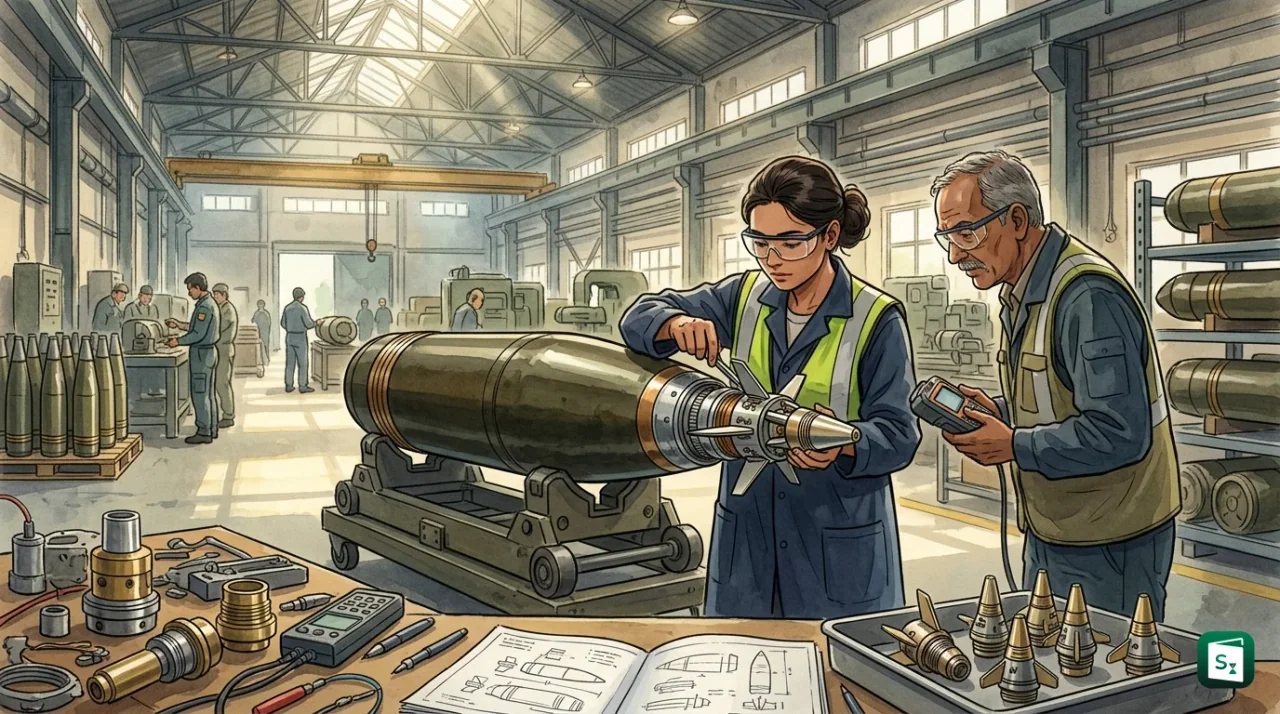
Sigma Advanced Systems Limited signed an exclusive memorandum of understanding with Munitions India Limited (MIL) on 14 October 2026 for the integration, indigenous manufacturing and supply of 155 mm artillery course correction fuzes (CCF). The pact also covers associated components, subsystems and advanced defence technologies for precision guided artillery ammunition. It combines proven guidance technology with MIL’s large ammunition production base to cut import dependence and support critical Indian military programmes.
What Is the Sigma Advanced Systems and Munitions India Agreement?
The exclusive MoU between Sigma Advanced Systems and Munitions India was announced on 14 October 2026 in Hyderabad. Under the pact, the two partners will jointly handle technology transfer, qualification, local manufacturing and integration of 155 mm course correction fuzes in India. The scope also includes related subsystems, components and advanced defence technologies for future artillery needs.
The programme will use a Course Correction Guidance Kit described by Sigma Advanced Systems as a mature solution already in use with international customers. Instead of building a new shell from scratch, this kit replaces the standard nose fuze of an existing 155 mm artillery shell and steers it in flight. Sigma Advanced Systems will bring its engineering design and programme execution strength, while MIL will provide its established ammunition manufacturing infrastructure and experience of working with the armed forces.
Sigma Advanced Systems Chief Executive Officer Sunil Kalidindi said the tie up was an important step for indigenous precision guided artillery capability in line with Atmanirbhar Bharat. Shares of Sigma Advanced Systems were in focus on Dalal Street after the announcement, as investors tracked the company’s growing role in domestic precision ammunition and its export orders, including a $104.90 million export order in July 2026 for extended range base bleed artillery shells.
What Is a 155 mm Course Correction Fuze?
The 155 mm course correction fuze (CCF) is a smart nose fuze that screws into a standard 155 mm high explosive shell and corrects its flight path to hit much closer to the target. It combines satellite navigation, small steering fins and a fuzing unit in the same housing that normally holds a simple mechanical fuze. This turns lakhs of existing dumb shells into affordable precision guided munitions without buying costly purpose built guided shells.
A 155 mm artillery shell is the standard heavy projectile fired by modern field howitzers. An unguided shell follows a purely ballistic path, so wind, temperature, barrel wear and small aiming errors can push it hundreds of metres away at maximum range. For example, a conventional shell can have a circular error probable (CEP) of more than 200 metres at long range, which means half the shells fall outside a circle of that radius around the aim point. A course correction kit continuously compares its actual position with the target coordinates fed before firing and moves tiny canards to nudge the shell back toward the planned path.
The gain is large even with modest correction. The well known American M1156 Precision Guidance Kit (PGK), the closest global parallel to this technology, cut CEP from over 200 metres to under 50 metres, with later lots achieving under 30 metres. That means fewer shells per target, lower logistics load, faster fire missions and far less collateral damage. For India, which is standardising on 155 mm guns, this efficiency matters across long borders and high altitude areas where moving extra ammunition is slow and costly.
How Does a Proximity Fuze Work?
A proximity fuze, also called a VT fuze or variable time fuze, is a fuze that bursts the shell automatically when it comes within a set distance of the target or ground without needing a direct hit. The fuze carries a tiny radio transmitter receiver that sends out continuous radio waves and listens for reflections from the ground, vehicles or troops. When the reflected signal becomes strong enough, which indicates the shell is at the chosen burst height, an electronic circuit fires the detonator.
In ground attack, this creates an airburst, typically around 10 metres above ground for many Indian electronic fuzes, with point detonation on impact kept as backup. An airburst scatters fragments over a wide area. It can be five to ten times more lethal against exposed troops than a shell that simply buries itself in the soil. Modern electronic proximity fuzes are set with an inductive fuze setter, are safe for at least 100 metres after leaving the muzzle, and have a shelf life of 15 years or more.
What Are the Main Artillery Fuze Types?
Munitions are complete military weapons and their explosives, while ammunition refers more narrowly to the shells, cartridges and fuzes that guns actually fire. A fuze is the small but critical device that decides when that ammunition explodes. The main families used in field artillery are easy to group by how they sense the moment to fire.
| Fuze Type | How It Fires | Typical Use |
|---|---|---|
| Point Detonating (PD) | Bursts on direct impact with the target or ground, with instant or short delay action | High explosive shells against buildings, bunkers, vehicles and ground |
| Mechanical or Electronic Time | Bursts after a pre set flight time fed by the fuze setter | Illumination, smoke, cargo and carrier shells that must open in the air |
| Proximity or VT | Bursts at a set height above ground after sensing reflected radio waves | Airburst against troops in the open, convoys and soft targets |
| Multi Option (MOFA) | Gunner can select proximity, point detonation, delay or time before firing | Modern 155 mm high explosive shells needing flexible effects |
| Course Correction or Guidance Kit | Adds satellite navigation and steering fins plus normal fuzing functions | Converts standard 155 mm shells into precision guided munitions |
A course correction fuze does not replace these functions. It adds guidance on top of them, so the same fuze can still act as a point detonating or proximity fuze at the end of flight.
What Is Munitions India Limited?
Munitions India Limited (MIL) is a central public sector defence company under the Ministry of Defence that designs, makes and sells ammunition, explosives, rockets and bombs for the armed forces. It is headquartered at Ammunition Factory Khadki in Pune, Maharashtra and was formed on 1 October 2021 after the corporatisation of the Ordnance Factory Board (OFB). MIL is the largest of the seven new defence public sector undertakings created from 41 ordnance factories.
MIL controls 12 state of the art manufacturing units across the country with a workforce of around 23,000 skilled personnel. These units have an integrated base for small, medium and high calibre ammunition, mortars, rockets and hand grenades, along with in house production of propellants, initiatory compositions and high explosives. The company supplies the Indian Army, Navy and Air Force and also exports to foreign militaries and civilian buyers. In its first year after formation, MIL received export orders worth about ₹1,500 crore, which showed early global demand for Indian ammunition.
| Unit Under MIL | Location |
|---|---|
| Ammunition Factory Khadki | Pune, Maharashtra |
| High Explosive Factory | Khadki, Maharashtra |
| Ordnance Factory Dehu Road | Pune, Maharashtra |
| Ordnance Factory Varangaon | Maharashtra |
| Ordnance Factory Bhandara | Maharashtra |
| Ordnance Factory Chanda | Chandrapur, Maharashtra |
| Cordite Factory Aruvankadu | Nilgiris, Tamil Nadu |
| High Energy Projectile Factory | Tiruchirappalli, Tamil Nadu |
| Ordnance Factory Itarsi | Madhya Pradesh |
| Ordnance Factory Khamaria | Jabalpur, Madhya Pradesh |
| Ordnance Factory Badmal (Bolangir) | Odisha |
| Ordnance Factory Nalanda | Bihar |
MIL works through open tenders and a formal vendor registration system for private suppliers of raw materials, components and technologies. That is why this MoU matters. A private technology partner like Sigma Advanced Systems can route its guidance electronics and subsystems through MIL’s qualified production chain and reach domestic military procurement faster. MIL’s role also includes testing, proof and quality assurance through its controllerate and training arms, including the National Academy of Defence Production.
What Is Sigma Advanced Systems?
Sigma Advanced Systems Limited is a Hyderabad based integrated defence and aerospace company that designs, develops and makes mission critical platforms, subsystems and components. The company was founded in Hyderabad in 1994 and is headquartered at Hardware Park near Hyderabad airport in Telangana. It was earlier linked to the listed entity Megasoft Limited, whose name changed to Sigma Advanced Systems Limited with effect from 12 January 2026.
Sigma Advanced Systems works across defence electronics, avionics, naval systems, radar, electronic warfare, unmanned aerial vehicles, counter drone systems, missile guidance and precision manufacturing. Its Indian operations span Hyderabad, Bengaluru and Sri City, with more than 300,000 square feet of manufacturing infrastructure across India and the United Kingdom and a team of over 700 people. More than 90 percent of its order book comes from international customers, with long term contracts running up to eight years.
The company has deep links with the domestic defence ecosystem. It supplies built to specification systems, control electronics and actuation solutions for surface to air missile, anti tank, anti radiation and naval programmes to partners such as Bharat Dynamics Limited (BDL), Hindustan Aeronautics Limited (HAL) and laboratories of the Defence Research and Development Organisation (DRDO). In February 2026, Sigma Advanced Systems won fresh orders worth about ₹100 crore from the Ministry of Defence and associated public sector units for missile, naval and airborne uses. It also signed a long term agreement valued at £300 million with Rolls-Royce in April 2026 for aerospace systems. The new pact with MIL builds on this base and moves the company from electronics and subsystems into complete precision guided artillery ammunition.
What Is 155 mm Artillery in the Indian Army?
Artillery in the Indian Army refers to large calibre guns, howitzers and rocket systems that give long range fire support to infantry and armour from many kilometres behind the front line. The Regiment of Artillery, which completed 198 years in September 2025, operates these systems through specialised artillery regiments. The Army is now standardising on 155 mm calibre as its main gun size, with a plan to make 155 mm the standard for all towed and self propelled guns by 2042 under its mediumisation and Field Artillery Rationalisation Plan.
This shift explains the current demand for 155 mm shells and fuzes. The Army already operates the American M777 ultra light howitzer, the K9 Vajra-T tracked self propelled gun made by Larsen and Toubro with South Korean technology, the indigenous Dhanush 155 mm by 45 calibre gun and the upgraded Sharang 155 mm by 45 calibre gun. The centrepiece of future induction is the Advanced Towed Artillery Gun System (ATAGS), a 155 mm by 52 calibre howitzer developed by the Armament Research and Development Establishment (ARDE) of DRDO with Bharat Forge and Tata Advanced Systems.
In March 2026, the Ministry of Defence signed contracts worth nearly ₹6,900 crore for 307 ATAGS guns and 327 high mobility gun towing vehicles to equip 15 artillery regiments. ATAGS can fire to 45 to 48 km with special ammunition and has an all electric drive, automatic ammunition handling and rapid deployment in about 85 seconds. The first regiment is expected to be ready by February 2027, while the total Army requirement for such modern 155 mm guns is estimated at more than 1,580 guns. The Army is also processing proposals for 100 additional K9 Vajra guns worth ₹7,628.70 crore ordered in December 2024 and a much larger follow on plan for over 300 more K9 guns.
Precision ammunition is the next layer of this modernisation. Munitions India and IIT Madras are jointly developing 155 mm smart ammunition with satellite navigation support from NavIC, fin stabilisation and canard control for a CEP target of about 10 metres. The Sigma Advanced Systems and MIL course correction fuze fits directly into this roadmap. It offers a low cost bridge between plain high explosive shells and expensive fully guided rounds, so existing ATAGS, Dhanush, Sharang, K9 and M777 guns can all fire smarter without changing the gun itself.
Why Precision Guided Munitions Matter for Indigenous Defence Production
Precision guided munitions are weapons that use navigation and control to hit very close to the aim point instead of relying only on ballistic flight. For artillery, this changes both cost and tactics. A precise shell needs far fewer rounds to destroy the same target. Studies on guidance kits show round requirements can fall by 55 to 68 percent for many missions. Fewer rounds mean fewer trucks, less barrel wear, faster engagement and lower risk to civilians near the target.
For India, local production of such fuzes supports Make in India in defence in three clear ways. First, it replaces imports of high value electronics, sensors and guidance modules with domestic design and assembly. Second, it keeps the large value addition inside the country, since the shell body, explosive fill and propellant are already made by MIL factories. Third, it builds a supply chain of private vendors for printed circuit boards, micro sensors, batteries and software that can serve missiles, drones and naval systems as well.
The MoU model itself is significant. MIL brings qualification, proof testing and access to Army trials, while a private firm brings speed, research spending and global links. Similar public private work has already shaped ATAGS, the guided Pinaka rocket with range beyond 75 km, and electronic fuzes made by Electronics Corporation of India Limited (ECIL) and Bharat Electronics Limited (BEL) for 105 mm, 130 mm and 155 mm guns. The next steps to watch are successful qualification firings, clearance for bulk production and conversion of the MoU into firm orders from the armed forces. If those milestones are met, India will have a domestic source for an affordable smart shell at a time when global demand for 155 mm ammunition remains very high.
Key Takeaways
- Sigma Advanced Systems and Munitions India signed an exclusive MoU on 14 October 2026 for indigenous manufacturing of 155 mm course correction fuzes.
- A course correction fuze turns a standard 155 mm shell into a precision guided munition by correcting its flight with navigation and steering fins.
- A proximity or VT fuze bursts the shell in the air at a set height and can be up to ten times more lethal than impact burst against troops in the open.
- Munitions India Limited, headquartered in Pune and formed on 1 October 2021 from the Ordnance Factory Board, operates 12 ammunition factories.
- Sigma Advanced Systems, founded in Hyderabad in 1994, makes defence electronics, avionics, radar and aerospace components across India and the United Kingdom.
- The pact supports 155 mm standardisation by 2042 and the induction of 307 ATAGS guns worth nearly ₹6,900 crore ordered in March 2026.