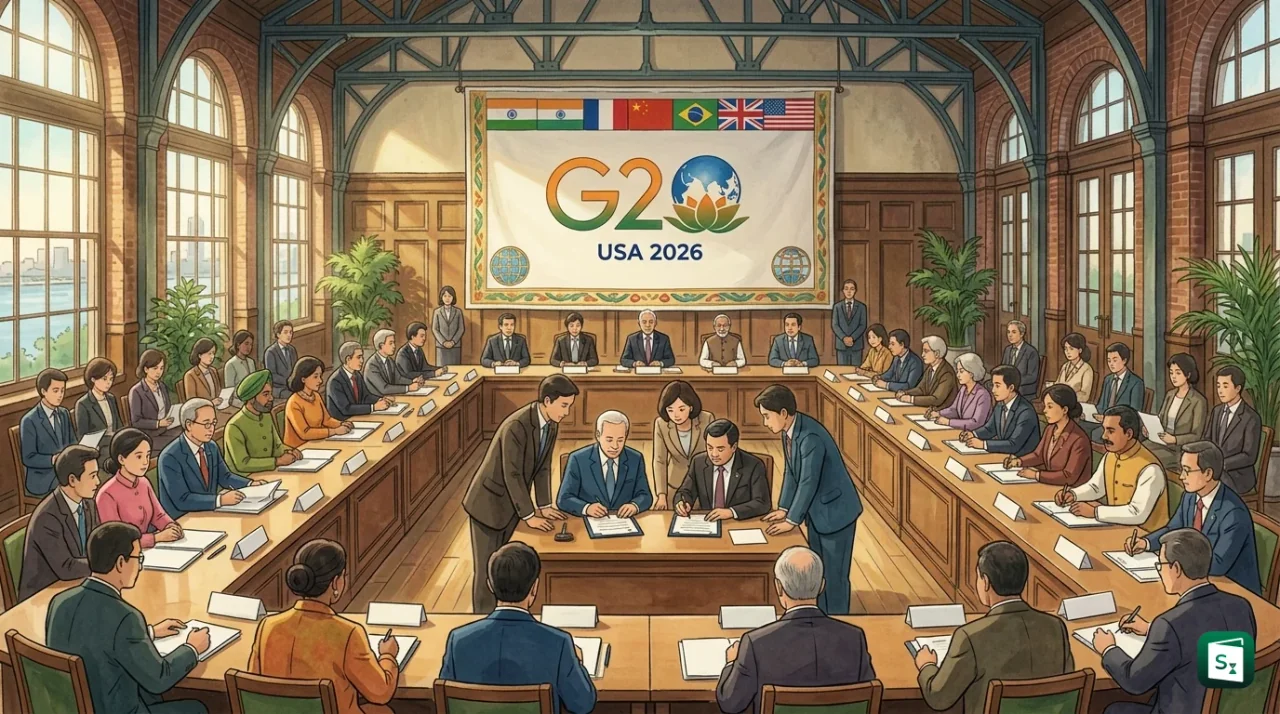
Union Minister of Commerce and Industry Piyush Goyal represented India at the G20 Trade Ministers Meeting 2026 held on 30 September to 1 October 2026 in Milwaukee, Wisconsin, hosted under the USA presidency. The Office of the US Trade Representative (USTR) released a Joint Ministerial Statement on structural excess capacity signed by 15 participants including India and the USA. The meeting also produced a full G20 consensus against the weaponisation of food trade and set the tone for the Leaders Summit in Miami in December 2026.
What Is the G20 and How Does It Work?
The Group of Twenty (G20) is an informal forum of the world’s major advanced and emerging economies that discusses and coordinates global economic policy. The G20 brings together 19 countries plus the European Union (EU) and the African Union (AU), making 21 members in total. Together, these members account for about 85% of global GDP, more than 75% of global trade and nearly two thirds of world population.
The G20 was formed on 26 September 1999 after the Asian financial crisis of 1997 to 1998 exposed gaps in global financial coordination. It began as a meeting of finance ministers and central bank governors. After the global financial crisis of 2008, leaders were brought into the process and the G20 became the premier forum for international economic cooperation. The first leaders summit took place in Washington in November 2008. Since 2011, the leaders summit has been held every year.
The G20 has no permanent secretariat or headquarters. The presidency rotates every year among members, and the country holding the presidency sets the agenda, hosts meetings through the year and hosts the final leaders summit. Presidency selection follows a system of regional groupings to ensure rotation across geographies. India held the presidency in 2023 and hosted the New Delhi summit where the African Union joined as a permanent member. South Africa held the presidency in 2025, the USA holds it in 2026 and the United Kingdom is due to take over in 2027.
G20 Summit 2026 Under the USA Presidency
The USA assumed the G20 presidency on 1 December 2025 and will host the G20 Leaders Summit in Miami, Florida, in December 2026. The USA last hosted the G20 leaders in 2009 at Pittsburgh, so the 2026 summit marks its return as host after 17 years. The 2026 cycle coincides with the 250th anniversary of American independence, which the presidency has projected as a theme of innovation and entrepreneurship.
The USA presidency has fixed three core themes for 2026. These are removing regulatory burdens to release economic growth, unlocking affordable and secure energy supply chains, and pioneering innovation in Artificial Intelligence (AI) and emerging technologies. To deliver on these themes, the presidency is working through four working groups. These cover the finance track, including debt transparency, cross border payments and digital assets, along with dedicated groups on innovation, energy abundance and trade issues.
The trade track feeds directly into the leaders summit. Ministerial meetings on trade, finance and foreign affairs held through the year build the draft language for the final leaders declaration. Milwaukee was the main trade ministerial of the year. Other ministerial gatherings have been scheduled across American cities, including finance meetings in Washington and Asheville and a foreign ministers meeting in Atlanta.
G20 Trade Ministers Meeting in Milwaukee: Agenda and Organisation
The G20 Trade Ministerial took place at the Pfister Hotel in Milwaukee, Wisconsin, on 30 September and 1 October 2026. The United States Trade Representative (USTR) Jamieson Greer chaired the meeting in his capacity as Chair of the Trade Ministerial. The USTR is the American government agency responsible for developing and coordinating international trade policy. Ministers visited the Rockwell Automation plant in Mequon and attended a welcome dinner at the Milwaukee Art Museum hosted with US Agriculture Secretary Brooke Rollins.
The USA presidency placed four workstreams on the table for the Trade and Investment Working Group. The first was denouncing the weaponisation of food through coercive trade actions. The second was addressing structural excess capacity and production. The third was reforming the Most Favoured Nation (MFN) principle. The fourth was eliminating forced labour from global supply chains. The MFN principle is a core rule of the World Trade Organization (WTO) which requires a country to extend the same tariff advantage given to one trading partner to all WTO members. The WTO itself was established in 1995 and is headquartered in Geneva, Switzerland.
Greer told ministers that hard questions should be discussed in Milwaukee itself rather than being pushed to Geneva. He compared the two lake cities to underline that the G20 could speak frankly on WTO reform. Ministers also joined side events, including a CEO roundtable with European and Japanese representatives and a tour of Harley Davidson to showcase American manufacturing. On the margins, Greer chaired a meeting of the Global Forum on Steel Excess Capacity (GFSEC), a cooperative platform created after the G20 Shanghai trade ministers statement of 2016.
Joint Ministerial Statement Signed by 15 Countries
The Joint Ministerial Statement on Addressing Structural Excess Capacity and Production was released by the USTR after the Milwaukee meeting. Structural excess capacity refers to a situation where state support and non market policies create far more factory output than the market can absorb, which then depresses prices and hurts producers in other countries. The statement was signed by the trade ministers of Argentina, Australia, Canada, the European Union, France, Germany, India, Italy, Japan, the Republic of Korea, Mexico, Poland, Türkiye, the United Kingdom and the United States.
The 15 signatories said excess capacity is now a fundamental challenge for the global economy and individual economies. They listed five sectors of immediate concern where overproduction could cripple domestic industry and destroy jobs. Senior officials met on the margins of the Organisation for Economic Co-operation and Development (OECD) Trade Committee in Paris to start follow up work. The OECD, established in 1961 and headquartered in Paris, provides economic data and policy analysis to its 38 member countries.
| Sector Flagged | Why It Matters for Signatories |
|---|---|
| Autos and Electric Vehicles | Price pressure from subsidised output threatens local vehicle makers and jobs |
| Batteries | Over supply weakens investment in domestic energy storage chains |
| Chemicals | Dumping lowers prices below cost and hits small producers |
| Foundational Semiconductors | Excess output risks supply chain dependence and security gaps |
| Solar Panels | Cheap imports slow local clean energy manufacturing |
The signatories called on all countries to end non market policies and practices that distort markets. They agreed to meet at technical level before December 2026 to prepare terms of reference, share non confidential data, identify information gaps using OECD work and explore complementary defensive actions. They also invited other countries inside and outside the OECD to join. The goal stated in the document is to restore conditions where market oriented competition can thrive again.
Consensus on Weaponisation of Food and Other Key Outcomes
The G20 Statement on the Weaponization of Food through Coercive Trade Actions was the only document on which the entire G20 reached consensus in Milwaukee. The Chair’s Statement issued on 2 October 2026 records this agreement. The statement holds that trade in food, farm products and farm inputs should not be used as a tool of economic or political pressure. India pointed to existing safeguards in this area, including the Agricultural Market Information System (AMIS) launched in 2011 and the WTO decision at its 12th Ministerial Conference to exempt humanitarian food purchases by the World Food Programme (WFP) from export restrictions.
Three other tracks did not reach full consensus but produced clear direction. On forced labour, only the USA, Mexico and Argentina signed a separate statement on eliminating forced labour from supply chains. The statement cites International Labour Organization (ILO) data that about 28 million people were in forced labour globally in 2021, a rise of nearly 10% in five years. The ILO was founded in 1919 and is headquartered in Geneva. The three signatories pledged to keep import bans on goods made wholly or partly with forced labour and urged others to adopt similar measures.
On steel, ministers meeting as the Global Forum on Steel Excess Capacity agreed on the Milwaukee Framework for joint action. The framework covers stronger trade remedies, better monitoring of steel supply chains and closer scrutiny of transhipment, where goods are routed through a third country to hide their origin. On MFN reform, the Chair noted that members across development levels saw merit in updating the rule to reflect today’s trade environment, though no agreed text was issued.
India’s Role and Piyush Goyal’s Engagements
Piyush Goyal is the Union Minister of Commerce and Industry (as of October 2026) and led India’s delegation in Milwaukee as part of a wider USA visit from 29 September to 5 October 2026 covering Milwaukee, Chicago and New York. India said it joined the talks in a constructive spirit and worked for a rules based, open, inclusive, transparent, equitable and non discriminatory trading system with the WTO at its centre, while protecting adequate policy space for developing countries. Goyal stressed India’s food security measures and support for small farmers, fishers, women entrepreneurs, startups and Micro, Small and Medium Enterprises (MSMEs).
On excess capacity, Goyal said India does not have structural excess capacity in the sectors identified by the presidency because Indian manufacturing serves both domestic demand and global demand. He warned that trade distorting support in some economies leads to overproduction and predatory pricing, where goods are sold below cost to drive out rivals. He said such concerns should be handled through WTO consistent tools based on evidence and judicial review, such as anti dumping duties and countervailing duties. Anti dumping duties counter exports priced below normal value, while countervailing duties offset subsidies given by foreign governments.
Goyal held a dense round of bilateral meetings. On the first day he met representatives of Brazil, the USA, the European Union, the United Kingdom, Mexico and Poland. On the second day he met counterparts from Australia, Saudi Arabia, France, the Republic of Korea and Canada. The meeting with USTR Jamieson Greer formed part of ongoing work on the India USA Bilateral Trade Agreement (BTA). The two sides had launched BTA talks on 13 February 2025 and reached a framework for an interim agreement on 6 February 2026. The framework provides for an American reciprocal tariff rate of 18% on Indian originating goods, Indian tariff cuts on American industrial goods and farm products, Indian purchases of $500 billion of American energy, aircraft, metals, technology and coking coal over five years, and cooperation on supply chain resilience.
G20 Members at a Glance
The G20 brings together systemically important economies from every region. Spain is a permanent guest invitee. The WTO, the International Monetary Fund (IMF), the World Bank and the United Nations are regularly invited to meetings.
| Region | Members |
|---|---|
| Asia | India, China, Japan, Indonesia, Republic of Korea, Saudi Arabia, Türkiye |
| Europe | France, Germany, Italy, United Kingdom, European Union |
| Americas | USA, Canada, Mexico, Brazil, Argentina |
| Africa and Oceania | South Africa, African Union, Australia, Russia |
Russia sits across Europe and Asia but is grouped with the wider Eurasian set for simplicity. The list shows why Milwaukee outcomes matter beyond trade ministries. Decisions on steel, batteries, semiconductors and food trade touch producers and consumers in all these economies at once.
Key Takeaways
- The G20 Trade Ministers Meeting was held on 30 September to 1 October 2026 in Milwaukee, Wisconsin, chaired by USTR Jamieson Greer under the USA G20 presidency.
- The Joint Ministerial Statement on structural excess capacity was signed by 15 participants including India, the USA, the EU, Japan and the UK.
- The full G20 reached consensus on the Statement on the Weaponization of Food through Coercive Trade Actions.
- A separate statement on eliminating forced labour was signed only by the USA, Mexico and Argentina, citing 28 million people in forced labour in 2021.
- India, represented by Piyush Goyal, backed a WTO centred trading system and said concerns should be handled through anti dumping and countervailing duties.
- The G20 Leaders Summit 2026 will be held in Miami in December 2026, closing the USA presidency before the UK presidency in 2027.