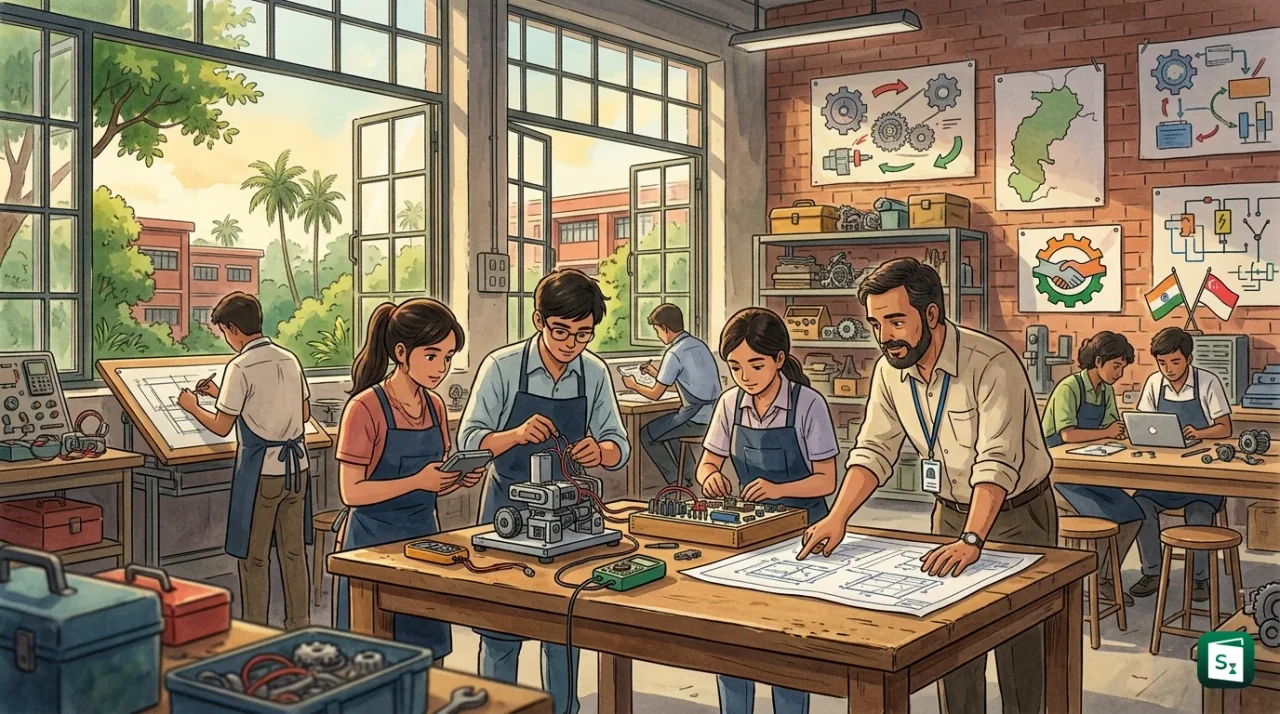
The Chhattisgarh government signed a Memorandum of Understanding with ITE Education Services (ITEES), Singapore, in early October 2026 to modernise technical and vocational education across the state. Chief Minister Vishnu Deo Sai sealed the pact during the inaugural Singapore-India Network for Growth (SING) Forum 2026 in Singapore, where Chhattisgarh was one of only two states invited by the Ministry of External Affairs. The agreement links classroom training directly to the Skill India Digital ecosystem at a time when the state has secured ₹43,600 crore in investment proposals that will need skilled workers.
What Does the Chhattisgarh ITE Singapore Pact Cover?
The Chhattisgarh MoU with ITE Education Services focuses on strengthening Technical and Vocational Education and Training (TVET), which means job oriented training in trades, services and applied technical skills. The pact aims to build industry aligned curricula, upgrade trainer skills and create stronger pathways from classrooms to employment for youth in Chhattisgarh.
The state government has said the collaboration will help prepare young people for industries arriving through new investments, including artificial intelligence ready digital infrastructure, advanced manufacturing, solar energy and agro processing. In practice, this type of partnership usually covers curriculum design, competency standards, assessment systems, training of trainers and advice on modern workshop and lab infrastructure. The exact trade list and rollout schedule for Chhattisgarh will be fixed by joint working groups in the coming months.
The skilling pact was part of a larger three day outreach. The Chhattisgarh delegation, led by Chief Minister Vishnu Deo Sai, returned to Raipur on 7 October 2026 after attending the SING Forum organised by the Singapore Business Federation (SBF) at Orchard Hotel Singapore. Chhattisgarh and Haryana were the only two states nominated by the Ministry of External Affairs for this first edition.
| Investment linked to Singapore visit | Value | Sector and purpose |
|---|---|---|
| Energy Capital Global data centre campus | ₹41,750 crore | 100 MW AI ready hyperscale data centre in Chhattisgarh |
| Sunstream Green Energy solar project | ₹1,500 crore | 300 MW solar plant with battery storage |
| Valency International agro hub | ₹350 crore | Integrated agro and food processing and export hub |
The Chief Minister also called on Singapore Foreign Minister Vivian Balakrishnan to discuss cooperation in investment, skilling, urban planning and technology. Separate discussions were held with the Global Finance and Technology Network, an initiative of the Monetary Authority of Singapore, on training youth in artificial intelligence and digital finance and helping startups reach global investors.
What Is ITE Singapore and How Does ITEES Work?
The Institute of Technical Education (ITE), Singapore, is Singapore’s principal public provider of career and technical education at the post secondary level. ITE was established on 1 April 1992 under the Ministry of Education, Singapore, and took over the functions of the former Vocational and Industrial Training Board (VITB) to raise the quality and status of hands on skills training.
ITE works on a model called One ITE System, Three Colleges. The three comprehensive campuses are ITE College Central, ITE College East and ITE College West. Its headquarters is at 2 Ang Mo Kio Drive, Singapore. ITE offers full time pre employment courses for school leavers, part time continuing education for adult workers, and work study diplomas with employers. Popular streams include engineering, electronics and info communication technology, business services, hospitality, design and media, applied and health sciences and logistics.
Certification follows the Nitec, Higher Nitec and Technical Diploma ladder. Since Academic Year 2022, ITE has moved to a three year Higher Nitec route that lets students earn a Higher Nitec directly in three years instead of four. It also runs Work-Study Diplomas, where trainees earn while learning with industry partners, and Technical Diplomas co developed with institutions in France, Germany and Switzerland. ITE became the first education institution to win the Singapore Quality Award in 2005, a mark of its global reputation in skills training.
ITE Education Services (ITEES) is the international arm that signed the Chhattisgarh pact. ITEES is a wholly owned subsidiary of ITE, set up in January 2003 to share Singapore’s skills system with other countries. ITEES provides consultancy and training in more than 30 countries across Asia, Africa, the Middle East and Latin America, working with governments, companies and development banks.
| ITEES support area | What it means in simple terms |
|---|---|
| Academic development | Designing courses, competency standards, lesson material and assessments |
| Capability development | Training teachers and master trainers in modern teaching methods |
| Quality assurance | Setting benchmarks and audit systems for training institutes |
| Infrastructure development | Planning workshops, labs and full campuses |
| Certification | Licensing ITE curriculum and testing for skills qualifications |
Why Does Chhattisgarh Need Stronger Technical and Vocational Training?
Chhattisgarh was formed on 1 November 2000 after separation from Madhya Pradesh, with Raipur as its capital and Nava Raipur Atal Nagar as the planned administrative city. The state has a large tribal population and many remote districts. Jobs depend heavily on mining, steel, power, cement and paddy farming. Power surplus status gives it an edge for data centres, but new age factories need workers trained in automation, electrical maintenance, cooling systems, solar installation and food processing. That gap between old trades and new industry demand is what the Singapore partnership seeks to close.
The Directorate of Technical Education (DTE), Chhattisgarh, based at Indravati Bhawan in Nava Raipur, acts as the nodal agency for engineering, polytechnic, pharmacy and management education. The state currently runs 4 Chhattisgarh Institutes of Technology, 2 government engineering colleges, 35 government polytechnics and 3 CGIT polytechnics, besides one university teaching department at the Chhattisgarh Swami Vivekanand Technical University (CSVTU), Bhilai. Engineering colleges offer about 11,528 seats and polytechnics offer about 8,408 seats. CSVTU, established in 2005 and headquartered in Bhilai, affiliates most technical colleges in the state.
Industrial Training Institutes form the base of the skilling pyramid. The Directorate of Employment and Training manages more than 100 government Industrial Training Institutes (ITIs) across all 33 districts, including tribal blocks. These ITIs run one to two year courses in trades such as electrician, fitter, welder, computer operator and programming assistant, mechanic and stenography. The curriculum follows National Council for Vocational Education and Training (NCVET) norms, which ensure national recognition of certificates.
The Chhattisgarh State Skill Development Authority (CSSDA) coordinates short term skill programmes. For 2026-27, the state provided ₹372.35 crore for technical education and ₹38 crore for the CSSDA. Under the Mukhyamantri Kaushal Vikas Yojana, more than 4,91,543 youth have received training so far, and about 2,72,754 of them have found employment. Around 366 training institutions run 212 short term courses under the scheme. Recent tie ups with private partners cover modern areas such as electric vehicles, electronics and health assistance. The ITE model adds global exposure to this home grown network.
How Does the Pact Fit Into Skill India Digital and the National Skill Ecosystem?
The Chhattisgarh ITE partnership sits inside the national Skill India Mission, which the central government launched on 15 July 2015 on World Youth Skills Day. The Ministry of Skill Development and Entrepreneurship (MSDE), created in November 2014, anchors this mission from New Delhi and runs training through Industrial Training Institutes, apprenticeships and short term courses listed on the Skill India Digital Hub (SIDH).
SIDH is the common online platform for courses, certification, job links and apprenticeship records. Search interest in Skill India Digital and Skill India Digital Hub has surged sharply through 2026, which shows that students now look first for government certified courses, ITI results and free certificate options online. Any new Chhattisgarh curriculum developed with ITEES will gain wider value if its certificates and credits are mapped to national standards and visible on SIDH.
| National scheme or body | What it does | Latest scale |
|---|---|---|
| Pradhan Mantri Kaushal Vikas Yojana (PMKVY) | Short term training and Recognition of Prior Learning for school dropouts and workers without certificates | More than 1.64 crore candidates trained and certified till October 2025 |
| National Apprenticeship Promotion Scheme (NAPS) | On the job training with employers and stipend support | 49.12 lakh apprentices engaged from 2016-17 to 2025-26 |
| Craftsman Training Scheme in ITIs | One to two year engineering and non engineering trades through ITIs | ITIs up from 9,776 in 2014 to 14,682 at present |
| Pradhan Mantri SETU | Upgrading 1,000 government ITIs in hub and spoke model with advanced labs, incubation and placement cells | Outlay of ₹60,000 crore over five years, launched in October 2025 |
The combined result is visible in workforce data. The share of youth aged 15 to 29 with formal vocational training rose from 7.1% in 2017-18 to 26.1% in 2023-24. Chhattisgarh’s move mirrors what other states are doing through their own missions, such as the Tamil Nadu Skill Development Corporation and the Bihar Skill Development Mission. The difference in Chhattisgarh is the direct use of Singapore’s industry first pedagogy, where students spend long hours on shop floors, not just in lecture halls.
What Is an MoU and Is It Legally Binding in India?
A Memorandum of Understanding (MoU), with full form meaning a written understanding between two parties, records their shared intent to work together on defined goals. In India, government departments, companies and foreign agencies use MoUs to list cooperation areas, roles and next steps before signing detailed contracts.
What is MoU in India
An MoU in India is a formal document that sets out how two or more parties plan to cooperate on a project or policy. It usually names the partners, objectives, duration, responsibilities and review method, but it avoids the detailed payment, penalty and dispute clauses of a final contract.
The Chhattisgarh ITE document follows this standard format. It identifies the state agencies and ITEES as partners and lists technical education and skill development as the cooperation field. Detailed work orders on course design, trainer deployment and fees follow through separate implementation plans.
Is MoU legally binding in India
An MoU in India is generally not legally binding by itself and acts as a statement of intent unless the parties clearly write that specific clauses will have legal force. Courts look at the actual language, obligations and signatures to decide if any part creates an enforceable contract under the Indian Contract Act, 1872.
In practice, most government skill MoUs, including state level training partnerships, are non binding frameworks. They signal political commitment and allow officials to start joint committees, site visits and pilot batches. Binding force comes later through consultancy contracts, licensing agreements and fund release orders.
The Way Forward for Chhattisgarh Youth
The Chhattisgarh government has said technical working groups will now coordinate with project promoters to finalise land allotment, power supply terms and statutory clearances. This follow up matters because hyperscale data centres need round the clock power, large land parcels and strong fibre links, areas where power surplus Chhattisgarh claims an advantage. If clearances move fast, construction and operations can create specialised posts in network architecture, system engineering, facilities management, solar maintenance and food processing logistics.
For young learners, the immediate benefit lies in updated courses and better trainers. ITE style training lays stress on attendance discipline, mentors from industry and continuous assessment. If Chhattisgarh adopts even part of this method in its ITIs and polytechnics, pass outs will find it easier to join apprenticeships listed on the Skill India Digital Hub and the National Apprenticeship Promotion Scheme.
Startups and small firms stand to gain as suppliers to large campuses. Farmers gain through the proposed agro and food processing hub, which plans a farm to market chain for exports. Tourism may also open new jobs. Learnings from Gardens by the Bay, Singapore, will guide botanical gardens in Nava Raipur, while the Mandai Wildlife Group has discussed support to upgrade Nandanvan Jungle Safari, Asia’s largest man made safari, into a world class destination.
Key Takeaways
- Chhattisgarh signed an MoU with ITE Education Services, Singapore in October 2026 to strengthen technical and vocational education and skill development.
- The pact was sealed during the inaugural SING Forum 2026 in Singapore, where Chhattisgarh and Haryana were the only two states nominated by the Ministry of External Affairs.
- The Institute of Technical Education, Singapore was established on 1 April 1992 and runs on the One ITE System, Three Colleges model with campuses at College Central, College East and College West.
- ITEES, set up in January 2003 as a wholly owned subsidiary of ITE, provides skills consultancy in more than 30 countries.
- The Singapore visit brought investment proposals worth ₹43,600 crore, including a ₹41,750 crore 100 MW data centre campus by Energy Capital Global.
- The pact aligns with the national Skill India Mission launched on 15 July 2015 and the Skill India Digital Hub platform for certified courses and apprenticeships.