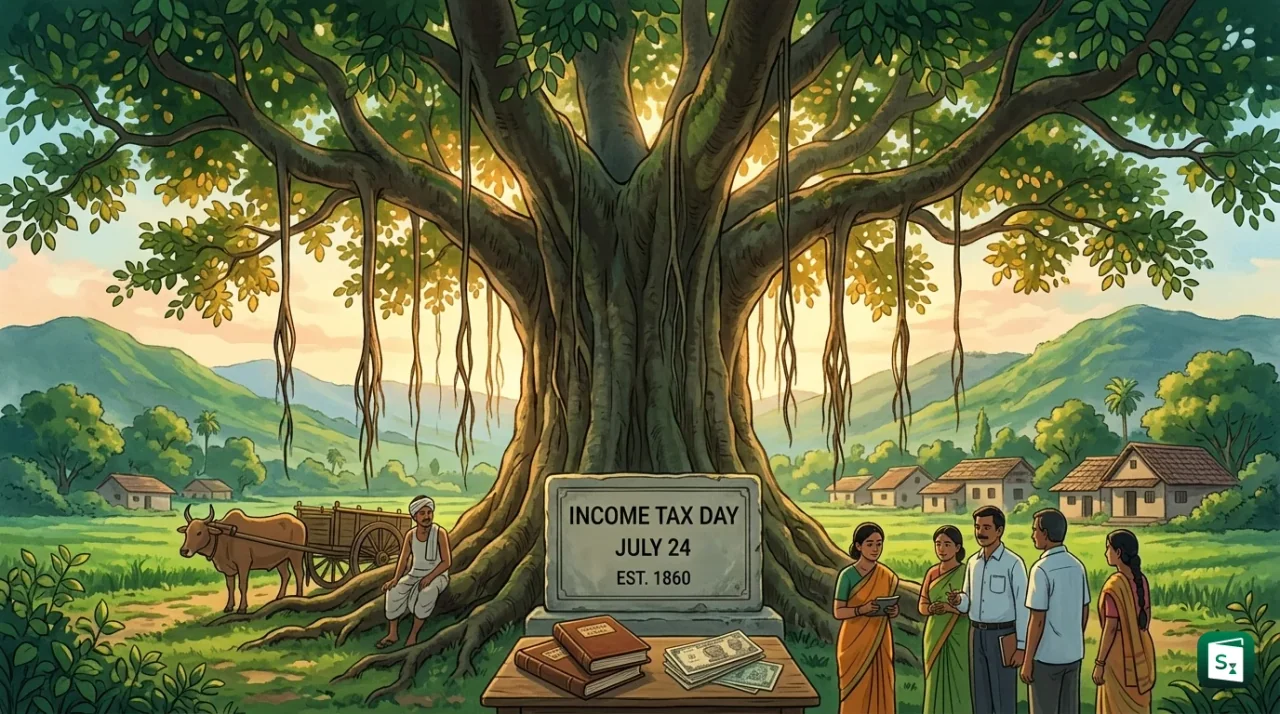
India observes Aaykar Diwas (Income Tax Day) every year on July 24, marking the day income tax was first introduced in the country in 1860. The tax was brought in by Sir James Wilson, a Scottish economist who served as British India’s first Finance Minister, to fill the treasury after the financial devastation of the 1857 Revolt. First officially celebrated in 2010 on the 150th anniversary, the day now serves as a reminder of the evolution of India’s direct tax system and the role of taxpayers in nation-building.
Sir James Wilson and the Birth of Income Tax in India
The 1857 Revolt had drained the British East India Company’s finances. The British Crown took direct control of India, and the new administration urgently needed revenue to stabilise its finances. Queen Victoria sent James Wilson to India in November 1859 to design a tax system, create a new paper currency, and restructure the country’s financial administration.
Wilson introduced the first Income Tax Act in February 1860, and it received the Viceroy’s assent on 24 July 1860, coming into effect immediately. The Act had 259 sections divided into 21 parts. Income was classified under four schedules: landed property, professions and trade, securities and annuities, and salaries and pensions. Agricultural income was also taxable initially. The tax followed a slab system charging 2% on annual incomes above a certain threshold, with higher rates for richer groups.
A remarkable feature of this first law was that it included a sunset clause: it was designed as a temporary measure and expired after a few years. Wilson did not live to see its long-term impact. He died in Calcutta on 11 August 1860, just 18 days after the Act came into force.
Evolution of India’s Income Tax System
Income tax returned in various forms over the following decades. The Income Tax Act, 1886 created the first structured legal framework for direct taxation in India. This was followed by the Income Tax Act, 1918 and a significantly revamped Income Tax Act, 1922, which transferred tax administration from provincial governments to the central government for the first time. The 1922 Act also introduced the practice of setting tax rules through annual Finance Acts.
After Independence, the government appointed the Direct Taxes Administration Enquiry Committee under Mahavir Tyagi, which submitted its report in 1959. Based on its recommendations, Parliament enacted the Income Tax Act, 1961, which came into force on 1 April 1962 and replaced the 1922 Act. This law, consisting of 298 sections and 14 schedules, remained the governing legislation for direct taxation in India for over six decades.
| Milestone | Year | Key Feature |
|---|---|---|
| First Income Tax Act | 1860 | Introduced by Sir James Wilson, 259 sections |
| Income Tax Act | 1886 | First structured legal framework |
| Income Tax Act | 1922 | Centralised tax administration |
| Income Tax Act | 1961 | Came into force 1 April 1962 |
| Income Tax Act, 2025 | 1 April 2026 | Replaced 1961 Act, simplified to 536 sections |
The most recent transformation came with the Income Tax Act, 2025, which took effect from 1 April 2026, replacing the 1961 Act. The new law reduces the number of sections from 819 to 536 and chapters from 47 to 23. It introduces a unified Tax Year concept, replacing the earlier terms “Assessment Year” and “Previous Year”, and streamlines TDS and TCS provisions.
Central Board of Direct Taxes: The Administering Authority
The Central Board of Direct Taxes (CBDT) is the apex body responsible for administering direct taxes in India. It was constituted in 1964 under the Central Board of Revenue Act, 1963, when the earlier Central Board of Revenue was split into two separate boards: the CBDT for direct taxes and the Central Board of Indirect Taxes and Customs (CBIC) for indirect taxes.
CBDT operates under the Department of Revenue, Ministry of Finance, and is headquartered in North Block, New Delhi. The board consists of a Chairman and six Members, each handling specific functional areas such as income tax, investigations, legislation, and taxpayer services.
Key Functions of CBDT
The CBDT formulates policies for the collection of direct taxes, administers the Income Tax Act and other direct tax laws, and issues circulars, notifications, and orders for tax compliance. It supervises the Income Tax Department, which is the largest revenue-generating arm of the central government. The board also represents India in international tax negotiations and double taxation avoidance agreements.
The CBDT reported direct tax collections of over ₹11.17 lakh crore in 2018-19, and the figure has grown substantially since then, reflecting both economic expansion and improved compliance.
Digital Transformation of Tax Administration
The Income Tax Department has undergone a major technology-driven overhaul over the past two decades. The introduction of Permanent Account Number (PAN) in 1972 and computerisation beginning in 1981 laid the early groundwork. The current 10-digit alphanumeric PAN was launched in 1995, providing unique identification for every taxpayer and enabling information matching across transactions.
The Centralised Processing Centre (CPC) was established in Bengaluru in 2009 to process bulk tax returns in a jurisdiction-free, technology-driven manner. The e-Filing Portal allows taxpayers to file returns online, reducing physical paperwork and processing time. The introduction of Faceless Assessment and Faceless Appeals eliminated human interface between taxpayers and tax officials, improving transparency and efficiency.
The Annual Information Statement (AIS), launched in November 2021, provides a comprehensive view of a taxpayer’s financial transactions across a financial year, including TDS, TCS, stock market trades, and mutual fund investments. PAN-Aadhaar Linking was made mandatory from 2017 to eliminate duplicate PANs and improve compliance. Through NUDGE Campaigns, based on behavioural economics, the department follows a “Trust First, Scrutinise Later” philosophy, using non-intrusive data nudges to encourage voluntary compliance rather than punitive action.
Significance of Aaykar Diwas
Aaykar Diwas was officially launched in 2010 to mark 150 years of income tax in India. The day serves several important purposes.
It promotes voluntary tax compliance by recognising honest taxpayers and spreading awareness about the link between taxes and public services. Income tax funds critical government spending on healthcare, education, infrastructure, defence, and social welfare schemes. In this sense, the day reinforces the social contract between citizens and the state: taxes paid translate into roads, schools, hospitals, and national security.
The day also highlights the evolution of tax administration from a manual, paper-heavy system to a transparent, digital-first model. The transition to faceless assessments, e-filing, and data-driven compliance has reduced corruption, improved the ease of paying taxes, and widened the tax base.
For the broader economy, direct taxes are the largest source of government revenue. Higher compliance directly translates into greater fiscal capacity for the government to invest in development programmes without relying excessively on borrowing.
Key Takeaways
- Aaykar Diwas (Income Tax Day) is observed on 24 July every year, commemorating the introduction of income tax in India in 1860.
- Income tax was introduced by Sir James Wilson, British India’s first Finance Minister, following the financial crisis caused by the 1857 Revolt.
- The Income Tax Act, 1961, which governed direct taxation for over six decades, was replaced by the Income Tax Act, 2025, effective from 1 April 2026.
- The Central Board of Direct Taxes (CBDT) is the apex body administering direct taxes. It was constituted in 1964 under the Central Board of Revenue Act, 1963.
- The Income Tax Department is the largest revenue generator for the central government, with collections exceeding ₹11.17 lakh crore in 2018-19.
- Aaykar Diwas was first officially celebrated in 2010, marking the 150th anniversary of income tax in India.